
10 Best Educational Board Games in 2026
This post contains affiliate links. As an Amazon Associate, we earn from qualifying purchases.
The best educational board game we found is the ThinkFun Gravity Maze Logic Game, a marble-run puzzle that builds critical thinking through spatial reasoning and engineering challenges. For early math skills, the Clever Fox Play Number Hunter Math Game turns addition and subtraction into active play, while the QUOKKA USA Geography Board Game makes learning all 50 states fun for the whole family.
The real challenge parents face is finding a game that kids actually want to play again, one that teaches without feeling like homework. A game that sits on the shelf is worthless, no matter how many skills it claims to cover.
We evaluated these games by studying manufacturer specifications, expert round-ups, and patterns in owner feedback to find the ones that balance genuine learning with replay value. This guide covers ten options for different ages and subjects, from preschool letter recognition to middle-school circuit building.
Top 10 Educational Board Games in the Market


Certain content that appears on this site comes from Amazon. This content is provided "as is" and is subject to change or removal at any time.
The Best Educational Board Games, Reviewed
ThinkFun Gravity Maze Logic Game

What We Like
- Builds critical thinking through marble runs
- Includes 9 towers for endless configurations
- Encourages collaborative play with family
- STEM-focused design for ages 8-12
Trade-offs
- Single-player focus; no competitive mode included
- Small marble pieces pose choking hazard for toddlers
This marble run logic game forces kids to think in three dimensions. Each puzzle asks you to place towers so a marble lands exactly on the target, which means planning ahead and testing your own assumptions. That trial-and-error process builds real problem-solving skills, not just memorizing facts. It’s ideal for the 8-to-12 crowd who are ready for something more than a simple board game, they get to engineer their own path, literally. The included 9 towers, 3 marbles, and game grid give enough variety to keep a curious mind busy for weeks without repeating the same solution twice.
The trade-off is that this is a solo puzzle experience, not a group race or turn-based competition. If you’re looking for a game where four kids sit around a table taking turns, Gravity Maze works better as a shared challenge, one person builds, the others watch and discuss, than as a free-for-all. Compare that to the ThinkFun Math Path Monster, which is a cooperative board game that encourages teamwork. For a child who loves logic puzzles and doesn’t mind working alone or with a single partner, this is a rewarding pick in the guide. Just keep the marbles away from any younger siblings under 8.
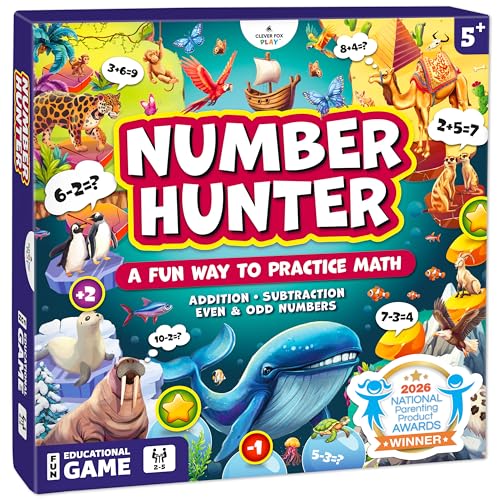
Clever Fox Play Number Hunter Math Game
What We Like
- Teaches addition and subtraction through play
- Includes fun action and math challenges
- Durable, non-toxic materials for repeated use
- Screen-free STEM activity for kids 5-7
Trade-offs
- No cooperative play mode, strictly competitive
The Number Hunter Math Game wraps addition, subtraction, and even-odd recognition into a globe-trotting board game where kids roll dice, solve math, and land on star tiles for action challenges. At 9.2 inches square and just over a pound, it’s compact enough for a homeschool shelf or a family game night bag. That makes it a natural fit for parents and teachers who want early math practice without the groan factor, kids are too busy racing to the finish line to realize they’re drilling facts. The non-toxic build means it’ll survive dropped dice and excited spills, and the screen-free design gives you a genuine alternative to tablet time.
This game is built squarely for the 5-7 crowd, so if you’ve got an 8-year-old who’s already past basic addition, they’ll find it too simple. For a kindergarten or first-grade classroom, or a household with a young math learner, it’s a focused, fun tool that does exactly what it says.
Learning Resources Math Island Addition & Subtraction Game
What We Like
- Volcano popper adds thrilling dice-launching action
- Two 10-sided dice plus operation die for varied equations
- Colorful board with adventure character pieces
Trade-offs
- Ages 6+ only, not suitable for younger siblings
- Requires 2-4 players, no solo play option
A volcano popper that launches dice when you land on special spaces turns basic addition and subtraction into a genuinely exciting race. Two 10-sided number dice and an operation die create endless equation combinations, so kids get repeated mental math practice without it feeling like drill work. Designed for 2-4 players ages 6 and up, it’s a natural pick for families who want game night to double as stealthy learning time, especially for children who need to build confidence with math facts.
At age 6+, this game targets children who are already practicing addition and subtraction, so it won’t work for younger siblings not yet ready for those skills. Compared to Learning Resources’ Sum Swamp, which also focuses on addition and subtraction, Math Island includes a volcano popper that launches dice when players land on special spaces, adding a surprise element. Reviewers note that the dramatic payoff keeps kids engaged and asking to play again.
Product photos
Learning Resources Sum Swamp Addition & Subtraction Game
What We Like
- Teaches addition and subtraction through dice play
- Designed for kindergarten and first-grade students
- Compact 10-inch board fits small tables
Trade-offs
- Limited to basic addition and subtraction only
- Not challenging enough for advanced math learners
A 10-inch square board keeps Sum Swamp compact enough to fit on a small table, making it a practical choice for kindergarten and first-grade students who are just starting with addition and subtraction. Rolling dice and moving a piece across a swamp-themed path turns math practice into a playful race, so kids can learn without the pressure of a formal lesson. Reviewers note that this low-stakes format helps young learners get comfortable with numbers before they encounter timed drills.
The game sticks strictly to basic addition and subtraction, so once a child has mastered those, there’s no room to grow into multiplication or more complex operations. Compared to Math Path Monster, which targets older kids with cooperative counting challenges, Sum Swamp is best as an early stepping stone rather than a long-term math tool. Its lightweight 1.3-pound board also tends to shift on slick tables, so you might want to set it on a grippy mat.
Product photos
QUOKKA USA Geography Board Game

What We Like
- Covers all 50 states with fun facts
- Includes capitals, landmarks, and history
- Compact and durable for travel storage
- Easy rules engage kids and adults
Trade-offs
- Limited to US geography only
- No expansion or additional card sets
Fifty illustrated state cards and a colorful game board turn memorizing capitals and landmarks into a race across the country. That’s a lot of content packed into an 8.7-inch square box, making it easy to toss in a bag for road trips or family visits. The trivia-style challenges keep kids ages 8 and up engaged, while the simple rules mean you can start playing within minutes of opening the box. It’s a solid way to sneak geography into family game night without anyone feeling like they’re back in a classroom.
The obvious trade-off is that this game only covers the United States. If your family already knows all fifty state capitals, the replay value drops once the cards become familiar. That said, for a family that wants to learn US geography together, the compact design and straightforward play make it a practical pick for both home and travel.
Product photos
Snap Circuits Snap 2 It Board Game

What We Like
- Teaches real circuit-building through play
- Fast 10-25 minute rounds keep attention
- Supports 1-4 players for flexible groups
- Endorsed by K-12 educators worldwide
Trade-offs
- Requires 4 player lights and battery pack to play
- Circuit complexity limited to included card deck
A 10-25 minute playing time means you can fit a round between homework and dinner without losing anyone’s focus. Snap Circuits Snap 2 It turns the brand’s classic snap-together electronics into a race: draw three cards, plan your path across the board, and be the first to light up your bulb. It’s built for 1 to 4 players, so it works as a solo brainteaser or a family showdown, and the educator endorsement tells you the circuit-building is legit, not just a gimmick.
Snap 2 It comes with a 46-card deck and 40 game pieces, so the puzzle variety is finite compared to an open-ended building set like ThinkFun Gravity Maze, which offers a different kind of logic challenge. That makes Snap 2 It better for quick, repeatable competition than for deep solo exploration. If your family thrives on fast-paced head-to-head races that sneak in STEM learning, this delivers. If you want a single-player logic marathon, Gravity Maze’s marble runs give you more solo mileage.
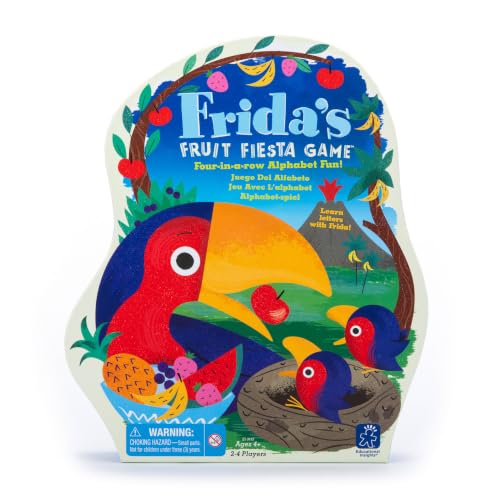
Educational Insights Frida's Fruit Fiesta Alphabet Game
What We Like
- Teaches letter recognition through matching
- Builds fine motor skills with squeezer
- Easy setup and storage as box
- Encourages turn-taking and social skills
Trade-offs
- Focuses solely on alphabet matching
- Not suitable for children under 4 years old
The triple spinner and Frida Squeezer turn letter recognition into a hands-on challenge that keeps little fingers busy. For kids ages 4 to 8, matching fruit bowls to nest cards builds both alphabet knowledge and fine motor control, so they’re learning without feeling like it’s school. The game board doubles as the box, which means cleanup is as simple as closing the lid, a small mercy for parents who’ve stepped on stray pieces.
The game teaches letter recognition through a fruit-collecting race, so kids practice the alphabet while building fine motor skills with the Frida Squeezer. Spin the triple spinner, match a letter to your nest card, and grab the correct fruit bowl, first to four in a row wins. But because it focuses solely on alphabet matching, once a child masters those letters, the challenge fades faster than a game that mixes in math or logic.
Product photos
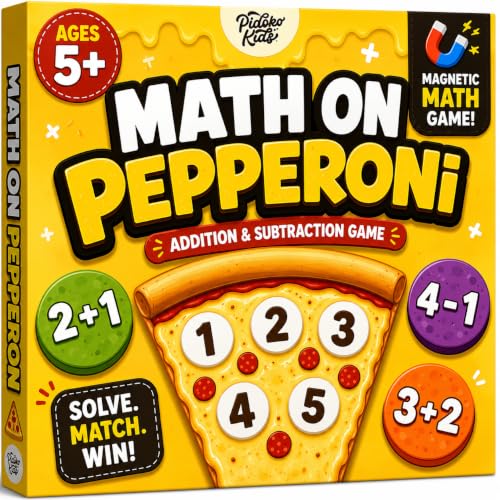
Pidoko Kids Pizza Math Board Game
What We Like
- Race to solve math for pepperoni tokens
- Spin, solve, and place mechanics
- Burnt and Wild Pepperoni add excitement
- Replayable with multiple problem combinations
Trade-offs
- Only 1-4 players limits larger groups
- No advanced math beyond basic addition/subtraction
Fifty colorful pepperoni math tokens and a spinner that mixes numbers with action spaces like Burnt Pepperoni mean every round feels like a pizza party, not a drill. Designed for kids 5 and up, it reinforces number recognition, counting, addition, subtraction, and turn-taking through fast-paced play. That hands-on, interactive approach turns math practice into a game kids actually want to play again and again.
The trade-off: it focuses solely on basic addition and subtraction, so once a child masters those, the game won’t grow with them into multiplication or division. Best for kindergarten and first-grade learners who need repeated, engaging practice with early math, not for older kids seeking more complex challenges.
Product photos
ThinkFun Math Path Monster Cooperative Game

What We Like
- Cooperative gameplay fosters teamwork
- Enhances STEM skills
- Suitable for kids and adults
- MESH accredited
Trade-offs
- Only one game mode limits replay variety
A 9.2-inch square board means this game fits neatly on any table, but the real draw is the cooperative twist: instead of competing, everyone works together to outsmart the Math Monster. That design turns arithmetic practice into a shared mission, and the MESH accreditation backs its educational value. ThinkFun has a reputation for brain games that actually engage, and this one delivers that same thoughtful engineering.
The game board is just 0.1 inches thick, which keeps the box lightweight and easy to toss into a bag for travel. That slim profile works fine on a table, though it won’t have the heft of a traditional board game. Compared to the Learning Resources Sum Swamp, which also targets addition and subtraction but in a competitive format, Math Path Monster’s cooperative twist stands out. If your group prefers working together over head-to-head pressure, this is the better fit.
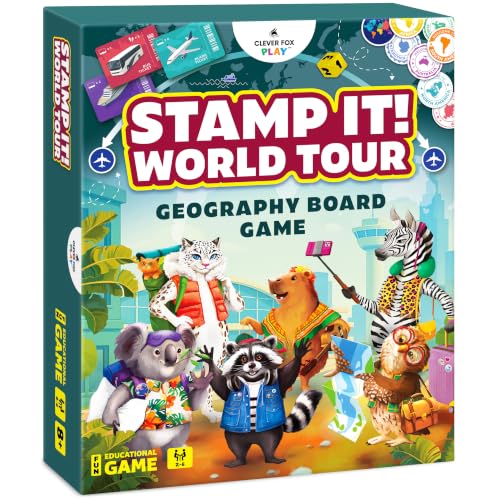
Clever Fox Play Stamp It! World Tour
What We Like
- 160 geography question cards
- Unique travel missions per player
- Fun animal character pieces
- Includes passports and stamp tokens
Trade-offs
- No expansion packs for additional countries
- Limited to 2-6 players
With 160 question cards covering states, flags, cultures, and landmarks, this game turns geography into a race across continents rather than a memorization drill. Each player picks an animal character and a unique mission, then chooses their route by bus, ship, or airplane, so every turn involves real decision-making, not just trivia recall. It’s ideal for families or classrooms with kids 8-12 who want a world map game that feels like an adventure, not homework.
The passport and stamp token system gives each session a tangible sense of progress. Players aren’t just answering questions; they’re collecting proof of their travels. As kids move across the board, they earn stamps for their passport, which makes each completed mission feel like a real achievement. This hands-on element keeps the game engaging and gives children a clear visual of how far they’ve come. Reviewers note that the physical stamps add a layer of excitement that simple scorekeeping can’t match, turning each round into a mini-adventure. The game includes 25 stamp tokens and 6 passports, so everyone gets their own record of the journey.
Product photos
How We Evaluated Educational Board Games
Our research began with a close look at each game’s stated learning goals and age ranges, cross-referencing those claims against the actual mechanics of play. We read through owner feedback to see which games held kids’ attention over multiple sessions and which ones collected dust after a single play. We also checked for durability concerns, missing pieces, and whether the instructions were clear enough for a parent to set up without frustration.
The four criteria that mattered most were educational value (does the game actually teach the skill it claims?), age appropriateness (is the difficulty right for the target range?), and replayability (will kids want to play it more than once?). Group flexibility was also key, can it handle different player counts and solo play? For younger children, we also weighed safety and small-part hazards.
A research-led evaluation like this has limits, we haven’t put every game through months of home testing. But by synthesizing what experts and hundreds of real families report, we can point you toward the options most likely to earn a permanent spot on your game shelf. For a deeper look at how these games compare, our guide to educational board games for kids covers the full selection.
What To Look For In Educational Board Games
The best learning games disguise instruction as fun. Look for mechanics that naturally require the skill, a geography game that makes you recall state capitals to advance, not one where you just read a fact card and move a token.
A great educational board game makes kids practice a skill repeatedly without realizing they’re studying. The learning should be baked into the rules, not tacked on as a separate step.
Age Range and Skill Level
Every game on this list has a recommended age, and those numbers matter more here than in pure entertainment games. A game that’s too easy bores kids in minutes; one that’s too hard frustrates them and kills confidence. For board games for preschoolers, look for simple matching or counting mechanics with large pieces. For ages 8 and up, games that involve strategy, logic, or multi-step planning tend to hold attention longer.
Group Size and Play Style
Some kids thrive on competition, while others shut down when they lose. Cooperative board games for kids let everyone work toward a shared goal, which can be a better fit for sensitive children or siblings with a wide age gap. Check whether a game supports solo play if your child likes to explore games independently. Also consider whether the player count fits your typical game-night group.
Subject Focus and Depth
A game can only teach so much. A math game focused on addition and subtraction won’t serve a child ready for multiplication, and a US geography game won’t help with world capitals. Think about what your child is currently learning in school or what they’re curious about. For broader coverage, educational math games and science board games can round out your collection.
- Check the box for small parts if you have children under 3 in the house
- Read the game’s description for the specific skills it teaches, not just the subject
- Look at the estimated play time, 10-minute rounds work better for short attention spans
- Consider whether the game requires adult reading or can be played independently
A good rule of thumb: if the game’s instructions take longer to read than a single round takes to play, look for something simpler.
Educational Board Games Compared
The table below compares all ten games by age, player count, subject focus, and play style so you can quickly narrow down the right fit for your family.
| Product | Age Range | Dimensions | Weight |
|---|---|---|---|
| ThinkFun Gravity Maze Logic Game | 8-12 years | 9.4 x 2.8 x 10.5 inches | 1.1 pounds |
| Clever Fox Play Number Hunter Math Game | 5-7 | 9.2 x 9.2 x 0.0 in | 1.4 lb |
| Learning Resources Math Island Addition & Subtraction Game | Ages 6+ | 10.0 x 2.6 x 10.0 inches | 1.1 pounds |
| Learning Resources Sum Swamp Addition & Subtraction Game | N/A | 10 x 10 x 1.5 inches | 1.3 pounds |
| QUOKKA USA Geography Board Game | 8 and up | 8.7 x 8.7 x 0.7 inches | N/A |
| Snap Circuits Snap 2 It Board Game | N/A | 12.0 x 2.8 x 12.0 inches | 1.4 pounds |
| Educational Insights Frida's Fruit Fiesta Alphabet Game | 4-8 years | 13.1 x 11.2 x 2.0 inches | 1.6 pounds |
| Pidoko Kids Pizza Math Board Game | 5+ years | N/A | 1.5 pounds |
| ThinkFun Math Path Monster Cooperative Game | N/A | 9.2 x 9.2 x 0.1 in | 1.2 lb |
| Clever Fox Play Stamp It! World Tour | 8-12 years | 10.2 x 8.3 inches | N/A |
Frequently Asked Questions
What is the best educational board game for a 6-year-old?
The Learning Resources Math Island Addition & Subtraction Game works well for most 6-year-olds, with a volcano popper that adds dice-launching action to math practice. For a cooperative option, the ThinkFun Math Path Monster Cooperative Game lets kids work together instead of competing.
How do I choose between a competitive and a cooperative educational game?
Watch how your child handles losing. If they get frustrated or give up, a cooperative game like Math Path Monster lets them practice skills without the pressure of defeat. If they’re motivated by winning, a competitive game like Sum Swamp can make practice feel more like a sport.
Can educational board games replace math worksheets?
Not entirely, but they can make practice feel less like work. Games are best used as a supplement to formal instruction, they build fluency through repetition and help kids apply skills in a low-stakes context. Many parents find that a short game session produces less resistance than a worksheet.
What educational board games work for a wide age range?
The QUOKKA USA Geography Board Game and ThinkFun Gravity Maze Logic Game both work well for ages 8 through adult. The trivia format of QUOKKA lets younger kids answer easier questions while older players tackle harder ones, and Gravity Maze’s puzzles scale naturally in difficulty.
How many players do most educational board games support?
Most games on this list support 2-4 players, with a few like Snap Circuits Snap 2 It supporting up to 4 and the Clever Fox Play Stamp It! World Tour supporting up to 6. If you need a game for larger groups, look for ones that specifically mention higher player counts or team-based play.
The Bottom Line
The ThinkFun Gravity Maze Logic Game is our best overall pick because it builds genuine critical thinking and spatial reasoning skills through a puzzle format that kids actually want to solve. It’s ideal for independent thinkers ages 8-12 who enjoy a challenge they can work through at their own pace.
If your child needs math practice, the Clever Fox Play Number Hunter Math Game offers the most engaging screen-free approach for ages 5-7. The Learning Resources Sum Swamp game is a gentler introduction for kindergarten and first grade. For families who want to learn together, the QUOKKA USA Geography Board Game turns trivia into a genuinely fun group activity.
The single most important factor in choosing an educational board game is whether your child will actually play it more than once. A game that matches their current skill level, preferred play style, and genuine interests will teach far more than one that looks impressive on paper but never leaves the box.
