
10 Best Educational Board Games For Kids in 2026
This post contains affiliate links. As an Amazon Associate, we earn from qualifying purchases.
For parents who want learning to feel like play, the Clever Fox Play Number Hunter Math Board Game is the best overall pick. It turns addition, subtraction, and even-odd recognition into a screen-free dice game for ages 4-8. The ThinkFun Zingo Bingo Award Winning Preschool Game earns the award for best early readers, while the Hasbro Gaming Scrabble Junior Board Game is our top word-building choice.
The challenge with educational board games is finding one that actually holds a child’s attention while teaching real skills. Many games lean too hard on the “educational” label and forget to be fun, or they target such a narrow age range that you are buying a new game every year.
This guide is research-based, drawing on manufacturer specifications, expert round-ups, and patterns in owner feedback across ten top-rated games. We focused on skill-building, age fit, replay value, and durability to help you choose the right game for your child.
Top 10 Educational Board Games For Kids in the Market

Certain content that appears on this site comes from Amazon. This content is provided "as is" and is subject to change or removal at any time.
The Best Educational Board Games For Kids, Reviewed
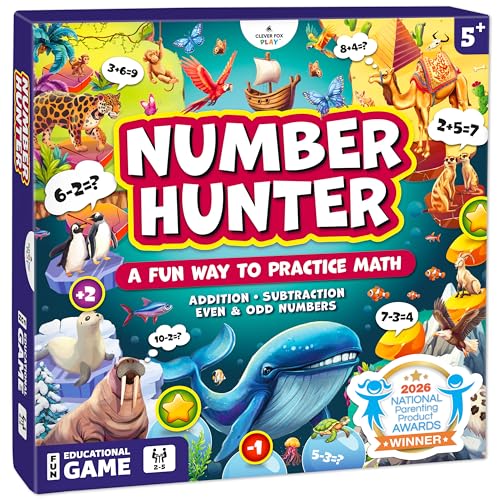
Clever Fox Play Number Hunter Math Board Game
What We Like
- Covers addition, subtraction, even/odd numbers
- Screen-free interactive play for ages 4-8
- Durable non-toxic child-safe materials
- Easy learn-and-play dice rolling mechanics
Trade-offs
- No expansion or advanced math concepts included
- Only 2-4 players limits larger groups
A 9.2-inch square board and 1.4-pound weight make this an easy tabletop companion that won’t slide around or need a huge play area. It turns basic addition and subtraction into a global adventure, with star tiles adding fun physical or math challenges so kids don’t realize they’re practicing. For parents wanting a first math game that feels like play, not homework, this hits the mark without overwhelming young learners.
The trade-off is that once your child masters the included operations, there’s no built-in way to ramp up difficulty or introduce multiplication. Best for families who want a dedicated math game that’s easy to teach and durable enough for repeated use.
ThinkFun Zingo Bingo Award Winning Preschool Game

What We Like
- Builds language and matching skills
- Fast-paced play for preschoolers
- Includes unique Zinger device
- Supports up to 7 players
Trade-offs
- Targets pre-readers and early readers only
- No math or advanced skill progression
Up to seven players can join in, which makes this one of the most inclusive preschool games for group play at home or in a classroom. The Zinger device adds a delightful mechanical twist that keeps little hands busy and eyes focused, while the fast-paced matching builds language and observation skills without feeling like a lesson. For families with kids ages four and up who are just starting to recognize words and pictures, this is a low-stress way to encourage early literacy through repetition and friendly competition.
Zingo is laser-focused on early reading and matching, so it won’t stretch kids who are already reading fluently or craving math challenges. Compared to other board games for this age group, Zingo is designed specifically for pre-readers and early readers, making it less suitable for older children or those seeking more advanced skill development. If your child is already past the pre-reader stage, you might find the gameplay too simple, but for that sweet spot of ages four to six, it hits exactly the right note.
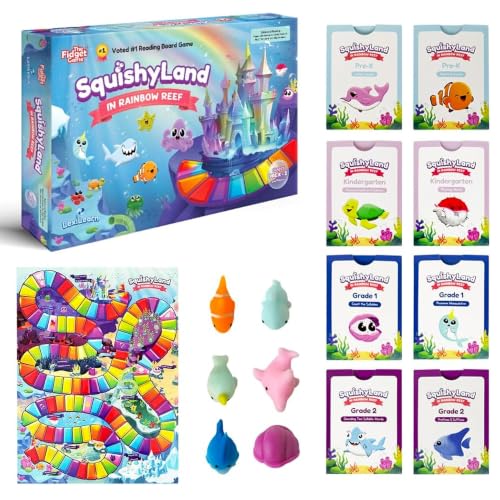
The Fidget Game SquishyLand Rainbow Reef Board Game
What We Like
- Developed by teachers using Science of Reading
- Multisensory with squishies, cards, and board
- Aligned with U.S. and Canadian standards
- Inclusive for autism, ADHD, dyslexia
Trade-offs
- Heavier than most board games at 3.3 pounds
- Targets Pre-K to 2nd grade only
A 16.5-inch board and a 3.3-pound box mean this game stays put on a table or classroom floor, so kids can spread out without pieces sliding off. The phonics progression builds from blending sounds and phoneme manipulation through rhyming, decoding syllables, prefixes, and suffixes, letting a child move from basic letter sounds to real word reading. That teacher-designed, Science of Reading–backed structure makes it a literacy tool that grows with the child, not just a one-afternoon activity.
SquishyLand Rainbow Reef Board Game is bulky: at 3.3 pounds and over a foot and a half long, it’s bigger than many compact games. But the multisensory design, squishies, colorful cards, a vibrant board, keeps kids engaged longer, especially those who benefit from tactile and visual stimulation. If you need a phonics game that works for a range of abilities and doesn’t mind the footprint, this is the one. Not ideal for families who need a compact, portable game for car trips or small apartments.
Hasbro Gaming Scrabble Junior Board Game

What We Like
- Two-sided board grows with kids
- Letter-matching for early readers
- Cute character tokens for score keeping
- Advanced level lets kids create words
Trade-offs
- Word building only, no math or geography skills
- No math or geography content
A two-sided gameboard means this single box covers both a beginner letter-matching phase and an advanced word-creation level, so it adapts as your child’s reading skills grow. The cute character tokens are used for score keeping, and the advanced side lets players create their own words. That dual design helps the game stay relevant as kids progress from matching letters to building words, all without needing a separate purchase.
The two-sided gameboard lets kids match letters on one side and create their own words on the other, so the same game adapts as reading skills improve. Reviewers note that the character tokens make scorekeeping fun for little ones. If your child needs math practice, a math-focused option like the Clever Fox Play Number Hunter might be a better fit.
Product photos
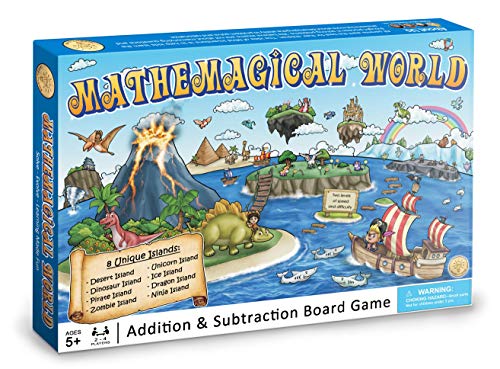
Mind Inventions Mathemagical World Math Board Game
What We Like
- Eight unique themed worlds
- Two difficulty levels included
- Covers addition, subtraction, double, half
- Prep for gifted & talented tests
Trade-offs
- Only 2-4 players limits larger groups
- No cooperative mode for team play
Eight distinct magic worlds. Desert Island, Dinosaur Island, Pirate Island, and five more, mean this math board game keeps kids exploring without repeating the same scenery. It teaches addition, subtraction, double, and half concepts, and includes two levels of difficulty and speed, so it grows with a child’s confidence. That makes it a natural fit for families looking to challenge quick learners or prepare for OLSAT and COGAT testing in preschool and kindergarten, without feeling like drill work.
Mathemagical World only supports 2-4 players, so larger playdates or classroom groups may need to take turns or pair up. Compared to ThinkFun Zingo Bingo, which plays with up to six players and is designed for ages 4 and up, Mathemagical World focuses on math skills for ages 5 and up with two difficulty levels. If you have a child who devours puzzles and wants worlds to conquer, this board game rewards that hunger, just plan for smaller sessions.
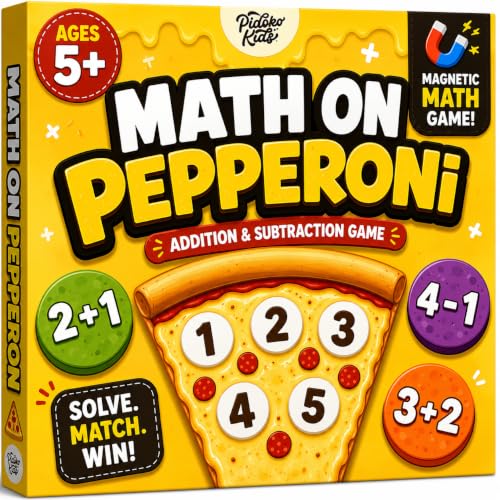
Pidoko Kids Pizza Math Board Game
What We Like
- Spin-to-solve math keeps kids engaged
- Burnt & Wild Pepperoni add surprise twists
- Reinforces addition and subtraction through play
- Fast-paced rounds encourage replayability
Trade-offs
- No advanced math for older kids beyond basic facts
Fifty colorful pepperoni math tokens and a spinner with action spaces turn basic addition and subtraction into a race to fill your pizza slice. That concrete hunt-and-solve mechanic means kids aren’t just drilling flashcards, they’re scanning, matching, and placing pepperonis while competing against up to three friends. It’s a lively way to reinforce number recognition and counting for kindergarteners and first graders, and the Burnt Pepperoni and Wild Pepperoni spaces keep each round from feeling like the last. For a family that wants math practice to feel like a game night staple rather than homework, this hits the mark.
The math stays firmly in the 5+ sweet spot, so once a child has mastered basic addition and subtraction, there’s no built-in progression to harder problems. That means you’ll likely get a couple of years of regular use before the math level is outgrown. It’s a straightforward, competitive race to fill your pizza slice, which keeps the focus on fast recall rather than strategy.
Product photos
Learning Resources Math Island Addition Subtraction Game
What We Like
- Volcano popper adds thrilling dice launch
- Two 10-sided dice create varied equations
- Fun learning experience for ages 6+
- Great for family game night or classroom
Trade-offs
- Only covers addition and subtraction, no multiplication
- Requires adult setup for volcano popper mechanism
A built-in volcano popper launches dice when players land on special spaces, turning math practice into an adventure. Two 10-sided number dice and an operation die create varied equations, so kids practice quick mental math with fresh problems each round. Designed for 2 to 4 players ages 6 and up, it fits siblings who need to sharpen addition and subtraction skills but would rather play than do worksheets. The colorful island theme and character pieces keep the energy high, and the popper adds enough unpredictability to make every round feel new.
Math Island Addition Subtraction Game stays focused on addition and subtraction only, so once a child masters those, you’ll need another game for multiplication or division. That focus is actually a strength if your child specifically needs fluency with basic facts, but it means the game covers a narrower skill set than a broader math board game. For a family with a 6- or 7-year-old who needs addition and subtraction practice, the volcano popper and varied dice make the experience engaging.
Product photos
University Games Scholastic Race Across The USA

What We Like
- Grade-appropriate questions for personalized learning
- Encourages multi-grade group play
- Covers U.S. states, capitals, and landmarks
- Combines race excitement with education
Trade-offs
- Ages 8+ excludes younger kids
- Requires reading and basic geography knowledge
Race Across the USA turns geography into a race where each player answers questions tailored to their own grade level. That means a third-grader and a sixth-grader can play together without one feeling left behind or bored, the questions adapt so everyone stays challenged. It’s designed for ages 8 and up, making it a reasonable choice for family game nights or classroom groups where kids of different ages need to learn geography at their own pace. The focus on U.S. states, capitals, and landmarks means it’s a game that teaches those topics while having fun.
If your child isn’t into maps or state facts, this game’s laser focus on U.S. geography might not grab them. That specialization makes it a perfect fit for a geography unit or road-trip prep, but it won’t replace a general educational game for kids who prefer math or spelling. For families or classrooms aiming to turn state capitals into a friendly competition, this is a smart, focused tool.
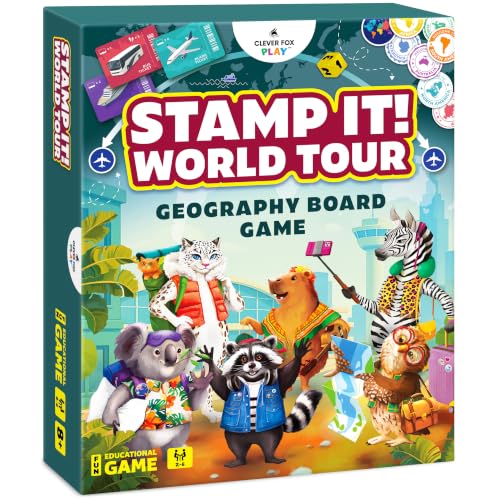
Clever Fox Play Stamp It World Tour Geography Game
What We Like
- 160 geography question cards included
- Unique animal character pieces
- Strategic route planning and travel choices
- Passport and stamp collection system
Trade-offs
- Limited to 2-6 players
- No expansion packs mentioned for added variety
With 160 question cards covering states, flags, cultures, and landmarks, this geography game turns world exploration into a race to fill your passport with stamps. Each player chooses an animal character, plans their route, and decides whether to travel by bus, ship, or airplane, so every turn mixes trivia with real decision-making. It’s built for kids 8-12 who want to learn without the memorization grind, and the unique mission system means no two games play the same way. That hands-on, strategic feel is exactly why it stands out among travel-themed board games for this age group.
The game board is 10.2 inches wide, so it fits easily on a small table or desk without taking over the room. For groups of four or more, players may need to share space, but the compact size makes it simple to set up and store between rounds. Reviewers find the geography trivia and travel missions keep everyone engaged, turning learning into a lively adventure rather than a memorization drill.
Product photos
ThinkFun Math Path Monster Cooperative Board Game

What We Like
- Cooperative gameplay fosters teamwork
- Enhances STEM skills through math
- Suitable for kids and adults
- MESH accredited for quality
Trade-offs
- Solo play lacks the team dynamic
The cooperative twist is what sets Math Path Monster apart from most math board games. Instead of racing against each other, players work together to outsmart the Math Monster, turning arithmetic practice into a shared mission. That teamwork focus makes it a great fit for siblings who tend to argue over who wins, or for family game nights where you want everyone rooting for the same outcome. The game is also MESH accredited, which signals that it meets educational standards for STEM learning, so you’re not just playing, you’re building number sense without the drill-and-kill feel.
The game’s slim packaging, at 0.1 inches thick, means it won’t take up much shelf space, but it also feels less substantial than a boxed game. For families who want to practice addition and subtraction in a low-pressure, collaborative setting, this cooperative format turns math into something everyone actually wants to do.
Product photos
How We Evaluated Educational Board Games For Kids
We started with the specs: age range, player count, materials, and the specific skills each game claims to teach. Manufacturer documentation told us whether a game uses non-toxic materials, how many players it supports, and what math or reading concepts it covers. From there, we cross-referenced expert round-ups from educators and toy reviewers who evaluate games for classroom use.
Three criteria mattered most. First, skill alignment, does the game actually teach what it promises, or is the learning tag a gimmick? Second, age range and adaptability, a good educational game grows with the child, offering multiple difficulty levels or a two-sided board. Third, engagement, if kids won’t ask to play it again, the learning never happens. We also weighed durability and safety for younger children.
A research-led evaluation has limits. Every child learns differently. Owner feedback patterns helped us identify common complaints (games that felt too easy after one play, or pieces that wore out quickly), but your child’s interests will always be the best guide.
What To Look For In Educational Board Games For Kids
The best educational board games hide learning inside a game kids actually want to play. Here is what to check before you buy.
Look for games that match your child’s current skill level, offer room to grow, and use durable, safe materials. Avoid games that teach only one narrow concept without any replay value.
Age Range and Skill Level
Most educational board games list a recommended age, but those ages are rough guides. A game labeled for ages 5-7 may assume the child already knows letter sounds, while another might start from zero. Check the specific skills covered, addition only, or addition and subtraction? Letter matching, or full word building? Games like the Clever Fox Play Number Hunter Math Board Game cover multiple math concepts (addition, subtraction, even/odd) within a single set of rules, which extends the useful life of the game.
Player Count and Group Dynamics
If you have more than two children or plan to use the game in a classroom, player count matters. The ThinkFun Zingo Bingo Award Winning Preschool Game supports up to seven players, making it ideal for larger groups. Many math games, including the Clever Fox Play Number Hunter and the Mind Inventions Mathemagical World Math Board Game, cap out at four players. Cooperative games like ThinkFun Math Path Monster cooperative board game let everyone work together, which works well for siblings who do not love competition.
Durability and Safety
Kids handle game pieces with enthusiasm, so materials matter. Look for non-toxic, child-safe components, especially for preschool-age children who may put pieces in their mouths. The Fidget Game SquishyLand Rainbow Reef Board Game uses squishy tactile pieces that hold up to repeated handling, though it is heavier than most at 3.3 pounds. Cardboard boards and thin card decks wear out faster than thick laminated boards or plastic components. If the game will travel to grandma’s house or the car, consider weight and box size too.
- Check the box for “non-toxic” or “child-safe” materials if the game is for ages 3-5.
- Look for two-sided boards or multiple difficulty levels so the game grows with your child.
- Count the player slots, will it fit your family or classroom group?
- Read owner feedback about piece durability, especially for dice, spinners, and small tokens.
- Consider storage: does the box keep everything organized, or will you lose pieces in a week?
A game that survives a toddler’s drop test and still gets played next year is worth more than a cheap game that falls apart after three rounds.
Educational Board Games For Kids Compared
The table below compares all ten games side by side, so you can see at a glance which skills each one teaches, the age range it fits, and how many players it supports.
| Product | Age Range | Players | Weight | Dimensions |
|---|---|---|---|---|
| Clever Fox Play Number Hunter Math Board Game | 4-8 years | 2-4 | 1.4 pounds | 9.2 x 9.2 x 0.0 inches |
| ThinkFun Zingo Bingo Award Winning Preschool Game | 4 and up | Up to 7 | 1.0 pounds | 8.2 x 3.5 x 10.2 inches |
| The Fidget Game SquishyLand Rainbow Reef Board Game | Pre-K to 2nd Grade | 2-6 | 3.3 pounds | 16.5 x 10.6 x 2.0 inches |
| Hasbro Gaming Scrabble Junior Board Game | 5+ | 2-4 | 1.6 pounds | 1.9 x 13.1 x 10.5 inches |
| Mind Inventions Mathemagical World Math Board Game | 5+ | 2-4 | N/A | 14.6 x 9.6 x 1.5 inches |
| Pidoko Kids Pizza Math Board Game | 5+ years | 1-4 | 1.5 pounds | N/A |
| Learning Resources Math Island Addition Subtraction Game | 6+ | 2-4 | 1.1 pounds | 10.0 x 2.6 x 10.0 inches |
| University Games Scholastic Race Across The USA | 8+ | N/A | 2.0 pounds | 10.5 x 10.5 x 2.0 in |
| Clever Fox Play Stamp It World Tour Geography Game | 8-12 | 2-6 | N/A | 10.2 x 8.3 x 0.0 inches |
| ThinkFun Math Path Monster Cooperative Board Game | N/A | N/A | 1.2 pounds | 9.2 x 9.2 x 0.1 inches |
Frequently Asked Questions
What age is best for educational board games?
Most educational board games target ages 3 and up, but the right age depends on the child’s attention span and skill level. Games like the ThinkFun Zingo Bingo Award Winning Preschool Game work for preschoolers, while the University Games Scholastic Race Across The USA is better for ages 8 and up. Look at the specific skills taught, not just the number on the box.
How do I know if a board game is truly educational?
A truly educational game teaches a skill through its core mechanics, not as an afterthought. If the game plays the same whether or not the child answers a question correctly, the learning is secondary. The best games, like the Clever Fox Play Number Hunter Math Board Game, make math or reading essential to winning.
What is the difference between cooperative and competitive educational games?
Cooperative games have all players working toward a shared goal, which reduces pressure and builds teamwork. The ThinkFun Math Path Monster Cooperative Board Game is a good example. Competitive games have one winner, which can motivate some children but frustrate others. Both styles can be educational; the choice depends on your child’s personality.
Can educational board games replace school learning?
No. Board games are a supplement, not a replacement, for formal instruction. They reinforce concepts through repeated play and build skills like turn-taking, patience, and strategic thinking. For children who struggle with worksheets, a game can make practice feel less like work. But games do not provide the depth or structure of a curriculum.
How many players do most educational board games support?
Most support two to four players, though some accommodate larger groups. The ThinkFun Zingo Bingo Award Winning Preschool Game supports up to seven players, making it one of the most flexible for classrooms or large families. Games limited to four players can still work for family game night, but you may need to rotate turns if you have more children.
The Bottom Line
The Clever Fox Play Number Hunter Math Board Game is the best overall educational board game for most families. It covers addition, subtraction, and even-odd recognition in a durable, screen-free format that ages 4-8 actually enjoy. If you have a preschooler just starting with letters, the ThinkFun Zingo Bingo Award Winning Preschool Game is the better starting point.
For families with a gifted learner who craves deeper math challenges, the Mind Inventions Mathemagical World Math Board Game offers eight themed worlds and two difficulty levels. Parents of older kids who need geography practice should look at the University Games Scholastic Race Across The USA. And if competition causes tears in your house, the ThinkFun Math Path Monster Cooperative Board Game lets everyone win together.
The single most important factor is fit, a game that matches your child’s current skill level and interests will get played, and a game that gets played teaches something. Pick the skill your child needs most practice with, then choose the game that makes practicing that skill fun.
