
10 Best Board Games For 4 Year Olds in 2026
This post contains affiliate links. As an Amazon Associate, we earn from qualifying purchases.
The best board game for 4 year olds requires zero reading and introduces young children to structured play through a simple color-coded path. That game is the Hasbro Gaming Candy Land Classic Board Game. For families focused on early math skills, the Hasbro Gaming Hi Ho Cherry-O Board Game is a strong choice, while the ThinkFun Zingo Bingo Award Winning Game excels at building language and matching skills for pre-readers.
A four-year-old’s attention span and fine motor skills are still developing, so the right game needs to balance simple rules with engaging, hands-on interaction. Games that are too complex lead to frustration, while those that are too passive fail to hold their interest.
We evaluated the top contenders by reviewing manufacturer specifications, expert round-ups on child development through play, and patterns in owner feedback. This guide breaks down the 10 best options by their specific strengths, so you can match a game to your child’s current abilities and interests.
Top 10 Board Games For 4 Year Olds in the Market
Certain content that appears on this site comes from Amazon. This content is provided "as is" and is subject to change or removal at any time.
The Best Board Games For 4 Year Olds, Reviewed
Hasbro Gaming Candy Land Classic Board Game

What We Like
- No reading required to play
- Classic beginner game for ages 3+
- Color-coded path and fun illustrations
- Cute gingerbread man pawns
Trade-offs
- No strategy or counting element for older 4-year-olds
- Purely luck-based with no decision-making
A no-reading-required design means a child as young as 3 can jump in the moment the box opens, matching colored cards to spaces on the path without any help from an adult. That independence is exactly what makes Candy Land the go-to pick for families introducing board games for the first time. The bright illustrations and gingerbread man pawns keep little hands engaged, and the simple race-to-the-castle structure teaches turn-taking and following a sequence without overwhelming a short attention span. It’s a gentle, confidence-building entry point that works equally well for siblings of different ages.
There’s zero strategy or counting, so every move is pure luck. That means a child who wants to make choices or practice numbers may lose interest after a few rounds. For a first game that prioritizes ease and shared fun over skill-building, Candy Land is hard to beat. For a family looking to stretch a bit further, a game with a simple counting mechanic might hold attention longer.
Product photos
Hasbro Gaming Hi Ho Cherry-O Board Game

What We Like
- Teaches counting, addition, and subtraction
- Simple turn-based gameplay for preschoolers
- Classic game familiar to many parents
Trade-offs
- Not challenging enough for older preschoolers
- Plastic fruit pieces are small choking hazard
A spinner tells you how many cherries, blueberries, apples, or oranges to pick or put back, turning counting into a race. For a child ages 3 and up who is learning numbers, that concrete matching of pieces to the spinner’s number is a practical math exercise. The board measures 10.5 inches square, so it fits on a small table or the floor without dominating the space. It works best for a child who is ready to practice counting, addition, and subtraction through a simple ‘first to fill their basket wins’ goal.
The same spinner can send a child backwards by requiring them to put fruit back, which may be frustrating for some. If a child struggles with that, the cooperative Peaceable Kingdom Count Your Chickens game offers a different approach where everyone works together to help the hen gather her chicks. Hi Ho Cherry-O is a straightforward counting game for a child who is comfortable with turn-taking and can handle the possibility of losing. But it may not be the gentlest introduction to game rules for every child.
ThinkFun Zingo Bingo Award Winning Game

What We Like
- Builds language and matching skills
- Includes unique Zinger device
- Supports up to 7 players
- Easy to learn with clear instructions
Trade-offs
- Beginner skill level limits appeal for older kids
- Requires 3 AA batteries not included
With support for up to seven players, this game lets nearly the whole preschool playgroup join in without anyone waiting. The Zinger device adds a tactile, exciting element that keeps little hands busy and attention spans engaged. Designed specifically for pre-readers and early readers, it builds matching and language skills through fast-paced play, exactly the kind of learning that feels like fun. The included clear instruction manual means you can get started right away, which matters when you’re wrangling a room of four-year-olds.
Peaceable Kingdom Count Your Chickens Cooperative Game

What We Like
- Cooperative play builds teamwork skills
- No reading required for young kids
- Teaches counting and early math
Trade-offs
- Only 2-4 players limits larger groups
- No solo play option for only one child
A cooperative counting game where everyone wins together, that single fact makes Count Your Chickens a standout for 4-year-olds. Players work as a team to help Mother Hen collect her 40 chicks, learning numbers and social skills without any reading required. The game has won five awards including the Oppenheim Toy Portfolio Platinum Award, which reflects recognition from the toy industry. For a preschooler who’s still building patience and turn-taking, this format removes the sting of losing and replaces it with shared celebration.
Cooperative play won’t appeal to every kid. If your child thrives on head-to-head competition, a game like Candy Land offers that classic race-to-the-finish tension. But for families where meltdowns over losing are a real concern, and at age 4 they often are, Count Your Chickens turns game night into a bonding exercise rather than a battle. The counting mechanic is simple enough for a 3-year-old to grasp, yet the 40-chick goal gives enough length to feel satisfying without dragging on.
Product photos
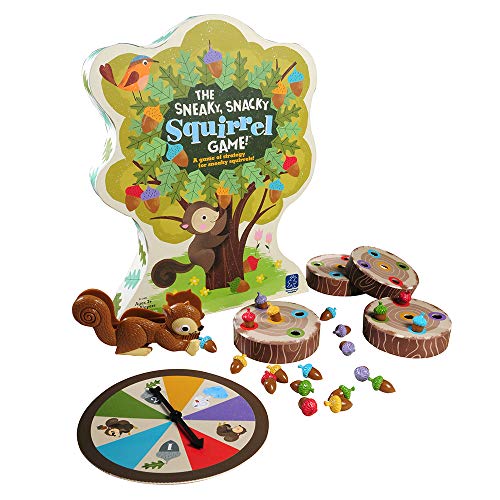
Educational Insights Sneaky Snacky Squirrel Game
What We Like
- Squirrel squeezer builds hand strength
- Color matching and strategic thinking
- Easy cleanup with box-as-board design
- Encourages turn-taking and sharing
Trade-offs
- Windstorm spinner can frustrate young kids
- Opponents can snatch acorns away
The tree-shaped game board weighs just a pound and doubles as its own storage box, so setup and cleanup are quick. The included squirrel squeezer helps develop hand-eye coordination, dexterity, and matching skills as kids pick up acorns. For a preschooler working on fine motor control, this game turns color matching into a playful challenge.
The spinner includes a windstorm space that can steal all your acorns, and opponents can grab yours too, so a child who is still learning to lose gracefully might get frustrated. Compared to the cooperative Peaceable Kingdom Count Your Chickens game, where the goal is to help the hen gather chicks together, Sneaky Snacky Squirrel introduces direct competition. If your child handles taking turns and sharing well, this game offers a fun test of strategy; if they are not ready for competitive play, a cooperative game may be a better fit.
Product photos
HABA Here Fishy Fishy Magnetic Fishing Game

What We Like
- Magnetic rod builds hand-eye coordination
- Sustainable wooden pieces from Germany
- Solo or multiplayer for 1-4 players
- Introduces turn-taking and color matching
Trade-offs
- Pieces are small for very young toddlers
- Limited replay value for older preschoolers
A magnetic fishing rod and color-matched fish pieces turn dice rolling into a deliberate, satisfying challenge. Designed for ages 2 and up, this game uses a simple roll-and-catch mechanic that rewards steady hands and focused attention. The wooden pieces feel substantial and the magnetic action gives clear feedback, so a child knows exactly when they’ve made a successful catch. It works for one player practicing alone or up to four kids learning to take turns, making it a natural fit for building the fine motor control and concentration that hand-eye coordination demands.
The dice adds a layer of randomness that may not always land on the color a player needs, which can test patience in young children. Compared to Candy Land, which is a simple path-based game for ages 3 and up, Here Fishy Fishy requires active physical skill each turn. So a child who struggles with the magnet might take longer to catch fish. It suits a child who enjoys practicing a physical challenge more than one who prefers a luck-based racing game.
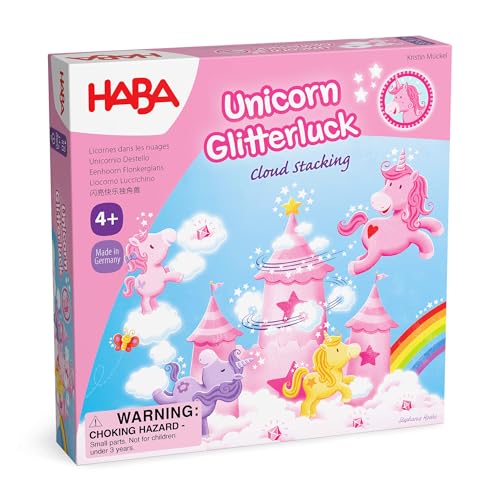
HABA Unicorn Glitterluck Cloud Stacking Game
What We Like
- Cooperative play builds teamwork skills
- Enhances fine motor skills and coordination
- High-quality German-made components
- Includes 10 crystals and 5 unicorns
Trade-offs
- Only one game mode limits replay variety
- Large box is awkward to store on shelves
A cooperative stacking game where all players work together to get five unicorns and ten crystals into the cloud kingdom before the rain starts means no one gets left out or loses. This makes it a great fit for preschoolers who are still learning to take turns and handle competition. The stacking action naturally builds fine motor skills and hand-eye coordination, so the playtime doubles as developmental practice without feeling like a lesson. HABA’s German-made construction also gives the pieces a durable feel that can survive the enthusiastic handling of a 4-year-old.
The stacking action can be challenging for little hands, but the cooperative win condition means everyone shares the success when all five unicorns and ten crystals are placed in the cloud kingdom. Compared to Candy Land, which uses a simple turn-and-move mechanic, this game focuses on fine motor skills and teamwork. For children who enjoy building and working together, the effort pays off in a shared victory.
Nene Toys Cooperative Orchard Board Game

What We Like
- Cooperative play builds teamwork early
- Chunky wooden pieces easy for small hands
- FSC-certified wood with child-safe finishes
- Teaches colors, numbers, and turn-taking
Trade-offs
- No competitive mode for kids who prefer rivalry
The 1.4-pound wooden set comes with chunky, easy-to-grasp pieces that a 2-year-old can pick up without frustration, making it a practical choice for toddlers learning colors, numbers, and turn-taking through cooperative play. The FSC-certified wood and smooth, child-safe finishes mean parents don’t have to worry about splinters or wear after repeated use. This game encourages teamwork and early learning without screens or batteries, offering a durable option for family play.
The cooperative-only format and 2-4 age range may not suit a 4-year-old who prefers head-to-head competition. For children who enjoy winning solo, a game like Hasbro’s Candy Land (ages 3 and up) provides a competitive alternative. However, for families seeking shared laughter and teamwork without arguments over who wins, this wooden game delivers a quiet, battery-free afternoon of working together.
Product photos
Jax SEQUENCE for Kids Strategy Game

What We Like
- No reading required to play
- Develops logical thinking skills
- Simple matching gameplay for young kids
- Designed for ages 3-6
Trade-offs
- Only 2-4 players limits larger groups
- Ages 3-6 exclude older children and adults
The fact that no reading is required opens this up to kids as young as three, letting them focus on matching characters and placing chips instead of decoding text. That’s a huge win for a strategy game aimed at preschoolers, it builds logical thinking without frustrating a child who hasn’t learned letters yet. If your four-year-old is ready for more than pure luck and wants to think a couple moves ahead, this is the one to grab.
Because the game is designed for ages 3-6, the strategy is intentionally simple. Once a child masters the pattern, it may feel repetitive sooner than games that rely more on chance. But for a kid who shows interest in planning and sequencing, Sequence for Kids provides meaningful choices without requiring reading or complex rules, making it a good next step from purely luck-based play.
Goliath Don't Wake Daddy Board Game

What We Like
- No reading required, ages 4+
- Develops fine motor skills
- Up to 6 players for groups
- Suspenseful surprise action
Trade-offs
- Only 2-6 players, not for larger groups
With room for up to six players and rules that require zero reading, this is one of the most accessible games for a mixed-age group. Every turn you press the button and hold your breath, will Daddy wake up? That suspense is exactly what keeps four-year-olds giggling and leaning in, all while they practice hand-eye coordination and turn-taking without realizing it. It’s the kind of playful tension that makes family game night feel like a shared adventure, not a lesson.
The surprise action can genuinely startle a child who’s more sensitive to sudden movement or sound, so it’s not for every temperament. Compared to a cooperative game like Peaceable Kingdom Count Your Chickens, where everyone wins together, this one has a clear loser (the player who wakes Daddy), something to consider if your group leans toward avoiding competitive stress. But for families who thrive on playful suspense and a little friendly risk, this delivers exactly that.
Product photos
How We Evaluated Board Games For 4 Year Olds
Our research started with the manufacturer’s age recommendations, component materials, and game mechanics for each title. We cross-referenced these specs with expert round-ups on early childhood play and developmental milestones to identify which features matter most at this age.
The three criteria that carried the most weight were readability (no reading required versus text-dependent play), skill focus (counting, matching, fine motor, or strategy), and player count (solo, small group, or larger gatherings). A game that demands reading or advanced strategy will frustrate a typical four-year-old, while a game that supports only two players may not fit a family with multiple children.
We also looked at the durability and safety of components, small plastic pieces, wooden parts, and the quality of game boards, based on owner reports of wear over time. Because this is a research-based guide, our evaluation relies on documented specifications, expert guidance, and the collective experience of hundreds of families shared in verified feedback. For more options in this age range, see our roundup of board games for 4 and 5 year olds.
What To Look For In Board Games For 4 Year Olds
Choosing a game for a preschooler means looking past the box art and focusing on how the rules match your child’s current stage of development. The best games teach turn-taking and patience without overwhelming a young mind.
A great board game for a four-year-old requires no reading, lasts about ten to fifteen minutes, and uses simple matching, counting, or color recognition. Avoid games with complex rulebooks or small pieces that pose a choking hazard.
No Reading Required
At age four, most children are still learning letters and cannot read game cards or instructions. Games that rely on pictures, colors, or symbols, like Candy Land’s color-coded path, allow pre-readers to play independently. The best games for 3 and 4 year olds often use visual cues rather than text to guide play.
Skill Focus and Developmental Fit
Different games build different skills. Counting games like Hi Ho Cherry-O reinforce early math, while matching games like Zingo strengthen vocabulary and pattern recognition. Fine motor games like Sneaky Snacky Squirrel use a squeezer tool to build hand strength. Choose a game that targets a skill your child is ready to practice, not one that is too far ahead or behind their current ability.
Player Count and Group Dynamics
Some games support only two to four players, while others can handle up to seven. If you have a single child, look for games with a solo mode or cooperative play that doesn’t require an opponent. For playdates or larger families, a higher player count prevents arguments over whose turn is next. Cooperative games like Count Your Chickens remove the stress of losing and teach teamwork instead.
- Check that all pieces are large enough to avoid choking hazards (especially for households with younger siblings).
- Confirm the game box includes clear, picture-based instructions that an adult can explain in under two minutes.
- Look for games with a storage solution inside the box, loose pieces that don’t fit back neatly lead to lost parts.
- Consider the replay value: games with a single mode may bore a child after a few rounds, while those with variable setups offer longer engagement.
- Read the age rating on the box, but also gauge your child’s temperament, a cautious four-year-old may need a cooperative game, while a competitive one may enjoy a simple race.
A good rule of thumb: if you can explain the rules in under a minute and your child can play a full round in under fifteen minutes, you have found the right game.
Board Games For 4 Year Olds Compared
The table below compares the 10 best board games for 4 year olds across key features like skill focus, player count, and whether reading is required.
| Product | Age Range | Players | Weight | Dimensions |
|---|---|---|---|---|
| Hasbro Gaming Candy Land Classic Board Game | 3 & Up | N/A | 1.1 pounds | 15.8 x 10.6 x 1.2 inches |
| Hasbro Gaming Hi Ho Cherry-O Board Game | 3 and up | 2 to 4 | 0.4 pounds | 10.5 x 10.5 inches |
| ThinkFun Zingo Bingo Award Winning Game | 4 and Up | Up to 7 | 1.0 pounds | 8.2 x 3.5 x 10.2 inches |
| Peaceable Kingdom Count Your Chickens Cooperative Game | 3 years and older | 2 to 4 | 1.0 pounds | 231.0 x 41.0 x 320.0 inches |
| Educational Insights Sneaky Snacky Squirrel Game | 3+ | 2-4 | 1.0 pounds | 14.2 x 11.0 x 2.1 inches |
| HABA Here Fishy Fishy Magnetic Fishing Game | 2+ | 1-4 | 1.4 pounds | 8.9 x 8.9 x 2.9 inches |
| HABA Unicorn Glitterluck Cloud Stacking Game | 4-8 years | 2+ | N/A | 8.9 x 11.0 x 14.2 inches |
| Nene Toys Cooperative Orchard Board Game | 2-4 years | N/A | 1.4 pounds | 8.7 x 8.7 x 1.4 inches |
| Jax SEQUENCE for Kids Strategy Game | 3-6 | 2-4 | 1.5 pounds | 6.7 x 10.5 x 0.0 inches |
| Goliath Don't Wake Daddy Board Game | 4+ | 2-6 | N/A | 10.5 x 2.5 x 10.5 in |
Frequently Asked Questions
What is the best board game for a 4 year old who cannot read?
The Hasbro Gaming Candy Land Classic Board Game is the top choice because its color-coded path requires no reading at all. Players simply draw a card and move their pawn to the matching color, making it accessible for even the youngest pre-readers.
How do I teach a 4 year old to play a board game?
Start by explaining only the most basic rule, for example, “draw a card and move your piece.” Play the first round with open hands and narrate each move. Keep the first session short, around 10 minutes, and stop while the child is still engaged. The top board games for kids 4 and up are designed to be taught in under a minute.
What skills do board games teach 4 year olds?
Board games for this age group typically teach turn-taking, patience, counting, color matching, and fine motor control. Cooperative games also build teamwork and emotional regulation by removing the pressure of winning or losing. Many educational board games combine these skills in a single play session.
How long should a board game for a 4 year old last?
The ideal playtime for a four-year-old is about ten to fifteen minutes. Games that run longer than twenty minutes often lose the child’s attention, leading to frustration or abandoned rounds. Look for games with a clear end condition that arrives before boredom does.
Can a 4 year old play board games with older siblings?
Yes, but choose a game with simple rules that an older child can still find engaging. Matching games like Zingo or cooperative games like Count Your Chickens work well across a wider age range. Avoid games that require reading or complex strategy, as they will exclude the younger player.
The Bottom Line
The Hasbro Gaming Candy Land Classic Board Game remains the best overall choice for families introducing a four-year-old to structured play. Its no-reading, luck-based design levels the playing field for all ages and makes it a reliable first game that siblings and grandparents can enjoy together.
If your child is ready for a counting challenge, the Hasbro Gaming Hi Ho Cherry-O Board Game turns math practice into a fun, turn-based activity. For families who prefer cooperative play without a clear loser, the Peaceable Kingdom Count Your Chickens Cooperative Game teaches teamwork and counting in a stress-free format.
The single most important factor when choosing a board game for a four-year-old is matching the game’s skill demands to your child’s current developmental stage. A game that feels too easy will bore them, while one that is too hard will frustrate them, the sweet spot is a game they can play independently after just one explanation. For more age-specific recommendations, browse our list of top board games for preschoolers.
