
10 Best Board Games For Kids- 4 And Up in 2026
This post contains affiliate links. As an Amazon Associate, we earn from qualifying purchases.
The best board game for kids 4 and up is Hasbro Gaming Candy Land Board Game. It requires no reading, uses simple color matching, and introduces preschoolers to turn-taking without frustration. For families wanting cooperative play, Peaceable Kingdom Count Your Chickens teaches counting and teamwork, while Jax SEQUENCE for Kids offers a no-reading strategy option.
At age four, children are ready for structured play but still developing patience, fine motor skills, and letter recognition. The right game builds these skills without overwhelming them. Too many rules or a long attention span requirement will lead to tears, not laughter.
We evaluated a selection of games based on skill development, age-appropriate complexity, and replay value. This guide draws on manufacturer specifications, expert round-ups, and patterns in parent feedback to help you choose a game your child will actually want to play again.
Top 10 Board Games For Kids 4 And Up in the Market

Certain content that appears on this site comes from Amazon. This content is provided "as is" and is subject to change or removal at any time.
The Best Board Games For Kids 4 And Up, Reviewed
Hasbro Gaming Candy Land Board Game

What We Like
- No reading required to play
- Classic beginner game for ages 3+
- Includes fun illustrations kids love
- Cute gingerbread man pawn pieces
Trade-offs
- No strategy or decision-making for older kids
- Too simple for children over age 5
With no reading required and a recommended age of 3 and up, this is the rare board game that a preschooler can actually play independently from the first turn. The colored cards and sweet-themed path keep little ones engaged without needing an adult to interpret rules or read instructions aloud. It’s a gentle introduction to turn-taking and following a sequence, all wrapped in a whimsical candy land that sparks imagination.
The trade-off is that there’s no strategy or decision-making, players simply draw a card and move to the matching color. For a 4-year-old who’s ready for a bit more challenge, something like Jax SEQUENCE for Kids offers a similar no-reading-required experience but with a layer of matching and planning. Keep that in mind if you’re hoping for something that grows with them over several years.
Product photos
Jax SEQUENCE for Kids

What We Like
- No reading required to play
- Develops logical thinking skills
- Simple matching mechanics for kids
- Classic Sequence adapted for young children
Trade-offs
- Only 2-4 players limits larger groups
The core mechanic, play a card, place a chip on the matching character, first to get four in a row wins, is dead simple, so even a three-year-old can grasp it without a word. That makes it a rare find for families where one child isn’t reading yet but still wants to play a real strategy game alongside older siblings. Logical thinking gets a gentle workout without any pressure, and the familiar faces on the board keep kids engaged.
The 3-6 age range means some kids at the upper end of the 4+ bracket might outgrow it quickly. If you want something that grows with a child past preschool, this one has a narrower window. But for pure, frustration-free fun that doesn’t require a reader at the table, it delivers exactly what it promises.
Hasbro Gaming Chutes and Ladders Marvel Spider-Man Edition
What We Like
- 8 Spider-Man character movers
- No reading required
- Brightly colored Marvel artwork
- Numbers practice for preschoolers
Trade-offs
- Luck-based gameplay with no strategy
- Only 2-4 players, not for larger groups
Eight Spider-Man character movers, including Venom, Green Goblin, and White Tiger, give this classic climb-and-slide game a superhero twist that immediately grabs a preschooler’s attention. The brightly colored gameboard is packed with Marvel artwork, and since no reading is required, kids can focus on the simple up-and-down action while practicing number recognition along the way. It works well for families who want a familiar, low-fuss game with enough superhero flair to keep little ones engaged through multiple rounds.
For a 3-year-old who can’t read yet, this Spider-Man edition of Chutes and Ladders offers a simple, luck-driven game that requires no decision-making. The bright artwork and eight character movers keep little ones engaged, but the lack of strategy means older preschoolers may lose interest quickly. If you want a quick, themed game for the youngest players, this fits the bill, but don’t expect it to hold attention for long sessions.
Product photos
Peaceable Kingdom Count Your Chickens

What We Like
- Teaches counting without reading
- Cooperative play builds social skills
- Award-winning design with pluck
- Frustration-free packaging
Trade-offs
- Only 2-4 players limits larger groups
- Cooperative only, no competitive option
The cooperative ‘everyone wins’ rule means no one gets left behind, perfect for young kids still learning to handle losing. Designed for ages 3 and up with no reading required, it focuses purely on counting and turn-taking, which builds early math skills while teaching patience and teamwork. That social development angle is rare in games this simple, and the five industry awards back up its thoughtful design.
Because it’s strictly cooperative, if your child thrives on head-to-head competition, you’ll want something like Hasbro’s Candy Land for that. At just 1 pound, the box is light enough to toss in a bag. For families who value shared success over winners and losers, this is a gentle, effective introduction to board games.
Product photos
Peaceable Kingdom Dinosaur Escape

What We Like
- Cooperative play builds teamwork
- Memory matching with dinosaur theme
Trade-offs
- Only 2-4 players limits larger groups
In this cooperative memory game, 2 to 4 kids work together to rescue dinosaurs before a volcano erupts. That shared goal means no one loses, which is a huge relief for parents tired of tears over competitive games. It’s designed for ages 4 and up, and the cooperative structure encourages kids to talk through their moves, building decision-making skills without the stress of winning or losing alone.
The memory mechanic can be tough for the youngest players; if a 4-year-old struggles to recall token positions, they might need extra help from teammates, which can slow the pace. Compared to Candy Land, which relies purely on luck and color matching, Dinosaur Escape asks for active recall and group coordination, so it’s better suited for kids who enjoy a bit of mental challenge. The 12 fern tokens also mean the game board stays manageable, but larger groups of 5 or more will need to take turns or sit out.
Product photos
Ravensburger Enchanted Forest

What We Like
- Enhances memory and puzzle-solving skills
- 30-minute playtime keeps kids engaged
- Supports 2-6 players for group fun
- Designed for ages 4 and up
Trade-offs
- Only one game mode limits replay variety
A 30-minute playtime hits the sweet spot for young attention spans, long enough to feel like a real game, short enough to avoid meltdowns. Ravensburger Enchanted Forest turns memory practice into a treasure hunt through fairy tale landmarks, making it a natural pick for families who want learning to feel like play. With 2-6 players, it works for small families or bigger gatherings, and the puzzle-like challenge gives kids a genuine sense of discovery without needing to read.
The trade-off: this is a memory game first, so a 4-year-old who struggles to recall card positions might get frustrated before the fun kicks in. Compared to Peaceable Kingdom Count Your Chickens, which is a cooperative counting game for 2-4 players, Enchanted Forest is a competitive memory game.
Product photos
Educational Insights Frida's Fruit Fiesta
What We Like
- Teaches letter recognition through matching
- Builds fine motor skills with Frida Squeezer
- Game board doubles as storage box
Trade-offs
- Only 2-4 players limits larger groups
- Fruit bowls are small pieces to track
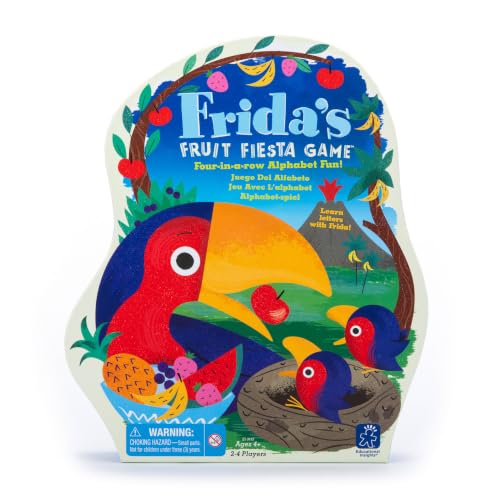
The Frida Squeezer and triple spinner turn alphabet practice into a hands-on challenge. Each spin directs players to choose a letter that matches their nest card, then collect the corresponding fruit bowl using the squeezer, building letter recognition and fine motor control at the same time. For a 4-year-old just starting to learn the ABCs, this game makes the process feel like a playful hunt rather than a drill. The game board doubles as the box, which means cleanup is just closing the lid, a small mercy for parents.
This game asks more of a child than a pure luck-based option like Candy Land. Kids need to know their letters or at least be willing to learn them quickly, so it’s better suited for families who want a little learning woven into game night. The 2-4 player count also means it won’t work for bigger playdates without taking turns. Still, for a focused alphabet game that builds motor skills alongside early literacy, it’s a thoughtful pick.
Product photos
Educational Insights Shelby's Snack Shack Board Game
What We Like
- Teaches counting and fine motor skills
- Includes Shelby Squeezer for motor skill practice
- Double spinner adds variety to gameplay
- Game board doubles as storage box
Trade-offs
- Limited to 2-4 players only
- Requires adult setup for younger children
The included Shelby Squeezer, a custom plastic tong, turns counting into a fine-motor workout, so kids aren’t just reciting numbers but actually pinching, lifting, and placing each bone. This hands-on approach helps preschoolers develop the small muscle control they’ll need for writing and other precise tasks. Parents often notice that the game naturally encourages patience and careful handling, as children must coordinate their grip to successfully transfer the bones. It’s a clever way to blend early math practice with physical skill-building, making learning feel like play.
The narrow age range is a limitation: the box says 4-6, so a child who has already mastered basic counting may find the math too simple, even if the motor challenge still appeals. Compared to Candy Land, which starts at age 3 and has no counting requirement, Shelby’s adds a genuine learning layer, but it also includes 40 small bones that need to be kept track of. Best for families who want a game that feels like play but secretly builds counting and fine motor skills.
Product photos
Goliath Don't Wake Daddy Board Game

What We Like
- No reading required for play
- Supports up to 6 players
- Develops fine motor skills
- Quick to learn rules
Trade-offs
- Requires flat stable surface for bed
- Not suitable for solo play
A 2-to-6 player count means this works for both small families and bigger playdates, and the no-reading-required rule set gets everyone playing within seconds. The core tension, press the button and hope Daddy doesn’t spring up, turns turn-taking into genuine giggle-inducing suspense. That physical surprise element also sneaks in hand-eye coordination practice, making it more than just a luck-based romp. For kids 4 and up who enjoy a little jump-scare humor, this delivers a focused, repeatable thrill that doesn’t rely on literacy or long attention spans.
The surprise mechanism can overwhelm very timid children; if your kid startles easily, the sudden pop-up might cause tears rather than laughter. Compared to Candy Land’s gentle color-matching progression, Don’t Wake Daddy leans harder into active physical reaction, which some families love and others find too intense. It’s a narrow but well-executed concept, best for households where the goal is controlled chaos and shared laughs, not quiet strategy.
PlayMonster Yeti in My Spaghetti Board Game

What We Like
- Fast-paced, easy-to-learn gameplay
- Encourages hand-eye coordination and focus
- Travel-friendly lightweight set
- Durable plastic noodles and bowl
Trade-offs
- No reading or counting skill development
- Single activity type limits replay variety
The 0.4-pound bowl and plastic noodles mean you can set up and play in seconds, no rulebook wrestling required. That light weight also makes it genuinely travel-friendly, toss it in a bag for a restaurant wait or a rainy-day playdate. The game encourages hand-eye coordination, patience, and concentration as children strategize which noodle to pull next, all wrapped in silly suspense that keeps kids laughing instead of frustrated. It’s a quick, giggle-filled activity that gets little hands working and doesn’t demand your full attention to explain.
The game’s main draw is that it hones hand-eye coordination and patience, making it a fantastic choice for a quick, giggle-filled activity that gets little hands working without demanding your full attention to explain. Families wanting a fast-paced, laugh-filled game that sharpens fine motor skills in preschoolers will find it hard to beat. Not ideal for kids who need reading, counting, or strategic thinking challenges.
How We Evaluated Board Games For Kids 4 And Up
Our research began with a deep look at manufacturer specifications and age recommendations for each game. We then cross-referenced those details with expert round-ups from child development specialists and toy reviewers who focus on early childhood play patterns. Finally, we analyzed common themes in owner feedback to understand which games hold up to repeated play and which frustrate young children.
The four criteria that mattered most were skill development, age-appropriate rules, player count, and replay value. Does the game teach counting, letter recognition, memory, or fine motor control? Can a four-year-old grasp the mechanics in under two minutes? Can the game accommodate a typical playdate or family of four? Will the child want to play it next week, not just today?
A research-led evaluation like this has limits. We have not personally played every game with every child, so we rely on the collective experience of hundreds of parents and experts. If you are looking for more specific recommendations by age, our guides to board games for 4 year olds and games for 5 year olds offer deeper dives into those narrower age brackets.
What To Look For In Board Games For Kids 4 And Up
The best game for a four-year-old is one they can play with minimal adult help. Focus on games that teach a single new skill, require no reading, and keep play sessions short.
Look for games with no reading required, simple rules you can explain quickly, and a short playtime. Avoid games with small pieces that pose a choking hazard or complex scoring systems that require adult calculation.
No Reading Required
The single most important feature for this age group is a game that does not require reading. Four-year-olds are just beginning to recognize letters and simple words. Games like Candy Land use color matching, while Jax SEQUENCE for Kids uses picture matching. This allows children to play independently and builds confidence.
Skill Development
Look for a game that reinforces one specific skill. Educational Insights Frida’s Fruit Fiesta teaches letter recognition through matching. Peaceable Kingdom Count Your Chickens focuses on counting. Educational Insights Shelby’s Snack Shack builds fine motor skills with its Shelby Squeezer. A game that tries to teach too many skills at once will overwhelm a four-year-old.
Player Count and Social Dynamics
Check the player count before you buy. Many games for this age group are limited to 2-4 players, which works for a small family but not a preschool playdate. Goliath Don’t Wake Daddy supports up to six players, making it a better choice for larger groups. Also consider whether your child prefers cooperative play or competition. Our guide to cooperative board games lists excellent options for kids who struggle with losing.
- Check that all pieces are large enough to avoid choking hazards (smaller than a toilet paper roll is a red flag).
- Confirm the game box lists an age range of 3+ or 4+ on the packaging.
- Read a few parent reviews to see if the game holds up after ten plays.
- Look for frustration-free packaging and a storage solution that keeps pieces organized.
A good rule of thumb: if you cannot explain the rules quickly, the game is too complex for a four-year-old.
Board Games For Kids 4 And Up Compared
The table below compares all games by key features like player count, skill focus, and whether reading is required. Use it to quickly narrow your options before reading the full reviews.
| Product | Age Range | Players | Weight |
|---|---|---|---|
| Hasbro Gaming Candy Land Board Game | 3 & Up | N/A | 1.1 pounds |
| Jax SEQUENCE for Kids | 3-6 | 2-4 | 1.5 pounds |
| Hasbro Gaming Chutes and Ladders Marvel Spider-Man Edition | 3 and up | 2-4 | 1.3 pounds |
| Peaceable Kingdom Count Your Chickens | 3 years and up | 2 to 4 | 1.0 pounds |
| Peaceable Kingdom Dinosaur Escape | 4+ | 2-4 | 1.1 pounds |
| Ravensburger Enchanted Forest | 4 years and up | 2-6 | 1.1 pounds |
| Educational Insights Frida's Fruit Fiesta | 4+ | 2-4 | 1.6 pounds |
| Educational Insights Shelby's Snack Shack Board Game | 4-6 | 2-4 | 0.9 pounds |
| Goliath Don't Wake Daddy Board Game | 4+ | 2-6 | N/A |
| PlayMonster Yeti in My Spaghetti Board Game | 4+ | Multi-Player | 0.4 pounds |
Frequently Asked Questions
What is the best board game for a 4-year-old who cannot read?
Hasbro Gaming Candy Land Board Game is the best choice for non-readers. It uses color matching instead of words, so children as young as three can play independently. Jax SEQUENCE for Kids is another excellent no-reading option that adds a layer of simple strategy through picture matching.
How long should a board game session last for a 4-year-old?
Most four-year-olds have a limited attention span for seated activities. Games like Candy Land and Yeti in My Spaghetti fit comfortably within this window. Avoid games with a long listed playtime unless your child has demonstrated longer focus.
Are cooperative board games better for 4-year-olds than competitive ones?
Cooperative games like Peaceable Kingdom Count Your Chickens and Dinosaur Escape teach teamwork and eliminate the disappointment of losing. This can be a better fit for sensitive children or siblings who tend to argue. Competitive games are fine for kids who understand turn-taking and can handle losing gracefully.
What skills should a board game teach a 4-year-old?
The most valuable skills at this age are turn-taking, counting, color and shape recognition, fine motor control, and memory. Educational Insights Shelby’s Snack Shack builds counting and fine motor skills. Ravensburger Enchanted Forest strengthens memory and puzzle-solving. Choose a game that targets one skill your child is currently developing.
Can a 4-year-old play the same board games as a 5-year-old?
Many games designed for ages 4 and up work well for both ages. Candy Land and Chutes and Ladders are simple enough for four-year-olds but still engaging for five-year-olds. For more targeted recommendations, see our guide to board games for 4-5 year olds.
The Bottom Line
Hasbro Gaming Candy Land Board Game is our best overall pick because it requires no reading, teaches turn-taking through simple color matching, and has entertained preschoolers for generations. It is the safest bet for a first board game, especially for children who have never played one before.
If your child is ready for more interaction, Peaceable Kingdom Count Your Chickens offers cooperative counting practice without the pressure of competition. For families with multiple children or frequent playdates, Goliath Don’t Wake Daddy supports up to six players and adds a fun physical element.
The most important factor is matching the game to your child’s current attention span and skill level. A game that is too complex will sit on the shelf. One that is too simple will bore them. Start with a no-reading, short game and build from there. For a broader look at what is available, check our best board games for kids guide.
