
Sandbox vs Sand Table: Which Should You Buy?
This post contains affiliate links. As an Amazon Associate, we earn from qualifying purchases.
A sandbox vs sand table decision turns on space and on age. A sandbox sits on the ground so several children can dig together; a sand table raises the play surface to standing height and uses far less sand. With a garden, choose the sandbox. With a balcony or a mouthing toddler, choose the table.
Sand volume is the number that decides most of your maintenance load. A ground sandbox sized to real depth holds a large loose-fill volume that has to be turned, dried, and eventually dug out and replaced. A table holds a few scoops you can tip out and refresh in minutes.
What follows walks the standards that actually apply, the cover question the sources disagree on, the sand labels that mean less than they look, and the build-versus-buy trade-off. By the end you’ll know which format goes in your space and what to do in week one.
Key Takeaways
- Ground sandboxes need at least 9 in. (23 cm) of sand to earn fall-attenuation credit under CPSC Publication 325, and sand is never accepted as a unitary surface under swings or slides.
- A lid alone does not meet CDC guidance on cat-feces contamination. The agency calls for excluding cats and washing hands, and treats covering as one measure among several.
- Toyzinn suggests considering a sand table first for children who still mouth objects, and ASTM F2373-11(2017) is the standard written for the 6-to-23-month range.
- Play sand sold as a toy is tested to EN 71-3:2019 for migration of 19 elements, including arsenic, lead, cadmium, mercury, and chromium VI.
- Owners report covers fail first: warped, blown off, or too heavy for one adult to lift alone, and the real fix is a fitted tarp plus a hard lid.
What the Standards Actually Say About Sand Depth
CPSC Publication 325 is the document that sets the depth figure, and it is written for public playgrounds rather than backyards.
Sand used as a protective surface in a public playground sandbox must sit at least 9 in. (23 cm) deep to earn fall-attenuation credit under CPSC Publication 325. The same handbook states that sand is not acceptable as a unitary protective surface beneath swings or slides, and that sand should be dug out and replaced rather than topped up.
That figure matters at home because it is the only published depth number tied to sand as a safety surface. I’ve seen boxes planned around a climbing frame that were never going to hold the depth. Depth fails quietly.
The mechanism isn’t mysterious. Sand grains settle under foot traffic and rain, and the top layer migrates out to the edges. Depth drops a little every month, and the fall-attenuation assumption in the standard fails without anyone noticing.
CPSC and EN 1176 guidance both name this. Loose-fill sand compacts and is displaced, so installed depth falls below the specified minimum. The root cause is maintenance, not manufacture.
| Standard | What it covers | Key requirement |
|---|---|---|
| CPSC Pub. 325 | Sand as a protective surface | At least 9 in. (23 cm) deep |
| EN 1176-1:2017 | Impact-attenuating surfacing | Documented, maintained depth |
| ASTM F1487-21 | Public playground equipment | No protrusion or entrapment hazards |
| ASTM F2373-11(2017) | Equipment for 6 to 23 months | Toddler scale, mouthing assumed |
| EN 71-3:2019 | Toy material migration | Limits 19 elements, lead included |
The two surface standards disagree about how strict the burden should be. CPSC gives sand fall-attenuation credit at a stated minimum depth. EN 1176-1:2017 goes further and requires that the depth be documented and maintained, because it treats sand’s performance as something that degrades.
In the UAE, uncovered sand in direct sun can become too hot to touch for much of the day. That’s a shade problem, not a depth problem, and a canopy or pergola solves it.
If a toddler is going into the box at all, the sandbox safety for toddlers basics come before the sand choice. The full depth rule sits in the CPSC Public Playground Safety Handbook.
Sandbox vs Sand Table: Which Fits Your Space?
Measure the shaded area first, because shade decides how much of the day either format is usable. In the UAE, uncovered sand in direct sun can become too hot to touch for much of the day, so a canopy, pergola, or tree is worth more than a bigger box.
| Factor | Ground sandbox | Raised sand table |
|---|---|---|
| Space needed | Garden corner with room to sit | Balcony or terrace footprint |
| Sand volume | Large, needs turning and replacing | A few scoops, easy to swap |
| Age fit | Siblings and mixed ages | Toddlers who still mouth sand |
| Movability | Fixed once filled | Moves indoors or into shade |
| Best for | Big digging and building games | Small spaces and hot climates |
Toyzinn’s guide draws the line the same way. Choose a sandbox if you have garden space, more than one child, or you want big digging and building games. Choose a table if you have a balcony, a small terrace, or you want something that moves indoors or into shade.
The Sandbox Case: Ground-Level Play for Siblings
A ground box lets children sit inside the sand and work at it with their whole body. That’s the play value, and it’s also why the sand volume is large.
Boxes get used by groups. That matches what I see on site.
Measure for legs, not just for bodies. A box needs enough space for children to sit with their legs stretched out, plus room for an adult to reach in and rake.
The Sand Table Case: Raised, Small, and Movable
A table raises the play surface to standing height, uses far less sand, and moves easily. On a balcony or a small terrace, that’s the whole argument.
Toyzinn also suggests starting a very young child on a table so you can control how much sand is in play. That lines up with the public-health position on mouthing-age children.
For a wider look at what’s on the market, the best sandboxes for kids roundup covers ground boxes, and the guide to types of sandboxes breaks down the design families.
Does a Cover Actually Keep the Sand Clean?
A lid keeps leaves out and lowers the odds of a cat using the box. Public-health guidance doesn’t treat covering as sufficient on its own, and the lid is the first part to fail.
We swapped the lid for a fitted tarp under a rigid panel, and that has held since.
The CDC position is the one to build your routine around. The agency documents Toxocara cati and Toxocara canis, the roundworms carried by cats and dogs, plus Toxoplasma gondii as real transmission routes through contaminated sand in uncovered boxes. Its guidance is to exclude cats and to wash hands.
Toyzinn takes a lighter line, advising a smaller amount of sand with a lid or cover kept on when the box isn’t in use. Both positions are worth knowing, because they lead to different weekly habits.
| Question | Position A | Position B |
|---|---|---|
| Is a lid enough? | CDC: exclude cats, wash hands | Toyzinn: cover when not in use |
| Sand-and-water combos? | Toyzinn: separate compartments | Owners: cross-contamination |
| Builder’s sand? | Toyzinn: avoid it | Owners: substitute it routinely |
Owners report a third angle that neither guide covers. Across parenting and landscaping forums and product Q&A, the consistent report is that covers warp, blow away, or end up too heavy for one adult to lift, and that the working fix is a fitted tarp under a hard lid.
Refresh or replace the sand if it smells, stays damp, or looks contaminated.
Before you start: Keep water play shallow and never leave small children unattended near any water, even in a table, so tip it out the same day. Refresh or replace the sand if it stays damp. Several CPSC juvenile-product recalls exist for Little Tikes sandbox/play tables with detachable small parts, cited as a choking hazard.
Five jobs keep a box usable, and they run in this order:
- Turn the top layer with a rake once a week. Sand that never gets air and sun stays damp underneath and starts to smell.
- Sift out leaves and flowers before they break down.
- Check the depth against the 9 in. (23 cm) mark if the box doubles as a fall surface. Sand compacts and displaces, so depth drops without any visible sign.
- Replace rather than top up. CPSC Pub. 325 says sand should be dug out and replaced. Topping up leaves the old layer sitting underneath.
- Store the cover flat, not leaning against a wall. Owners report covers warp and are lost in wind.
The full routine, including what to do after heavy rain, is in the guide on how to keep a sandbox clean. CDC’s toxocariasis page covers the roundworm route in more detail.
Why the Age Label on the Box Is Not a Safety Rating
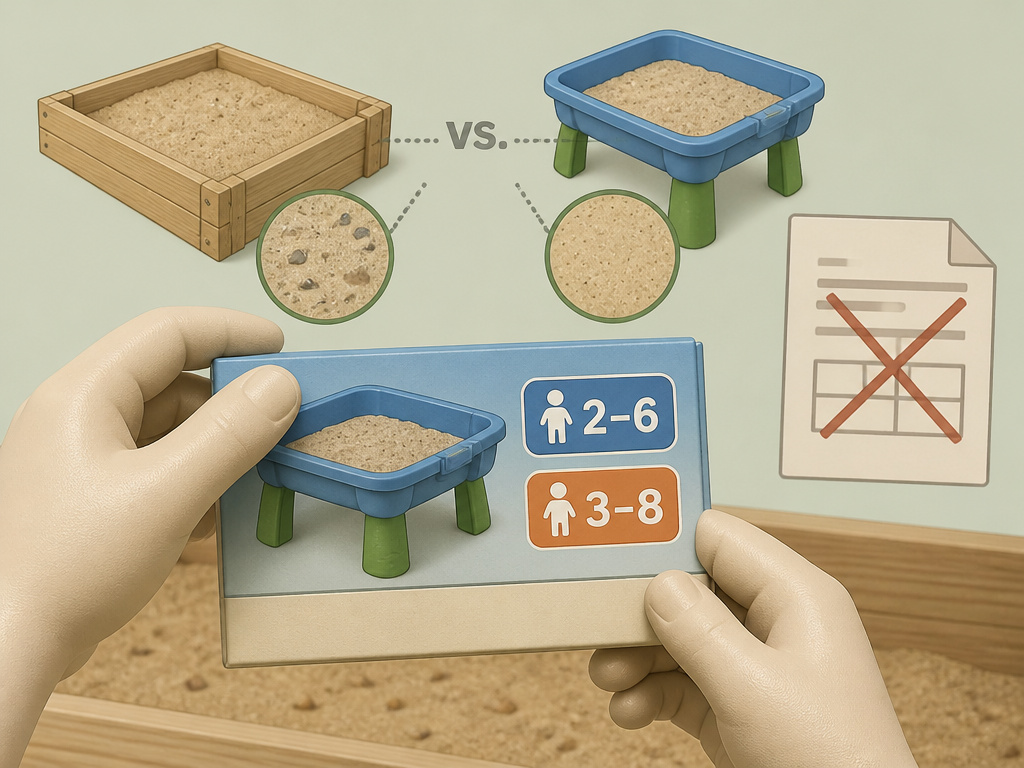
The age range printed on a sandbox is a marketing suggestion, and the two standards behind it don’t agree with each other.
ASTM F1487-21 governs sandbox enclosures as public playground equipment for ages 5 to 12, and it assumes the child has independent mobility. ASTM F2373-11(2017) covers public use play equipment for children 6 months through 23 months, and it assumes mouthing and no independent way out.
The two standards assume different children. A single product can’t satisfy both framings, which is why the label on the box is a rough hint rather than a rating.
There’s a second gap worth naming. No CPSC, EU Safety Gate, or GCC/ESMA recall record names a sand table as the recalled article, and the consumer children’s sand table category has no published OEM service manuals or peer-reviewed benchmarks. Anyone quoting you a sand table spec sheet is quoting a retailer listing.
The absence of a recall doesn’t mean the category is safe. It means the category hasn’t been tested the way tools or toys with published specs have.
What Sand to Buy, and Where the Label Stops Meaning Anything
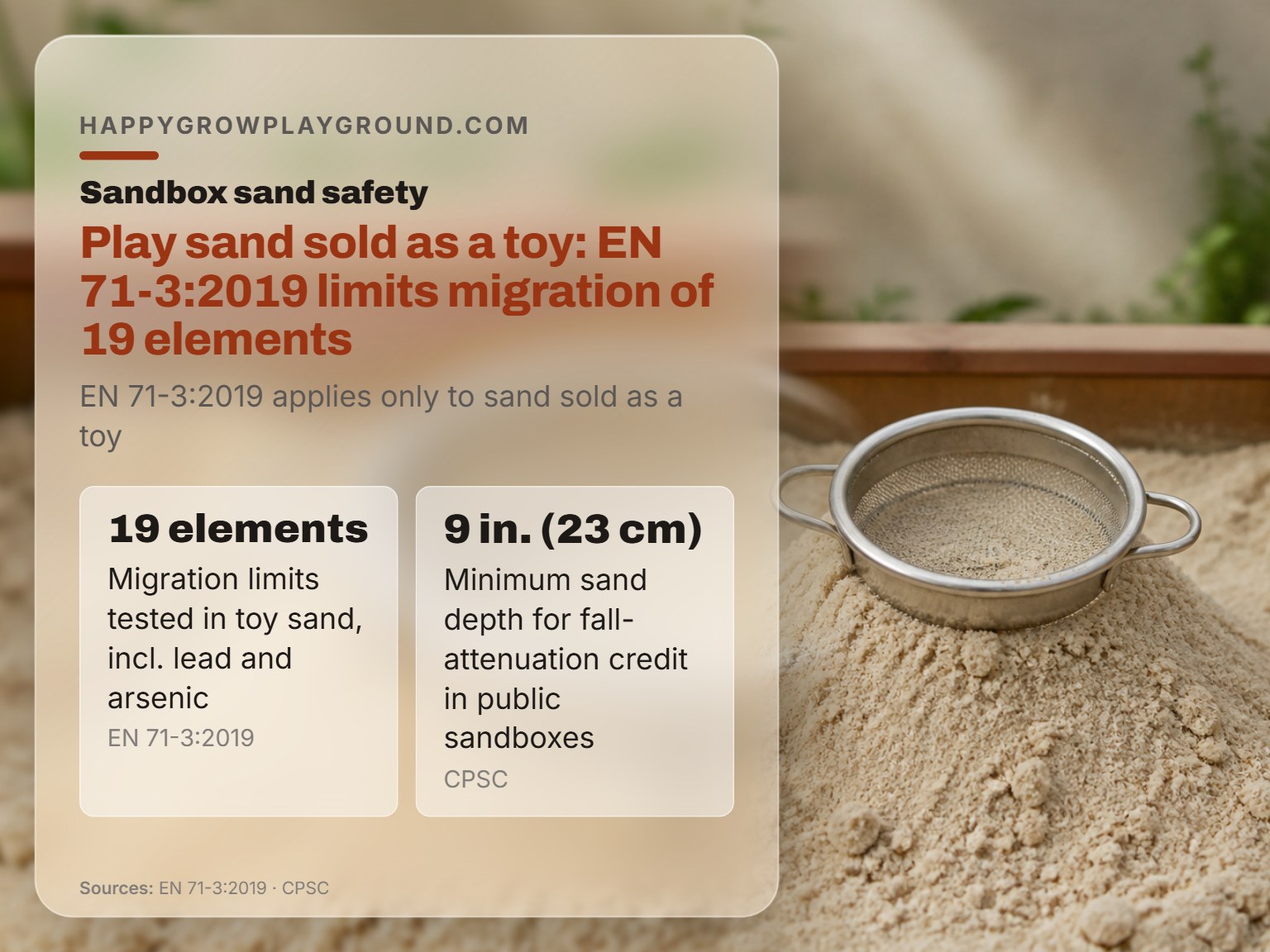
Nineteen elements. That’s what EN 71-3:2019 tests for when sand is sold as a toy, and the list includes arsenic, lead, cadmium, mercury, and chromium VI. ISO 8124-3 is the international equivalent.
That standard is the actual basis for a “non-toxic play sand” claim. It’s a toy claim, and it only applies to sand sold and labelled as a toy.
Toyzinn’s advice is to choose non-toxic play sand that is washed and fine-grained, sold specifically for children’s play, to avoid construction or builder’s sand because it can be dusty and coarse, and to check the product label for safety information.
Here’s where the label and the reality part ways. Owners routinely substitute builder’s sand, a documented divergence between what the label intends and what actually goes in the box. Builder’s sand isn’t tested to EN 71-3, so the migration limits don’t apply to it.
Wet or dry changes the play, not just the safety. Dry sand hisses when a child pours it and won’t hold a wall. A lightly damp mix goes quiet and packs, because the water forms thin bridges between grains that resist sliding.
Signs the sand is finished:
- It smells sour, like a wet towel.
- It stays damp for days after rain.
For the bag-by-bag comparison, the best sand for sandbox guide covers grain size, washing, and what each label actually claims.
What most people get wrong: Buying builder’s sand because it’s cheaper and looks the same. It isn’t tested to EN 71-3:2019, and the dust it throws in a dry climate settles on everything the child touches next.
Build It or Buy It: Splinters, Warping, and Exposed Fixings
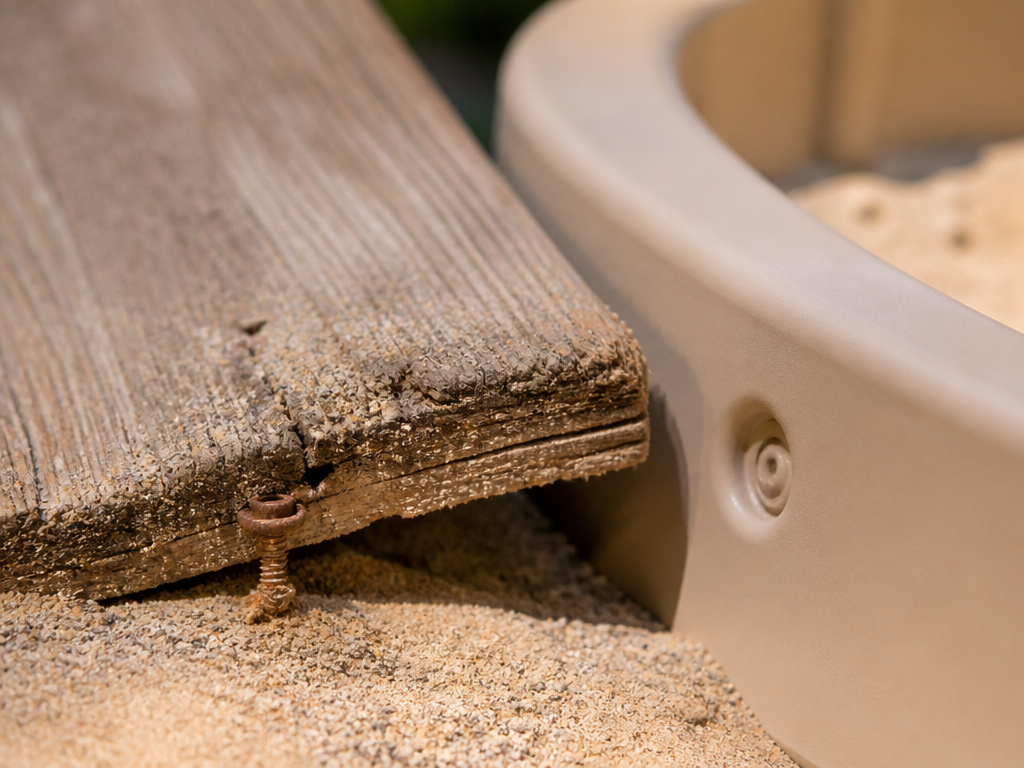
You picture a neat timber box with a hinged lid, and then one summer of sun gets to it.
Toyzinn flags the trade-offs on a homemade sandbox: untreated wood can splinter, fixings can be exposed, and a homemade lid may not seal out dust or pests. Heat and sun can warp materials quickly. A ready-made box is built for child use, usually has smoother finishes, and often comes with a cover.
If you’re weighing materials, the wooden vs plastic sandbox comparison covers how each one ages in heat and sun.
Buying doesn’t remove the risk. There’s a CPSC recall on the Step2 Naturally Playful sandbox covering lid and cover components, cited for laceration or entrapment hazard in specific production runs. CPSC juvenile-product recalls also exist for Little Tikes sandbox and play tables with detachable small parts, cited as a choking hazard.
What to Inspect Before You Assemble
- Lid weight. If one adult can’t lift it one-handed, owners report it will end up on the ground.
- Fixings. Recessed heads, and no exposed thread ends inside the sand volume.
- Edges. Run a thumb along every rim.
- Drain.
Check the date code on any used box before you take it. Recalls are production-run specific.
Sand Toys, Sensory Play, and What the Research Really Shows
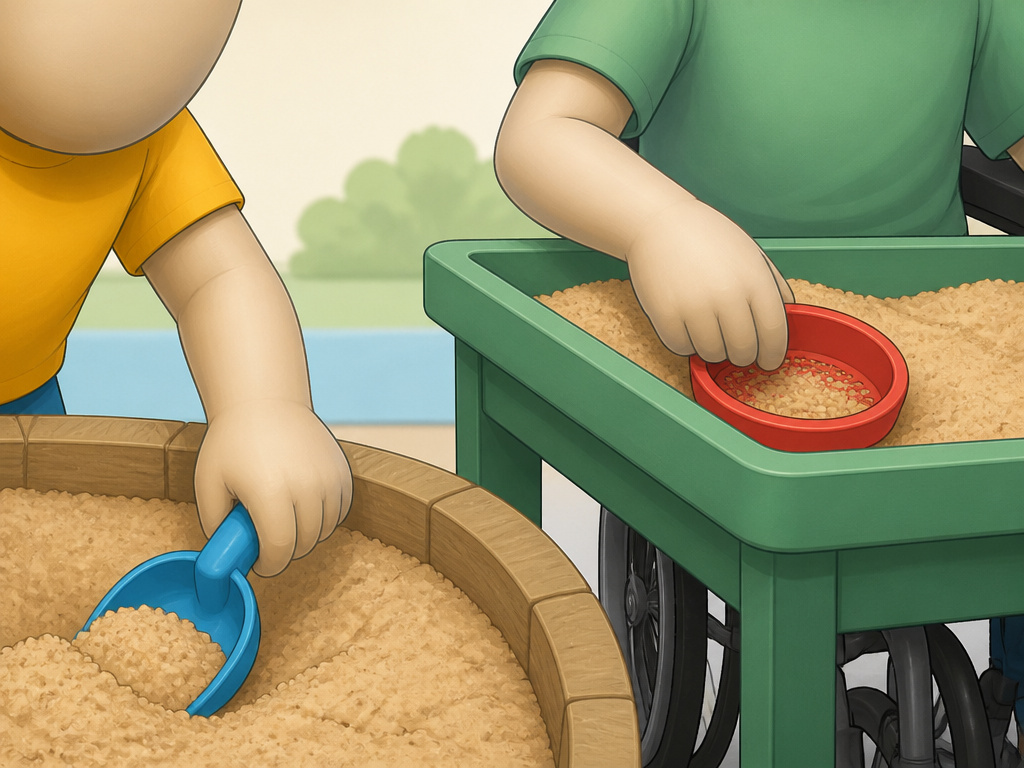
The research on sand play is real, and it’s narrower than the marketing suggests.
Peer-reviewed occupational therapy literature, including work published in the American Journal of Occupational Therapy and Physical & Occupational Therapy in Pediatrics, supports tactile and proprioceptive sensory input from sand play. The same literature notes that a raised table allows seated or standing access for children with mobility limitations, where a ground pit does not.
That accessibility point carries the strongest evidence of any format claim here. Pediatric OT literature cites sand and water play as supporting proprioceptive and fine-motor development, but it doesn’t compare table against box. The literature supports sand play. It doesn’t rank the formats.
Manufacturers position sand-and-water combo tables as dual-use. Owners report the compartments cross-contaminate, with wet sand clogging the drain and water carrying sand into the dry side. In practice, dual-use turns into single-use.
If you’re weighing the alternative, the water table vs sand table comparison covers what each format is actually good at. For the small stuff, the sandbox toys guide covers scoops, sifters, and moulds.
I get asked for the research on this constantly, and the honest answer is that it’s thin. Buy the format that fits the space. The sensory benefit comes from the sand, not from the height of the box.
Frequently Asked Questions
Is a sandbox or a sand table better for a toddler?
Sand table is the easier format for a child under three who still mouths objects, because you control the sand volume and the play surface sits off the ground. Toyzinn recommends starting very young children on a table for exactly that reason. A ground box works well once the child stops putting everything in their mouth.
How deep should the sand be in a sandbox?
CPSC Publication 325 gives sand fall-attenuation credit at a minimum depth of 9 in. (23 cm). That figure applies to sand used as a protective surface on public playgrounds. If your box sits under a climbing frame or a slide, sand isn’t accepted as a unitary protective surface there at all.
Do I need a cover on a sandbox?
Cover keeps out leaves and reduces the odds of a cat using the box, but CDC guidance on toxocariasis and toxoplasmosis calls for excluding cats and washing hands, and doesn’t treat covering alone as sufficient. Owners also report covers are the first part to fail. A fitted tarp under a rigid lid is the more reliable setup.
Does a sand-and-water combo table work as two toys in one?
Manufacturers position combo tables as dual-use with separate compartments. Owners report the compartments cross-contaminate, with wet sand clogging the drain and water carrying sand into the dry side. Treat a combo table as a single-use toy with a spare compartment.
What kind of sand should I put in a sandbox?
Play sand sold as a toy is tested to EN 71-3:2019, which limits migration of 19 elements including lead and cadmium. Builder’s sand carries no such claim. Toyzinn advises washed, fine-grained play sand and warns against construction sand, though owners substitute builder’s sand routinely.
Can I use a sand table indoors?
Yes. Toyzinn suggests taking a sand table indoors for rainy or very hot days, and a table’s small sand volume makes that practical. Keep the amount of sand low and put a mat under the legs.
Before You Go
Here’s the one number to check before you buy anything. If the box will sit under a swing, a slide, or any climbing frame, the sand has to hold 9 in. (23 cm) of depth and stay there. If you can’t commit to raking it back up every few weeks, buy a table instead and keep the fall zone clear.
That’s the concession most guides skip. Sand as a safety surface is a maintenance commitment, not a purchase.
For week one, do one thing: measure your shaded area, then measure it again with a chair sitting in it. Whichever format leaves an adult able to reach the sand without stepping into it is the one still in use next summer.
Kids vote with their feet.
