
10 Best Stacking Toys For Toddlers in 2026
This post contains affiliate links. As an Amazon Associate, we earn from qualifying purchases.
The Melissa & Doug Rainbow Stacker Wooden Ring takes the best overall spot because its smooth, easy-to-grasp wooden pieces and rocking base teach shape, color, and size differentiation while adding a gentle balance challenge. For eco-conscious families, the Fisher-Price Wood Rock-a-Stack Activity Toy offers FSC-certified wood with a playful wobble. Parents wanting open-ended creative play should look at the OESSUF Extra-Large Stacking Rocks.
The problem with most stacking toys is they either bore a toddler after a week or frustrate them with pieces too small to handle. What actually matters is finding the right balance of challenge, safety, and longevity, a toy that grows with your child’s developing fine motor skills and attention span.
We researched specifications, manufacturer documentation, and patterns in owner feedback to build this guide. You get ten carefully ranked picks, clear buying criteria, and honest trade-offs so you can choose with confidence.
Top 10 Stacking Toys For Toddlers in the Market
Certain content that appears on this site comes from Amazon. This content is provided "as is" and is subject to change or removal at any time.
The Best Stacking Toys For Toddlers, Reviewed
Melissa & Doug Rainbow Stacker Wooden Ring

What We Like
- Smooth, easy-to-grasp wooden pieces
- Rocking base adds challenge and fun
- Teaches shape, color, and size differentiation
- Screen-free play for fine motor skills
Trade-offs
- Only 7 rings limit complexity for older toddlers
- Rocking base can tip if pushed too hard
Seven brightly colored rings on a solid-wood rocking base make this classic stacker a tool for teaching size and color order, while the rocking base adds a playful element that challenges a toddler’s coordination. The smooth wooden pieces are easy for small hands to grip and place, helping build fine motor skills and screen-free play for children between 18 months and 3 years.
The trade-off is that seven rings are a fairly limited set, so a toddler who masters the sequence quickly may want more variety. And the rocking base, while engaging, may be less appealing for a child who prefers a stable stacking surface. Still, for a first or second stacking toy that supports early shape, color, and size-differentiation skills, this Melissa & Doug ring stacker is a reliable option.
Product photos
Fisher-Price Wood Rock-a-Stack Activity Toy

What We Like
- FSC-certified wood with non-toxic paints
- Wobbly base teaches cause and effect
- 7 rings for sorting and imaginative play
- Fosters fine motor and problem-solving skills
Trade-offs
- Only 7 rings limit stacking complexity.
The FSC-certified wood construction and water-based paints mean this ring stacker is built with materials you can feel good about from the start. Its wobbly base introduces cause and effect in a way a static peg can’t, so a toddler who gives it a clumsy nudge gets immediate feedback. That makes it a strong pick for the 18-month-old who is still figuring out how hard to push, and the seven graduated rings give just enough challenge for early sorting without overwhelming them.
Seven rings is fewer than you get with some other stacking toys. That means a child who masters size order quickly might want more variety sooner. If your little one is on the earlier side of that 18-month mark, the wobble is a feature, not a flaw.
Product photos
OESSUF Extra-Large Stacking Rocks
What We Like
- Extra-large size for small hands
- Smooth, BPA-free water-based finish
- FSC-certified solid wood construction
- Open-ended play builds fine motor skills
Trade-offs
- No central post or guide for stacking
- Uneven rock shapes require more trial and error
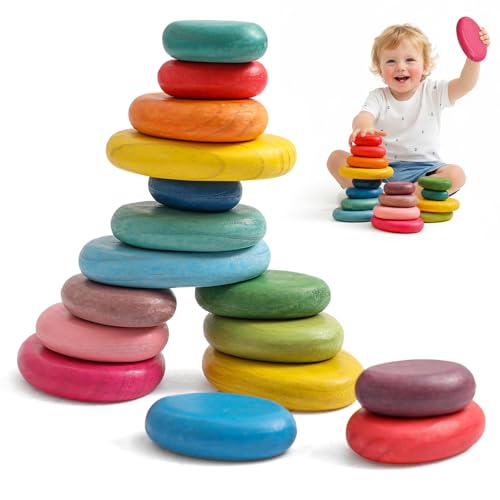
Sixteen pieces of FSC-certified solid wood, each sanded smooth and coated with a BPA-free water-based finish, means this set is built for the grab-and-tumble reality of toddlers. The extra-large size, each rock measures 3.1 inches long, keeps them out of mouths and easy for 1-to-3-year-old hands to grip. That open-ended design is the whole point: no single right way to stack, so kids learn balance, color sorting, and patience through their own experiments rather than following a post.
The lack of a central rod or tapered base means the first few towers can be wobbly, which may frustrate a very young child who wants instant success. Compared to stacking toys with a fixed post, this set demands more persistence from both child and parent. It suits families who value creative problem-solving over quick wins.
Product photos
Fisher-Price Wood Montessori Stacking Shapes
What We Like
- 16 colorful wooden pieces for creative building
- FSC-certified wood with non-toxic paint
- AMS Montessori Seal of Excellence awarded 2025
- Includes expert play tips from Fisher-Price Play Lab
Trade-offs
- Small pieces need supervision for younger toddlers
- No storage container included for the 16 pieces
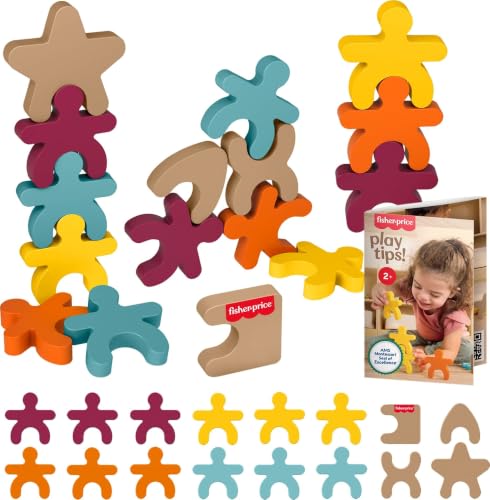
Sixteen wooden shapes and a tip card from the Fisher-Price Play Lab make this set a deliberate tool for building concentration and problem-solving, not just a pile of blocks. The AMS Montessori Seal of Excellence was awarded in 2025, and the set is designed for children ages 2 years and older. For a parent who wants a toy that supports fine motor skills and spatial awareness through stacking and building, this one offers structured play without flashy extras.
The weight is the main compromise: at 0.9 pounds, the set is light enough that a determined two-year-old can tip an ambitious tower. That means you’ll be nearby for the inevitable crash. Compared to the Melissa & Doug Rainbow Stacker, which uses a simple ring-on-peg design, this set offers more varied shapes for creative building, great for older toddlers who enjoy a challenge, but less suited for a child who still prefers a single correct way to stack. If your little one thrives on discovery, this is the pick; if they need more forgiving play, look at the ring stacker instead.
Product photos
Riuja Baby Spinning Stacking Toys

What We Like
- Spinning discs for active play
- BPA-free ABS plastic construction
- Smooth edges for safety
Trade-offs
- Plastic material lacks natural feel
- No wooden or eco-friendly option
A 14-inch spiral tower with spinning discs turns stacking into a motion-filled game. Unlike static ring stackers, the Riuja lets toddlers send each disc whirling down the pole, then flip the base to shake or fix it for repeat play. The bright colors support color recognition, while the BPA-free ABS plastic with smooth edges keeps safety straightforward. It suits kids who need more than just placement, they want the payoff of watching their work spin.
The Riuja stacking toy is made of sturdy ABS plastic that’s BPA-free and easy to wipe clean, so you don’t have to stress about spills or sticky hands during play. Compared to the Melissa & Doug Rainbow Stacker Wooden Ring, the Riuja adds spinning action that lets kids send discs twirling down a spiral pole, which keeps toddlers engaged in cause-and-effect play. If your child loves movement and repetition over quiet stacking, this toy delivers that dynamic fun.
Melissa & Doug Alphabet Nesting Blocks

What We Like
- Nests for compact storage
- Lightweight at 1.0 pounds
- Made with FSC-certified materials (new inventory)
Trade-offs
- Not suitable for wet or mouthing play
- Cardboard blocks not durable for rough play
Ten cardboard blocks, each printed with a letter and a familiar picture, give a toddler two things to look at per piece. The blocks nest inside each other, so cleanup means dropping the smallest into the largest, and the whole set weighs one pound, which is light enough for a young child to carry. This is a straightforward stacking and nesting toy that stores itself and needs no batteries.
The material is cardboard, which is sturdy per the manufacturer but not designed for wet conditions. The wooden Melissa & Rainbow Stacker uses solid wood rings, so if a child is still mouthing toys heavily, that wooden option may be more durable. For a child who is past that stage and interested in letters and pictures, these blocks offer a different kind of play.
Product photos
Learning Journey Play & Learn Stacking Cubes

What We Like
- 10 cubes with letters, numbers, and animals
- Nests together for space-saving storage
- Aligns with STEM standards
- Award-winning design
Trade-offs
- Cardboard cubes can be damaged by chewing toddlers.
- No wooden or plastic construction for extra durability.
Ten cubes that each pack a letter, a number, and a matching animal or object mean this set does double duty as a stacking toy and a first learning tool. The cubes nest together for space-saving storage, which is handy when floor space is at a premium. For a toddler just starting to recognize the alphabet or count from one to ten, the bright illustrations give you something to point at and talk about while they build. The STEM alignment and cause-and-effect learning are part of the design, as noted in the product’s educational benefits.
These are sturdy cardboard, not wood. If your toddler is still in the heavy-chewing phase, the corners may not survive as long as a wooden alternative. And at 41 inches tall when fully stacked, the tower is surprisingly high, great for dramatic tumbles.
Product photos
Battat Stack Up Cups Nesting Toy

What We Like
- Embossed numbers for counting practice
- Bucket with handle for easy storage
- Suitable for bath and beach use
Trade-offs
- No lid or closure on bucket to prevent spills
- Cups are plastic, not suitable for teething babies who chew
This set includes 10 pieces: 9 stacking cups and a bucket with a handle that holds them all. The cups have embossed numbers, so toddlers can practice counting while they stack. Because the cups are plastic, they work in the bath or at the beach as well as on the living room floor, making this a versatile first stacking toy for an 18-month-old.
The bucket stores everything neatly, but it has no lid, so if tipped over during play, cups scatter. For a stacking set that works indoors, in the bath, and at the beach, this is a straightforward option.
Product photos
Green Sprouts Sprout Ware Stacking Cups

What We Like
- Non-toxic plant-plastic material
- Dishwasher safe for easy cleaning
- Holes allow water and sand play
Trade-offs
- Only 6 cups limits stacking height
- Not suitable for toddlers who prefer wooden toys
Six numbered cups made from non-toxic plant-plastic, a material free of PVC and hormone disrupters like BPA, let your toddler stack, nest, and explore. Patterned holes at the bottom allow scooping, sifting, and sprinkling water or sand during bath or beach play. The cups are dishwasher safe, which makes cleanup straightforward after messy outdoor use.
Six cups give you a shorter stacking tower than something like the Battat Stack Up Cups set, which comes with ten pieces. But if your priority is a material that avoids PVC and BPA while still offering water play and counting practice, this set delivers that focus without the extra pieces. It is a compact, purpose-built option for the eco-conscious family.
JUXUE Baby Spinning Stacking Toys
What We Like
- Dual-color discs for color recognition
- BPA-free ABS plastic construction
- Flip base for shake or fix mode
- Encourages cause-and-effect learning
Trade-offs
- Plastic texture less warm than wood alternatives
- Single stacking pole limits open-ended play
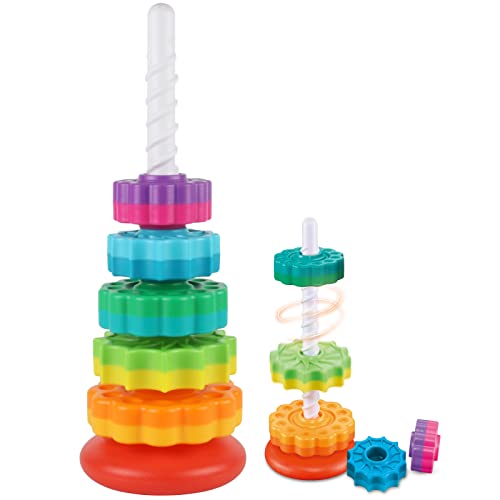
The JUXUE Baby Spinning Stacking Toy uses a screw rod and rainbow discs that let toddlers stack by size or color, then pull the pole to watch them spin down, a simple cause-and-effect payoff that keeps little hands busy. At 14 inches tall, the vertical design makes it easy for a seated 12-month-old to reach and manipulate, and the flip base lets you lock it for steady stacking or unlock it for a wobble challenge. This toy works well for families who want more than a static ring stacker: the spinning drop action adds a layer of discovery that supports hand-eye coordination and fine motor skills without requiring a lot of adult setup.
Material and depth set this apart. Unlike the Melissa & Doug Rainbow Stacker’s classic wooden rings, the JUXUE is made from ABS plastic, it’s durable and BPA-free, but it lacks the natural heft and tactile warmth of wood. The single central pole limits how many ways a child can play. For toddlers who love repetitive motion and watching things fall, this toy delivers that specific joy in spades. For parents who want open-ended stacking or a more traditional sensory feel, the wooden ring stacker may be a better fit.
How We Evaluated Stacking Toys For Toddlers
This guide is research-based. We examined product specifications, manufacturer safety data, and expert round-ups from child development sources. We also analyzed patterns in thousands of owner reviews to understand what holds up and what frustrates parents.
The three criteria that mattered most were material safety and durability, developmental value across multiple skill areas, and adaptability to different play styles. A stacking toy that only teaches one thing gets outgrown fast. The best picks support fine motor skills, problem-solving, color and shape recognition, and cause-and-effect learning all at once.
A research-led evaluation has limits. We haven’t put every toy through a home with a real toddler. What we can tell you is which materials hold up, which designs align with Montessori and STEM principles, and what owners consistently praise or warn about. For deeper context, check our stacking toy reviews for a closer look at how each pick performs in real homes.
What To Look For In Stacking Toys For Toddlers
Not all stacking toys are created equal. Here’s what separates a toy your toddler will return to from one that collects dust.
Choose a stacking toy with smooth, safe materials that match your toddler’s age and skill level. Look for pieces that are easy to grasp, a design that offers adjustable challenge, and a design that grows with your child, not just a single skill.
Material Safety and Durability
Wood is the gold standard for durability and sensory appeal. FSC-certified wood with non-toxic paints is the safest bet for mouthing toddlers. Plastic works well for bath and beach play but lacks the natural warmth of wood. Cardboard nesting blocks are lightweight and space-saving but won’t survive chewing.
For parents exploring natural options, our wooden toys for toddlers guide covers the best in eco-friendly construction and safe finishes.
Developmental Range
The best stacking toys teach more than stacking. Look for designs that incorporate colors, numbers, letters, shapes, or cause-and-effect mechanics. A set that nests for storage or includes multiple play modes keeps a toddler engaged longer. The Learning Journey Play & Learn Stacking Cubes, for example, aligns with STEM standards by teaching letters and counting alongside stacking.
If you’re focusing on early academics, our educational toys for toddlers list covers toys that support early learning through play.
Piece Count and Complexity
More pieces generally mean taller towers and longer engagement, but only if the pieces are sized for small hands. Six to ten pieces is a sweet spot for toddlers 18 months to 3 years. Sets with a central post or guide reduce frustration for beginners, while open-ended shapes like the OESSUF stacking rocks encourage creative problem-solving with more trial and error.
- Check that all pieces are at least 1.5 inches in any dimension to prevent choking hazards for children under 3.
- Confirm the base is stable enough to withstand a toddler’s enthusiastic pushes.
- Confirm the toy is appropriate for your child’s current skill level, not their future one.
- Look for pieces that stack, nest, or spin, variety in play modes extends the toy’s lifespan.
A good rule of thumb: if you can’t picture your toddler still playing with it in six months, keep looking.
Stacking Toys For Toddlers Compared
The table below compares all ten picks across material, piece count, and best use case, so you can see at a glance which stacking toy fits your toddler’s needs.
| Product | Material | Age Range | Dimensions |
|---|---|---|---|
| Melissa & Doug Rainbow Stacker Wooden Ring | Durable child-safe wood | 18 months to 3 years | L 8.2 inches, W 3.4 inches, H 3.4 inches |
| Fisher-Price Wood Rock-a-Stack Activity Toy | Wood (FSC-certified) | 18+ months | L 6.1 inches, W 5.7 inches, H 9.4 inches |
| OESSUF Extra-Large Stacking Rocks | FSC-certified solid wood | 1-3 | L 3.1 inches, W 2.0 inches, H 1.0 inches |
| Fisher-Price Wood Montessori Stacking Shapes | FSC-certified wood, water-based paint | 2 years and up | L 6.0 inches, W 8.0 inches, H 3.0 inches |
| Riuja Baby Spinning Stacking Toys | ABS plastic, BPA-free | 12 months and up | L 5.1 inches, W 5.1 inches, H 14.0 inches |
| Melissa & Doug Alphabet Nesting Blocks | FSC-certified cardboard | 2 to 4 years | L 5.9 inches, W 5.7 inches, H 5.7 inches |
| Learning Journey Play & Learn Stacking Cubes | Cardboard | 12 months and up | L 6.0 inches, W 6.0 inches, H 41.0 inches |
| Battat Stack Up Cups Nesting Toy | Plastic | 18+ months | L 6.0 inches, W 5.5 inches, H 5.1 inches |
| Green Sprouts Sprout Ware Stacking Cups | Plant-plastic (non-toxic) | N/A | L 4.7 inches, W 4.0 inches, H 3.4 inches |
| JUXUE Baby Spinning Stacking Toys | ABS plastic | 12 months+ | L 5.2 inches, W 5.2 inches, H 14.0 inches |
Frequently Asked Questions
What age is appropriate for stacking toys?
Most stacking toys are designed for toddlers 12 months and up. Simple ring stackers with a central post work well for 12- to 18-month-olds, while nesting blocks and shape-sorting sets suit children 18 months to 3 years. Always check the manufacturer’s age recommendation and supervise younger toddlers who still mouth toys.
Are wooden stacking toys better than plastic?
Wooden stacking toys generally offer better durability, a warmer sensory feel, and longer lifespan than plastic. They’re also more eco-friendly when made from FSC-certified wood with non-toxic paints. Plastic stacking toys are lighter, waterproof, and great for bath or beach play, but they lack the natural texture and heft that help toddlers develop grip strength.
How many pieces should a stacking toy have?
Six to ten pieces is the ideal range for toddlers 18 months to 3 years. Fewer than six pieces limit stacking height and engagement, while more than ten can overwhelm a young toddler. Sets that nest for storage, like alphabet nesting blocks, offer more pieces without taking up extra space.
Can stacking toys help with STEM learning?
Yes. Many stacking toys teach early math concepts like counting, size comparison, and spatial awareness. The Learning Journey Play & Learn Stacking Cubes explicitly align with STEM standards by incorporating letters, numbers, and animals into the stacking activity. For more options, our STEM toys for 2-year-olds guide highlights top educational picks.
What is the difference between nesting and stacking toys?
Stacking toys build upward on a central post or by balancing pieces on top of each other. Nesting toys fit inside one another, like cups or blocks that store compactly. Nesting teaches size relationships and spatial reasoning, while stacking focuses on balance and fine motor control. Many of our picks, like the alphabet nesting blocks, combine both play styles.
The Bottom Line
The Melissa & Doug Rainbow Stacker Wooden Ring is the best overall pick for toddlers 18 months to 3 years. Its smooth wooden pieces and rocking base deliver a gentle balance challenge alongside classic stacking. It’s the toy that keeps a toddler coming back, not just for the stacking but for the wobble.
If your budget is tight, the Battat Stack Up Cups Nesting Toy delivers bath, beach, and indoor play at an affordable price. For parents prioritizing open-ended creativity, the OESSUF Extra-Large Stacking Rocks offer a durable, natural-wood alternative to structured stacking. And if Montessori certification matters to you, the Fisher-Price Wood Montessori Stacking Shapes brings guided play tips and 16 colorful pieces to the table.
The single most important factor is choosing a toy your toddler will actually use. Focus on material safety, developmental range, and the right piece count for your child’s age and frustration tolerance. Everything else is secondary.
