
10 Best Card Or Board Games For Cognitive Development (2026)
This post contains affiliate links. As an Amazon Associate, we earn from qualifying purchases.
The best board game for cognitive development is Jax SEQUENCE for Kids, a no-reading strategy game that builds logical thinking through simple visual matching. For older children, ThinkFun Rush Hour Traffic Jam Logic Game sharpens planning skills, while Clever Noodle Pig Fig Wig Fun Word Game targets phonics and reading.
Parents and educators looking for games that do more than entertain face a crowded market. The real challenge is finding games that match a child’s age and skill level while actually exercising specific mental muscles like memory, flexible thinking, or strategic planning.
This guide is based on a review of specifications, manufacturer documentation, expert round-ups, and patterns in owner feedback across ten carefully selected games. We break down what each game does best, who it suits, and what to look for when shopping.
Top 10 Card And Board Games For Cognitive Development in the Market


Certain content that appears on this site comes from Amazon. This content is provided "as is" and is subject to change or removal at any time.
The Best Card And Board Games For Cognitive Development, Reviewed
Jax SEQUENCE for Kids

What We Like
- No reading required for play
- Develops logical thinking skills
- Classic Sequence adapted for kids
- Simple match-and-place gameplay
Trade-offs
- Only suited for ages 3-6
- Limited to 4 players max
- No expansion or variant rules included
No reading is required to play, so even preschoolers can jump right in without frustration. Kids simply match picture cards to characters on the board and place chips, building pattern recognition and logical thinking through visual matching. The classic Sequence mechanic rewards planning ahead, but the cognitive load is perfectly tuned for ages 3-6. That makes this one of the few strategy games that actually works for early learners.
The trade-off is that the same simplicity that makes it accessible also limits its shelf life. Once a child outgrows the 3-6 window, the game offers no advanced rules or variants to grow into. Compare that to ThinkFun Rush Hour, which offers a range of challenge levels for older kids. For a family with a tight age spread, Sequence for Kids works best as a dedicated early-years tool, not a long-term investment. But for its intended audience, it delivers focused cognitive practice in a package they can actually play.
ThinkFun Rush Hour Traffic Jam Logic Game

What We Like
- 40 challenges from beginner to expert
- Develops logical reasoning and planning skills
- Over 50 million sold worldwide
Trade-offs
- Single-player only, no multiplayer interaction
- Only 0.1 inches thick, feels flimsy
Forty challenges that ramp from beginner to expert mean this logic puzzle grows with a child rather than gathering dust after one afternoon. Each challenge asks you to slide cars and trucks out of a gridlock so the red car can escape, a simple premise that forces you to plan several moves ahead. That kind of step-by-step reasoning is exactly what builds the planning skills kids need for math and science, and the tactile sliding pieces keep it from feeling like homework. With over 50 million units sold, ThinkFun has clearly refined the experience to hit that sweet spot between frustration and satisfaction.
Rush Hour is strictly a solo activity. If you’re looking for a game that gets siblings or friends talking and negotiating, something like Jax SEQUENCE for Kids would serve that purpose better with its multiplayer turn-based play. But for quiet, focused cognitive work, the kind that strengthens a child’s ability to think through consequences before acting, this is hard to beat.
Jumbo Stratego Original

What We Like
- Classic two-player battle strategy
- Includes sorting trays and screen
Trade-offs
- Only two players, no solo or group mode
- Pre-printed pieces limit customization
It suits older kids and adults who enjoy methodical planning and bluffing, because the hidden setup forces you to think several steps ahead while defending your own flag. The included screen and sorting trays keep the game organized, so you can focus on outmaneuvering your opponent rather than hunting for pieces.
Stratego is strictly for two players, so it won’t work for larger family game nights the way a flexible card game like Rethink This! does. But if you want a battle of wits that rewards careful strategy and memory, this is the classic choice.
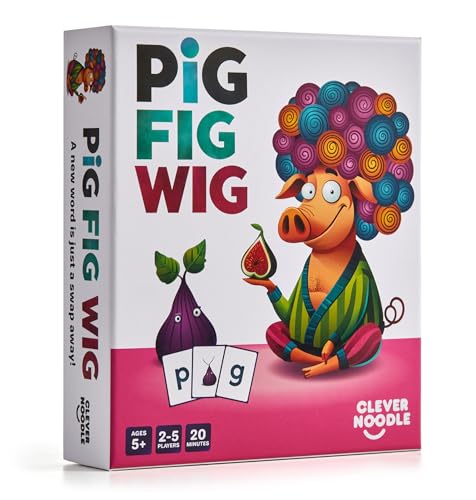
Clever Noodle Pig Fig Wig Fun Word Game
What We Like
- Teaches phonics through fast-paced play
- Change-one-sound mechanic builds word chains
- Multiple play levels for growing skills
- Compact card game for travel or classroom
Trade-offs
- Limited to 2+ players, not solo
- Requires reading ability for competitive play
Racing to change one sound at a time, pig to fig to fit, transforms what could be dry phonics practice into a lively competition. The first player to empty their hand wins, so every move is a blend of quick thinking and word-building skill. Reviewers note that the fast pace keeps even reluctant readers engaged, and the simple mechanic creates countless unique word chains, ensuring no two games feel the same. It is designed for ages five through twelve, with multiple play levels that let families start cooperatively and later shift to competitive rounds, making it a lasting addition to game night.
Pig Fig Wig isn’t a solo activity; you need at least two players, and younger kids who aren’t yet blending sounds will need an adult or older sibling to guide them. Compared to Bananagrams, which is purely about speed spelling with letter tiles, Pig Fig Wig focuses specifically on the ‘change one sound’ mechanic. If your goal is targeted phonics practice in a social setting, this card game offers that. Just don’t expect it to work as a quiet independent activity.
Lost Boy Entertainment Plunder A Pirate's Life
What We Like
- Unique map every game from 6 double-sided tiles
- No player elimination keeps everyone engaged
- Easy to learn with intuitive rules
- Supports 2-6 players plus team play
Trade-offs
- Heavy box at 6.3 pounds limits portability
- Playtime scales with player count up to 2 hours
- Large 12.8-inch board needs table space
Six double-sided ocean tiles combine into a different map every time you play, so no two games of Plunder A Pirate’s Life ever feel the same. That modular board is the engine behind its high replayability, you’ll keep discovering new island layouts and adjusting your strategy on the fly. It’s easy to learn, with thematic rules that let new players start commanding a fleet quickly, yet the shifting geography means veterans won’t get bored. The no-elimination rule keeps everyone in the fight until the final turn, which makes it a good choice for family game nights where nobody wants to sit out.
A strategy game that rewards repeated plays without ever repeating itself, Plunder A Pirate’s Life uses six double-sided ocean tiles to create a unique map configuration each time you play. Adventure awaits any swashbuckler brave enough to command a fleet, as you conquer islands to gain valuable resources and build or upgrade your ships with masts and cannons. Just be ready for longer sessions: with six players, the average playtime is 20 minutes per player, totaling about two hours of swashbuckling. The game accommodates 2 to 6 players with a team play option, and there is no player elimination, so every captain fights to the very end.
Product photos
ThinkPsych Rethink This! Flexible Thinking Card Game
What We Like
- Promotes cognitive flexibility and problem solving
- Created by a licensed clinical social worker
- Over 100 unique challenges for variety
- Fast-paced one-minute timer adds urgency
Trade-offs
- Requires at least 2 players, not solo
With over 100 unique challenges, this card game offers variety that directly supports the flexible thinking it targets: kids invent new uses for everyday objects and explain mysterious scenarios, all while racing a one-minute timer. Designed by a licensed clinical social worker who specializes in play-based interventions, it’s built for home, school, and counseling settings where social-emotional learning matters. For parents or therapists looking to stretch a child’s imagination and build problem-solving skills, this card game offers structured, repeatable fun that feels more like a party than a lesson.
The catch is that it demands at least two players, so it won’t help a solo kid on a rainy afternoon. And while the timer adds excitement, younger or anxious children might find the countdown stressful rather than motivating. If your goal is group play that builds flexible thinking and social-emotional skills, this card game earns its place in the guide.
Product photos
Ravensburger Rivers, Roads and Rails

What We Like
- Award-winning Parent's Choice Gold Seal design
- Supports 1-8 players for flexible groups
- 15-minute rounds fit busy schedules
- Builds associative skills and memory
Trade-offs
- Lightweight box at 0.0 lb feels insubstantial
- Tile-matching relies on luck, not pure strategy
With a 15-minute play time and support for up to eight players, Ravensburger Rivers, Roads and Rails fits neatly into family game night without dragging on. The beautifully illustrated tiles create a new transportation network each round, so kids practice associative thinking and memory as they match paths. It works for ages five and up, making it one of the more inclusive picks in this guide for mixed-age groups. The Parent’s Choice Gold Seal design backs up the educational angle, and the simple instructions mean you can jump in right away.
The award-winning design from Ravensburger, which earned the Parent’s Choice Gold Seal, means this game is recognized for quality. But the tile-matching system relies on luck of the draw, which can feel limiting for kids who prefer pure strategy games. The box is surprisingly light at 0.0 pounds, so it won’t feel substantial on the shelf. Still, for a quick game that builds cognitive skills without requiring reading or long setup, this is a good choice for families with young children.
Ravensburger Enchanted Forest

What We Like
- Engaging treasure hunt gameplay
- Enhances memory and puzzle-solving
- 30-minute playtime keeps kids focused
- Ages 4+ with room to grow
Trade-offs
- Limited to 2-6 players per session
- Not suitable for solo play
A 30-minute playtime means this game fits neatly into a family evening without dragging on, which is exactly what you want for young children whose attention spans are still developing. Designed for ages 4 and up and supporting 2 to 6 players, it grows with your child from preschool playdates to school-age game nights. The treasure hunt setup naturally encourages memory recall and puzzle-solving, making it a smart pick for parents who want screen-free fun that actually builds cognitive skills.
The main trade-off is the player count. If you regularly host larger groups, you’ll need to pair it with something like Jax SEQUENCE for Kids, which handles up to 4 players and adds a different kind of strategic thinking. At 1.1 pounds, the box is light and portable. Still, for its target age range and memory-boosting focus, Enchanted Forest delivers exactly what it promises without overcomplicating things.
Product photos
Bananagrams Classic Word Game

What We Like
- Portable banana-shaped pouch for travel
- Fast-paced spelling and anagram play
- Educational word building for kids
- Accommodates 1 to 8 players
Trade-offs
- Requires reading and spelling skills
- No reading-free option for pre-readers
The Bananagrams Classic Word Game packs 144 letter tiles into a banana-shaped pouch that weighs just 0.3 pounds, making it easy to toss into a bag for travel or family game night. Players race to build crossword grids from their own set of tiles, and the game accommodates 1 to 8 players ages 7 and up. It is a fast-paced spelling and anagram game that is both entertaining and educational, helping kids practice spelling while having fun. The compact pouch takes up little space compared to other board games, so it is great for on-the-go play.
Product photos
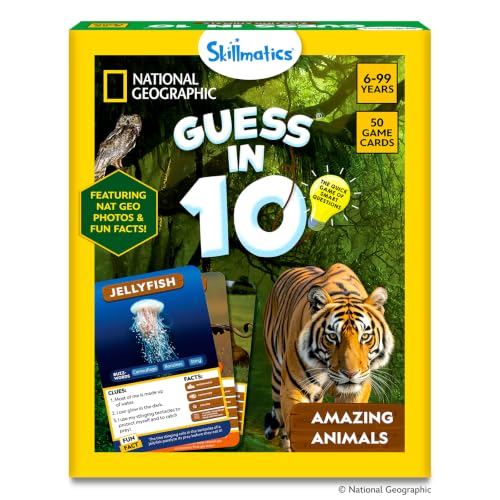
Skillmatics Guess in 10 National Geographic Animals
What We Like
- Encourages logical thinking and questioning
- Includes 50 animal cards with National Geographic facts
- Quick 20-minute rounds for repeat play
- Travel-friendly box for on-the-go fun
Trade-offs
- Requires at least 2 players, no solo option
Twenty minutes and a deck of 50 National Geographic animal cards is all it takes to turn a car ride or a rainy afternoon into a sharp guessing game. Each card challenges players to ask up to ten yes-or-no questions, ‘Is it a carnivore? Does it live in groups?’, before running out of clues. That question-asking process is where the cognitive work happens: kids learn to sort traits, eliminate options, and plan their next move. The clue cards add a thin layer of strategy, letting you hold back information or force a rival to guess early. For families who want a screen-free activity that builds communication and decision-making without feeling like homework, this hits the sweet spot.
Compared to a game like ThinkFun Rush Hour, which offers a different style of solo puzzle play, Guess in 10 relies more on social interaction than solo replayability. Still, for group settings, playdates, road trips, or family game night, the combination of trivia and strategy makes it a practical pick.
Product photos
How We Evaluated Card And Board Games For Cognitive Development
Our evaluation started with the mechanics of each game, the core action a player performs on their turn. We looked for games where the mental load is intentional, not accidental. A game that asks a child to plan three moves ahead develops different cognitive skills than one that rewards quick word recall.
We weighed four criteria most heavily. First, the specific cognitive skill targeted: memory, logic, flexible thinking, or planning. Second, age appropriateness and whether the game grows with the child. Third, replay value, a game played once teaches less than one played weekly. Fourth, the social dynamic: cooperative, competitive, or solo play all build different skills.
A research-led evaluation has limits. We did not playtest every game ourselves. Instead, we synthesized patterns from expert recommendations, manufacturer claims about cognitive targets, and what owners consistently report in their feedback. For more on how play supports learning, see our guide on toys for cognitive development.
What To Look For In Card And Board Games For Cognitive Development
Not every game labeled “educational” actually exercises a child’s thinking. The best games for cognitive development have a clear mental challenge at their core, match the child’s current abilities, and stay engaging long enough to build skill over time.
Focus on the specific cognitive skill you want to develop: memory, logic, planning, or flexible thinking. Then choose a game whose core mechanic directly exercises that skill at the right difficulty level for your child.
Match the Cognitive Skill to the Game’s Core Mechanic
A game’s primary action determines what it teaches. Memory games like Ravensburger Enchanted Forest reward recall of hidden locations. Logic games like ThinkFun Rush Hour require sequential planning. Word games like Bananagrams build vocabulary under time pressure. Strategy games like Jumbo Stratego Original teach hidden-information reasoning. Choose the skill first, then the game.
Consider Age and Reading Level
Many cognitive games assume a baseline reading ability. Jax SEQUENCE for Kids works for ages 3-6 with no reading required, making it accessible for pre-readers. Clever Noodle Pig Fig Wig requires comfort with letter sounds for ages 5-12. Bananagrams demands spelling skills for ages 7+. Check the age rating and reading requirement before buying. This is especially important for younger children or struggling readers.
Evaluate Replay Value and Group Size
A game played once teaches little. Lost Boy Entertainment Plunder A Pirate’s Life creates a unique map every game from six double-sided tiles, ensuring no two sessions are the same. ThinkFun Rush Hour offers 40 challenges from beginner to expert. Ravensburger Rivers, Roads and Rails supports 1-8 players with 15-minute rounds. Consider how often the game will be played and who will play it.
- Check the recommended age range and reading level before purchase.
- Look for games with multiple difficulty levels or expansion options.
- Consider the number of players, some games are solo only, others need a group.
- Read the box weight and dimensions if portability matters.
- Verify the average playtime fits your family’s schedule.
A game that matches a child’s current skill level and offers room to grow will be played far more often than one that is too easy or too hard on day one.
Card And Board Games For Cognitive Development Compared
The table below compares all ten games across the cognitive skills they target, player counts, age ranges, and key features so you can find the right fit at a glance.
| Product | Players | Age Range | Weight | Dimensions |
|---|---|---|---|---|
| Jax SEQUENCE for Kids | 2-4 | 3-6 years | 1.5 pounds | L 6.7 inches, W 10.5 inches, H 0.0 inches |
| ThinkFun Rush Hour Traffic Jam Logic Game | N/A | 8 to 80 | 0.8 pounds | L 9.2 inches, W 8.8 inches, H 0.1 inches |
| Jumbo Stratego Original | 2 | 8+ | 2.5 pounds | L 10.5 inches, W 3.0 inches, H 10.5 inches |
| Clever Noodle Pig Fig Wig Fun Word Game | 2+ (family) | 5-12 | 0.6 pounds | L 1.0 inches, W 2.0 inches, H 3.0 inches |
| Lost Boy Entertainment Plunder A Pirate's Life | 2-6 | N/A | 6.3 pounds | L 12.8 inches, W 12.8 inches, H 4.2 inches |
| ThinkPsych Rethink This! Flexible Thinking Card Game | 2+ | Ages 6+ | N/A | N/A |
| Ravensburger Rivers, Roads and Rails | 1-8 | 5+ | N/A | L 9.0 inches, W 2.2 inches, H 13.2 inches |
| Ravensburger Enchanted Forest | 2-6 | 4 and up | 1.1 pounds | L 14.8 inches, W 10.8 inches, H 2.2 inches |
| Bananagrams Classic Word Game | 1-8 | 7 years and up | 0.3 pounds | L 9.0 inches, W 3.0 inches, H 3.0 inches |
| Skillmatics Guess in 10 National Geographic Animals | 2 or more | 6 and up | 0.7 pounds | L 6.6 inches, W 5.7 inches, H 2.0 inches |
Frequently Asked Questions
What is the best board game for cognitive development for a 4-year-old?
Jax SEQUENCE for Kids is the best choice for ages 3-6. It requires no reading, uses visual matching to build logical thinking, and adapts the classic Sequence gameplay for young children. The simple match-and-place mechanic keeps short attention spans engaged.
Are there board games that improve memory in children?
Yes. Ravensburger Enchanted Forest is designed specifically for memory enhancement through treasure hunt gameplay. It also builds puzzle-solving skills in 30-minute sessions for ages 4 and up. For more options, see our guide on memory games.
What is a good two-player strategy game for kids?
Jumbo Stratego Original is the classic two-player battle strategy game for ages 8 and up. It teaches hidden-information reasoning and forward planning. The included sorting trays and screen keep the game organized and fair.
Can board games help with flexible thinking?
ThinkPsych Rethink This! Flexible Thinking Card Game is built specifically for cognitive flexibility and problem-solving. Created by a licensed clinical social worker, it offers over 100 unique challenges with a one-minute timer that adds urgency and builds adaptability.
What is the most replayable board game for families?
Lost Boy Entertainment Plunder A Pirate’s Life offers the highest replay value with a unique map generated from six double-sided tiles every game. It supports 2-6 players, has no player elimination, and playtime scales up to two hours. For more family-friendly options, check out our list of family strategy games.
The Bottom Line
For most families, Jax SEQUENCE for Kids is the best overall choice for building logical thinking in children ages 3-6 without requiring reading skills. It is simple to learn, quick to play, and directly exercises matching and planning skills through a format young children can grasp immediately.
If your child prefers solo problem-solving, ThinkFun Rush Hour Traffic Jam Logic Game offers 40 escalating challenges that build planning and reasoning skills. For families with older children who love head-to-head strategy, Jumbo Stratego Original delivers classic hidden-information gameplay that rewards careful thinking.
The single most important factor is matching the game’s cognitive demand to your child’s current abilities. A game that is too simple bores, one too complex frustrates. Choose the skill you want to develop first, then find the game that exercises it at the right level. For more ideas, browse our full selection of educational board games.
