
Types of Toys for Preschoolers: The Two That Won
This post contains affiliate links. As an Amazon Associate, we earn from qualifying purchases.
The main types of toys for preschoolers fall into four groups: open-ended construction toys, replica play toys, puzzles and board games, and pretend props. Safety comes first: any item a mouthing child can reach needs at least 1 1/4 inches in diameter and 1 to 2 1/4 inches long.
Those four groups map onto four different jobs. Construction toys build spatial reasoning, replica play toys drive conversation, and educational toys for preschoolers like puzzles and board games teach turn-taking and rules.
What follows covers the categories that held up across ten years of preschool research, the sizing numbers that decide whether a toy is safe in your house, and the buying habit that quietly wastes more money than any other.
Key Takeaways
- Open-ended construction toys and replica play toys produced high-quality play in every year of a ten-year preschool study.
- Anything a child under three can reach needs at least 1 1/4 inches in diameter and 1 to 2 1/4 inches in length.
- Puzzle piece counts disagree between NAEYC and Seattle Children’s for the same age band, so treat any single number as a starting point.
- Toys labeled for older kids get used less fully, and how much depends on the toy category and the child’s age.
- Sources disagree on toys that play for your child. TIMPANI found a talking doll and a sound-making cash register produced less imaginative play than their silent versions, while NAEYC permits electronic toys such as CD and DVD players, interactive computer programs, and simple apps or hand-held games.
What Are the Main Types of Toys for Preschoolers?
Four categories cover the whole list of best toys for preschoolers for this age band. Blocks and building sets, replica play pieces like small animals and vehicles, puzzles and board games, and pretend props such as dress-up clothes and play food.
The U.S. Consumer Product Safety Commission sorts toys into five age bands: young infants, older infants, 1-year-olds, 2-year-olds, and preschoolers at ages 3, 4, and 5. Those characteristics shift in importance as a child grows.
That structure matters when you shop for types of toys for preschoolers, because the label on the box is written for the youngest child the maker is willing to accept. It says nothing about the kid standing in front of you.
| Toy Category | What It Does Best | Skip It If |
|---|---|---|
| Open-ended construction | Builds spatial reasoning and shared planning | The set builds only one model |
| Replica play | Drives conversation and cooperative stories | Pieces are too small for the label |
| Puzzles and board games | Teaches rules, turn-taking, problem-solving | Piece count is far above the child’s band |
| Pretend props | Lets a child act out adult roles | The prop does the talking for the child |
Ten Years of Research, One Consistent Answer
Ten years. More than a hundred toys. One finding kept repeating.
The TIMPANI Toy Study at Eastern Connecticut State University investigated more than a hundred toys over a ten-year period, and the highest-scoring toys were consistently the simple ones. A plain wooden cash register led children into long buying-and-selling conversations. A plastic register that made noise when buttons were pushed mostly led children to push the buttons again.
A plastic register that produced sounds mostly inspired repeated button pushing. A wooden one inspired lots of buying-and-selling conversation, and the quiet is where the talking happens.
That pattern held for dolls too. A talking doll produced less imaginative play than a plain doll the child had to speak for.
The boxes became a store, then a house, then something I never did figure out. I stopped shopping by battery count after that.
The Two Categories That Won Every Year
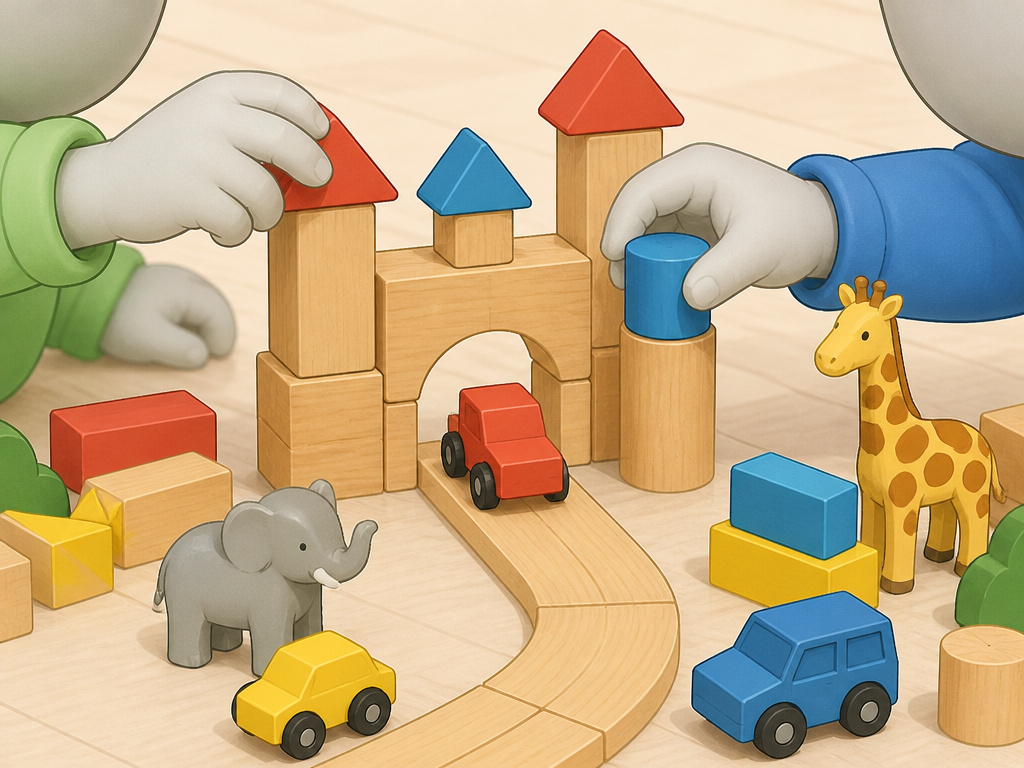
Jeffrey Trawick-Smith, who led the TIMPANI study, names construction toys and replica play toys as the two most powerful categories for preschoolers. Both held up across all ten years.
Construction Toys: What Open-Ended Actually Means
“Open-ended” gets used loosely, so here is the operational version. The best construction toys are not kits for building one specific model. They come with enough pieces that a child can build many different things, and the pieces stay plain enough to become something else.
Children in the study used plain hardwood blocks as houses, zoo enclosures, castles, and roads. They also pretended individual blocks were phones, cars, and sandwiches. That flexibility is the whole mechanism behind interactive toys for preschoolers: the toy hands the child a decision, and the decision is what holds attention.
Small people, animals, and vehicles are the workhorses on the replica side.
Replica Play Toys and the Realism Argument
Replica play toys are the small people, animals, and vehicles. TIMPANI found these did well over multiple years, producing elaborate make-believe scenarios, rich conversation, and cooperative play. A set of construction vehicles, much like the best outdoor toys for preschoolers, got kids learning and acting out what a bulldozer, a front loader, and a steam roller each do.
Replica pieces come with built-in roles, so two kids can agree on who is the driver without negotiating from scratch.
The sources genuinely disagree on one point, and it’s worth knowing rather than settling. TIMPANI ranks non-realistic toys as especially powerful, because a plain brick forces a child to decide what it is and then explain that decision to a playmate, while Seattle Children’s and NAEYC both list realistic replica play as core preschool material. Seattle Children’s and the NAEYC good toys by age guide both list realistic replica play as core preschool material, including toys that mimic adult tools like a vacuum, a shopping cart, and a small wheelbarrow.
Both positions have support. TIMPANI’s own text concedes replica play toys also did well, so the two camps aren’t fully opposed. They just weight realism in opposite directions.
If a toy has only one way to play with it, it’s a novelty. Open-ended pieces hold attention far longer.
How Many Puzzle Pieces Should a 4-Year-Old Have?
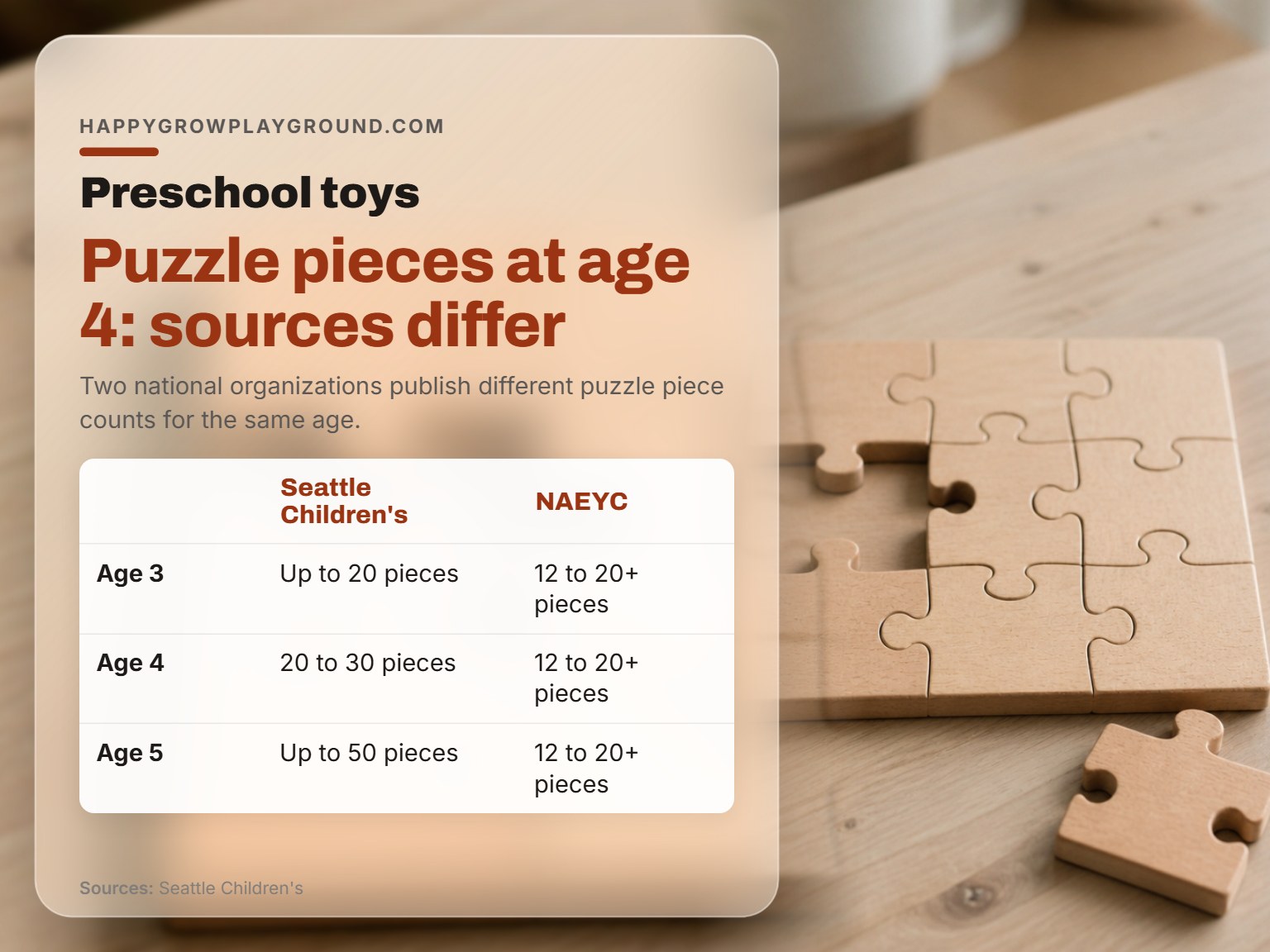
Two national organizations publish puzzle piece counts for the same age band, and the numbers don’t line up.
NAEYC puts puzzles for 3- to 6-year-olds at 12 to 20+ pieces. Seattle Children’s breaks it down by year: up to 20 pieces at age 3, 20 to 30 at age 4, and up to 50 at age 5.
| Age | Seattle Children’s | NAEYC |
|---|---|---|
| 3 | Up to 20 pieces | 12 to 20+ pieces |
| 4 | 20 to 30 pieces | 12 to 20+ pieces |
| 5 | Up to 50 pieces | 12 to 20+ pieces |
The gap is a signal. Piece count tracks fine-motor control and frustration tolerance, and those vary more between two kids the same age than between a 4-year-old and a 5-year-old. NAEYC makes the point directly: items on one list, as long as they’re safe, can be good choices for children younger and older than the suggested range.
Puzzles and board games earn their place for a different reason than blocks do. TIMPANI found they teach children to solve specific problems, follow rules, and take turns, which is a narrower job than open-ended building but a necessary one.
The Sizing Numbers That Decide Whether a Toy Is Safe
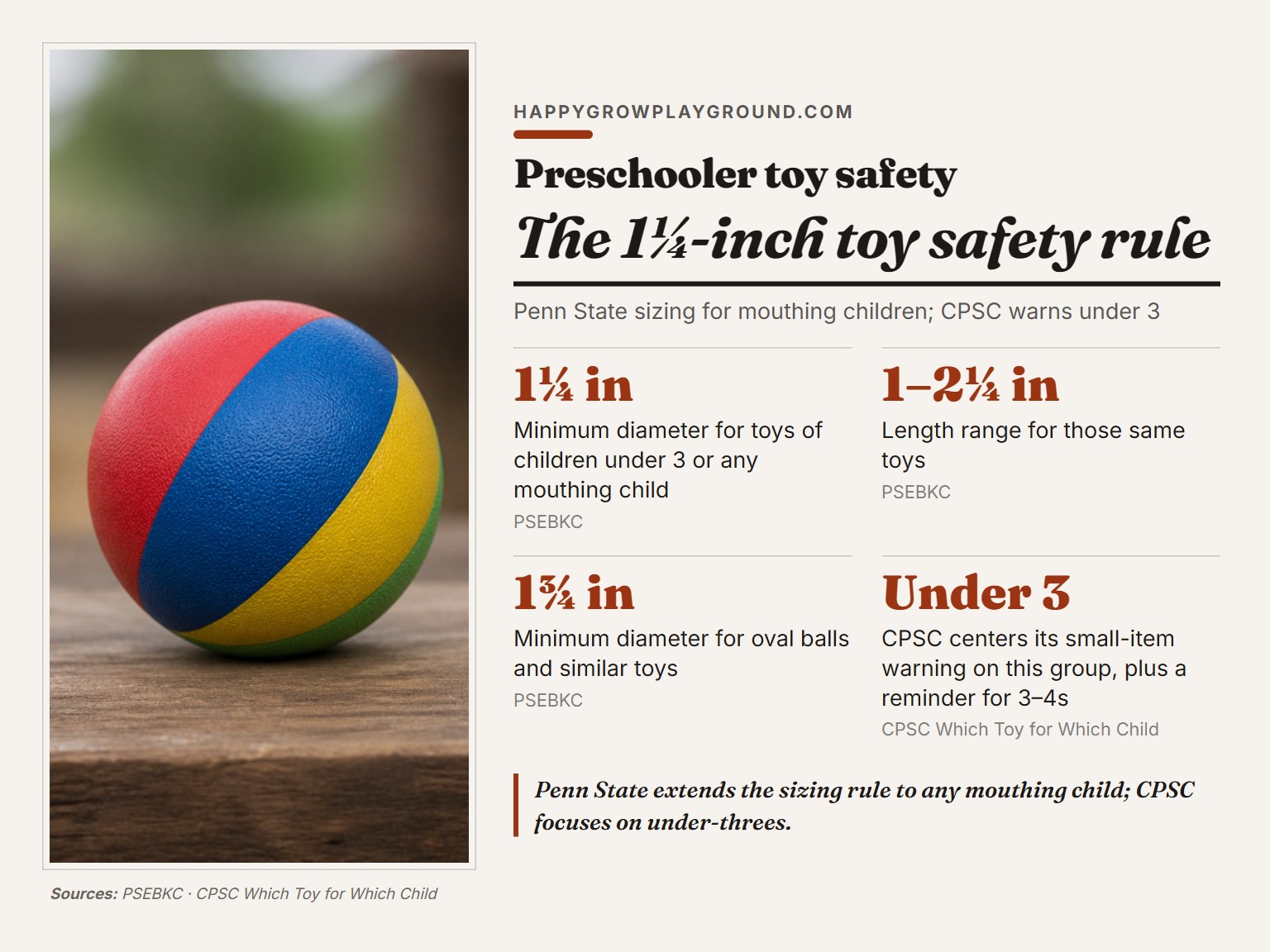
One number decides most of it.
That number is 1 1/4 inches. Penn State Extension’s Better Kid Care program says items for children under three, and for any child who puts toys in their mouth, should be at least 1 1/4 inches in diameter and between 1 and 2 1/4 inches in length. Oval balls and similar toys should be at least 1 3/4 inches in diameter.
Before you start: Look at every toy in the room, not just the ones labeled for your preschooler. A sibling’s building set with tiny pieces is a risk your kid will find, and an easily removable button battery is the one item worth confiscating on sight. Button batteries are a medical emergency when swallowed, not a wait-and-see.
The 1 1/4-Inch Rule and Who It Covers
The rule is easy to remember and easy to misapply, because it isn’t only about age. Penn State applies it to any child who mouths toys, not just the under-three crowd, while the CPSC centers its warning on under-threes and adds a verbal reminder for 3- and 4-year-olds rather than a hard size rule.
The CPSC birth through five toy guide takes a related but slightly different line: keep all small items away from children who mouth objects, especially those under three, and remind 3- and 4-year-olds to keep such items out of their mouths.
So the two sources overlap but don’t match. Penn State extends the sizing rule to any mouthing child at any age. The CPSC centers the warning on under-threes and adds a verbal reminder for 3- and 4-year-olds rather than a hard size rule.
The Small Parts Regulation, 16 C.F.R. §1501, is cited in the research on toy safety.
Button Batteries and High-Powered Magnets
Seattle Children’s is blunt about batteries: don’t let children play with toys that have miniature disk or button batteries that can be removed easily.
NAEYC’s advice is to check toys often, because normal use can turn a safe toy into a hazardous one.
Frequently Asked Questions
How do I know if a toy is too advanced for my preschooler?
Watch how much of the toy your child actually uses. A toy labeled for older kids tends to get used less fully, and the gap depends on the category and the child’s age. If your child ignores half the pieces or asks you to do the hard parts every time, the toy is above their band. Put it away for a few months rather than pushing through frustration.
Should I buy toys that light up, talk, or play music?
Sources do not agree, so treat this as a judgment call rather than a rule. One study found that a talking doll and a sound-making cash register produced less imaginative play than their silent versions. Other guidance permits electronic items such as simple apps and hand-held games. A reasonable middle path is to keep electronic toys in the minority and watch whether your child’s play gets richer or thinner.
Why do puzzle piece counts differ between experts for the same age?
Because the numbers are starting points, not standards. NAEYC and Seattle Children’s disagree on piece counts for the same age band. The variation reflects that children develop at different rates and that piece size, image complexity, and knob style matter as much as the count. Start below the published number and move up when your child finishes a puzzle without help.
Is it worth buying a set that builds only one model?
Usually not, if you want the toy to last. Open-ended construction toys earn their place by supporting shared planning and spatial reasoning across many sessions. A single-model kit runs out of new problems once the model is built. Sets that allow many different builds keep giving your child something to figure out.
