
10 Best Educational Toys For Preschoolers in 2026
This post contains affiliate links. As an Amazon Associate, we earn from qualifying purchases.
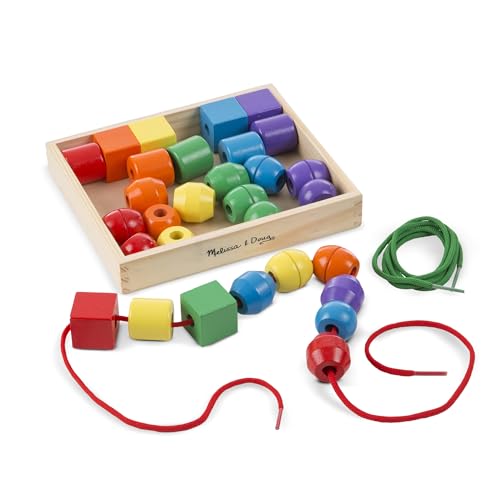
The best educational toy for preschoolers is the LeapFrog 2-in-1 LeapTop Touch, which wins because it adapts to a child’s growing skills. It offers five learning modes and a clever 2-in-1 design that flips from keyboard to tablet, so kids can switch between typing and touchscreen play. For building writing skills, the LeapFrog Mr Pencil’s Scribble Write and Read earns the award for Best For Writing Skills, while the Melissa & Doug Primary Lacing Beads earn the award for best fine motor skills.
A preschooler’s brain is a sponge, but the wrong toy gets ignored after five minutes. The real challenge is finding something that holds their attention long enough to teach letters, numbers, or problem-solving without feeling like homework. You need toys that match their developmental stage and play style.
This guide is based on manufacturer specifications, expert round-ups, and patterns in owner feedback. We focused on durability, skill-building value, and whether kids actually want to pick them up again tomorrow. Our 10 picks cover everything from electronic learning toys to classic wooden puzzles.
Top 10 Educational Toys For Preschoolers in the Market
Certain content that appears on this site comes from Amazon. This content is provided "as is" and is subject to change or removal at any time.
The Best Educational Toys For Preschoolers, Reviewed
LeapFrog 2-in-1 LeapTop Touch

What We Like
- 2-in-1 keyboard and tablet modes
- Customizable name spelling for child
- Five learning modes cover ABCs through music
- Familiar laptop design encourages pretend play
Trade-offs
- Demo batteries included; new ones needed for regular use
- Screen flips but is not a real touchscreen
The 2-in-1 keyboard-to-tablet flip means your preschooler gets two ways to play with letters, numbers, and music in one sturdy package. Kids can pretend to be like mom and dad with role-play activities like e-mailing Scout, and parents can customize the name spelling activity. The five learning modes cover ABCs, numbers, games, music, and messages, keeping things fresh without overwhelming a young mind. The familiar laptop shape makes role-play feel real.
The 2-in-1 design lets the screen flip from a keyboard to a tablet mode, so kids can switch between typing and tapping as they play. The keyboard covers letters A-Z and numbers 1-10, and the tablet mode works with touch, though some children may need a moment to adjust to the response. Five learning modes cover ABCs, numbers, games, music, and messages, which gives a preschooler plenty of variety without overwhelming them.
LeapFrog Mr Pencil's Scribble Write and Read

What We Like
- Teaches uppercase and lowercase letter writing
- Turns letters into animated animals
- Custom name practice for first, middle, last
- Sound-it-out bar lights up as you slide
Trade-offs
- Demo batteries included; new ones needed for regular use
- Screen size limits writing space for longer words
The step-by-step letter tracing with animated rewards means a child sees their scribbles turn into a hopping frog or a waddling penguin. That instant feedback keeps little fingers engaged far longer than a dry erase board ever could. At under a pound and with a compact 7.7-inch width, it fits easily on a lap or a small desk, and the ability to enter a child’s full name turns a generic toy into something personal. For a preschooler just starting to connect sounds to symbols, this is the tool that makes the connection stick without feeling like homework.
The trade-off is the screen size: longer words or sentences will need scrolling, which can interrupt the flow for a child who wants to write their whole name at once. Compared to other writing toys, the LeapFrog focuses on letter formation and phonics, making it a structured tutor rather than a free-draw canvas. That focus is ideal for building writing skills, but if your child craves open-ended doodling, a different toy might suit them better.
Melissa & Doug Primary Lacing Beads
What We Like
- 30 colorful wooden beads for sorting
- 2 laces included for threading play
- Wooden storage case keeps pieces tidy
- Builds hand-eye coordination and fine motor skills
Trade-offs
- Only 5 shapes limit variety for advanced sorters
- Storage case is small for extra beads
Thirty painted wooden beads in five distinct shapes give little hands plenty of practice grasping and threading, exactly the kind of hands-on work that builds fine motor control and hand-eye coordination. This set is ideal for preschoolers who are ready to move beyond simple stacking and into more deliberate, focused play. The included wooden storage case keeps everything organized, so you’re not hunting for beads under the couch after every session. It’s a straightforward, screen-free activity that rewards patience and precision.
The beads are small, which makes them good for little fingers, but it also means they’re not suitable for children still mouthing objects. Compared to a laptop-shaped learning toy with a keyboard and screen, this set is purely hands-on and relies on your child’s own motivation to keep threading. If your preschooler needs more variety or electronic features to stay engaged, the electronic laptop might hold their attention longer. But for building the foundational dexterity that writing and self-care tasks require, this bead set delivers exactly what it promises.
VTech Write and Learn Creative Center
What We Like
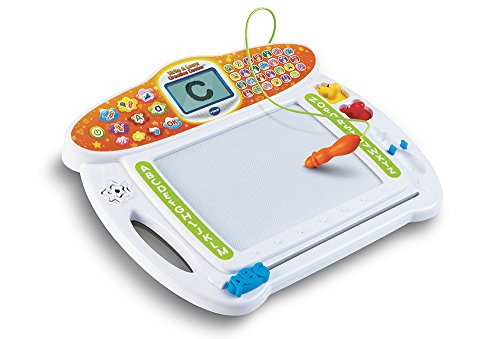
- Animated stroke-order demonstrations for letters
- Teaches name writing step by step
- Includes stencil for 26 objects
Trade-offs
- Demo batteries only; fresh AA needed immediately
- Magnetic board limits drawing to one color
- No sound or feedback for free drawing
The animated demonstrations that show proper stroke order for both uppercase and lowercase letters make this more than just a doodle pad, it’s a guided handwriting tutor for preschoolers. At 12.1 inches wide and weighing just 1.8 pounds, it’s light enough to toss in a diaper bag for restaurant waits or road trips. The step-by-step name-writing feature personalizes the learning, which keeps kids engaged longer than generic tracing sheets. For a three-year-old just starting to hold a stylus, the magnetic board offers forgiving resistance that builds fine motor control without the frustration of paper and pencil.
The VTech Write and Learn Creative Center uses a magnetic drawing board to teach letter formation through repetition and clear visual guidance, making it a screen-free option for parents who want to avoid digital distractions. At 1.8 pounds, it’s heavier than the LeapFrog Mr Pencil’s Scribble Write and Read (0.9 pounds), which offers sound effects and a backlit display but lacks a stencil for drawing objects. This VTech model includes a stencil toy that progresses from simple lines to 26 different objects, giving kids a structured way to explore drawing without flashy animations.
VTech Race and Discover Driver

What We Like
- Turn signals, horn, gear shift
- Counting, spelling, problem-solving games
- Three racetracks with hazards
Trade-offs
- At 2.0 pounds, heavier than some portable toys
- Screen-based play offers less hands-on tactile experience
The colorful game screen and interactive dashboard, complete with turn signals, horn, gear shift, and buttons for calls, maps, and traffic reports, turn pretend play into a mini simulation. That simulation builds counting, spelling, and problem-solving skills at each destination. For a child who loves vehicles and role-play, this is the kind of toy that makes learning feel like an adventure, not a lesson.
A child who wants the full driver-seat experience will find plenty to engage with here. The toy includes a colorful game screen and working turn signals, a horn, and a gear shift. High-tech dashboard buttons let kids pretend to take calls, check maps, and hear traffic reports on the radio. Counting, spelling, and problem-solving games appear at destinations around town, building preschool skills with every turn. Three exciting racetracks challenge young drivers to avoid hazards and race to first place to level up. The set measures about 13.4 inches wide and weighs 2.0 pounds, so it stays steady on a table or floor during play.
Melissa & Doug Self-Correcting Alphabet Wooden Puzzles
What We Like
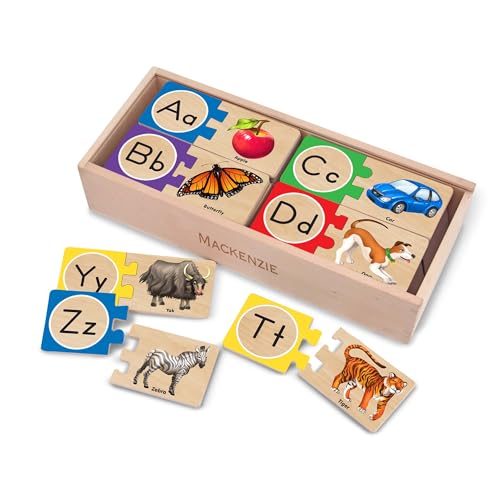
- Self-correcting pieces build confidence
- Includes storage box for portability
- Supports letter recognition and fine motor skills
- Screen-free, open-ended play
Trade-offs
- At 2 pounds, heavier than some travel toys
With 52 self-correcting wooden pieces that only fit their matching match, this puzzle turns alphabet practice into a hands-on discovery game. Each piece pairs a capital or lowercase letter with a labeled image, so kids can test, try again, and build confidence through trial and error. The included storage box keeps everything portable, making it easy to take learning on the go. It’s ideal for preschoolers who need tactile, screen-free play that supports letter recognition, vocabulary, fine motor control, and problem-solving through repeated matching and sorting.
At 2 pounds, it’s heavier than some other learning toys, so it’s less suited for tossing in a diaper bag. But for a sturdy, durable puzzle that encourages independent discovery and can be used again and again, the weight reflects the quality of the wood and the storage case. If your child is just starting with letters, the 52 pieces might feel like a lot at first, but the self-correcting design means they can work through it at their own pace without frustration.
Product photos
NASHRIO Magnetic Wooden Fishing Game
What We Like
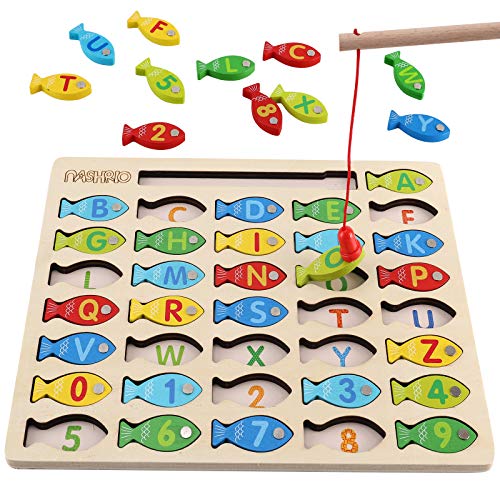
- Eco-friendly non-toxic water-based paint
- Teaches letters, numbers, and colors
- Smooth edges for safe play
- Develops hand-eye coordination and problem-solving
Trade-offs
- Single pole means only one child can play at a time
- Small board limits play area for multiple kids
A wooden board packed with colorful fish pieces printed with letters and numbers means your preschooler gets to practice ABCs and counting while physically catching each fish with a magnetic pole. That combination of cognitive and motor challenge is exactly what makes this more than a simple puzzle, it builds hand-eye coordination, fine motor control, and early academic recognition all in one game. For a three- to five-year-old who’s just starting to show interest in letters and numbers, this is a gentle, engaging way to turn play into learning without any screens involved.
The board is 0.6 inches thick, which is slim enough to store easily but means it may shift on a smooth surface during play. Compared to an electronic laptop toy that offers audio feedback and multiple activities, this wooden set is quieter and more tactile but lacks the interactive sounds that some kids crave. Best for families who want a screen-free, hands-on toy that sneaks in letter and number recognition during active play, not ideal for children who need audio encouragement to stay engaged.
Product photos
NASHRIO Wooden Puzzles 3-Pack ABC Number Shape
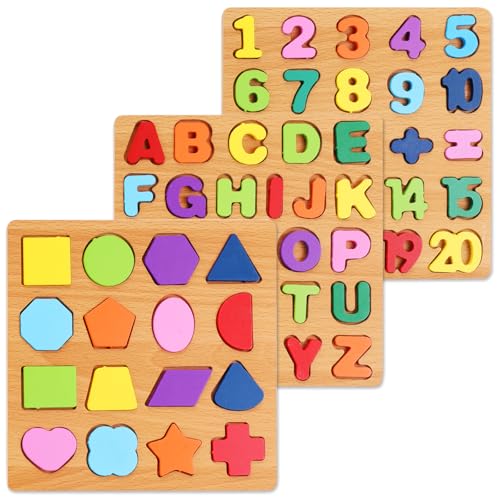
What We Like
- Three puzzles in one set
- Self-correcting design builds logic
- Smooth, splinter-free wooden pieces
- Colorful matching illustrations for engagement
Trade-offs
- Thin 0.4-inch boards feel less substantial than thicker puzzles
- No built-in storage for loose pieces
Three separate wooden puzzle boards covering ABCs, numbers, and shapes give you a lot of learning ground for a single purchase. The self-correcting cutouts mean kids can figure out mismatches on their own, which builds logic and concentration without constant adult help. For a family on a budget who wants a sturdy, screen-free option that covers multiple early skills, this set delivers real mileage.
The self-correcting cutouts on these three separate boards, covering ABCs, numbers, and shapes, let kids figure out mismatches on their own, building logic and concentration without constant adult help. For a family on a budget who wants a sturdy, screen-free option that covers multiple early skills, this set delivers real mileage. The boards are only 0.4 inches thick, so they won’t feel as chunky as thicker wooden puzzles, and you’ll need to provide your own storage for the pieces. Compared to the Melissa & Doug Self-Correcting Alphabet Wooden Puzzles, which is a single alphabet puzzle, the Nashrio set offers more variety across three subjects but focuses on breadth rather than depth in one area.
Product photos
Oomloid Counting Animals Montessori Toys

What We Like
- 36 multi-colored animals for sorting
- 6 rainbow bowls for color matching
- 2 tweezers develop fine motor skills
- Storage bucket for easy cleanup
Trade-offs
- No number or letter recognition built in
- Small pieces pose choking hazard for under 3
With 36 animal pieces, 6 sorting bowls, and 2 tweezers, this set gives you a hands-on way to introduce counting, color matching, and grouping. That makes it a natural pick for building early math confidence. It suits preschoolers who learn best by touching and moving things, and the tweezers require careful hand control, which helps strengthen fine motor skills.
This set focuses entirely on sorting and counting, with no alphabet or letter recognition included. If you want a single toy that covers both numbers and letters, the Melissa & Doug Self-Correcting Alphabet Wooden Puzzles might be a better fit. But for a dedicated early math tool that’s easy to store and clean up, this one delivers exactly what it promises.
Product photos
MUONE Montessori Busy Book Color Sorting Toys
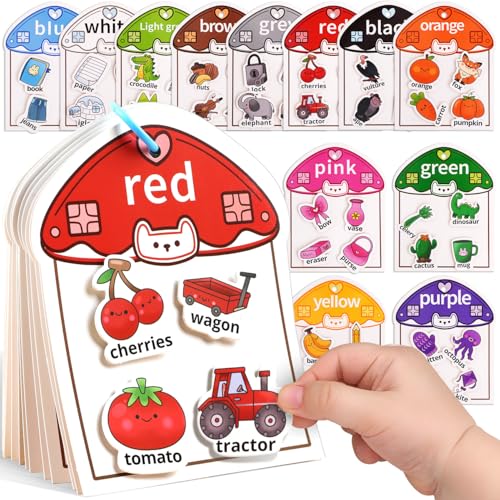
What We Like
- Teaches 12 colors with 48 stickers
- Hook-and-loop fastener for easy matching
- Thick, tear-resistant cardboard construction
- Rounded safety corners and smooth edges
Trade-offs
- Limited to color matching only
- No numbers or letters for early math or literacy
With 48 matching stickers across 12 colors, this busy book turns color recognition into a hands-on game that builds fine motor skills and vocabulary at the same time. The thick, tear-resistant cardboard and rounded corners mean it can survive the enthusiastic handling of a 2-4 year old without falling apart or causing owies. Parents looking for a focused, mess-free way to teach colors and pre-reading basics will find this a tidy alternative to bins of loose pieces that scatter everywhere.
This is a single-skill tool that excels at color sorting but doesn’t offer the broader range of activities you get from something like an electronic laptop toy. The slim 0.3-inch profile makes it easy to store in a drawer or tote, though it’s best placed on a flat surface for matching play. For a dedicated color-matching activity that’s portable and durable, it’s a smart pick.
Product photos
How We Evaluated Educational Toys For Preschoolers
We started by looking at what each toy actually teaches. Manufacturer documentation told us the learning modes, age ranges, and skill targets. We cross-referenced those claims against patterns in owner feedback to see which toys truly delivered on their promises. A toy that claims to teach letter formation but gets poor marks from parents for confusing instructions didn’t make the cut.
Four criteria mattered most. First, skill alignment: does the toy teach something a preschooler is developmentally ready to learn? Second, engagement: will a three-to-five-year-old return to it after the first play session? Third, durability: can it survive drops, throws, and the occasional tantrum? Fourth, value: does the toy offer enough variety or replayability to justify its place in your home?
An evaluation like this has limits. Individual children vary widely in what they find engaging. What we can do is synthesize feedback to point you toward the options most likely to succeed in your home.
What To Look For In Educational Toys For Preschoolers
The best educational toys for preschoolers do one thing well: they teach a specific skill through play that a child actually wants to repeat. Look for toys that match your child’s current abilities while offering just enough challenge to keep them growing.
The right toy meets your child where they are developmentally, teaches a real skill, and survives the enthusiasm of a three-to-five-year-old.
Skill Alignment With Developmental Stage
A toy that teaches algebra is useless to a four-year-old. The best toys for preschoolers target skills they are ready to learn: letter recognition, counting to ten, color sorting, fine motor control, and basic problem-solving. The LeapFrog 2-in-1 LeapTop Touch, for example, teaches name spelling and ABCs through five learning modes that grow with the child. The Melissa & Doug Primary Lacing Beads build hand-eye coordination through threading, which is exactly the kind of fine motor work a three-to-five-year-old needs.
Engagement and Replay Value
A toy that gets played with once and abandoned is not educational, no matter what the box says. Look for toys that offer variety or open-ended play. The VTech Race and Discover Driver keeps kids coming back with three racetracks, hazards, and multiple game modes. The NASHRIO Magnetic Wooden Fishing Game offers a different arrangement of fish each time. If a toy has only one way to play, it needs to be a very compelling way.
Durability and Safety
Preschoolers are not gentle. Toys need to survive drops from table height, being thrown across the room, and the occasional stomp. Wooden toys like the Melissa & Doug Self-Correcting Alphabet Wooden Puzzles and the NASHRIO Wooden Puzzles 3-Pack are built to last. Electronic toys should have sturdy casings and recessed buttons. Always check for small parts that could pose a choking hazard for children under three, and look for non-toxic finishes on painted toys.
- Check for small parts that could break off or be swallowed
- Look for rounded edges and smooth surfaces on wooden toys
- Confirm batteries are securely enclosed with a screw-on compartment
- Verify the toy is age-rated for your child’s specific age, not just “3+”
- Read owner feedback about durability before buying
If a toy cannot survive a preschooler’s enthusiasm, it cannot teach them anything.
Educational Toys For Preschoolers Compared
The table below compares all 10 educational toys for preschoolers side by side, showing their primary skill focus, best-use scenario, and key trade-offs at a glance.
| Product | Age Range | Dimensions | Weight |
|---|---|---|---|
| LeapFrog 2-in-1 LeapTop Touch | 2-5 years | 2.0 x 10.1 x 6.0 inches | 1.3 pounds |
| LeapFrog Mr Pencil's Scribble Write and Read | 3+ years | 2.0 x 7.7 x 8.6 inches | 0.9 pounds |
| Melissa & Doug Primary Lacing Beads | Ages 3+ | 8.8 x 7.3 x 1.3 inches | 1.3 pounds |
| VTech Write and Learn Creative Center | 3 to 6 years | 12.1 x 14.4 x 2.8 in | 1.8 lb |
| VTech Race and Discover Driver | 3-6 years | 9.7 x 13.4 x 5.4 inches | 2.0 pounds |
| Melissa & Doug Self-Correcting Alphabet Wooden Puzzles | Ages 4+ | 13.0 x 6.0 x 3.0 inches | 2.0 pounds |
| NASHRIO Magnetic Wooden Fishing Game | 3+ years | 11.8 x 8.9 x 0.6 inches | N/A |
| NASHRIO Wooden Puzzles 3-Pack ABC Number Shape | Ages 3-5 | 11.7 x 11.7 x 0.4 inches | N/A |
| Oomloid Counting Animals Montessori Toys | 3-5, 4-8 years | 5.9 x 3.1 x 3.1 inches | N/A |
| MUONE Montessori Busy Book Color Sorting Toys | 2-4 years | 7.7 x 6.2 x 0.3 in | 0.5 pounds |
Frequently Asked Questions
What is the best educational toy for a 3-year-old?
For a three-year-old, focus on toys that build fine motor skills and basic recognition. The Melissa & Doug Primary Lacing Beads are excellent for hand-eye coordination, while the MUONE Montessori Busy Book teaches color matching through a simple, repeatable activity. Avoid toys that require letter formation or reading at this age.
How do I choose an educational toy for my preschooler?
Start by identifying the skill you want to develop. For literacy, choose toys like the LeapFrog Mr Pencil’s Scribble Write and Read. For math, the Oomloid Counting Animals Montessori Toys are a strong choice. Match the toy’s difficulty to your child’s current ability, and prioritize toys with replay value. Our guide on choosing educational toys goes deeper into the decision process.
Are electronic or non-electronic toys better for preschoolers?
Both have their place. Electronic toys like the LeapFrog 2-in-1 LeapTop Touch provide audio feedback and structured learning paths that can hold attention longer. Non-electronic toys like wooden puzzles and lacing beads build fine motor skills without screen time. The best approach is a mix of both, depending on what skill you want to target.
What skills should an educational toy for a 4-year-old teach?
A four-year-old should be working on letter recognition, counting to 20, name writing, color sorting, and basic problem-solving. The educational toys we recommend for 4-year-olds target exactly these skills. The LeapFrog 2-in-1 LeapTop Touch covers letters, numbers, and music, while the VTech Write and Learn Creative Center focuses on name writing and stroke order.
How many toys does a preschooler need for effective learning?
Quality matters far more than quantity. Three to five well-chosen toys that target different skills are more effective than a room full of toys that all do the same thing. Rotating toys every few weeks also keeps interest high. Focus on one literacy toy, one math toy, one fine motor toy, and one creative toy to cover the bases.
The Bottom Line
The LeapFrog 2-in-1 LeapTop Touch is our best overall pick for most families because it grows with your child and covers multiple skills in one durable package. If your preschooler needs help with handwriting, the LeapFrog Mr Pencil’s Scribble Write and Read offers structured guidance that actually works. For families on a budget, the NASHRIO Wooden Puzzles 3-Pack delivers three skills in one affordable set.
The single most important factor in choosing an educational toy is whether your child will actually play with it. A perfectly designed toy that sits on a shelf teaches nothing. Match the toy to your child’s interests first, and the learning will follow naturally.
