
10 Best Stem Toys For Preschoolers in 2026
This post contains affiliate links. As an Amazon Associate, we earn from qualifying purchases.
The best STEM toy for preschoolers is the iPlay iLearn Rocket Space Toy, which combines interactive building with an electric drill, detachable stages, and immersive lights and sounds. For families who prefer hands-on science, the Doctor Jupiter Preschool Science Kit offers over 100 experiments, while the Educational Insights Design & Drill ABCs & 123s builds early literacy and fine motor skills.
A preschooler’s brain is wired for cause and effect, pattern recognition, and sensory exploration, exactly what a good STEM toy delivers. The challenge is finding a set that matches their attention span, safety needs, and your tolerance for setup and cleanup.
This guide is research-based, drawing on manufacturer specifications, expert round-ups, and patterns in owner feedback. We organized ten top-rated picks by play style so you can match the right toy to your child’s interests.
Top 10 STEM Toys For Preschoolers in the Market


Certain content that appears on this site comes from Amazon. This content is provided "as is" and is subject to change or removal at any time.
The Best STEM Toys For Preschoolers, Reviewed
iPlay iLearn Rocket Space Toy

What We Like
- Interactive building with electric drill
- Detachable stages and command module
- Lights and sounds for immersive play
- Promotes STEM learning through assembly
Trade-offs
- Electric drill requires batteries (not included)
- 14.5-inch height can tip over during energetic play
A 14.5-inch rocket with detachable stages, boosters, and a command module means this isn’t just a static toy, it’s a build-and-rebuild project that doubles as a playset. The included electric drill lets children assemble the rocket themselves, which supports hand-eye coordination and problem-solving in a way that feels like real work, not a worksheet. That hands-on assembly, combined with interactive lights and sounds, makes it a strong candidate for the child who wants to feel like they’re actually launching a mission, not just pushing a button. It suits families looking for a STEM toy that blends construction with open-ended pretend play, especially for kids who already enjoy building with blocks or tools.
The rocket stands 14.5 inches tall, about the height of a toddler’s arm, so it needs a clear spot on the floor and a steady hand during assembly. The electric drill runs on batteries that are not included, which means you’ll need to buy those separately before the first use. Compared to the Educational Insights Design & Drill ABCs & 123s, this toy tells a space story through its detachable stages and command module, but it takes up more room during play. Reviewers note that children ages 3 to 8 can build it, but the smaller parts and stages require patience from the youngest builders.
Product photos
Doctor Jupiter Preschool Science Kit

What We Like
- 100+ experiments for variety
- Child-safe, food-grade materials
- Step-by-step illustrated instructions
- Screen-free sensory play
Trade-offs
- Requires parent involvement for setup
- Some experiments require adult prep work
With over 100 experiments included, this kit gives a preschooler plenty of chances to mix, pour, and fizz through colors, bubbles, water, motion, sound, and simple reactions. The materials are described as child-safe and food-grade, and the bright step-by-step illustrated instructions are designed to make parent-guided play straightforward. That variety means a child can explore different activities without repeating the same one too soon, though an adult will need to be on hand for setup and cleanup.
The kit is not a set-and-forget activity. Unlike other products in the guide, the Doctor Jupiter kit does not claim to be independent; the instructions are meant for parent and child to explore together. At 1.5 pounds the box is light, and the kit is aimed at ages 3 and up. If you are comfortable being the lab partner, the number of experiments offers a range of experiences in one package.
Educational Insights Design & Drill ABCs & 123s

What We Like
- Drill and screwdriver build fine motor skills
- Pre-perforated board guides letter and number shapes
- Kid-friendly toy drill included
Trade-offs
- Requires 3 AAA batteries (not included)
The 50 bolts and two fastening tools give preschoolers a hands-on way to practice letter and number shapes while building fine motor control. Rather than just tracing, kids align bolts into pre-perforated holes on the board, then use the drill or screwdriver to secure them, turning abstract symbols into a tangible construction task. That dual focus on early literacy and tool use makes it a natural fit for a child who loves both building and learning their ABCs.
The trade-off is that the drill needs three AAA batteries you have to supply, and the board is compact enough that one child will likely work alone rather than with a sibling. For a preschooler who enjoys following a card to create a letter or number, it delivers purposeful engagement without overwhelming them.
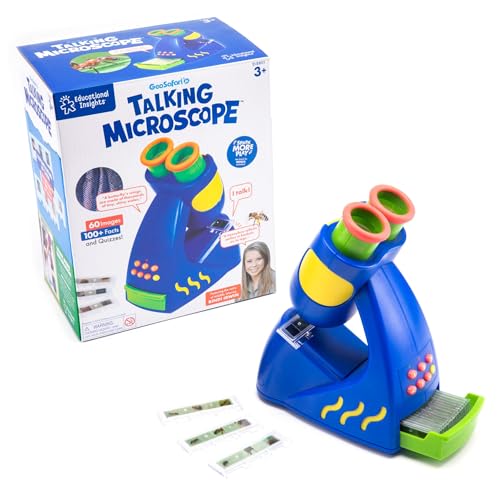
Educational Insights GeoSafari Talking Microscope
What We Like
- 60 full-color images on 20 slides
- Two play modes: Fact & Quiz
- Voice of Bindi Irwin guides learning
- Slide storage compartment built in
Trade-offs
- Requires 3 AAA batteries, not included
- Fixed slide set limits exploration variety
Sixty full-color images across twenty slides give a preschooler a real library of plants, animals, and natural wonders to explore without needing to prep their own specimens. That’s the whole point of a talking microscope at this age. It turns a passive curiosity into an interactive listen-and-learn session, with Bindi Irwin walking them through facts and then quizzing them to reinforce what stuck. The two eyepieces mean a parent or sibling can share the view without a fight over turns.
You’re locked into the twenty slides that come in the box, so once a curious kid has cycled through all sixty images a few times, the novelty fades. Compared to the Doctor Jupiter Preschool Science Kit, which offers over a hundred hands-on experiments for the same age group, this microscope trades open-ended tinkering for a guided, screen-free audio experience. It’s a better pick for the child who thrives on structured narration and repeatable quizzes than for the one who wants to mix baking soda and vinegar.
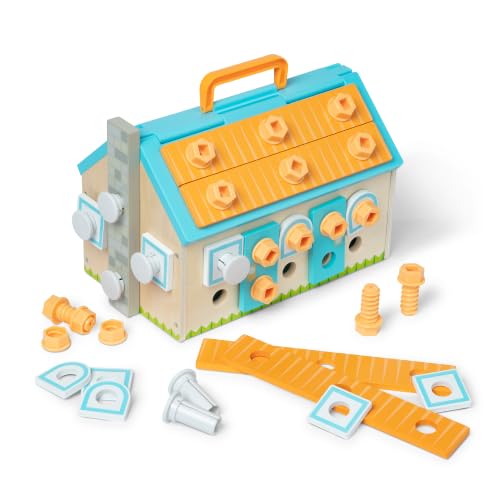
Melissa & Doug Build-A-House Wooden Toolbox
What We Like
- No batteries needed for drill
- 51 pieces for creative building
- Chunky handles for small hands
- Portable house-shaped storage box
Trade-offs
- Drill is squeeze-powered, not motorized
- Only one building surface (toolbox panels)
A squeeze-powered drill that needs no batteries means this set is always ready to play, with no dead batteries to replace. With 51 wooden pieces including windows, doors, shingles, nuts, and bolts, your preschooler can attach real building components to the toolbox panels, learning how structures go together without any motor noise to distract them. It suits families who want hands-on engineering play that builds fine motor control and problem-solving skills, all packed into a clever house-shaped box that doubles as the building site and storage.
The drill is manual, not electric, so kids who expect a spinning bit might need a minute to adjust. This Melissa & Doug set offers a battery-free building experience that never needs charging or replacement batteries. It is ideal for parents who want a simple, durable construction toy and for preschoolers who enjoy turning a screw by hand.
COUOMOXA Magnetic Building Blocks

What We Like
- Large pieces pass choke tube test
- Point-line-plane design for geometry basics
- Smooth edges protect little hands
- Screen-free creative play
Trade-offs
- Only 42 pieces limit larger builds
- No instructions means some kids need help
The 42-piece count here is deliberate: rods and balls click together with strong magnets, so a three-year-old can connect a line to a point and suddenly see a triangle form. That point-line-plane approach is the simplest way I’ve found to introduce geometry without frustration. No tiny parts to swallow, no sharp edges, and the magnetic connection holds stable enough that a wobbly toddler hand doesn’t knock the whole thing over. It’s built for the kid who’s just starting to ask ‘why does that shape work?’ and needs an answer they can hold.
Forty-two pieces run out fast once a child wants to build a castle or a rocket. Compared to the Bubble Fun STEM Building Blocks Set’s 30 pieces, this set offers more pieces to work with, but it’s still a starter kit, not a full construction system. For the parent who wants a clean, safe introduction to spatial thinking without screens or mess, this hits the mark.
Product photos
Learning Resources Gears Deluxe Building Set
What We Like
- 100-piece set with colorful gears
- Includes crank handle for moving models
- Strengthens fine motor and spatial skills
- Open-ended building for endless creations
Trade-offs
- No storage container for 100 small pieces
- Too heavy for a preschooler to carry alone
A 100-piece interlocking gear system means your preschooler can build spinning towers, moving machines, and mechanical structures that actually turn, not just stack. The included crank handle lets them experiment with motion and cause and effect. That hands-on play builds fine motor skills and early engineering concepts without feeling like a lesson. For a four-year-old who loves to figure out how things work, this set delivers open-ended construction that grows with their curiosity.
The 100-piece set includes colorful gears, connectors, bases, pillars, axles, and a crank handle for building countless moving models, so kids can experiment with cause and effect and early engineering concepts through hands-on play. At 2.2 pounds, the set is sturdy but can feel heavy for a preschooler to carry around. Compared to the lighter Bubble Fun STEM Building Blocks Set, this one may require more adult help with cleanup. But if your child is ready for real mechanical play, snapping gears and connectors together and building models that move, the Learning Resources Gears set rewards that effort with hands-on engineering discovery.
Product photos
Learning Resources Fizzy Volcano Preschool Science Lab
What We Like
- 10 guided fizzy experiments included
- Builds observation and STEM skills
- All pieces store inside the volcano
Trade-offs
- Limited to chemical reaction experiments only
- No experiments for biology or physics topics
Ten guided experiments mean this kit doesn’t just hand you a volcano and walk away. Each one builds observation and experimentation skills through fizzy chemical reactions, and the full-color guide supports a four-year-old through the steps. The set includes a beaker, funnel, dropper, and test tube designed for little hands, so the focus stays on the science rather than on wrestling with oversized tools. That makes it a strong pick for a preschooler’s first real lab experience, especially if they’re drawn to the dramatic foam and fizz rather than quieter building tasks.
This kit lives entirely in the fizzy-reaction lane. Once the 10 experiments are done, you’re mixing baking soda and vinegar on your own, and the 13-piece set doesn’t offer the open-ended building or imaginative play that something like the Learning Resources Gears Deluxe Building Set provides. For a child who loves cause-and-effect reactions and wants to feel like a real scientist, that focused design is a feature. For one who prefers constructing or storytelling, it may feel narrow. When the experiments are finished, all pieces fit inside the volcano for easy storage.
Product photos
Tsomtto 10-in-1 STEM Building Kit

What We Like
- 10 different models from 167 pieces
- Includes step-by-step guide booklet
- Sturdy storage box included
- Non-toxic, washable blocks
Trade-offs
- Builds one model at a time, not simultaneously
- Small pieces pose choking hazard for kids under 3
With 167 pieces that build into 10 different models, tower crane, forklift, rocket car, robot, and more, this set gives a preschooler a whole fleet of projects from one box. The step-by-step booklet helps kids follow along independently, which is exactly what you want for early STEM play: hands-on problem-solving that doesn’t require constant adult rescue. It’s a strong pick for a child who likes variety and doesn’t mind taking one thing apart to start the next.
The catch is that you can only build one model at a time, so if siblings want to play simultaneously or your kid loves displaying finished builds, that single-model limit can frustrate. That keeps it simpler and quieter, but kids who crave mechanical action might find it a little static after a few builds.
Product photos
Bubble Fun STEM Building Blocks Set

What We Like
- Translucent blocks for light table play
- 60+ tiered challenge guide included
- BPA-free with smoothed edges
- Scratch-resistant and easy to clean
Trade-offs
- Only 30 pieces limits large builds
- No motorized or moving parts
- Light table not included
The included dual-sided guidebook with over 60 tiered builds gives you a structured path from fine-motor practice for a 3-year-old to early geometry for a 5- or 6-year-old. It covers flat 2D patterns all the way up to multi-tier 3D towers, so you don’t need to invent challenges yourself.
Piece count is the limiting factor here: at just 30 blocks, you cannot build large floor constructions the way you could with a bigger set. That is fine for tabletop play, but if your child prefers sprawling builds, they will run out of bricks fast. The blocks are also strictly manual, no gears, drills, or moving parts, so kids who crave mechanical action might lose interest sooner. For families who want a light-table-compatible STEM toy with a clear progression of challenges, this set delivers on its stated features.
Product photos
How We Evaluated STEM Toys For Preschoolers
We started by reviewing the specifications and age recommendations from manufacturers, then cross-referenced those with expert round-ups from child development and toy safety sources. Patterns in owner feedback, what parents praised and what frustrated them, helped us separate toys that work in real homes from those that only look good in the box.
Four criteria mattered most for this age group. Safety came first: no small parts for kids under three, smooth edges, and non-toxic materials. Engagement followed, a toy a preschooler abandons after five minutes teaches nothing. We looked for open-ended play value, which stretches a toy’s useful life from days to months. Finally, we considered the parent’s role: some toys demand active adult involvement, while others let a child explore independently.
Every evaluation has limits. Our recommendations are based on what the specs, the experts, and the collective voice of thousands of owners tell us. For a deeper look at the thinking behind these choices, our guide on how to choose STEM toys walks through the decision process step by step.
What To Look For In STEM Toys For Preschoolers
Not every STEM toy labeled “for ages 3+” is worth your money. The best ones balance safety, durability, and genuine learning without requiring a PhD in assembly.
Look for toys that match your child’s current fine motor skills, offer open-ended play, and require minimal adult setup. Avoid sets with dozens of tiny pieces unless your child is past the mouthing stage.
Safety and Age Appropriateness
The choke tube test is your friend. Any part small enough to fit inside a toilet paper tube is a hazard for children under three. Many manufacturers state “ages 3+” but include small pieces anyway, so check the piece count and dimensions yourself. Smooth edges and non-toxic, BPA-free materials are non-negotiable. The COUOMOXA Magnetic Building Blocks, for example, pass the choke tube test with their large pieces, making them a safe entry point for younger preschoolers.
Open-Ended Play vs. Structured Activities
Some preschoolers thrive on step-by-step instructions; others want to build whatever comes to mind. A kit like the Tsomtto 10-in-1 Building Kit offers structured model building, which teaches following directions and persistence. An open-ended set like the Learning Resources Gears Deluxe Building Set lets kids invent their own spinning contraptions, which builds creativity and problem-solving. The best approach is to own one of each type.
Parent Involvement Required
Be honest about how much time you have. The Doctor Jupiter Preschool Science Kit delivers a huge variety of experiments, but many require adult prep and supervision. The Melissa & Doug Build-A-Saw Wooden Toolbox, by contrast, is battery-free and nearly self-explanatory once you show the squeeze-powered drill. If you need a toy that buys you 20 minutes of quiet, prioritize sets with simple, intuitive play that your child can start alone.
- Check the battery requirement before buying, many sets need AAA batteries that are not included.
- Look for a storage solution: sets without containers (like the Gears Deluxe) scatter quickly.
- Read the “best for” and “not ideal for” lines in each pick to see if it fits your child’s personality.
- Consider the noise level: battery-powered drills and sound effects may be fun for your child but grating for you after the 50th liftoff.
A good rule of thumb: if the toy does not survive a 10-minute play session on day one, it will not survive the year.
STEM Toys For Preschoolers Compared
The table below compares all ten picks side by side, with key specs and trade-offs for each.
| Product | Age Range | Dimensions | Weight |
|---|---|---|---|
| iPlay iLearn Rocket Space Toy | 3-8 years | 14.5" H x 7.5" L x 7.2" W | 2.9 lbs |
| Doctor Jupiter Preschool Science Kit | Ages 3+ | 11.6 x 9.8 x 1.8 inches | 1.5 pounds |
| Educational Insights Design & Drill ABCs & 123s | N/A | 9.3 x 8.8 x 3.8 in | N/A |
| Educational Insights GeoSafari Talking Microscope | 3-5 years | 10.1 x 8.1 x 5.6 inches | 1.5 pounds |
| Melissa & Doug Build-A-House Wooden Toolbox | 3+ | 1.4 x 8.8 x 11.9 inches | N/A |
| COUOMOXA Magnetic Building Blocks | 3-5 years | 7.5 x 7.5 x 2.0 in | N/A |
| Learning Resources Gears Deluxe Building Set | Ages 4+ | 12 x 10.4 x 4.1 inches | 2.2 pounds |
| Learning Resources Fizzy Volcano Preschool Science Lab | 4+ years | 10.0 x 8.5 x 5.0 inches | 0.8 pounds |
| Tsomtto 10-in-1 STEM Building Kit | 4-8+ years | 10 x 6 x 5 inches | 2.3 pounds |
| Bubble Fun STEM Building Blocks Set | 3-6 years | 1.0 x 1.0 x 1.0 inches | 1.1 pounds |
Frequently Asked Questions
What is the best STEM toy for a 3-year-old?
For a child just turning three, the category of STEM toys for 3-year-olds favors large, safe pieces with simple cause-and-effect mechanics. The iPlay iLearn Rocket Space Toy works well because the pieces are chunky and the drill is easy to grip, but the 14.5-inch height can tip during active play.
What is the difference between STEM toys and regular toys?
STEM toys are designed to teach one or more of the science, technology, engineering, or math concepts through play. A regular toy block is just a block; a STEM building set like the COUOMOXA Magnetic Building Blocks introduces geometry through its point-line-plane design. The best STEM toys hide the lesson inside the fun.
Are STEM toys worth the money?
Yes, when they match the child’s developmental stage and interests. A set that gets used weekly for months is a better value than a cheap toy that breaks in a week. The pros and cons of STEM toys article breaks down the long-term benefits and the common drawbacks, including the parent involvement trade-off.
How many pieces should a preschool STEM toy have?
Between 30 and 100 pieces is the sweet spot for ages 3 to 5. Fewer than 30 limits what a child can build, and more than 100 overwhelms most preschoolers and creates a cleanup nightmare. The Bubble Fun STEM Building Blocks Set has 30 pieces with a tiered challenge guide, which keeps frustration low and success high.
Can a preschooler use a STEM toy independently?
It depends on the toy. The Educational Insights GeoSafari Talking Microscope guides the child with audio, so they can use it alone once an adult loads the slides. The Doctor Jupiter Science Kit requires adult setup for most experiments. Our guide on educational toys for preschoolers has more detail on independent-play options.
The Bottom Line
The iPlay iLearn Rocket Space Toy earns the best overall spot because it nails the three things a preschool STEM toy needs: hands-on building, imaginative play, and a clear learning goal. It works for a wide age range, 3 to 8, and the detachable stages keep it interesting long after the first assembly. If your child prefers science experiments to construction, the Doctor Jupiter Preschool Science Kit is the better fit.
For a budget-friendly, battery-free option, the Melissa & Doug Build-A-House Wooden Toolbox delivers solid construction play without the noise or the need for fresh batteries. And if your preschooler is already showing an interest in letters and numbers, the Educational Insights Design & Drill ABCs & 123s turns tool play into early literacy practice.
The single most important factor when buying a STEM toy for a preschooler is the match between the toy’s required adult involvement and the time you actually have to give. A great toy your child can use on their own will get played with more than a perfect kit that sits on the shelf waiting for you to set it up.
