
10 Best Stem Toys For 10 Year Olds in 2026
This post contains affiliate links. As an Amazon Associate, we earn from qualifying purchases.
The Snap Circuits Explorer SC-100 Electronics Kit wins as the best overall because it lets a 10-year-old build over 100 working electronic projects with zero soldering or tools. For a bigger challenge with 200+ builds, the Snap Circuits 203 Electronics Kit takes the award for best 200+ projects kit. And the Smartivity Robotic Mechanical Hand STEM Toy is our pick for best screen-free engineering.
At ten, kids are ready for real mechanical and electrical principles but still need projects that deliver a sense of accomplishment without hours of frustration. The right STEM toy bridges that gap: it feels like a toy first and a lesson second. The wrong one either bores them with complexity or leaves them bored after one build.
This guide is a research-based evaluation of the ten best options on the market. We looked at manufacturer specifications, expert round-ups, and patterns in owner feedback to find the kits that actually hold a 10-year-old’s attention and teach something real.
Top 10 STEM Toys For 10 Year Olds in the Market
Certain content that appears on this site comes from Amazon. This content is provided "as is" and is subject to change or removal at any time.
The Best STEM Toys For 10 Year Olds, Reviewed
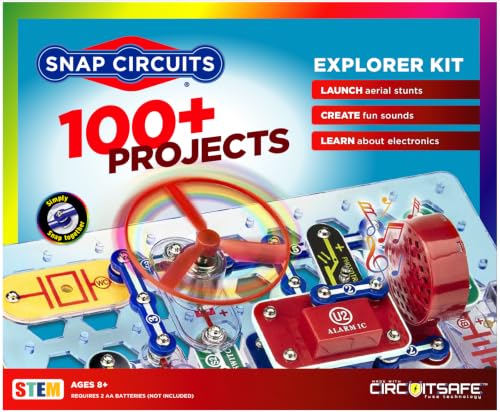
Snap Circuits Explorer SC-100 Electronics Kit
What We Like
- 100+ projects from 28 snap parts
- No soldering or tools needed
- Award-winning STEM.org trustmark
Trade-offs
- Batteries not included
- Only 28 parts limit project complexity
A hundred-plus projects from a single box of 28 snap-together parts means a ten-year-old can build a flying saucer, sound an alarm, and learn the basics of circuitry without ever touching a soldering iron. That’s the whole point of Snap Circuits Explorer SC-100: it drops the intimidation and lets kids focus on what happens when you connect a switch to a motor. For a first electronics kit, that safety and simplicity make it the natural starting point for any curious builder.
The trade-off is that 28 parts won’t stretch as far as the 42 modules in the Snap Circuits 203 kit, so a kid who devours the first hundred projects will eventually want more. But for a ten-year-old who hasn’t yet snapped a single circuit, the Explorer SC-100 offers the clearest on-ramp to electrical engineering without overwhelming them. It’s the kit that gets built, not the one that sits in the box.
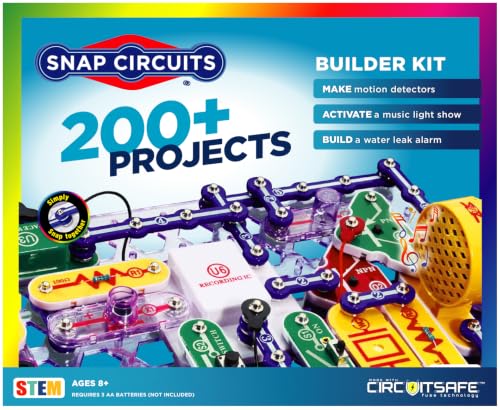
Snap Circuits 203 Electronics Kit
What We Like
- 42 snap modules for 200+ projects
- No extra tools needed to start
- Full-color project manual included
- Award-winning brand reputation
Trade-offs
- At 2.2 pounds, less portable than lighter kits
- Projects are pre-designed, not open-ended builds
With 42 snap modules and over 200 projects packed into one box, this kit gives an 8-year-old enough variety to keep coming back. The numbered, color-coded pieces snap onto the included plastic grid without any tools, so a child can start building a burglar alarm or a doorbell within minutes of opening the package. That hands-on introduction to electrical engineering, safe, guided, and repeatable, makes it a natural fit for kids who enjoy following a clear path from start to finish and feeling the satisfaction of a working circuit.
This kit is a patient teacher for a structured learner who wants to understand how switches, lamps, and sound modules actually work before designing their own circuits. It comes with plenty of ready-to-build fun right out of the box. The pre-designed projects don’t leave much room for free-form invention. If your child thrives on open-ended tinkering, they may want a kit that encourages that style.
Product photos
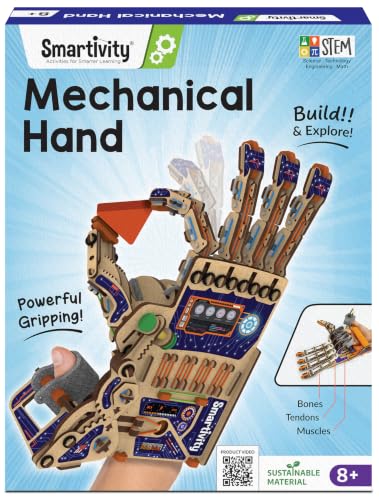
Smartivity Robotic Mechanical Hand STEM Toy
What We Like
- Screen-free DIY engineering build
- Sustainable wood construction
- Lifetime replacement parts included
- Step-by-step instructional manual
Trade-offs
- No electronic or coding elements
- Single project, not expandable
This 0.6-pound kit uses sustainable engineered wood for a hands-on mechanical build that’s safe for kids. The step-by-step instructional manual guides them through assembling a working robotic hand, so they learn about mechanical principles without a screen. For parents who want their child to have a focused, screen-free DIY experience, this delivers a functional toy they built themselves.
This is a pure mechanical project, so if your kid is itching to code or wire up LEDs, they’ll be better served by the Snap Circuits 203 Electronics Kit. That kit offers over 200 projects with snap-together modules. But for the child who loves building with their hands and needs a break from electronics, the Smartivity provides a satisfying build they can actually use to demonstrate mechanical motion. No batteries required, just wood and curiosity.
Thames & Kosmos My Robotic Pet Coding Chameleon

What We Like
- Unplugged coding with physical action cards
- Three distinct play modes
- Realistic articulated joints and eyes
- Teaches biomimicry and engineering
Trade-offs
- Requires adult help for ages 8-11
- Batteries not included
This build-it-yourself chameleon uses physical action cards to program movements, with no screen or app required. The 48-page manual guides assembly and explains how nature inspires engineering design. For a child who wants to see how code makes a creature respond, this offers a hands-on, unplugged approach that pure electronics kits don’t provide.
Younger builders (8-11) need an adult to help with assembly, and the batteries are sold separately. Those are small annoyances, but worth planning for. Compared to the Teach Tech Mech-5, which uses a mechanical coding wheel, this chameleon gives a more interactive, pet-like experience with its three modes (Coding, Wild, and Pet). If your kid prefers tinkering with gears and pistons, the Hydraulic Boxing Bots might be a better fit. But for a child who wants a responsive creature to program and play with, this delivers a genuinely different kind of STEM play.
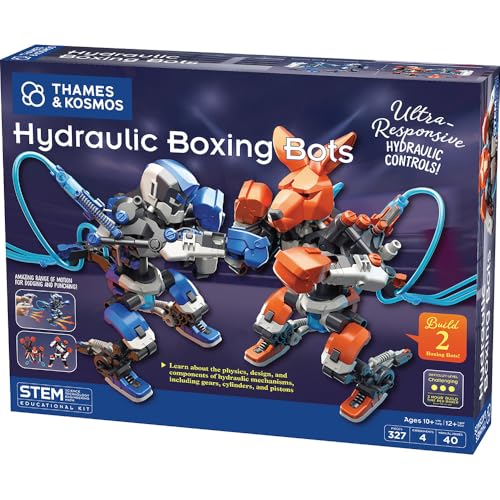
Thames & Kosmos Hydraulic Boxing Bots
What We Like
- Two-player hydraulic robot battles
- Teaches gears, cylinders, pistons
- Independent upper and lower body movement
- Includes scoreboard for competition
Trade-offs
- Requires water for hydraulic operation
- Single-purpose build limits replay variety
- Assembly needed before any play begins
Building two separate boxing robots from one kit means your 10-year-old can’t claim boredom while a sibling waits. Each bot uses water-powered hydraulics to move its upper and lower body independently, so they can jab, dodge, and punch with accuracy. The kit introduces physics and engineering lessons through a hands-on building project. It’s perfect for a pair who love a little friendly competition and don’t mind spending an afternoon snapping parts together first.
The kit builds two boxing bots that spar with a friend using water-powered hydraulics, so after assembly the play is focused on head-to-head matches rather than open-ended tinkering. For a 10-year-old who wants a moving, interactive project that leads to shared play, this delivers a concentrated activity. The Snap Circuits Explorer SC-100 offers 100+ projects for a kid who prefers variety, but this set is all about the duel.
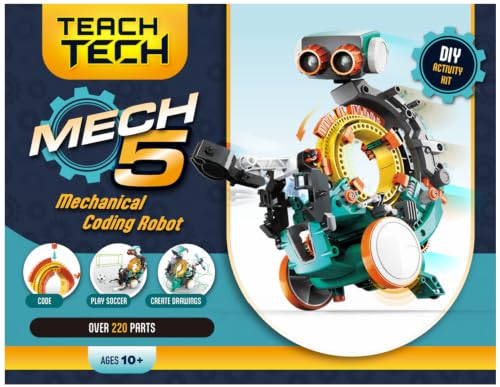
Teach Tech Mech-5 Coding Robot Kit
What We Like
- Mechanical coding wheel programs real actions
- Throws, lifts, kicks, draws without screens
- Step-by-step assembly builds patience and skill
Trade-offs
- Multiple hours of build time before any play
- No electronic coding or app integration
A mechanical coding wheel that you snap buttons onto to program the robot to throw, lift, kick, or draw means your child learns sequencing and cause-effect without a single screen. That hands-on, gear-driven approach suits the kid who wants to understand how machines actually work, not just tap a tablet. At one pound and with a detailed step-by-step build taking multiple hours, it rewards patience and careful assembly, exactly the kind of deep project that sticks with a future engineer.
All that build time happens before any action, and the robot’s actions are limited to what the coding wheel allows. Compare that to the Snap Circuits Explorer SC-100, which offers over 100 projects with 28 snap-together parts and a full-color manual. If your ten-year-old loves tinkering and figuring out mechanical logic, this robot is a focused, screen-free win. If they want instant variety and quick results, look toward the Snap Circuits instead.
LEGO Technic NASA Mars Rover Perseverance

What We Like
- Buildable Ingenuity helicopter included
- Augmented reality app brings mission to life
- Fully articulated suspension for uneven surfaces
- Detailed scientific instruments for display
Trade-offs
- 1132 pieces means a long build session
- No motor or battery for powered movement
- AR app requires a compatible smart device
With 1132 pieces, this build is a weekend project rather than a quick afternoon activity, which suits a 10-year-old ready to dive into something substantial. The fully articulated suspension allows the rover to roll over uneven surfaces, and the set includes a separate buildable Ingenuity helicopter. Kids get a detailed display piece that teaches about Mars mission challenges through 360-degree steering and movable arms that mimic scientific instruments. The augmented reality app lets them explore rover and mission details, turning the finished model into a learning tool beyond a shelf ornament.
This set is purely mechanical, with no motor or battery pack, so the rover doesn’t drive on its own. That puts it in a different category from something like the Thames & Kosmos My Robotic Pet Coding Chameleon, which teaches coding and bionic technology. If your child wants a robot that moves and responds, the Perseverance will feel static after the build. But if they study NASA press releases and want to understand how suspension and steering work on another planet, the hands-on engineering here offers a strong learning experience. Just have a clear table, a patient afternoon, and a phone or tablet ready for the AR experience.
Product photos
ThinkFun Gravity Maze Logic Game

What We Like
- Builds critical thinking through marble logic puzzles
- Endless designs with 9 towers and grid
- Encourages collaborative family play
- Compact storage at 1.1 lb
Trade-offs
- Small pieces can be misplaced easily
- No motorized or electronic elements for variety
Each puzzle forces your child to think several moves ahead, arranging towers so a marble lands exactly in the target. That spatial reasoning and trial-and-error loop is the same mental muscle engineers use when designing real systems. For a child around age ten who already enjoys puzzles or building, this is a quiet, focused alternative to screen time that still feels like a game. It’s lightweight enough to toss in a bag for car trips or waiting rooms, and the single-player format means no arguments over turns.
Once you’ve solved every challenge, the replay value depends on your child’s willingness to invent their own layouts. Compared to the Snap Circuits Explorer SC-100, which offers over 100 projects, Gravity Maze stays purely mechanical, no batteries, just a marble and gravity. That makes it more portable and less likely to frustrate a kid who gets distracted by complex electronics. But it also means less variety in project types. Best for the logic-lover who treats puzzles like a personal challenge, not for the child who craves motors or constant new components.
Product photos
Smartivity DIY Pinball Machine

What We Like
- Spring launcher and flippers for real arcade play
- Teaches momentum, energy transfer, and mechanical advantage
- Free lifetime replacement parts if pieces break or go missing
- No glue or screws needed for assembly
Trade-offs
- No electronic scoring or sound effects
- Requires a flat tabletop for stable play
A spring launcher, working flippers, and real scoring targets turn this build-it-yourself kit into a tabletop arcade game that actually gets played long after assembly day. The wooden construction is sturdy enough for repeated use. The engineering lessons, levers, ramps, momentum, are built right into the action, not buried in a manual. For a child around age ten who wants to build something that does something fun, this delivers a payoff that most STEM kits forget to include.
The finished machine weighs 1.2 pounds, which is light enough to move around easily on a tabletop. Compared to the Snap Circuits Explorer SC-100, which offers 100+ electronic projects with snap-together parts, this pinball kit focuses on a single, replayable build. If your child enjoys building one item they can play and compete on with friends, this kit delivers that experience. If they prefer a wider variety of quick projects, the Snap Circuits option provides more breadth.
Product photos
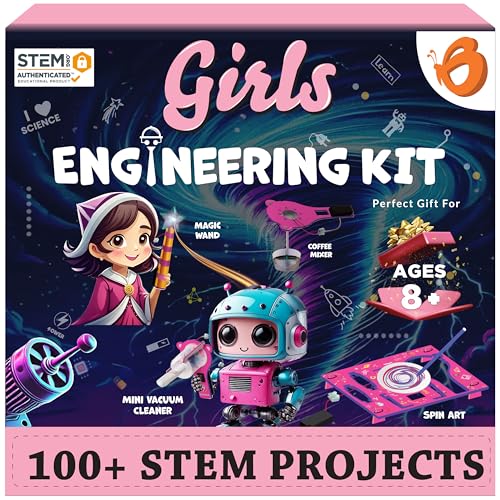
Butterfly EduFields Girls Engineering Science Kit
What We Like
- 100+ hands-on engineering and science projects
- Teaches gears, levers, circuits, and machines
- Screen-free, reusable parts rebuild again
- Clear step-by-step illustrated guides
Trade-offs
- No electronics focus like Snap Circuits kits
- No single-project depth like Smartivity's mechanical hand
A hundred-plus STEM projects in one box means your daughter can build gears one afternoon, levers the next, and a working machine by the weekend, all without a single screen. Every project teaches a core science, technology, engineering, or math idea by doing, not memorizing. The step-by-step guides are illustrated and age-right for girls 8 to 12, so an elementary or middle-schooler can explore science experiments at home. It suits curious girls who love building and want to try many different hands-on activities.
Focus is the trade-off here. With 100 projects, a child who prefers finishing one thing completely might feel pulled in too many directions. For a more concentrated electronics experience, the Snap Circuits Explorer SC-100 also offers 100+ projects but sticks to snap-together circuits with a full-color project manual. The Butterfly kit wins on breadth, with gears, levers, circuits, and working machines all in one box. But if your daughter already knows she loves circuits, the Snap Circuits path is more focused. For a broad, screen-free introduction to STEM, this kit delivers.
Product photos
How We Evaluated STEM Toys For 10 Year Olds
We started by cross-referencing manufacturer specifications and build requirements against the developmental abilities of a typical 10-year-old. That meant checking each kit’s age rating, part count, assembly time, and whether it required screens, batteries, or adult supervision. Then we reviewed patterns in owner feedback to see which kits kids actually finished and played with again, not just opened once.
Three criteria mattered most. First, project depth and replay value, a kit with one build and nothing else to try later ranks below one that offers 100 or 200 variations. Second, independence level, a 10-year-old should be able to start without constant adult rescue. Third, skill-building clarity, the best kits teach a concept (circuits, hydraulics, coding) in a way the child can name afterward.
A research-led evaluation has limits. We haven’t put these kits in front of a panel of kids, and individual tastes vary wildly. A child who loves following instructions will enjoy guided kits, while a free-form builder needs open-ended parts. The recommendations here reflect what most kids in this age range report enjoying.
What To Look For In STEM Toys For 10 Year Olds
The best STEM toy for a 10-year-old balances challenge with reward. Look for a kit that matches their patience level, teaches a real concept, and offers enough projects that they don’t exhaust it in one afternoon.
*A 10-year-old needs a project that takes hours, not weeks, to finish, and that they can explain to a friend afterward.
Project Variety and Replay Value
A single-build kit is fine if the build is the point. A multi-project kit is better if the child likes variety. The best STEM toys for 8-10 year olds often include 100 or more projects, which means the toy stays interesting for months. For a 10-year-old, look for at least 20 distinct projects unless the single build is exceptionally detailed, like the LEGO Technic Mars Rover.
Build Time and Independence
Some kits take hours to assemble before any play begins. That’s fine for a patient tinkerer, but a child who wants instant results will abandon a multi-hour build. Check whether the kit requires adult help for assembly or only for troubleshooting. The best educational toys for 10 year olds usually let the child work independently after a quick adult demonstration.
Real Concepts, Not Just Gadgets
The toy should teach something the child can name: circuits, gears, hydraulics, coding, mechanical advantage. A kit that just lights up or moves without explaining why is a gadget, not a STEM toy. The best robot toys for 10 year olds often include a clear manual or action cards that explain the principle behind each function.
Screen Time and Complexity
Screen-free kits use physical action cards or mechanical coding wheels skip the need for a phone or tablet. For parents looking to reduce screen exposure, these are the right choice. The [best toys for 10 year olds](https://happygrowplayground.com/best-toys-for-10-year-olds/] offers several screen-free options.
A good rule of thumb: if the toy needs a screen, make sure the child can play without one, it’s a coding toy, not a screen toy. Both are fine, just match the child’s habits.
STEM Toys For 10 Year Olds Compared
The table below compares all ten picks side by side, so you can see which one fits your child’s interests, patience level, and skill goals at a glance.
| Product | Age Range | Weight | Dimensions |
|---|---|---|---|
| Snap Circuits Explorer SC-100 Electronics Kit | 8+ | 1.4 pounds | L 12.0 inches, W 9.5 inches, H 1.8 inches |
| Snap Circuits 203 Electronics Kit | 8+ | 2.2 pounds | L 15.0 inches, W 2.2 inches, H 12.0 inches |
| Smartivity Robotic Mechanical Hand STEM Toy | 8-14 years | 0.6 pounds | 11.8 x 9.8 x 7.5 inches |
| Thames & Kosmos My Robotic Pet Coding Chameleon | 8+ | 1.5 pounds | L 10.0 inches, W 4.7 inches, H 11.0 inches |
| Thames & Kosmos Hydraulic Boxing Bots | 10+ | 1.8 lbs | 14.8 x 3.0 x 11.3 in |
| Teach Tech Mech-5 Coding Robot Kit | 10+ | 1.0 pounds | L 12.4 inches, W 2.5 inches, H 9.1 inches |
| LEGO Technic NASA Mars Rover Perseverance | 10+ | 3.5 lb | 15.0 x 10.3 x 4.6 in |
| ThinkFun Gravity Maze Logic Game | 8-12 | 1.1 lb | 9.4 x 2.8 x 10.5 in |
| Smartivity DIY Pinball Machine | 8-14 years | 1.2 lb | 14.6 x 5.3 x 11.0 in |
| Butterfly EduFields Girls Engineering Science Kit | 8-12 years | 1.3 pounds | L 10.0 inches, W 5.0 inches, H 1.0 inches |
Frequently Asked Questions
What is the best STEM toy for a 10-year-old beginner?
The Snap Circuits Explorer SC-100 Electronics Kit is the best overall for a beginner. It requires no soldering or tools, and the 28 snap parts snap together to build over 100 working projects. The full-color manual guides each build step by step, so a child can work independently after a quick demonstration.
Are STEM toys for 10-year-olds worth the money?
Yes, when they offer replay value. A kit with 100+ projects, reusable parts, or multiple build configurations gives far more value than a single-build kit that sits on a shelf after one afternoon. The Snap Circuits 203 kit offers 200+ builds. The Smartivity Robotic Mechanical Hand offers a single extended build but lifetime replacement parts. The Butterfly EduFields Girls Engineering Science Kit offers 100+ projects.
What STEM toy for a 10-year-old who loves coding?
The Thames & Kosmos My Robotic Pet Coding Chameleon is the best coding pet for a 10-year-old. It uses physical action cards to teach coding without a screen. The chameleon responds to action cards with realistic articulated joints and eyes. The Teach Tech Mech-5 Coding Robot Kit is a mechanical coding robot that throws, lifts, kicks, and draws without screens.
What is the best STEM toy for a girl in STEM?
The Butterfly EduFields Girls Engineering Science Kit is the best for girls in STEM. It offers 100+ hands-on engineering and science projects that teach gears, levers, circuits, and machines. The Snap Circuits Explorer SC-100 is also a good option for girls who want a variety of projects at home.
What is the best STEM toy for a 10-year-old who loves space?
The LEGO Technic NASA Mars Rover Perseverance is the best space exploration model for a 10-year-old. The Thames & Kosmos My Robotic Pet Coding Chameleon is the best coding pet for a 10-year-old. The Snap Circuits Explorer SC-100 is also a good option for a 10-year-old who loves space.
The Bottom Line
The Snap Circuits Explorer SC-100 Electronics Kit is the best overall for most 10-year-olds. It’s the safest bet for a child who has never built a circuit and wants to see immediate results. The 28 parts and 100+ projects give enough variety to hold interest for weeks without overwhelming a beginner.
If your child already has a Snap Circuits kit or wants a bigger challenge, the Snap Circuits 203 offers 200+ projects with 42 modules. For a screen-free engineering build, the Smartivity Robotic Mechanical Hand is the best pick. And for a child who loves animals and coding, the Thames & Kosmos My Robotic Pet Coding Chameleon is the best coding pet.
The single most important buying factor is replay value. A STEM toy that gets built once and forgotten is a waste. Choose a kit that offers enough projects, builds, or configurations to keep a 10-year-old coming back. That’s what separates a toy from a lesson.
