
9 Best Robot Toys For 3 Year Olds in 2026
This post contains affiliate links. As an Amazon Associate, we earn from qualifying purchases.
For a three-year-old, the best robot isn’t a complicated machine, it’s a friend who dances, listens, and reacts. The Danny Go! Dancing Robot wins as Best Overall because it combines active dance play with simple programming in one officially licensed, battery-included package. The Ruko Smart Robot Dog earned Best Interactive Puppy for its expressive, programmable pet experience, while the Educational Insights Design & Drill Robot is our top pick for hands-on building.
At this age, a robot toy needs to survive drops, hold a toddler’s attention span, and offer more than just flashing lights. The real challenge is finding something that sparks curiosity without requiring a degree in engineering to operate. We looked for toys that encourage cause-and-effect learning, fine motor skills, and imaginative play.
This guide is built from manufacturer specifications, expert round-ups, and patterns in parent feedback. We focused on safety, durability, ease of use, and whether a toy genuinely engages a three-year-old. You’ll find nine carefully selected robots, each with a specific strength, so you can match the right toy to your child’s personality.
Top 9 Robot Toys For 3 Year Olds in the Market
Certain content that appears on this site comes from Amazon. This content is provided "as is" and is subject to change or removal at any time.
The Best Robot Toys For 3 Year Olds, Reviewed
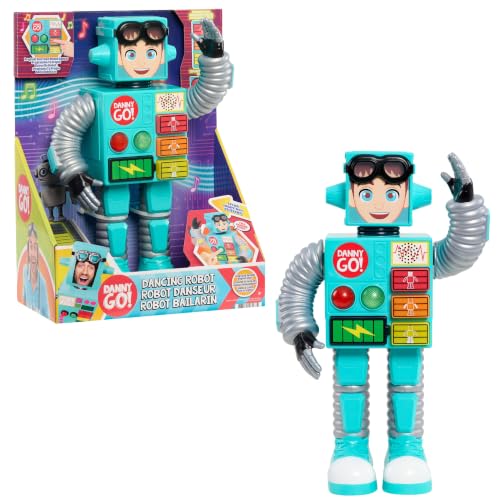
Danny Go! Dancing Robot
What We Like
- Three distinct play modes
- Batteries included out of box
- Light-up buttons for active play
- Officially licensed Danny Go! toy
Trade-offs
- Only one song built in
- No remote control for distance play
A 14-inch interactive robot responds to button presses, song cues, and kid-programmed dance sequences. That means your three-year-old can match moves, freeze on command, or build their own sequence by pressing the head, arms, and legs. This makes it the most versatile pick for a toddler who wants to be the choreographer, not just a spectator. The three play modes, Dance and Freeze, Program, and Speed, keep play fresh without overwhelming a young child, and the included batteries mean you can open the box and start dancing immediately. It suits families who want a toy that encourages active movement rather than passive watching, especially if your child already knows the Danny Go! YouTube or Netflix show.
The Danny Go! Dancing Robot plays only one built-in song, ‘The Robot Dance,’ so after a few dance parties you’ll hear it plenty of times. Kids press the buttons on the robot to make it dance, freeze, or perform a programmed sequence, which gives them direct hands-on control. For a child who wants to be the one calling the shots and freezing the dance floor, this robot delivers exactly that.
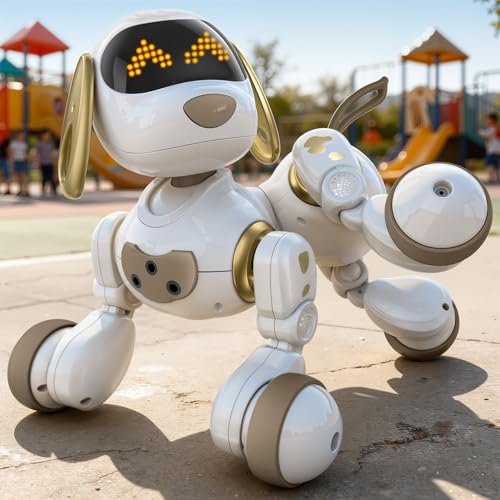
Ruko Smart Robot Dog
What We Like
- Program up to 50 custom moves
- Obstacle-avoidance sensors for safe play
Trade-offs
- 45-minute playtime needs frequent recharging
- Remote requires 2 AAA batteries (not included)
With 70 glowing LEDs and over 30 animated expressions, this puppy’s face actually shows moods, happy eyes, goofy winks, the works, so a child gets real emotional feedback during play. That turns a simple robot into a pretend-play partner, and the programming mode lets kids chain up to 50 moves into a dance routine or trick parade. For a toddler who wants a pet without the mess, this delivers the interactive experience without the puddles.
A full three-hour charge delivers up to 45 minutes of playtime, so families should plan for recharging during longer indoor sessions. The included USB A-C cable handles the recharge, though the remote itself needs two AAA batteries that are not included. This balance keeps the robot lightweight enough for a child to carry around the house. It still provides enough run time for a quick dance routine or a series of programmed tricks before needing a break.
Product photos
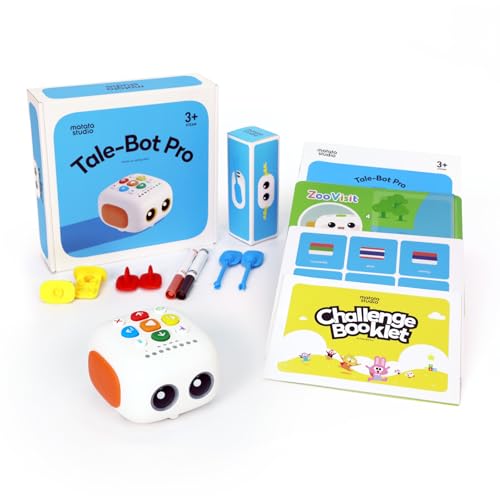
MatataStudio TaleBot Pro Coding Robot
What We Like
- Voice recording for storytelling
- Compatible with Lego blocks
- Supports 10 languages
Trade-offs
- Requires interactive map for full use
- Limited to 256 commands for complex sequences
A robot that accepts up to 256 commands lets a child as young as three press physical buttons to make it walk, draw, sing, or dance, all without a screen. The instant voice feedback gives a clear cause-and-effect response, so a toddler can grasp sequences and loops through play. The included double-sided map and challenge booklet with 14 missions provide guided activities, and the recording function lets kids record their own stories, which can help develop language skills alongside the STEM learning. For a parent who wants early coding education that feels like a toy, this is the one.
The trade-off is that the TaleBot Pro is a guided experience rather than a free-roaming gadget. If your three-year-old prefers to boss a robot around with a remote rather than follow a story-based coding path, the TaleBot’s structured approach might feel limiting. But for building foundational problem-solving skills step by step, this design is deliberate and effective.
Ruko 6088 Programmable Robot

What We Like
- Four control methods for varied play
- 200 editable program icons boost logic
- 120-minute battery from 2-hour charge
- Non-toxic ABS with smooth edges
Trade-offs
- App required for full programmability
- No screen-free coding option included
Four separate control methods, remote, app, gravity sensor, and infrared gesture, mean a 3-year-old can start with the simple remote and grow into programming 200 custom actions. That range keeps the toy relevant for years, not just the first week. The 120-minute battery life (from a 2-hour charge) means fewer mid-play charging breaks, which matters when a toddler’s attention span is the real timer. It suits families who want one robot that adapts as their child’s skills develop, from basic dancing to logical sequencing.
Full programmability requires the app, so a parent’s phone becomes part of the toy. Compared to the Danny Go! Dancing Robot, which is purely dance-and-go, the Ruko 6088 offers far more depth but demands more setup time. The flexible joints and 9 dynamic expressions help kids practice reading non-verbal cues. Best for families who value long-term versatility over instant simplicity.
Contixo R1 Smart Robot

What We Like
- Voice recording for replay
- Touch induction steering
- Compact size stores easily
- Safe, easy-clean plastic
Trade-offs
- Batteries not included
- No remote control or app
- Small size limits floor presence
At 3.5 inches wide and 5 inches tall, this robot is small enough to fit in a bag or toy bin without taking up much room. That compact size means a child can carry it easily and set it down on a table or floor next to other toys. Voice control and touch induction let a child tap or speak to make it walk forward or backward, or record a voice and replay it. For a first robot that offers simple interaction without complex controls, the size and straightforward operation work well together.
The trade-off for that small size is that it stays low to the floor rather than standing out like the 16.5-inch Danny Go! Dancing Robot, which includes batteries. The Contixo R1 uses only voice and touch controls, so there is no remote for an adult to step in. That suits the intended age range of 3-8 years, as the robot responds directly to the child’s actions. Just remember to buy three AAA batteries before gifting, because the box does not include them.
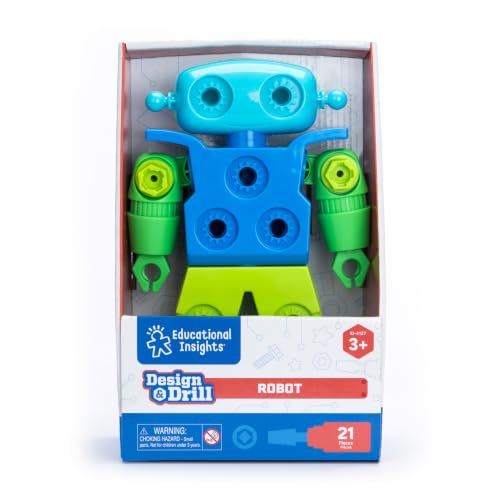
Educational Insights Design & Drill Robot
What We Like
- Build-it-yourself snap-and-screw robot
- Swiveling head, arms, and upper body
- Includes 15 colorful bolts and stickers
- Kid-friendly screwdriver for fine motor practice
Trade-offs
- No batteries or electronics for sound/motion
- 15 small bolts can easily get lost
A 21-piece set lets a 3-year-old build a robot using a kid-friendly screwdriver and 15 colorful bolts, so they get real practice with fine motor control and hand-eye coordination. The robot has a swiveling head, arms, and upper body, plus a sheet of decorative stickers for customization. Once assembled, the figure can be posed for pretend play, and the whole thing can be taken apart and rebuilt again.
This robot does nothing on its own, no lights, no sounds, no motors, so once assembled it’s a static figure that relies entirely on your child’s imagination. That makes it a better fit for parents who want a quiet, screen-free building activity rather than a flashy electronic toy. Just keep the bolts in a small container when not in use, because 15 tiny pieces can wander.
Product photos
Contixo R3 Robot Dog

What We Like
- Programmable remote teaches sequencing
- Reacts to head touches with sounds
- Durable, shatterproof ABS plastic
- No sharp corners for safety
Trade-offs
- At 1.8 lb, it's heavy for tiny hands
- No rechargeable battery mentioned
The remote includes more than seven pre-set commands, so a three-year-old can press a button and watch the dog sit, dance, or bark. That immediate cause-and-effect response builds early logic without feeling like a lesson. The shatterproof ABS plastic and rounded corners also means fewer tears when it tips over onto a hardwood floor.
Weight is the trade-off here. At 1.8 pounds, this dog is heavier than some other robot pets in its class, which can make it harder for a three-year-old to carry around or topple onto a child underneath. If your kid prefers a lightweight buddy they can haul everywhere, a lighter model may suit them better. But if you want programmable control and a sturdier build that survives drops, the Contixo R3 delivers exactly that.
Product photos
FunMission Programmable Robot
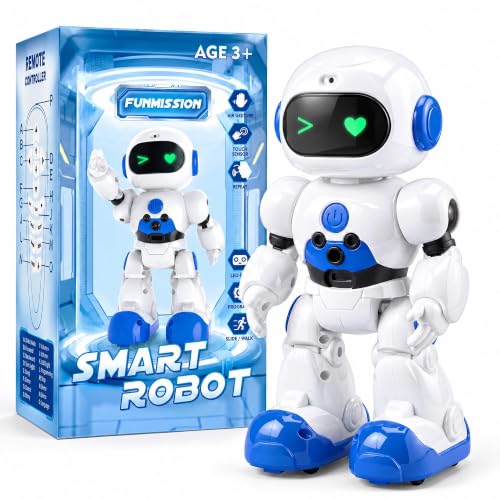
What We Like
- Programmable up to 50 actions
- Gesture and remote control
- Voice recording and playback
- Rechargeable via USB
Trade-offs
- At 6.9 inches tall, smaller than some rivals
- No app control for tech-savvy parents
A programmable robot that lets a three-year-old build custom routines of up to 50 actions sounds ambitious. FunMission keeps it simple with two control methods: hand gestures for quick play and a remote for when little fingers need a break. The robot also repeats voices, giggles when you blow on the microphone, and lights up with LED eyes, all screen-free interactions that hold a child’s attention without demanding dexterity. For families on a budget who want more than a one-trick toy, this is the kind of robot that grows with a kid from basic remote driving to sequencing dance moves and songs.
The FunMission robot stands 6.9 inches tall, which is less than half the height of the 16.5-inch Danny Go! Dancing Robot. That smaller size makes it easy for a young child to carry, though it won’t command the same visual presence in a playroom. If your child has room for big movements and you want a showstopper, the Danny Go! might fit better. For most families, the FunMission’s programmability and price makes it a practical starter robot.
Product photos
MindPal Auto-Demonstration Robot

What We Like
- One-click auto-demo dancing and singing
- LED eyes adjustable via controller
- USB rechargeable robot (remote needs AAA batteries)
Trade-offs
- Remote requires 2 AAA batteries not included
- No programmable or interactive modes mentioned
The one-click auto-demonstration button is the whole point here. Press it, and this little blue robot starts dancing and singing on its own, no fumbling with controls or reading a manual. For a young child who just wants instant fun, that simplicity matters more than any feature list. The robot itself is rechargeable via USB, so you can plug it into a power bank, socket, or computer. It comes with tracks and six wheels, which help it move on different surfaces. The remote control, however, needs two AAA batteries (not included).
This robot does exactly one thing well: auto-demo mode. There’s no programming, no gesture control, no voice commands, so once the novelty of watching it dance fades, a curious three-year-old may want more interaction. Compared to the Danny Go! Dancing Robot, which offers two dance modes, the MindPal is more limited in features. But if your goal is a low-fuss toy that reliably performs on command without requiring parent setup, this one delivers that specific job without overcomplicating it.
Product photos
How We Evaluated Robot Toys For 3 Year Olds
We started by reading through manufacturer data sheets and safety certifications for dozens of robot toys aimed at toddlers. Then we cross-referenced those specs with expert recommendations from child development specialists and toy reviewers who focus on early learning. The final step was identifying patterns in thousands of parent reviews, what actually holds up, what frustrates kids, and what gets left in the toy box after a week.
Three criteria mattered most. First, safety and durability: every robot had to be made from non-toxic materials with no sharp edges or small parts that pose a choking hazard. Second, ease of use: a three-year-old should be able to activate the toy with minimal adult help. Third, engagement value: we favored robots that offer multiple play modes or grow with the child rather than a single, short-lived gimmick.
An evaluation has limits. Individual children’s preferences vary widely. What we can do is give you a clear, honest picture of each toy’s strengths and trade-offs. For a deeper look at the broader landscape, our comprehensive robot toy guide covers options for all ages.
What To Look For In Robot Toys For 3 Year Olds
Choosing a robot for a toddler is different from picking one for an older child. The best robot for a three-year-old is one that feels like a toy first and a learning tool second.
Look for a robot that is durable, easy to operate with small hands, and offers interactive play without requiring a smartphone or tablet. Safety certifications and non-toxic materials are non-negotiable at this age.
Safety and Durability
A three-year-old’s play is physical. Robots get dropped, thrown, chewed, and stepped on. Look for toys made from shatterproof ABS plastic with no sharp corners or small parts that could break off. Check that the battery compartment is secured with a screw, this prevents little fingers from accessing batteries. The FunMission Programmable Robot and the Contixo R3 Robot Dog both use durable, non-toxic ABS with smooth edges.
Ease of Use and Independence
The best robot for this age is one a child can operate mostly on their own. Buttons should be large, clearly labeled, and require only a gentle press. The Danny Go! Dancing Robot excels here with its light-up buttons that are easy for small fingers to find. Avoid toys that require complex sequencing or app setup as the primary mode of play. If you want a toy that truly grows with your child, the best robot toys for 4 year olds offer more advanced programming features.
Play Value and Longevity
A robot that does one thing, dance a single song, for example, will entertain a toddler for about ten minutes. Look for multiple play modes, recording features, or the ability to program simple sequences. The Ruko 6088 Programmable Robot offers four control methods and 200 editable program icons, giving it a much longer shelf life. Consider whether the toy encourages active play (dancing, chasing) or quiet, focused play (building, storytelling). The MatataStudio TaleBot Pro Coding Robot is a strong choice for screen-free storytelling and early coding.
- Check that batteries are included or clearly stated as required.
- Look for a volume control or low-volume mode, some robot songs are surprisingly loud.
- Make sure the robot’s size is appropriate for your child’s hands and strength.
- Consider whether the toy needs an app or works entirely screen-free.
A good rule of thumb: if you need to read a manual to set it up, your three-year-old won’t play with it alone.
Robot Toys For 3 Year Olds Compared
The table below compares all nine robot toys side by side, highlighting their key features and best uses so you can see at a glance which one fits your child.
| Product | Age Range | Height | Control Methods |
|---|---|---|---|
| Danny Go! Dancing Robot | 3 years and up | 14 inches | 2 modes + program mode |
| Ruko Smart Robot Dog | Age 3+ | 9.8 inches | 2.4GHz Remote & Gesture Control |
| MatataStudio TaleBot Pro Coding Robot | 3-5 years | 3.5 inches | Screen-free |
| Ruko 6088 Programmable Robot | Age 3-6 | 10.8 inches | 4 (remote, app, gravity, gesture) |
| Contixo R1 Smart Robot | 3-8 years | 5.0 inches | Voice & touch induction |
| Educational Insights Design & Drill Robot | 3+ years | 3.8 inches | N/A |
| Contixo R3 Robot Dog | 3-12 years | 10.0 inches | 7+ RC commands |
| FunMission Programmable Robot | 3+ years | 6.9 inches | Gesture & remote |
| MindPal Auto-Demonstration Robot | 3 years and up | 5.4 inches | 2.4GHz remote control |
Frequently Asked Questions
What is the best robot toy for a 3 year old who loves to dance?
The Danny Go! Dancing Robot is the best choice for toddlers who love active dance play. It has three distinct play modes, light-up buttons that are easy for small fingers to press, and batteries are included so it works right out of the box.
What is the difference between a programmable robot and a remote control robot?
A remote control robot lets you steer it with a controller, like a car. A programmable robot lets you teach it a sequence of moves, forward, turn, dance, that it then performs on its own. For a three-year-old, a remote control robot is easier to start with, while a programmable one builds problem-solving skills over time.
Are robot toys safe for 3 year olds?
Yes, when chosen carefully. Look for robots made from non-toxic ABS plastic with no sharp edges, small parts, or long cords. The battery compartment should be secured with a screw. Always check the manufacturer’s age recommendation and supervise play with any toy that has small accessories like bolts or stickers.
What should I look for in a STEM robot toy for a preschooler?
Focus on screen-free operation, large buttons, and a simple cause-and-effect loop. The MatataStudio TaleBot Pro Coding Robot is a great example, it uses voice recording and physical blocks to teach sequencing without a tablet. For a broader selection, our guide to STEM toys for 3 year olds covers many excellent options.
Can a robot toy help with my child’s fine motor skills?
Absolutely. The Educational Insights Design & Drill Robot is built for exactly that, kids snap and screw the robot together using a kid-friendly screwdriver and 15 colorful bolts. This strengthens hand-eye coordination and finger dexterity. Other good options for development also target fine motor skill development through hands-on play.
The Bottom Line
For most families, the Danny Go! Dancing Robot is the best all-around choice. It’s the one toy that will have your three-year-old actually moving and laughing, not just staring at lights. If your child is more interested in animals than machines, the Ruko Smart Robot Dog offers a wonderfully expressive, programmable pet experience without the mess.
Budget-conscious parents should look at the FunMission Programmable Robot, it offers gesture and remote control and voice recording for a very reasonable investment. And for the parent who wants a building toy that quietly develops fine motor skills, the Educational Insights Design & Drill Robot is a standout. No matter which you choose, the single most important factor is whether the toy invites your child to play, not just watch.
