
10 Best Family Board Games For All Ages in 2026
This post contains affiliate links. As an Amazon Associate, we earn from qualifying purchases.
For a family game night that actually works for everyone, the Hasbro Gaming Trouble Board Game is our best overall pick. Its Pop-o-Matic bubble keeps dice secure and speeds up play, making it a hit with kids as young as five. We also love the strategic depth of CATAN for older players and the hilarious chaos of Big Potato Herd Mentality for large gatherings.
The hardest part of choosing a family board game is finding one that keeps a five-year-old engaged without boring a teenager. Many games either skew too simple for older kids or have rules too complex for younger ones. You need options that span ages and play styles.
We built this guide by looking at manufacturer specs, expert round-ups, and patterns in owner feedback across dozens of games. The result is a curated list of ten picks that cover luck, strategy, creativity, and pure fun for families with kids from preschool through high school.
Top 10 Family Board Games For All Ages in the Market
Certain content that appears on this site comes from Amazon. This content is provided "as is" and is subject to change or removal at any time.
The Best Family Board Games For All Ages, Reviewed
Hasbro Gaming Trouble Board Game

What We Like
- Pop-o-Matic bubble keeps die secure
- Easy to learn and quick setup
- Power Up Spaces for extra challenge
- Classic family game for ages 5+
Trade-offs
- Only 2-4 players limits larger groups
- No solo or single-player mode
The Pop-o-Matic bubble is the star here: press it to roll the die, and it never gets lost under the couch. That simple mechanical joy makes this a game even the youngest players can jump into without frustration. For families with kids as young as five, the quick setup and straightforward goal (first to move all pieces around the board wins) mean you’re playing within minutes, not reading a rulebook. It bridges the gap between toddler attention spans and adult nostalgia without anyone feeling left out.
The trade-off is that Trouble relies heavily on luck, so strategic thinkers might find it repetitive. But that simplicity is also its strength: no one gets stuck overthinking a move, and the Power Up Spaces option adds just enough variety to keep a second round fresh. For a standard family of four with young kids, this is a game that actually gets played.
Product photos
Hasbro Gaming Sorry! Board Game
What We Like
- Classic race-to-home gameplay
- Each player gets 4 pawns
- Family game for ages 6+
- Slide, collide, and score mechanics
Trade-offs
- Relies on luck from card draws
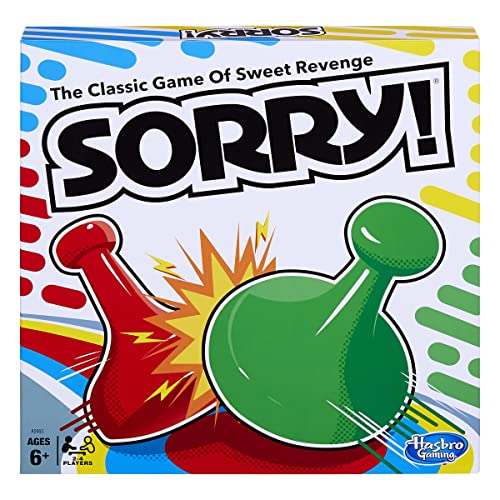
Each player gets four pawns, giving everyone multiple chances to slide, collide, and score their way home. This classic race game keeps families on edge as players send each other back to start with the right card. It’s designed for kids ages 6 and up who enjoy a mix of luck and the strategy that comes from choosing which card to play, and it brings back the familiar Sorry! experience for parents who grew up with it.
The main trade-off is that the game relies on card draws, so players who prefer more control may find it less satisfying than strategy-focused games. At 1.0 pounds and a compact 10.5-inch square box, it’s easy to store and carry, but the simple mechanics might not hold the attention of older kids or adults looking for deeper strategy. Still, for a quick, chaotic family race, it delivers exactly what it promises.
Product photos
CATAN Board Game 6th Edition

What We Like
- Modular board ensures high replayability
- Encourages strategic resource management
- Supports 3-4 players for group play
- Classic family strategy gameplay
Trade-offs
- Ages 10+ excludes younger children
- 3-4 player limit without expansion
The modular hexagonal board ensures no two games are alike, which is why this strategy classic has endured for decades. You’re constantly adapting to a fresh layout, deciding whether to trade resources or build roads and settlements. Designed for ages 10 and up, it rewards players who think ahead rather than just rolling dice and moving pieces. The 60-90 minute playtime fits neatly into a family game night without overstaying its welcome.
The biggest trade-off is the age floor: at 10+, it leaves out younger siblings who might be ready for something simpler, unlike the Ravensburger Labyrinth which works for ages 7 and up. And while the 3-4 player count is fine for many families, you’ll need the separate expansion if you want to include more than four people. That said, if your group enjoys deep strategy and doesn’t mind a bit of negotiation, this is one of the most rewarding family board games you can put on the table.
Days of Wonder Ticket to Ride Board Game

What We Like
- Easy to learn, hard to master
- Beautiful map and miniature trains
- Multiple ways to win
- Fun for all ages 8+
Trade-offs
- Not playable by children under 8
- Box is heavy for travel at 2.8 pounds
With a playtime of 30 to 60 minutes and support for two to five players, this cross-country train adventure hits a sweet spot for family game nights. The simple rules mean you can teach it in minutes, but the strategic depth of collecting color sets and claiming routes keeps everyone engaged. It’s the kind of game where a new player can win on their first try, yet veterans still find fresh challenges. That balance makes it a natural fit for mixed-age groups, especially families with kids eight and up who are ready for something beyond pure luck.
Younger siblings under eight will have to wait a few years to play. Compared to something like Hasbro’s Trouble, which starts at age five, Ticket to Ride demands a bit more patience and planning. But if your family includes older kids or adults who enjoy a little strategy, the beautiful map and miniature trains create an immersive experience that keeps everyone at the table. It’s not a quick filler game, but the payoff is a satisfying journey that feels different every time.
Product photos
Mattel Games Blokus Board Game
What We Like
- Learn in under a minute
- Color-blind accessible piece patterns
- Strategic corner-touch placement rule
Trade-offs
- Ages 7+ excludes younger siblings
- 2-4 player limit for larger groups
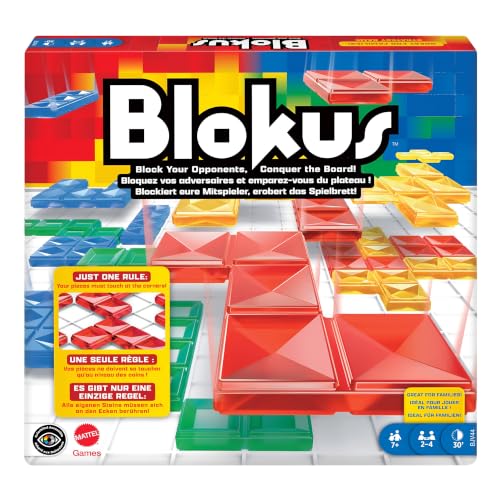
The corner-touch rule is the whole game: each of your 21 pieces must connect to another of the same color, but only at the corners. That one constraint turns a quick-to-learn placement puzzle into a game where you’re simultaneously expanding your territory and boxing in opponents. With 84 vibrant pieces across four colors, the board fills fast, and the game ends when no more pieces can be placed. It’s ideal for ages 7 and up, and the unique patterns on each piece mean color-blind players can join without a second thought.
There’s no dice, no luck, no catch-up mechanic: if you make a bad placement early, you’re playing catch-up the rest of the game. That’s great for developing strategic thinking, but it can feel less forgiving for younger or more casual players who prefer the random chaos of something like Hasbro Gaming Trouble. Blokus is a strategy game that rewards planning, so it’s best for families where at least a couple of players enjoy thinking a few moves ahead. If your group leans toward light, luck-driven fun, this might sit on the shelf more than it hits the table.
Product photos
Ravensburger Labyrinth Board Game

What We Like
- Ever-changing maze for endless replayability
- Builds critical thinking and planning skills
- Simple rules, quick to learn for all ages
- Includes 34 maze and 24 treasure cards
Trade-offs
- 2-4 player limit excludes larger groups
- Not suitable for groups larger than 4 players
The shifting maze is the heart of this game: the maze is rearranged with every turn, so no two rounds play the same. That means kids and adults alike stay engaged, planning routes to treasures while blocking opponents. Rounds wrap up in 20-30 minutes, so even short attention spans stay hooked. The simple rules let everyone jump in fast, but the ever-changing paths keep even experienced players on their toes. If you’re after a game that rewards careful thinking without demanding a long sit-down, this one delivers.
Big Potato Herd Mentality Board Game
What We Like
- Supports 4-20+ players
- Easy to learn and quick to play
- Includes 20 extra questions
- Fun icebreaker for all ages
Trade-offs
- Not suitable for kids under 10
- Odd one out gets the pink cow of doom
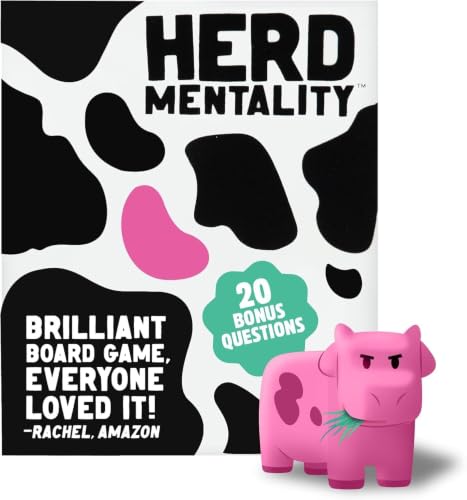
With room for 4 to 20+ players, this is the rare board game that actually fits a big family gathering or a party full of friends without leaving anyone out. It’s built around a simple idea: think the same as everyone else to win cows, while the odd one out gets stuck with the pink cow of doom. The rules are easy enough to learn in a minute, and the 20 extra questions in this version keep rounds fresh, so it works as an icebreaker for teens and adults alike.
The recommended age starts at 10, so younger kids won’t be able to join in, unlike something like the Ravensburger Bugs in the Kitchen game that welcomes players as young as 5. But for anyone looking to get a big, mixed-age group laughing together without a long setup or complicated rules, this is the game to grab.
Product photos
USAOPOLY HUES and CUES Board Game
What We Like
- 480 color squares for variety
- Quick to learn rules
- Supports 3-10 players
- Unique clues each round
Trade-offs
- Ages 8+ limits younger kids
- No competitive scoring mechanic
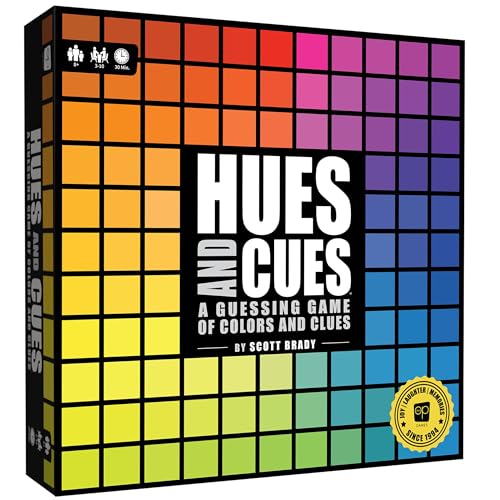
With 480 colorful hues, this game turns color guessing into a creative challenge that works for groups of 3 to 10 players. The simple one- or two-word clue system means you can learn the rules quickly and jump right in. That makes it a natural fit for gatherings where not everyone has the patience for a long rulebook. It fosters fun team interaction without requiring deep strategy, so it suits families looking for something light and social.
The game supports up to ten players, so it works for large groups where Ticket to Ride maxes out at five. Because no two rounds are the same, the replay value stays high even after many game nights. The recommended age is 8+, meaning younger kids might struggle with the vocabulary or color distinctions needed to play well.
Product photos
Merchant Ambassador 100 Classic Games Set

What We Like
- 100 classic games in one box
- 5 double-sided boards for variety
- Full instructions for every game
- Suitable for ages 3 and up
Trade-offs
- Only 5 boards for 100 games means many share a board
- No electronic or modern game mechanics included
With 100 classic games packed into one set, you get more variety than any single-game box can offer. The five double-sided boards cover everything from Chess and Checkers to Ludo and Parcheesi, so you can switch between strategy and luck-based play without digging for another box. Full instructions for every game mean no one sits out trying to remember the rules. This collection is built for families who want a single purchase that serves everyone from preschoolers to grandparents, making it the widest set of family games available under one lid.
One catch is that 100 games share just five boards, so many games rely on the same layout or just different pieces. If your family prefers deep strategy games that offer dedicated boards and unique mechanics, this set may not provide that level of specialization. But if you want a library of classics that offers variety without buying a dozen separate boxes, this is a strong option.
Product photos
Ravensburger Bugs in the Kitchen Board Game

What We Like
- Includes a special edition HEXBUG Nano
- High quality components for hundreds of plays
- Easy to learn and play
- Quick 15-minute game rounds
Trade-offs
- Only 2-4 players limits larger groups
- No solo play option for single children
The special edition HEXBUG Nano creates a buzzing, unpredictable chase that keeps every round lively, so kids stay glued to the board instead of zoning out. Designed for ages 5 and up, the rules are simple enough that a five-year-old can grasp them in one round. With a 15-minute playtime, it fits neatly before bedtime or between chores. The 18 pegs let you build different paths each time, which keeps the game feeling fresh without needing a long setup.
The short 15-minute playtime and 2-4 player limit mean this won’t anchor a long family game night, but for a quick session with a couple of kids, it’s ideal. Ravensburger’s 130-year track record for durable components means the HEXBUG and board will hold up to repeated use. If you want a game that gets the youngest players excited without overwhelming them, this fits the bill.
How We Evaluated Family Board Games For All Ages
We started by reviewing the specifications and recommended age ranges from each game’s manufacturer, then cross-referenced those with expert round-ups and common themes in owner feedback. No game made our list without clear evidence that it genuinely works across multiple age groups.
The three criteria that mattered most were age range inclusivity, player count flexibility, and replayability. A game that only works for ages 10 and up or only supports four players limits its usefulness for a family with younger kids or larger gatherings. We also prioritized games that change each time you play, whether through modular boards, shifting mazes, or randomized card draws.
A research-led evaluation like this cannot replace the feel of a game in your hands. But it does surface the patterns that matter most: which games frustrate younger players, which ones bore older ones, and which ones families return to again and again. We focused on those patterns to give you a confident starting point.
What To Look For In Family Board Games For All Ages
The best family game is the one everyone actually wants to play a second time. Focus on age range, play time, player count, and the balance of luck versus strategy.
Age Range and Complexity
The recommended age on the box is a starting point, not a rule. A game rated for ages 8 and up may still work with a sharp six-year-old if the rules are simple and the game relies more on luck than strategy. Look at the mechanics: games like Trouble use pure dice-rolling, while CATAN requires resource management that clicks around age 10.
If you have a wide age gap, pick a game with adjustable difficulty or one where younger players can participate without fully understanding the strategy. For families with very young kids, the best board games to play with kids offer simpler rules and shorter rounds.
Player Count and Group Size
Check the player count before you buy. A game that supports only 2-4 players will leave out siblings or guests in a larger family. Games like Herd Mentality handle up to 20 players, making them ideal for extended family gatherings. If your group is usually four or fewer, the best family games in the 2-4 range give you more strategic depth. For larger families, look for games that scale well without adding too much downtime between turns.
Play Time and Attention Span
A 15-minute game like Bugs in the Kitchen works for young kids, while a 60-90 minute game like Ticket to Ride suits older children and adults. Mix short and long games in your collection so you can match the energy level of the room. Families with younger kids should prioritize games under 30 minutes, while those with teens can explore deeper strategy games that reward longer sessions.
- Check the box for “ages X+” and compare it to your youngest player’s patience, not just their age.
- Look at the average play time on the box and double it for a family with young kids.
- Read a few owner comments about how the game works with mixed-age groups.
- Consider whether the game has a “take that” mechanic that might frustrate sensitive players.
- Verify the game supports your typical number of players, including guests.
A good rule of thumb: the best family game is the one that gets played more than once.
Family Board Games For All Ages Compared
The table below compares our ten picks across age range, player count, play time, and the type of gameplay each offers.
| Product | Age Range | Players | Weight |
|---|---|---|---|
| Hasbro Gaming Trouble Board Game | 5 and up | 2-4 | 0.8 pounds |
| Hasbro Gaming Sorry! Board Game | 6 and up | 2-4 | 1.0 pounds |
| CATAN Board Game 6th Edition | 10+ | 3-4 | 2.6 pounds |
| Days of Wonder Ticket to Ride Board Game | 8+ | 2-5 | 2.8 pounds |
| Mattel Games Blokus Board Game | 7+ | 2-4 | 1.1 pounds |
| Ravensburger Labyrinth Board Game | 7-10 and older | 2-4 | 2.1 pounds |
| Big Potato Herd Mentality Board Game | 10+ | 4-20+ | 1.0 pounds |
| USAOPOLY HUES and CUES Board Game | 8+ | 3-10 | 2.7 pounds |
| Merchant Ambassador 100 Classic Games Set | 3 and up | N/A | 1.9 pounds |
| Ravensburger Bugs in the Kitchen Board Game | 5+ | 2-4 | 1.9 lb |
Frequently Asked Questions
What is the best family board game for all ages?
The Hasbro Gaming Trouble Board Game is our best overall pick for families with kids ages 5 and up. Its simple dice-rolling mechanics and Pop-o-Matic bubble make it easy for young children to play, while the Power Up Spaces add a little extra challenge for older players.
What board games can a 5 year old play?
Ravensburger Bugs in the Kitchen is an excellent choice for kids ages 5-7. It features a real HEXBUG Nano that moves around the board, and rounds last only about 15 minutes, which matches a young child’s attention span. Trouble is also a strong option for this age group.
What is a good board game for a family of 5?
Big Potato Herd Mentality supports 4 to 20 players, making it perfect for a family of five or larger groups. It is a quick, hilarious party game where players try to guess the most popular answer. The “odd one out” gets a pink cow, which adds silly stakes without being mean.
What is the best strategy board game for families?
CATAN is our top pick for families with kids ages 10 and up. Its modular board and resource trading mechanics create high replayability, and it teaches strategic thinking without being overly complex. For younger strategists, Blokus offers spatial strategy that kids as young as 7 can learn in under a minute.
Are there cooperative board games for families?
While our list focuses on competitive games, families looking for team-based play can explore cooperative games where everyone works together toward a common goal. These games are great for families who prefer collaboration over competition.
The Bottom Line
The Hasbro Gaming Trouble Board Game earns our best overall spot because it works for the widest age range (5 and up). It sets up in seconds and delivers the kind of fast, luck-driven fun that keeps everyone engaged. If you have older kids who want more depth, CATAN offers the best strategic experience for ages 10 and up. For large family gatherings, Big Potato Herd Mentality handles up to 20 players without slowing down.
Budget-minded families should look at the Merchant Ambassador 100 Classic Games Set, which packs a huge variety of traditional games into one box suitable for ages 3 and up. Families with very young kids will find Ravensburger Bugs in the Kitchen a perfect entry point with its moving bug and 15-minute rounds.
The single most important factor when choosing a family board game is knowing your group’s age range and attention span. Pick a game that matches your youngest player’s patience, and you will set the table for a fun night that everyone actually wants to repeat.
