
10 Best Educational Toys For 5 Year Olds in 2026
This post contains affiliate links. As an Amazon Associate, we earn from qualifying purchases.
The best educational toy for most 5-year-olds is the LeapFrog Mr Pencil’s Scribble Write and Read, which teaches letter and number writing with step-by-step stroke guidance and a sound-it-out phonics bar. For bilingual families, the VTech Genio Bilingual JuniorBook Learning Laptop offers 80+ offline activities. The Doctor Jupiter My First Science Experiments Kit is our pick for Best Science Kit, great for hands-on STEM exploration.
A 5-year-old’s brain is building the foundational skills for reading, writing, and math, but they still learn best through play, not worksheets. The right toy bridges that gap by making letter formation, counting, and problem-solving feel like a game rather than a lesson.
We researched specifications, manufacturer documentation, expert round-ups, and patterns in owner feedback to find the 10 best educational toys for 5-year-olds. Each pick targets a specific skill, from handwriting to science, so you can match the toy to your child’s current interests and needs.
Top 10 Educational Toys For 5 Year Olds in the Market
Certain content that appears on this site comes from Amazon. This content is provided "as is" and is subject to change or removal at any time.
The Best Educational Toys For 5 Year Olds, Reviewed
LeapFrog Mr Pencil's Scribble Write and Read

What We Like
- Step-by-step uppercase and lowercase letter writing
- Numbers transform into countable objects
- Customizable name practice for child
- Sound-it-out bar lights up for phonics
Trade-offs
- Batteries included only for demo purposes
- Screen size limits simultaneous multi-child use
Tracing uppercase and lowercase letters step-by-step, then watching them transform into animated animals and more, turns handwriting practice into a guided activity. Mr. Pencil shows kids how to form each letter, so they get visual guidance without needing a parent to demonstrate every stroke. That feedback loop, trace a letter, see it come to life, can keep a young child engaged longer than a static workbook might. It also lets you enter their full name, which makes the practice feel personal and relevant. For a child just starting to form letters, this is a tool that builds skills through repetition that feels like play.
Mr. Pencil guides kids step-by-step through writing uppercase and lowercase letters, then turns those letters into animated animals. That makes learning feel like a game rather than a drill. The screen is compact, meaning only one child can comfortably use it at a time, which might require turn management if siblings are close in age. Compared to the VTech Write and Learn Creative Center, which offers a different approach to writing practice, the LeapFrog focuses on guided letter and number formation with audio feedback, making it a better fit for a child who needs structured learning support rather than free-form drawing. The demo batteries are included only for initial try-out, so plan on picking up fresh AAs before the first regular session.
VTech Genio Bilingual JuniorBook Learning Laptop
What We Like
- 80+ bilingual activities pre-loaded
- Full-size QWERTY keyboard
- No internet needed
- Includes calendar, notebook, music
Trade-offs
- Requires 4 AA batteries for regular use
- No internet connectivity for online content
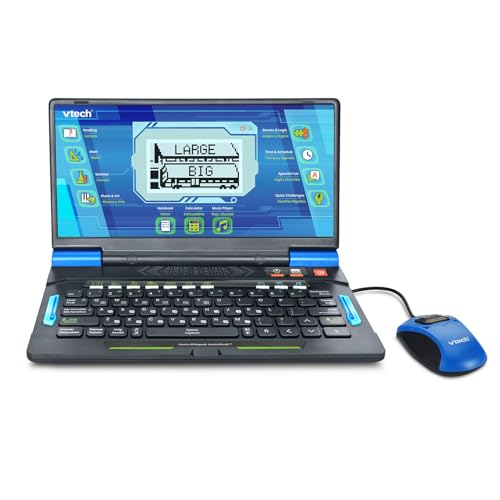
With over 80 pre-loaded activities that can be played in English or Spanish, this laptop lets a child explore math, science, language arts, music, and Spanish without needing an internet connection. The full-size QWERTY keyboard and cursor controller mimic a grown-up computer, helping build basic typing and navigation skills. Every activity is ready to play offline, so there is no need for Wi-Fi or subscriptions. For families who want a bilingual learning tool that covers a wide range of subjects, this is a self-contained option that works right out of the box.
The trade-off is that you will need to keep four AA batteries handy for regular use; the included demo set will not last long. Compared to the LeapFrog Mr. Pencil’s Scribble Write and Read, which focuses on handwriting, the VTech Genio offers a broader curriculum with over 80 activities in two languages. If your five-year-old is ready to start learning computer basics and academic subjects in English and Spanish, this laptop delivers that experience without any online distractions. Just be prepared to replace batteries periodically depending on how often it is used.
Doctor Jupiter My First Science Experiments Kit

What We Like
- 100+ experiments in one kit
- STEM learning through hands-on play
- Step-by-step illustrated instructions
- Meets U.S. safety standards ASTM F963-17
Trade-offs
- Requires adult guidance for many experiments
- 100+ experiments require significant parent involvement
This kit packs over 100 experiments into one box, giving a child a wide variety of hands-on science activities. That means they can explore projects like Water Fireworks and Walking Water without needing a new kit every week. The set is designed to promote critical thinking and observation, which suits a curious child who enjoys asking questions and seeing answers happen. The illustrated manual makes it easy for an adult to guide the fun without needing a chemistry degree. The whole thing meets U.S. safety standards ASTM F963-17 so you’re not worrying about what’s inside the test tubes.
VTech Write and Learn Creative Center
What We Like
- Animated stroke-order demonstrations for letters
- Teaches name writing step-by-step
- Includes stencil for drawing 26 objects
- Lightweight at 1.8 lb for travel
Trade-offs
- Demo batteries only; fresh ones needed for regular use
- No sound or voice feedback for letter recognition
- Magnetic screen can't save or share drawings
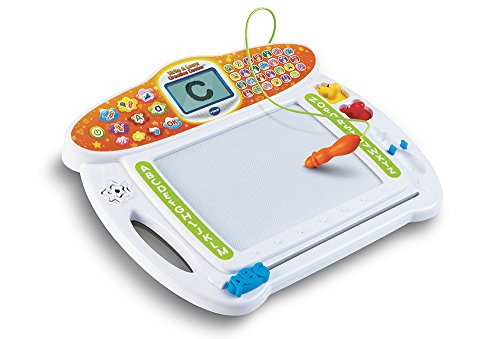
The animated stroke-order demonstrations set this apart from basic doodle boards: kids watch exactly how to form each uppercase and lowercase letter before trying it themselves. That step-by-step guidance, paired with a name-personalization feature, makes it a focused tool for building handwriting confidence in a 5-year-old. It also includes a stencil system that walks children from simple lines to 26 different objects, so they can practice drawing while they learn. At just 1.8 pounds, it’s easy to carry along for travel, and the magnetic screen means no messy markers or paper waste.
The VTech Write and Learn Creative Center is a magnetic drawing board that uses animated demonstrations to teach proper stroke order for uppercase and lowercase letters. Kids can follow along visually as they learn to write. It comes with a stylus and includes a doodler feature that lets toddlers customize the board to practice writing their own name step by step. The set also works as a stencil toy, guiding children from simple lines and shapes to drawing 26 different objects, which encourages creative exploration. Just keep in mind that the included 2 AA batteries are for demo use only, so you’ll want fresh ones ready for regular play.
Clever Fox Play Number Hunter Math Board Game
What We Like
- Teaches addition and subtraction through play
- Includes fun action and math challenges
- Screen-free interactive STEM activity
- Durable non-toxic construction
Trade-offs
- No reading or writing skills covered
- Not suitable for kids under 4 due to small parts
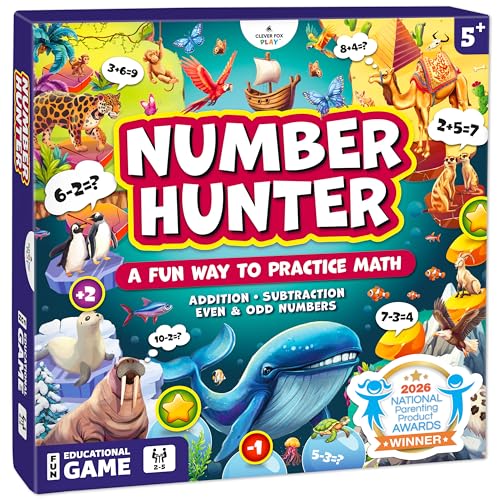
A 9.2-inch square board means this game fits on any kitchen table or classroom desk without taking over the whole surface, so you can set it up and pack it away in seconds. It turns math practice into a global expedition where kids roll dice, add or subtract to move, and land on star tiles that trigger silly actions or extra math challenges. That hands-on, screen-free approach builds early STEM skills like critical thinking and problem solving while keeping a 5-year-old genuinely engaged, not just staring at a worksheet. It’s a solid fit for families who want a quick, repeatable way to reinforce number facts without nagging.
The game focuses entirely on arithmetic and even/odd recognition, so if your child needs help with reading, writing, or science concepts, you’ll want to pair it with something like the Mr. Pencil Scribble Write and Read from LeapFrog. The durable, non-toxic materials hold up well to repeated play. For a dedicated math booster that keeps kids moving and laughing, this earns its place in the guide.
Learning Resources STEM Explorers Brainometry
What We Like
- Solo play builds concentration without screens
- 34 durable puzzle blocks included
Trade-offs
- Solo play only, no multiplayer or group mode
- Puzzle patterns limited to 10 challenge cards
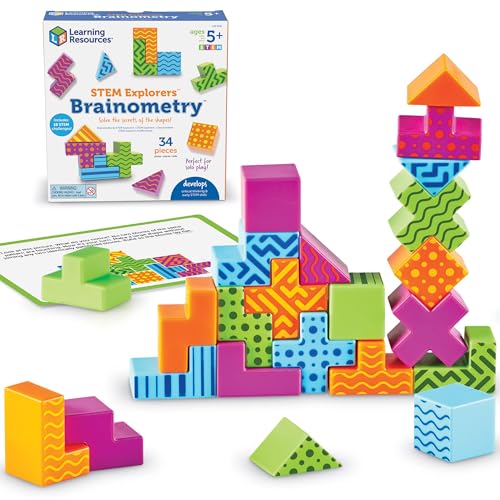
It suits a five-year-old who enjoys figuring things out on their own, especially one who needs a screen-free activity that still feels like a game.
This is strictly a solo activity, so it won’t work for siblings who want to play together. Compared to the Mr. Pencil’s Scribble Write and Read from LeapFrog, Brainometry focuses on independent problem-solving. If your child prefers collaborative play, you might look elsewhere, but for a kid who loves a quiet challenge, this toy grows with their thinking skills.
Product photos
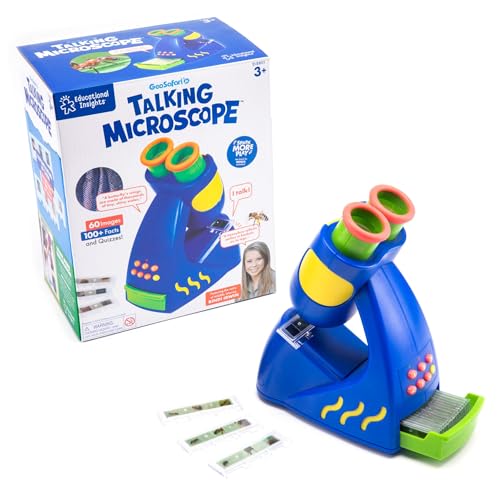
Educational Insights GeoSafari Talking Microscope
What We Like
- Bindi Irwin voice adds engagement
- 60 full-color images on 20 slides
- Two play modes: Fact & Quiz
- Dual eyepieces for easy viewing
Trade-offs
- Requires 3 AAA batteries not included
- Fixed slide set limits exploration variety
The voice of Bindi Irwin guides kids through over 100 fun facts and quizzes, turning sixty full-color images on twenty slides into a self-led science lesson. That built-in narration means a preschooler can explore plants and animals independently while picking up real vocabulary. Parents get a screen-free STEM activity that actually holds attention and teaches something.
The slide set is fixed, so once your child has memorized all sixty images, the novelty fades faster than with an open-ended kit. You can’t swap in new slides or explore backyard finds under magnification. Still, for a preschooler just getting curious about the world, the structured content and quiz mode make this a focused introduction. It’s best for kids who respond to guided learning and need a gentle start to science.
Product photos
Snap Circuits Beginner SCB-20 Electronics Toy

What We Like
- Childproofed for ages 5+
- 21 step-by-step projects included
- Real working circuits with snap-together parts
- Color-changing fan adds visual fun
Trade-offs
- Larger builds need a flat, clear surface
- Limited to 21 projects only
Twenty-one snap-together projects let a five-year-old build working circuits without any soldering or tools, and the lighted color-changing fan makes the results instantly visible. Extra childproofing features and a manual with age-appropriate diagrams help younger kids follow along safely. For parents wanting a STEM introduction that avoids tiny parts requiring fine motor skills, this kit offers a practical starting point.
Only 21 projects are included, and a child who completes them may want more. Compared to the Doctor Jupiter science kit, which includes a variety of experiments, Snap Circuits focuses on circuitry. That focus is a strength for learning about circuits, but if a five-year-old wants more variety, you might consider a different kit.
Product photos
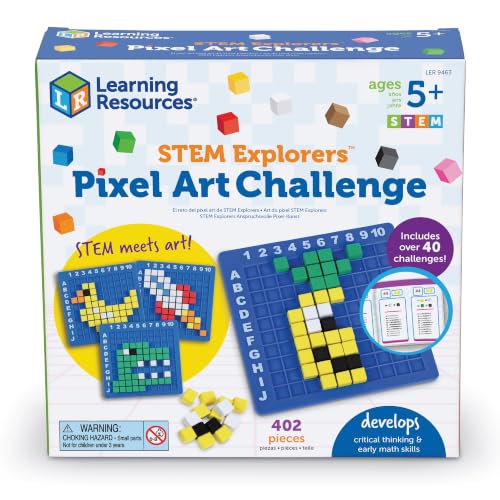
Learning Resources Pixel Art Challenge
What We Like
- 400 durable foam pixel pieces
- 40 progressive challenge levels
- Screen-free STEM play
- Builds fine motor skills
Trade-offs
- Single-player focus limits group play
- Tray size (5.5×5.5 inches) restricts large designs
With 400 foam pixel pieces and 40 challenges that ramp up in difficulty, this kit turns pattern building into a genuine workout for spatial reasoning and problem-solving. The tray is compact enough to tuck away after play, yet the variety keeps kids engaged longer than a single puzzle sheet. It’s a hands-on, screen-free way to introduce coding concepts and math skills through tactile creation.
The 5.5-inch tray limits how big or complex a design can get, and the single-player format means siblings or friends will need to take turns. For a child who loves patterns and independent problem-solving, it’s a focused, durable choice.
Product photos
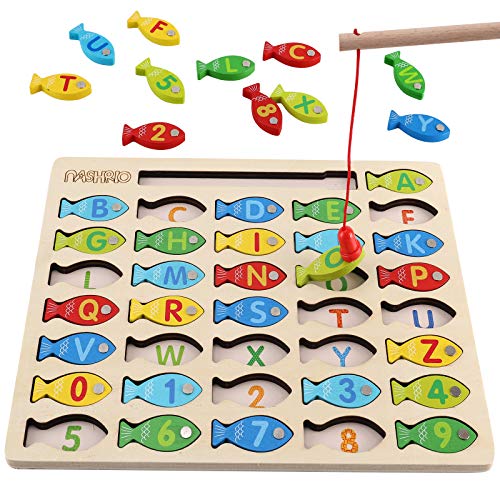
NASHRIO Magnetic Wooden Fishing Game
What We Like
- Eco-friendly water-based paint
- Smooth edges for safety
- Teaches letters, numbers, and colors
- Develops hand-eye coordination and fine motor skills
Trade-offs
- Only 11.8 inches long, limited play surface
- Fishing pole requires steady hand for small kids
A wooden board with colorful fish, each marked with a letter or number, turns letter recognition into a physical game. Your child uses the magnetic pole to catch the fish, which builds hand-eye coordination and fine motor control while they learn the alphabet and counting. The well-polished wood and non-toxic water-based paint mean you don’t have to worry about splinters or chemicals, making this a safe pick for preschoolers. It’s especially suited for parents who want a quiet, screen-free activity that sneaks in early literacy and math skills without feeling like a lesson.
The board’s size is a consideration: at 11.8 by 8.9 inches and only 0.6 inches thick, it’s compact enough to toss in a bag but can slide around on a smooth table during play. Compared to the VTech Write and Learn Creative Center, which offers an interactive screen and stylus for writing practice, this fishing game is purely hands-on and tactile. If a five-year-old needs more fine motor challenge or prefers active play, this is a great budget-friendly option. But if they’re ready for digital letter tracing or more complex puzzles, you might want to look at the Mr. Pencil’s Scribble Write and Read from LeapFrog instead.
Product photos
How We Evaluated Educational Toys For 5 Year Olds
Our evaluation started with manufacturer specs and documentation to confirm each toy’s intended age range, skill targets, and safety certifications. We then cross-referenced those claims against patterns in verified owner feedback to understand what works in real homes, not just on the box. Expert round-ups from child development and education sources helped us identify which features actually support learning at this age.
We focused on four criteria that matter most for 5-year-olds. Skill alignment checks if the toy teaches a specific pre-K or kindergarten skill. Engagement measures whether a child will return to it more than once. Independence looks at whether a 5-year-old can use it with minimal adult help. Durability considers if it can survive a drop from a small table. A toy that scores high on all four is rare; most of our picks excel at two or three.
Because this is a research-led evaluation rather than a hands-on test, we relied on documented features and what owners consistently report. If a toy’s feedback was split, some parents loved it, others found it frustrating, we noted the trade-off. The best choice for your child depends on their personality and your tolerance for parent involvement.
What To Look For In Educational Toys For 5 Year Olds
A 5-year-old is caught between preschool play and kindergarten readiness. The best educational toys for this age teach a specific skill, letter writing, counting, logic, without feeling like homework. Look for toys that match your child’s attention span and your own willingness to sit beside them.
Choose toys that target one skill clearly, require minimal parent setup, and offer repeatable play. Avoid anything that promises too many skills at once, it usually delivers none well.
Skill Focus And Age Alignment
A 5-year-old’s developmental range is wide: some are sounding out words while others are still mastering pencil grip. The best toys meet the child where they are. The LeapFrog Mr Pencil’s Scribble Write and Read, for example, teaches uppercase and lowercase letter formation with stroke-by-stroke animation, a perfect fit for a child who knows letter names but needs handwriting practice.
The Clever Fox Play Number Hunter Math Board Game targets addition and subtraction through physical play, which suits a child who can count to 20 and is ready for simple math.
Look for a toy that teaches exactly one or two skills rather than a “jack of all trades” approach. A focused toy gets used more often because the child can master it and feel proud.
Parent Involvement Required
Some toys are designed for independent play; others need an adult to set up, explain, or supervise. The Doctor Jupiter science kit, for instance, requires significant parent guidance for its 100+ experiments. That is a feature if you enjoy doing science projects together, but a drawback if you need 20 minutes of quiet time. The Learning Resources Brainometry and Pixel Art Challenge are better for solo play, a child can work through the challenge cards alone once shown the basics.
Be honest about how much time you have. A toy that demands parent involvement but does not get it will sit on a shelf.
Durability And Safety For This Age
Five-year-olds are still rough on toys. Magnetic screens, plastic puzzle pieces, and snap-together circuits all need to survive drops and enthusiastic handling. The NASHRIO Magnetic Wooden Fishing Game uses eco-friendly water-based paint and smooth edges, a good sign for safety-conscious parents. The Snap Circuits Beginner kit is childproofed for ages 5 and up, with parts that snap together securely but come apart without tools.
Check that the toy meets U.S. Safety standards (ASTM F963-17, as the Doctor Jupiter kit does) and that small parts are clearly labeled. A toy that is “for ages 3+” may have pieces too small for a 5-year-old who still mouths objects.
- Does the toy target one clear skill or try to do everything?
- How much parent setup and supervision does it actually need?
- Are the materials durable enough for daily use by a 5-year-old?
- Does it offer repeatable play (multiple levels, challenges, or activities)?
- Is the toy screen-based or hands-on? Which does your child need more of?
A 5-year-old will play with a toy that makes them feel capable. Choose the one that matches their current skill level, not the one that impresses other parents.
Educational Toys For 5 Year Olds Compared
The table below compares all 10 educational toys for 5-year-olds by their primary skill focus, play style, and best-use scenario.
| Product | Age Range | Weight | Dimensions |
|---|---|---|---|
| LeapFrog Mr Pencil's Scribble Write and Read | 3+ years | 0.9 pounds | 2.0 x 7.7 x 8.6 inches |
| VTech Genio Bilingual JuniorBook Learning Laptop | 5+ years | 1.9 pounds | 11.3 x 7.5 x 7.5 inches |
| Doctor Jupiter My First Science Experiments Kit | 4+ years | 1.5 pounds | 12.6 x 9.4 x 2.0 inches |
| VTech Write and Learn Creative Center | 3 to 6 years | 1.8 pounds | 12.1 x 14.4 x 2.8 in |
| Clever Fox Play Number Hunter Math Board Game | 5-7 years | 1.4 pounds | 9.2 x 9.2 x 0.0 inches |
| Learning Resources STEM Explorers Brainometry | 5+ years | 0.6 pounds | 10.0 x 9.0 x 4.5 in |
| Educational Insights GeoSafari Talking Microscope | 3-5 | 1.5 pounds | 10.1 x 8.1 x 5.6 in |
| Snap Circuits Beginner SCB-20 Electronics Toy | 5-9 years | 0.5 pounds | 11.7 x 2.0 x 7.4 inches |
| Learning Resources Pixel Art Challenge | 5+ years | 0.6 pounds | 8.0 x 8.0 x 2.5 inches |
| NASHRIO Magnetic Wooden Fishing Game | 3-5 years | N/A | 11.8 x 8.9 x 0.6 inches |
Frequently Asked Questions
What is the best educational toy for a 5-year-old who is learning to write?
The LeapFrog Mr Pencil’s Scribble Write and Read is our top pick for writing skills. It guides the child through uppercase and lowercase letter formation with a light-up sound-it-out bar for phonics, plus customizable name practice. The VTech Write and Learn Creative Center is a good alternative if your child already knows letter sounds and needs structured handwriting practice with drawing stencils.
Are there good educational toys for 5-year-olds that do not use screens?
Yes. Several of our picks are completely screen-free. The Learning Resources STEM Explorers Brainometry uses 34 durable puzzle blocks and 10 challenge cards for solo logic play. The Clever Fox Play Number Hunter Math Board Game teaches addition and subtraction through physical action challenges. The NASHRIO Magnetic Wooden Fishing Game teaches letters, numbers, and colors with a tactile fishing pole and painted wooden pieces.
What is the best science kit for a 5-year-old?
The Doctor Jupiter My First Science Experiments Kit offers 100+ experiments with step-by-step illustrated instructions and meets U.S. Safety standards. It requires adult guidance for most activities, so it works best for families who enjoy doing science together. The Educational Insights GeoSafari Talking Microscope is a good alternative for independent exploration. Bindi Irwin’s voice guides the child through 60 full-color images on 20 slides.
How do I choose between a math toy and a reading toy for my 5-year-old?
Match the toy to the skill your child is currently working on. If they are sounding out letters and trying to write their name, choose a writing-focused toy like the LeapFrog Mr Pencil. If they can count to 20 and are ready for addition and subtraction, the Clever Fox Play Number Hunter Math Board Game is a better fit. Most 5-year-olds benefit from both, so rotating between a literacy toy and a math toy throughout the week works well.
What educational toys help with fine motor skills for 5-year-olds?
Several toys on our list build fine motor skills through different mechanisms. The Learning Resources Pixel Art Challenge requires placing 400 foam pixel pieces to complete 40 progressive patterns. The NASHRIO Magnetic Wooden Fishing Game develops hand-eye coordination and steady hand control. The Snap Circuits Beginner kit requires snapping small parts together to build working circuits, which strengthens finger dexterity.
The Bottom Line
The LeapFrog Mr Pencil’s Scribble Write and Read is the best educational toy for most 5-year-olds because it directly teaches the handwriting and phonics skills they need for kindergarten, with step-by-step guidance that builds confidence. It is ideal for a single child who is ready to write letters and their own name.
If your child needs a different focus, our award picks cover the gaps. The VTech Genio Bilingual JuniorBook Learning Laptop serves bilingual households. The Doctor Jupiter science kit is for families who love hands-on projects. The Clever Fox math game targets addition and subtraction through play. And the NASHRIO Magnetic Wooden Fishing Game is our budget-friendly pick for tactile letter and number learning.
The single most important factor in choosing an educational toy for a 5-year-old is whether the child will actually play with it. A toy that matches their current skill level, challenging enough to hold interest but easy enough to avoid frustration, will teach far more than a toy that looks impressive on the box but sits unused.
