
What Is Parallel Play? Ages, Signs, and Benefits
This post contains affiliate links. As an Amazon Associate, we earn from qualifying purchases.
Parallel play is when two or more young children play side by side with similar toys and never try to steer each other’s game. Wikipedia, citing Parten’s 1932 research, puts the typical onset around 24 to 30 months, though other sources stretch that window from 18 months to 4 years.
Those numbers matter less than the behavior they describe. Two toddlers in a sandbox, shoulders parallel, eyes on their own hands, are doing exactly what their brains need at that moment. The age tells you when to expect it. The behavior tells you whether it’s working.
What follows: what parallel play looks like up close, why four credible sources give four different ages, and how to set up a yard or playroom that invites it without you hovering.
Key Takeaways
- Parallel play sits third in Parten’s stages, between onlooker play and associative play.
- Expect it somewhere between 18 months and 4 years. The sources genuinely disagree, and no single number is authoritative.
- Kids who play beside others want company but haven’t built the skills for cooperative play yet, per Rubin et al. (1976).
- Duplicate toys can help. NCHS recommends multiple sets of similar toys, while EBSCO advises letting children learn to share even if a companion grabs their toy.
- After parallel play, children are most often found in Together or Group Play, not back in solitary play.
What Is Parallel Play, Up Close in a Sandbox
Two three-year-olds in the same sandbox, not one word between them. One is burying a plastic dinosaur. The other fills a bucket, dumps it, fills it again. Neither looks up.
Parallel play is defined as children engaging in recreational activities adjacent to one another without attempting to influence each other’s behavior. It is the third of Mildred Parten’s six stages of social participation, following onlooker play and preceding associative play, and it typically begins around 24 to 30 months, tapering off as children get older.
Parents watching that scene read it as a problem. In Parten’s framework, it’s a milestone with a name and a fixed place in a sequence.
Vanderbilt University’s Barton Lab describes it plainly: children play near each other with similar toys and in similar ways, and they don’t talk to each other about the play. The Vanderbilt parallel play research brief is short and practical.
The parallel play encyclopedia overview adds the piece parents miss. An observer will notice children occasionally watching what the others are doing, then modifying their own play accordingly.
What you’ll actually see:
- Shoulders angled slightly away from each other, even when the kids are a foot apart
- Two children using the same toy type, right down to the color
- A sideways glance, then a small adjustment to copy what the other kid just did
- Long stretches of silence, broken by one kid narrating their own play out loud
The sound gives it away. Two toddlers in a sandbox make almost no noise beyond the scrape of a plastic scoop and the thump of a bucket landing. Shrieks mean you’ve moved past parallel play and into a dispute.
Why the Age Ranges Don’t Match: 18 Months to 4 Years
Wikipedia, citing Parten, says 24 to 30 months. EBSCO Research Starters says 1.5 to 3 years in one entry and 3.5 to 4 years in another. The NCHS blog says 2 to 3 years, then 18 to 36 months a few paragraphs later. Vanderbilt’s Barton Lab gives the widest window of all: toddler years through the preschool years.
| Source | Stated onset for parallel play |
|---|---|
| Wikipedia (citing Parten) | 24 to 30 months |
| EBSCO Research Starters | 1.5 to 3 years |
| EBSCO Research Starters (second entry) | 3.5 to 4 years |
| NCHS blog | 2 to 3 years, and 18 to 36 months |
| Vanderbilt Barton Lab | Toddler years through preschool |
That spread runs from 18 months to 4 years. Any single source handing you one number is picking a side, and the honest answer is that the window is wide.
Wikipedia notes that even older preschool children keep engaging in parallel play, and that the older children get, the less frequently it shows up. The behavior doesn’t switch off at a birthday. It fades.
If you’re tracking a two-year-old specifically, play milestones for a 2 year old lay out what to expect without treating any number as a deadline.
Practitioner organisations publish their own versions, and the Zero to Three parallel play guide is written for people who work with groups of toddlers rather than one child at home.
What most people get wrong: Treating a missed age window as a delay. A four-year-old who drops back into side-by-side play in an unfamiliar group is doing something normal, and it fades once the group stops being unfamiliar.
Is Parallel Play a Stage, a Coping Style, or Something Optional?
The researchers don’t agree here either, and the disagreement is more useful than a tidy answer.
EBSCO Research Starters calls parallel play a developmental stage in early childhood. Wikipedia records that Smith believed it was optional and not required. Jens B. Asendorpf, also cited by Wikipedia, describes it as a coping style instead: children who want to play with an unfamiliar peer engage in the same activity from a distance until they feel comfortable enough to join in.
Asendorpf’s version explains something the stage model can’t. Watch a child walk into a new playgroup and you’ll see them drift toward the edge of whatever the group is doing. That’s orbiting, and it’s the coping style he described.
I get why parents worry when their kid plays next to a group instead of joining it. I’ve watched it go the other way too many times to panic. One parent told me her shy kid spent time circling a small climbing dome, and then started organizing games on it. Same kid, same dome, four weeks apart.
Parten’s sequence, and the stages of play in early childhood that follow it, works better as a map than a timetable.
For the clinical framing, the NCBI StatPearls peer play chapter sits on the NIH Bookshelf and covers peer play as a broader category.
What Twenty Quiet Minutes Actually Builds
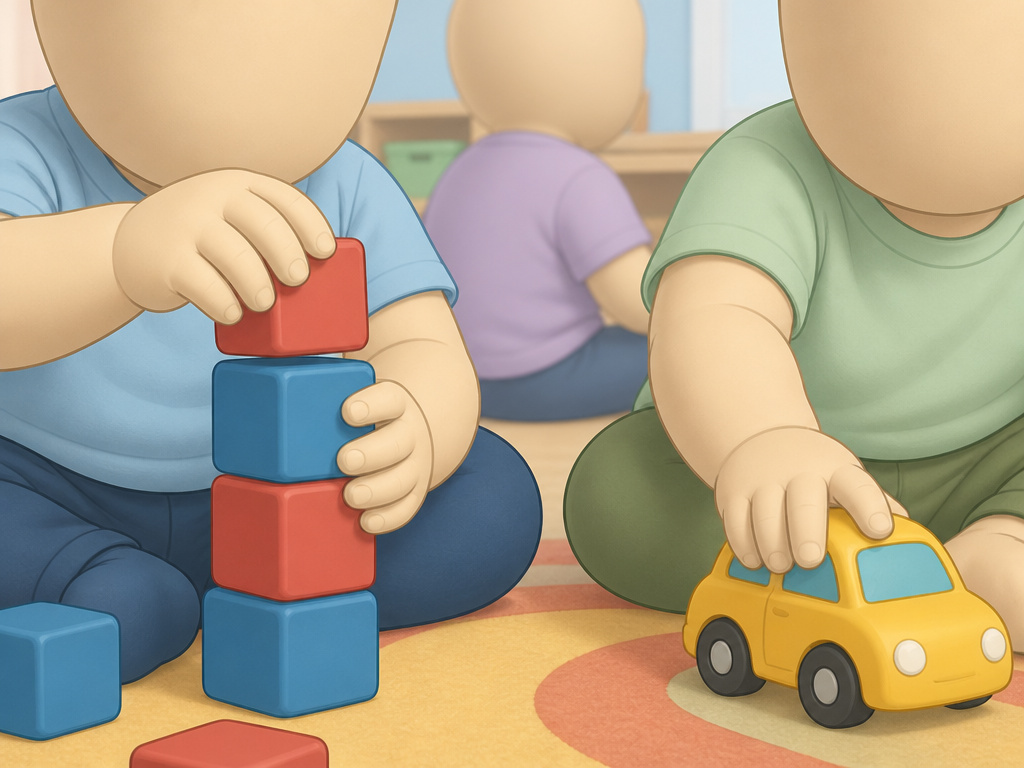
Gross and fine motor skills show up first. Both Wikipedia and EBSCO Research Starters credit parallel play with developing them, and the mechanism is simple: the child does the work themselves, at their own pace, without a coach.
- Fine and gross motor control, built through the child’s own repeated play rather than a guided drill
- Confidence, because playing near other children is a low-stakes rehearsal for joining them
- Observation and imitation, which Vanderbilt lists alongside cooperation and self-esteem
- Language, since kids pick up new words by hearing a peer name a toy or an action
- Emotional expression, because nobody is directing what happens next
A 2003 analysis published in Early Childhood Research Quarterly looked at a narrower group: children who enjoy watching others engage in parallel play. For kids who were neglected or rejected by their peers, parallel-play activities gave them a workable bridge into more social play.
NCHS puts cooperative play at 4 to 6 years, which is the same transition that 2003 analysis was trying to smooth out.
The confidence piece is the one I notice most when I’m walking a play area. Kids who’ve spent time playing beside a group walk into it differently than kids who got pushed in.
Long stretches of silence feel like an eternity when you’re standing at the edge of a sandbox. For a three-year-old, absorbed, self-directed play is a long attention span.
That’s the ground floor of social skills through play. The skills get built before the interaction does.
How Do You Set Up a Space That Invites Parallel Play?
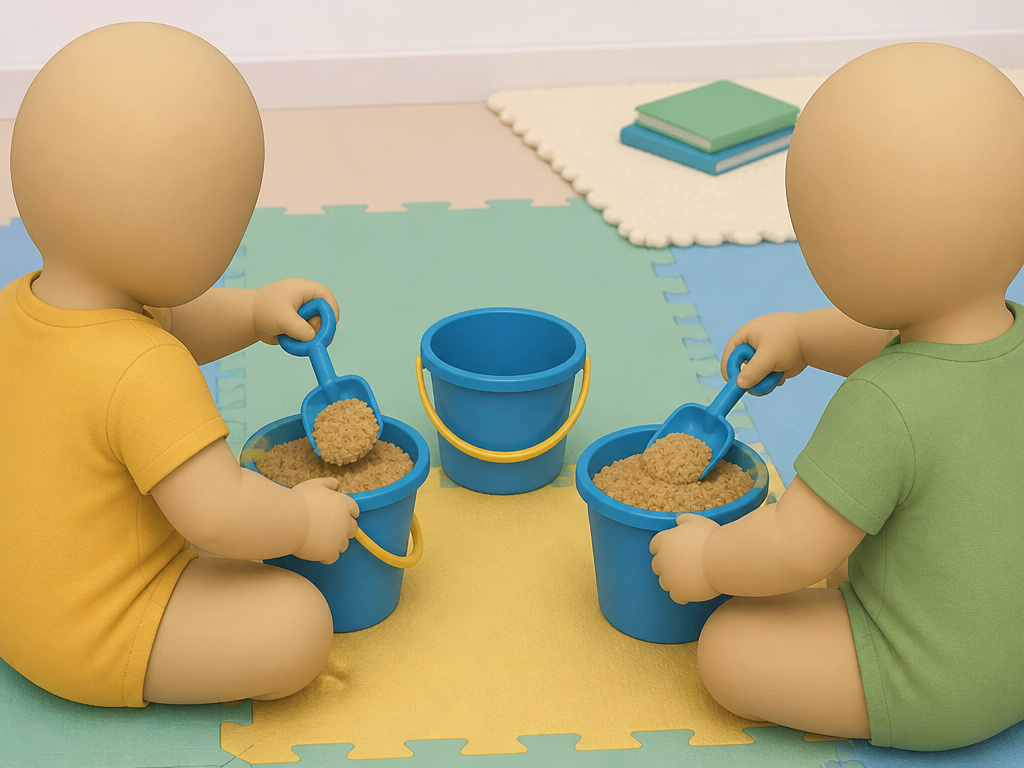
Duplicate the toys, keep them easy to share, and stay close without joining in. That’s the whole setup, and it costs less than one big feature.
A client asked me for a toddler play structure, and I spec’d equipment built for kids two years older. The toddlers climbed it once, got frustrated, and drifted back to the sandbox. I’ve matched equipment to developmental stage rather than the age on the box ever since.
- Buy two of the same toy instead of one bigger toy. NCHS recommends multiple sets of similar toys or art supplies to cut competition, and Vanderbilt asks for several similar, age-appropriate toys that are easy to share. Skip this and you’ll spend time refereeing one blue bucket.
- Rotate what’s out. Vanderbilt suggests rotating toys so the experience stays new. A bin that’s been put away gets played with like it just arrived.
- Stay close and narrate. Vanderbilt’s guidance is to stay close and comment on the play, and NCHS suggests modeling it by working alongside your child. Skip the commentary and you lose the language benefit entirely.
- Give them time and room. Vanderbilt asks for plenty of time and adequate space. Rush a toddler through a transition and the play never gets deep enough to matter.
- Set up same-age playdates. The NCHS parallel play blog post recommends regular playdates with children in the same age group. That’s the step most families skip, and it’s the one that makes the rest work.
The Duplicate-Toy Rule in Practice
Two identical sandboxes side by side beat one deluxe sandbox with a cover, a slide, and a built-in bench. I’ve set up both. The fancy one gets one kid at a time. The two plain ones get two kids at once.
Wooden building blocks work the same way. Buy two sets rather than one deluxe set, because two kids can build without negotiating over the same pieces.
A single mega-tower with a slide, a climbing wall, and a play kitchen looks like better value. In practice, one structure means one kid at a time, and the second kid wanders off.
Think of it like soup. Two identical bowls beat one bowl with everything in it, because nobody has to negotiate over the contents.
A brick box handles the same trick indoors, and a water table does it in summer.
If you want one purchase that does the most work here, it’s a second identical sandbox. Duplicates remove the fight before it starts, and that’s the entire job.
Leave a Quiet Corner Empty
Every play space I’ve designed gets one zone with nothing in it but a mat and a couple of books. That’s where the kid who’s had enough goes without leaving the room. Without it, the overstimulated kid either melts down or gets dragged along, and neither one is play.
Common mistake: Buying one big feature instead of two identical small ones. You’ll spend the next two years mediating a fight that a second bucket would have prevented.
Once the setup is right, the way you support social play is by staying out of the way.
Two Kids, One Toy: Where Sharing Actually Fits
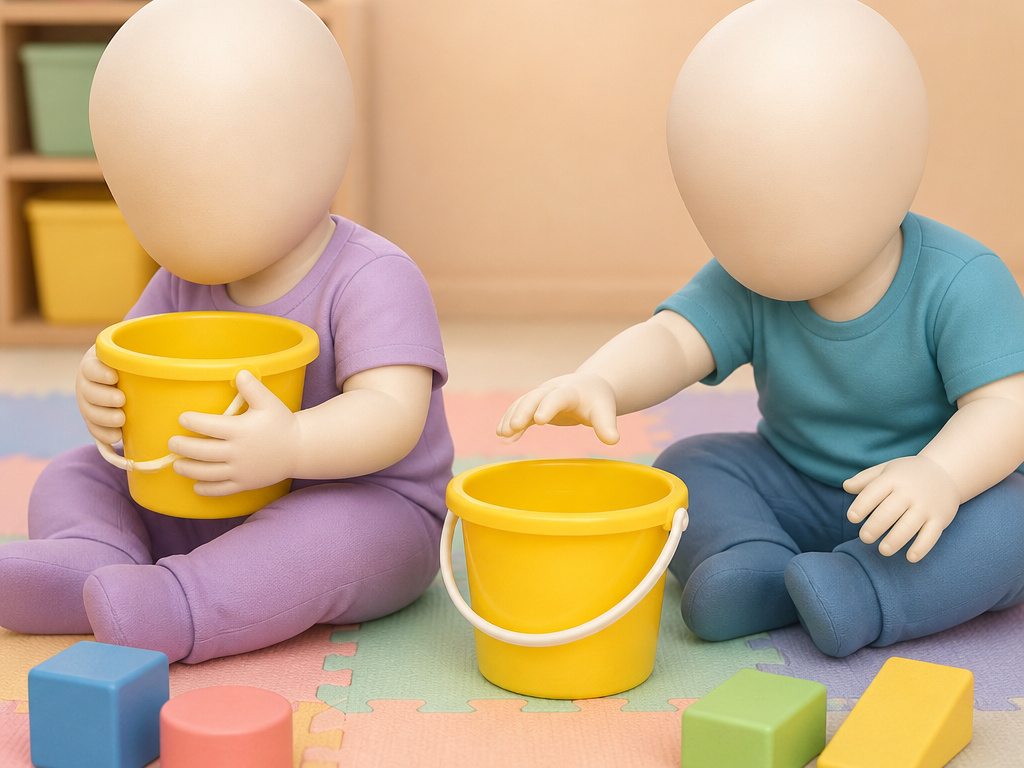
EBSCO Research Starters treats parallel play as a formative window for learning about sharing and empathy. The same entry notes that toddlers at this stage can be fiercely protective of their toys because they don’t yet understand what sharing is.
Both halves of that are true at once, and the tension is the useful part.
| What you see | What it means | What to do |
|---|---|---|
| A child clutches a toy and turns away | Normal possessiveness at this stage | Keep your hands off and let the moment pass |
| A peer grabs the toy | The other child is testing the same boundary | Don’t force a handover; offer a duplicate instead |
| Both kids yell, then settle back in | Conflict resolution in progress | Stay nearby and say nothing unless it escalates |
| One child copies the other’s play | Observational learning, not empty mimicry | Leave it alone; that’s the mechanism working |
EBSCO advises letting children learn to share even when a companion grabs their toy, while NCHS recommends providing multiple sets of similar toys to reduce competition. That’s a hard instruction to follow with a screaming toddler in front of you.
Two identical toys end more fights than any lesson about sharing. Buy the second bucket before you buy the bigger one.
What to Do in the Moment
- Name what you see, not what you want (“You’re both building towers”)
- Offer a duplicate before you offer a solution
- Skip the forced apology; it teaches the words, not the feeling
- Let the moment end on its own
The skills show up on their own timeline, which is why teaching sharing through play works better as a slow build than a single conversation.
What comes next is cooperative play, where kids build the same thing together. Wikipedia notes that after parallel play, children are most often found in Together or Group Play, not back in solitary play.
Easy to miss: The kid who never grabs anything. Some children stay in parallel play because it’s comfortable, not because they’re ready to move on. Watch whether they ever shift position to stay near a peer.
When Parallel Play Shows Up in Adults
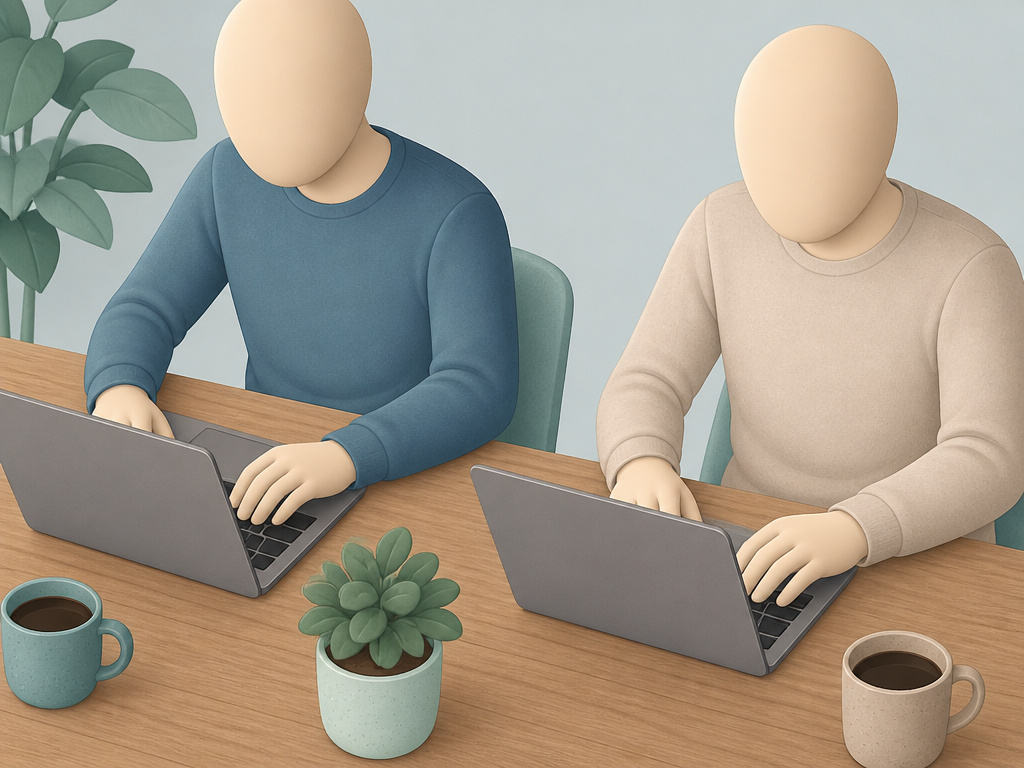
Adults do this too, and almost nobody calls it by the right name.
Wikipedia notes that parallel play in adults is under-researched, and RMIT University psychology lecturer Dr James Collett has suggested the gap comes from cultural stereotypes that adults should be autonomous and self-sufficient.
Independent coworking, also called body doubling, is the work equivalent. Wikipedia describes adult parallel play as a peaceful, low-pressure way to socialise, and between family members and romantic partners it can indicate a healthy form of attachment.
Body Doubling Is the Grown-Up Version
Two people at one table, each on their own laptop, neither talking. That’s the shape. Autistic people often keep engaging in parallel play into adulthood with other autistic people, caregivers, and others.
For toddlers, independent play sits right next to this stage. Both are about being present without being demanded of.
Frequently Asked Questions
What is parallel play in one sentence?
Parallel play is when young children play side by side with similar toys and don’t try to change what the other child is doing. The interaction is indirect, but the choice to use the same toys is itself a social move.
At what age does parallel play start?
The sources disagree, and that disagreement is real. Wikipedia, citing Parten, says 24 to 30 months. EBSCO Research Starters gives 1.5 to 3 years, and 3.5 to 4 years in a separate entry. NCHS says 2 to 3 years, and 18 to 36 months elsewhere. Treat the window as roughly 18 months to 4 years.
How is parallel play different from cooperative play?
In parallel play, two children work on separate versions of the same activity without negotiating. In cooperative play, they share a goal and divide the work. NCHS places cooperative play at 4 to 6 years, and Wikipedia notes that after parallel play, children are most often found in Together or Group Play.
Should I worry if my child only plays alone?
Parallel play and solitary play look similar from across the room, so watch for the sideways glance. If your child adjusts what they’re doing after watching a peer, that’s parallel play. If they never look up at all, keep offering same-age playdates and give it time.
Do I need to teach my toddler to share during this stage?
EBSCO advises letting children learn to share even when a companion grabs their toy, while NCHS recommends providing multiple sets of similar toys to reduce competition; EBSCO also notes that toddlers at this stage can be protective because they don’t yet understand sharing. Duplicate toys do most of the work. A second bucket prevents more fights than a lecture does.
Is parallel play only for kids?
No. Wikipedia notes that parallel play in adults is under-researched, and that body doubling, or independent coworking, is the work equivalent. Autistic people often engage in parallel play into adulthood.
The Bottom Line
Here’s the threshold I’d watch. If your child spends weeks near other children but never adjusts what they’re doing after watching them, that’s worth a conversation with a preschool teacher or your pediatrician. The sideways glance is the whole mechanism, and it should show up eventually.
Everything above assumes a child who gets regular chances to be near other kids. A toddler who spends most days alone with an adult won’t show much parallel play, and the fix is a playdate, not a program.
I’ll take it further than most people in my line of work would. I’d rather see a kid spend time playing beside a group than get pushed into the middle of it on day one. The push looks like progress. The month is the progress.
So what is parallel play worth to you as a parent? Mostly, it’s permission to stop hovering. Buy the second bucket, sit down nearby, and let quiet minutes be quiet minutes.
