
Water Beads Safety for Kids: New Federal Rule
This post contains affiliate links. As an Amazon Associate, we earn from qualifying purchases.
Water beads safety for kids starts with one rule: keep them out of any home or classroom with a young child. UK regulators draw the line at under 5, the CPSC at 3 and younger. In liquid, the beads swell to 100 times their original size, and a swallowed bead can block a child’s intestine.
Those two age lines describe the same hazard, judged differently, much like the water beads safety for kids question, which also hinges on a child’s age. The UK alert notes that young children put objects in their mouths more than anyone else, and it draws the line at under 5. The CPSC draws its line at 3 and younger.
What follows is the practical version: what the new federal rule actually requires, how big these things really get, what to do with a jar you already own, and which play setups give a toddler the same scoop-and-pour thrill without a bead that keeps growing, including how to keep a water table clean if you switch to that kind of play.
Key Takeaways
- Keep water beads out of any home with a child under 5. The UK OPSS goes further and says caregivers of under-5s should avoid having them at all, even when the beads belong to an older sibling.
- The US rule took effect March 12, 2026. Water bead toys made after that date must pass a 5.0 mm expansion gauge and cap extractable acrylamide at 325 micrograms.
- Symptoms can lag by a day or more. Vomiting and stomach pain are the signs to watch for, and UK and New Zealand regulators both say ingested beads are hard to spot on an X-ray.
- A dry bead is pinhead-sized and nearly invisible on carpet. Beads also stick to wet hands and transfer to the mouth, which is how many of the youngest cases start.
- Call 800-222-1222 if you suspect ingestion. That’s the National Poison Help Line, staffed around the clock.
Water Beads Safety for Kids: What the New Federal Rule Changes
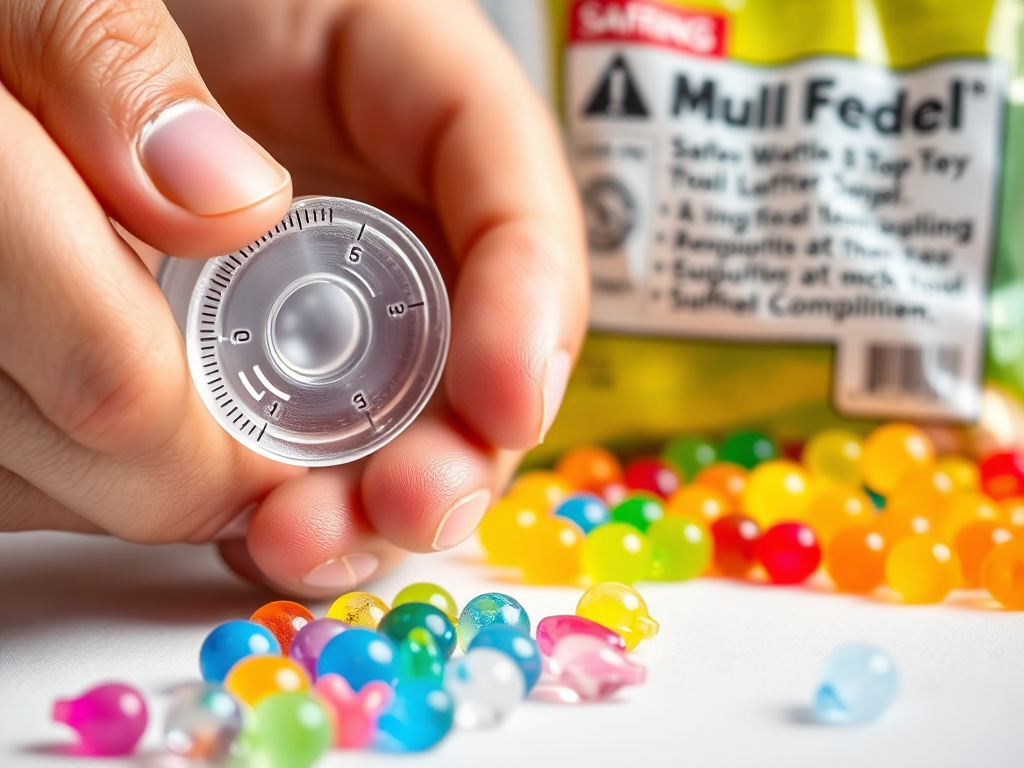
The Consumer Product Safety Commission’s final rule on water bead toys took effect on March 12, 2026. Any water bead toy manufactured after that date has to meet new performance, labeling, and testing requirements. Products that fail are illegal to sell in the United States.
The standard applies to water beads in toys whether or not the beads are accessible. Dehydrated beads that fit inside the small parts cylinder must pass through a 5.0 mm funnel or sieve gauge once fully expanded. Extractable acrylamide is capped at 325 micrograms per 100 small beads or one large bead.
The labeling side is the part I think will actually change behavior, much like learning to clean a water table changes how families manage water play. Warning labels now have to follow ANSI Z535.4-2023 formatting, and the final rule made them more explicit about ingestion and insertion hazards than the earlier draft, the same way guidance on mold-free bath toys spells out hidden risks.
| Requirement | Value in 16 CFR 1250.4 |
|---|---|
| Acrylamide limit | 325 micrograms per 100 small beads or 1 large bead |
| Small bead, dehydrated | Under 4.0 mm in all dimensions |
| Large bead, dehydrated | 4.0 mm or more in any dimension |
| Expansion gauge | 5.0 mm funnel or sieve gauge |
| Test bath temperature | 37 +/- 2 C (98.6 +/- 3.6 F) |
| Submersion time | 72 hours, measured at 6, 24, 48 and 72 |
Manufacturers have to list “16 CFR 1250.4” on the Children’s Product Certificate that ships with the toy. The CPSC water bead toys business guidance spells out exactly what that paperwork has to contain. The [Federal Register water bead safety standard](https://www.federalregister.gov/documents/2025/12/12/
Frequently Asked Questions
How long does it take for a swallowed water bead to cause symptoms?
Signs may not appear for twelve hours or more after a bead goes down, and some children look completely fine at first. Vomiting, stomach pain, and refusal to eat are the usual clues once a bead has begun swelling inside the gut. Because the delay is long, tell any clinician the exact time you think the bead was swallowed.
Do I need to throw away water beads if my children are all older than five?
Not automatically, but the beads still need rules. Keep them away from younger visitors, pets, and any sibling who still mouths objects. Store the container sealed and up high, and count what you pour out so you notice strays before a toddler crawls through the room.
Can a water bead be seen on a scan at the hospital?
Often it cannot. Regulators in the UK and New Zealand both warn that these beads are frequently invisible on standard X-rays because they are mostly water. That is why a parent’s report of possible ingestion carries so much weight in the emergency room, even when imaging looks clear.
What should I do if I find a stray bead on the floor?
Pick it up with a damp paper towel rather than dry fingers, since beads cling to moisture and travel easily to the mouth. Sweep or vacuum the surrounding area, then empty the vacuum canister outside if the beads were dry. Check under furniture and along baseboards, where a rolling bead tends to settle.
