
Types of Musical Toys: What Breaks First
This post contains affiliate links. As an Amazon Associate, we earn from qualifying purchases.
Types of musical toys fall into five families: struck, plucked, blown, electronic, and wind-up. Each one fails in a different place. A wooden beater or a set of keys can come free and fit a small-parts cylinder, which is why the CPSC has recalled musical toys over the years.
That detachment test is where most of the trouble starts. A part only has to come loose once, and a toy that looked fine on the shelf becomes a choking hazard small enough to swallow. The UK’s PRISM risk assessment puts it plainly: a part that releases below the 90 Newton threshold is riskier than one that holds, even though both fail the same 90 Newton threshold.
What follows sorts those five families by how they’re played, how they fail, and what to check before one comes home. There’s a section on why a 3+ age label doesn’t make a toy safe for a three-year-old, one on battery specs and the screw that strips, and one on why the toy with the most buttons gets abandoned first.
Key Takeaways
- Five families cover the category: struck, plucked, blown, electronic, and wind-up, and each family breaks in its own place.
- Check the smallest white sewn-in label, not the care label. Kids Preferred recall coverage depends on a matching model number and batch code.
- Battery format is model-locked. A Mattel P8598 piano takes two AA (LR6) batteries; the P8598 guitar takes three LR44 button cells.
- A 3+ label doesn’t override the design.
- Take the toy away first, ask questions later. Every CPSC remedy for these five recalls starts with removing the toy from young children.
The Five Types of Musical Toys and What Each One Actually Does
The types of musical toys cover nearly everything in the musical toy aisle: struck, plucked, blown, electronic, and wind-up. Sort by what makes the sound, and the safety profile falls out of the same sort.
Here’s what each family looks like on a shelf:
- Struck toys cover xylophones, drums, cymbals, and tambourines. The sound comes from a hit, so the parts that matter are the beater and whatever holds the bars in place.
- Plucked toys are guitars, ukuleles, and harps. Strings under tension, tuning pegs, and a soundbox. Mattel’s P8598 guitar sits in this group.
- Blown toys put a mouthpiece against a child’s face, which is why the standards treat them on their own.
- Electronic toys light up and play fixed tunes, and they run on batteries. The Pooh Poppin’ Piano was one.
- Wind-up toys hide a metal mechanism inside a plush body. Turning the handle plays the music, and the handle is the part that comes off.
If you’re shopping the struck and plucked end of that list, most of what you’ll find are wooden toys, and the material is doing real work: no battery door, no fixed tune, nothing to reset.
Which Type of Musical Toy Fits Which Age?
Ever watched a two-year-old put a xylophone beater straight into their mouth? That’s the behavior the age bands are built around.
By six, children don’t mouth toys to any significant degree.
Here’s what the data says at each stage:
- Under three: mouthing is the dominant hazard, and the research concentrates almost entirely here.
- Four to five: mean mouthing time drops to about 3 minutes and 1 minute per day.
- Six and up: mouthing drops off to nothing significant.
The label on the box doesn’t change any of that.
For a baby, the useful picks are the ones with no removable parts at all, which is why the musical toys for babies list looks so different from musical toys for 1 year olds. Once a child is walking and grabbing, the choice widens, and musical toys for 2 year olds can include a drum with a fixed beater. The musical toys for 3 year olds end of the range adds instruments with real strings and small moving parts.
In short: the risk window sits under three, and the label on the box doesn’t move it.
Electronic vs. Wooden Musical Toys: What Actually Breaks First
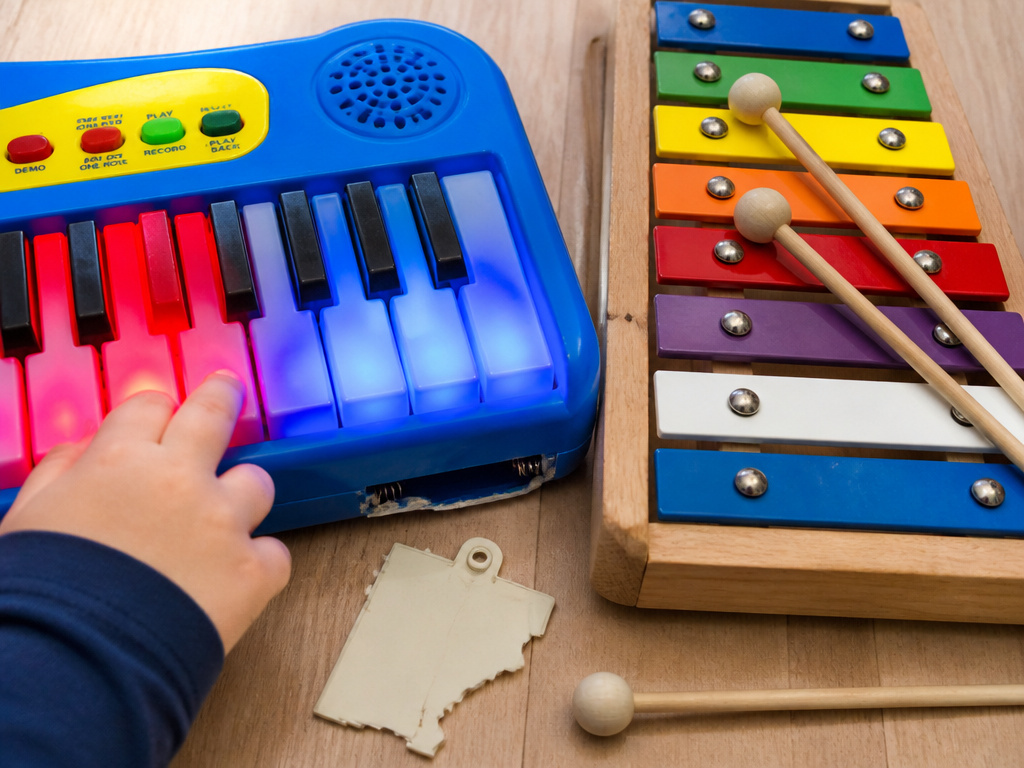
Wooden wins on almost every count, with one exception that matters more than the rest.
| Question | Electronic musical toys | Wooden musical toys |
|---|---|---|
| Power source | Batteries, model-locked | None |
| Documented failure point | Battery doors, screws, microphone tops | Beaters, pegs, separating balls |
| What the manual says | No consumer serviceable parts | Not addressed in the records |
| How the sound gets made | Fixed tunes from a speaker | Whatever the child does to it |
For a child under three, wooden wins, and it isn’t close. No battery door to open, no button cell to swallow, no microphone top to snap off.
Durable beats flashy every time. That said, there’s a real case for the electronic side, and it’s narrower than the packaging suggests.
The One Case Where an Electronic Toy Wins
Playing along with a tune is the thing wood can’t do. The Fisher-Price 71102 Lights ‘n Sounds Piano lights its keys and plays a musical tone when they’re touched, and a child can press two or three keys to make chords or follow the tune one note at a time.
That’s a genuine skill, and it needs a speaker and a circuit. A wooden xylophone will never teach a kid to match pitch against a backing track.
Anything with a speaker raises a question wood never does: volume. Loud toys and hearing safety covers that side of it, and the electronic vs traditional toys divide tracks how much work the child does versus how much the toy does.
What Five Recalls Reveal About Musical Toy Design
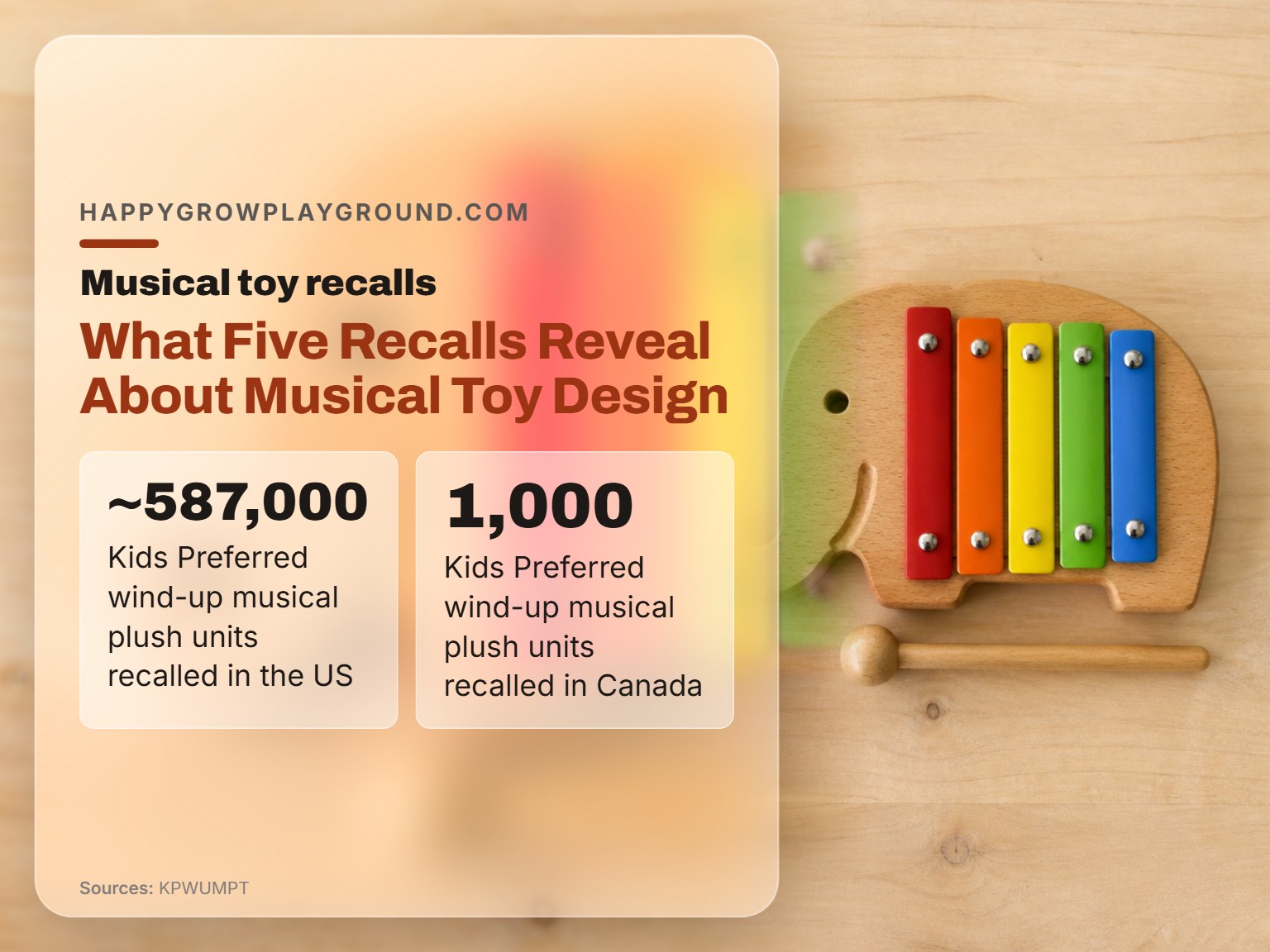
The CPSC’s recall records for musical toys read like a design manual written after the fact. Five recalls, five different failure points, one shared remedy.
The oldest is the Reeves International Kouvalias music toy recall from 1994. Roughly 18,400 units came back after colored wooden balls and gear components separated during routine CPSC testing. The toy was a wooden base five inches across, a platform three and a half inches across, a two-inch ball, and nine more balls on 1-1/2 inch coil springs. Neither the CPSC nor Reeves knew of any injuries at the time.
The Pooh Poppin’ Piano recall notice followed in 1999 and covered about 202,000 units. The green leafy top of the carrot-shaped microphone could break off. Parents and caregivers were told to take the toy away from children immediately and contact Tiger for a free replacement.
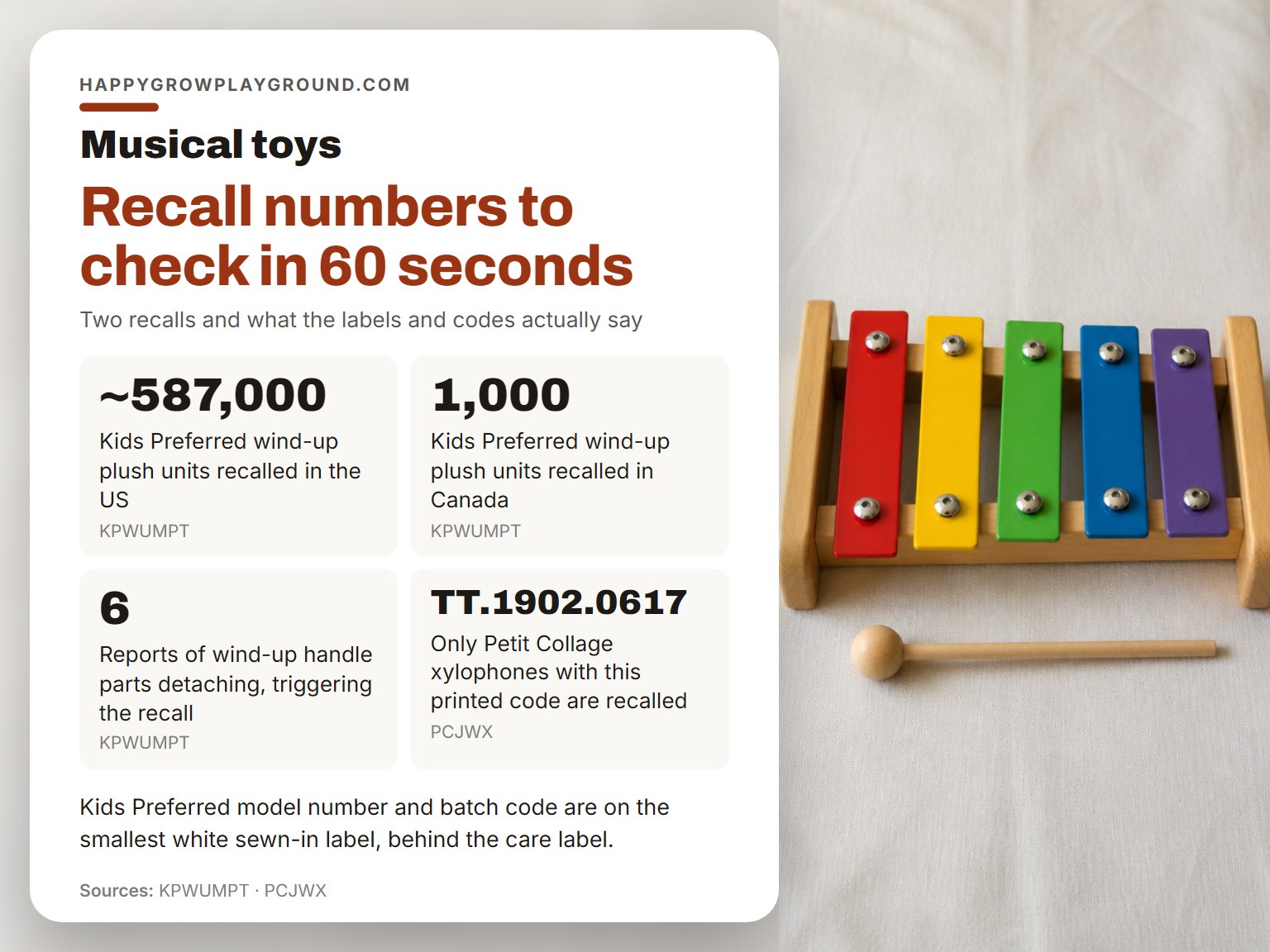
The Kids Preferred wind-up toy recall is the biggest of the five: about 587,000 units in the US and 1,000 in Canada, sold under Carter’s, Child of Mine, Guess How Much I Love You, and Just One You. Six reports of wind-up handle parts detaching triggered it.
Petit Collage’s jumbo wooden xylophone came last, in 2018. The toy is a wooden base shaped like an elephant profile with five colored metal keys and a beater stick about 5 5/8 inches long by 3/4 inches wide. Only units printed with the code TT.1902.0617 are covered.
What most people get wrong: assuming a recall covers every unit of that toy.
What the Unit Counts Tell You
Counts range from a few thousand to more than half a million, and the spread says more about production volume than about danger.
A recall record is what happens when nobody asks.
The Battery Spec Sheet Nobody Reads (and the Screw That Strips)
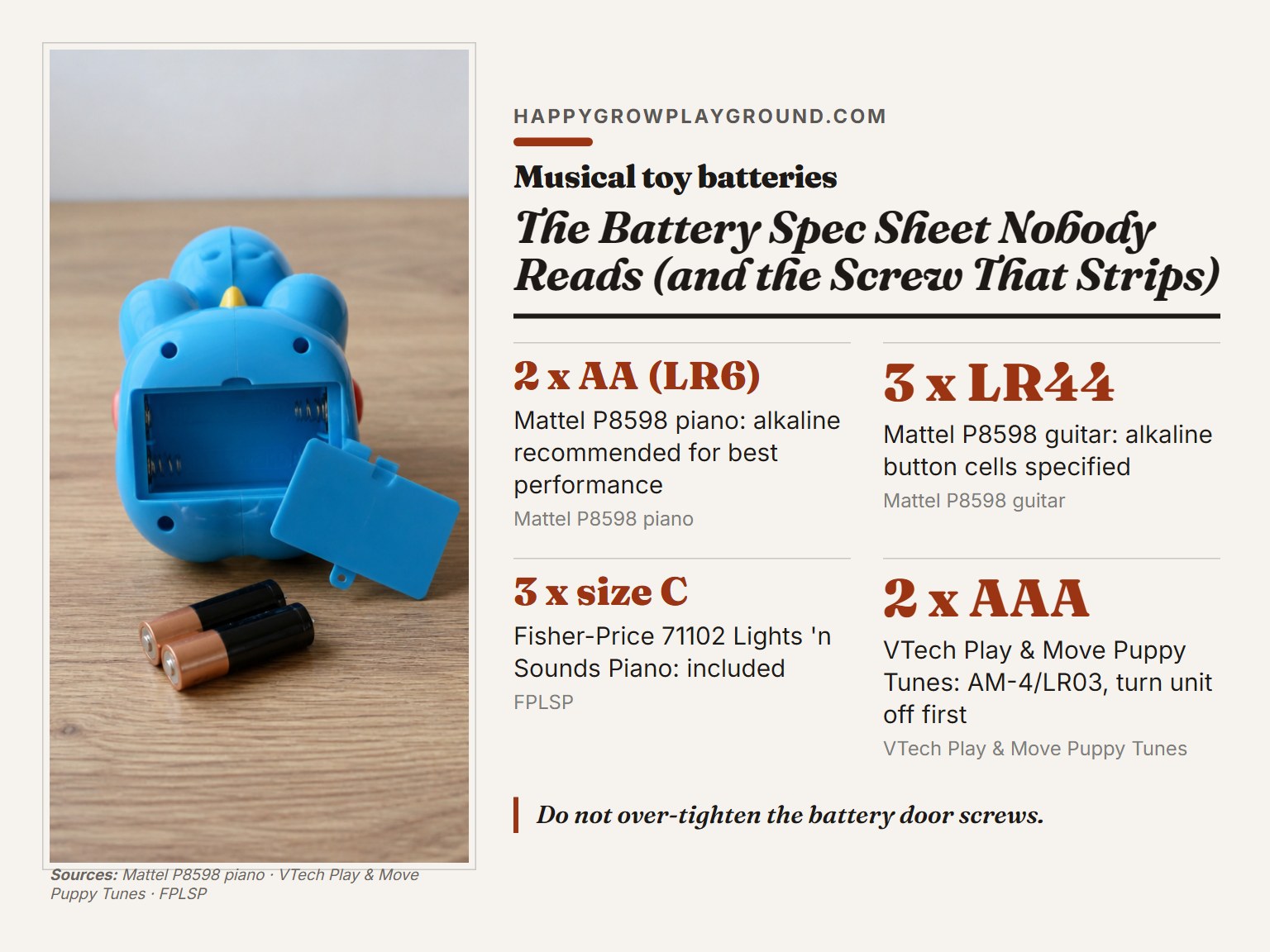
Battery compartments are where musical toys quietly fail. A battery compartment is the ash pan of a toy. You ignore it until the whole thing stops working.
Before you start: Work over a tray with a lip so a loose cell can’t roll off the table, and keep the screwdriver out of reach while the door is open.
| Toy | Batteries | Notes |
|---|---|---|
| Mattel P8598 piano | 2 x AA (LR6) alkaline | Door on the bottom, screws |
| Mattel P8598 guitar | 3 x LR44 button cells | Alkaline specified |
| Fisher-Price 71102 Lights ‘n Sounds Piano | 3 x size C (included) | Phillips screwdriver needed |
| Fisher-Price CCW02 | 3 x AA | Per Mattel’s product listing |
| VTech Play & Move Puppy Tunes | 2 x AAA (AM-4/LR03) | Turn the unit off first |
Five toys, four different battery formats, and no manual claims any of them are interchangeable. Treat the format as model-locked and read the compartment before you buy cells.
Here’s the sequence, with the part that bites if you skip it:
- Turn the toy off first. VTech’s manual says to make sure the unit is off before installation, and a live circuit is how you get a reset you didn’t ask for.
- Loosen the screws on the battery door. Mattel puts the P8598 door on the bottom of the toy, and Fisher-Price’s 71102 calls for a Phillips screwdriver.
- Take out the exhausted batteries and throw them away. Mattel says to always remove exhausted batteries, because a dead cell left sitting in the compartment is the one that leaks.
- Insert the new batteries as indicated inside the compartment. Mattel’s manual says to follow the markings, and VTech says to match polarity.
- Replace the door and tighten the screws, but don’t over-tighten. Mattel warns about this specifically, and a stripped screw means the door never seals properly again.
- If the toy starts acting erratically, pull the batteries and replace them. Mattel’s manual lists that as the reset for the P8598 line.
Mixing Batteries: The Warning Every Manual Repeats
Mattel and VTech say the same thing in almost the same words. Don’t mix old and new batteries, and don’t mix alkaline with standard carbon-zinc or rechargeable nickel-cadmium cells.
Both manuals also warn against charging non-rechargeable batteries, and both say to remove rechargeable batteries before charging them, under adult supervision. Mattel adds that batteries can leak fluid in exceptional circumstances and cause a chemical burn injury or ruin the product.
Pull the batteries out during long periods of non-use. Neither manual wants them sitting in a toy that’s been in a closet for a year. And neither toy is meant to come apart: both Mattel and Fisher-Price state their toys have no consumer serviceable parts, so wipe the surface with a clean damp cloth and stop there.
Does a Musical Toy Need Batteries to Be Worth Buying?
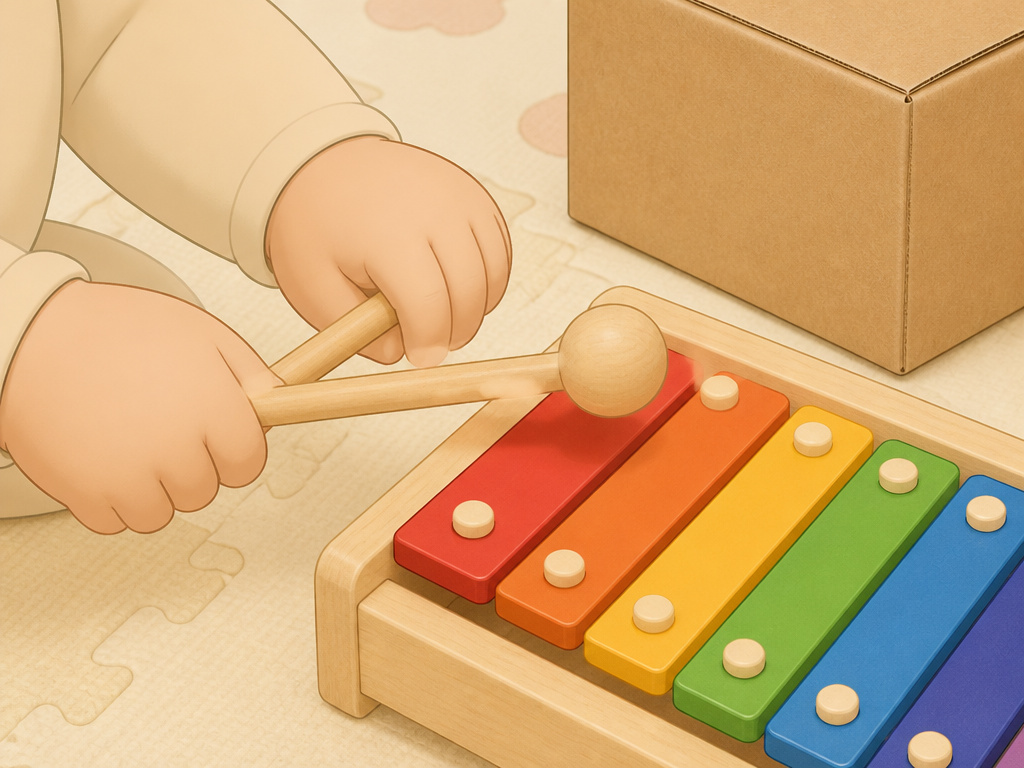
Does a toy that sings the alphabet actually teach anything? In my experience, no. The interaction teaches, and the toy is just the excuse for it.
I’ve been buying open-ended pieces ever since.
Buying a musical toy for a toddler is like buying a grill for someone who’s never cooked. The tool doesn’t make the meal.
That’s the test I run on anything new.
If you do want an electronic one for a child who’ll actually play along, the Fisher-Price 71102 Lights ‘n Sounds Piano has automatic shut-off, which saves batteries.
For a first instrument, the musical toys for toddlers shortlist is where I’d start. (And yes, I’ve watched a kid get more out of a box than out of the thing that came in it.)
How to Vet a Musical Toy in 60 Seconds
Sixty seconds in the aisle is enough to rule a musical toy in or out. The checks below are the ones that actually catch something.
- Read the smallest white sewn-in label, not the care label. The Kids Preferred recall needs a matching model number and batch code, and the care label alone won’t tell you either one.
- Look for the printed code TT.1902.0617. The Petit Collage recall covers only xylophones marked TT.1902.0617.
- Check the battery door. If it opens without a tool, put it back on the shelf.
- Shake it and listen. A rattle means something inside is already loose, and that’s the noise you’d otherwise hear six weeks later.
- Check the age label, then check the design anyway. A 3+ warning doesn’t
Frequently Asked Questions
Are blown musical toys safe for toddlers to share?
Mouthpiece that touches one child’s face and then another’s is a hygiene problem before it is a safety problem, and shared classroom instruments rarely get cleaned between users. Blown toys also demand a seal around the lips that most children under four cannot hold, so the toy ends up chewed rather than played. If a blown toy is in a shared bin, treat it as a single-owner item.
Do wind-up musical toys need different checks than battery toys?
Yes, because the failure point sits outside the sealed body. The crank handle, the key, and the shaft it turns are all exposed and all under load every time the toy is wound, so they loosen with use rather than with impact. A battery toy hides its hazard behind a screwed door; a wind-up toy puts its hazard in a child’s hand.
Why do electronic musical toys often stop working before they break?
Button cells drain fast when a toy plays a fixed tune on repeat, and the battery compartment screw is usually the first thing to strip when an adult opens it. Once that screw rounds out, the door no longer sits flush, which turns a working toy into an accessible battery compartment. Check the screw head before you buy, not after the music stops.
Can a plucked toy’s strings hurt a child?
Strings under tension can snap, and a snapped end whips back toward the face and eyes. Loose tuning pegs are the other concern, since they can be turned out far enough to detach on some models. Inspect the pegs and string condition each time the toy comes out of the bin.
