Puzzles Pros and Cons: What to Know Before You Buy
This post contains affiliate links. As an Amazon Associate, we earn from qualifying purchases.
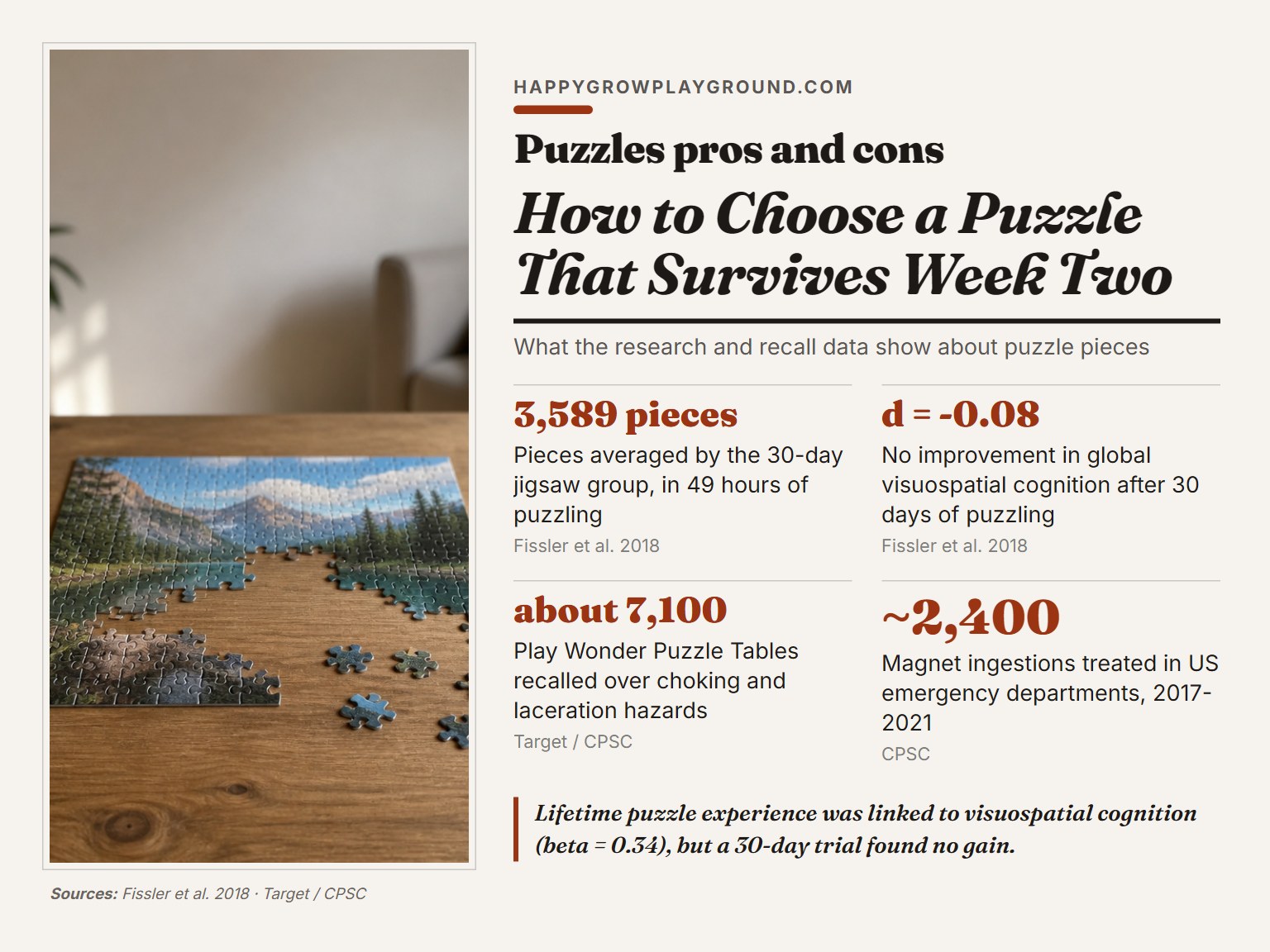
Puzzles pros and cons split along two lines: what the research shows and what the recalls show. Lifetime puzzle experience tracks with stronger visuospatial skills, the ability to read shapes and space, but a 30-day jigsaw trial found no measurable gain. On safety, Target recalled about 7,100 Play Wonder Puzzle Tables over choking and laceration hazards.
That 30-day result is the one worth sitting with. The same paper reports the opposite signal for lifetime habits, which points to a benefit that builds over years instead of weeks. A puzzle abandoned in week one never gets that chance.
What follows: the split research record, the three recalls that shaped modern toy safety rules, the heat problem that destroys 3D-printed puzzles, and the picks that survive past week two.
Key Takeaways
- Lifetime puzzle habits track with stronger visuospatial scores, but a 30-day trial moved nothing.
- Target recalled about 7,100 Play Wonder Puzzle Tables. Take them from kids and return them to any Target for a full refund.
- Bagging PLA pieces separately doesn’t stop heat damage. It changes how the puzzle fails.
- PC Blend survived a dashboard that destroyed PLA and PETG. Bell flagged the PETG result as anomalous, either the peak temperature exceeded 64 C or PETG can fuse below its glass-transition temperature.
- Match the puzzle to the kid, not to the age label printed on the box.
Do Puzzles Actually Make You Smarter? The Evidence Is Split
Fissler et al. Tested this directly, and their own paper reports two answers that don’t line up. Adults with a lifetime of jigsaw experience scored higher on global visuospatial cognition, with a beta of 0.34.
Fissler et al. (2018) enrolled adults aged 50 and older and assigned a 30-day jigsaw intervention. The puzzle group averaged 3,589 pieces across 49 hours of solving. Global visuospatial cognition showed no improvement: effect size -0.08, p-value 0.39. The same paper reports that lifetime puzzle experience is associated with a beta of 0.34.
Read those two findings side by side and the disagreement is the whole story. The same authors, in the same paper, report a strong link for lifetime habits and a flat result for a month of hard solving. Fissler et al. Describe puzzling as a “potential protective factor” for cognitive aging while their own short-term data sits at zero.
So which one do you believe? Both, and that’s the honest answer. A p-value of 0.39 means the month-long result could easily be chance. A beta of 0.34 from a lifetime habit study can’t prove the puzzles caused anything either.
That distinction matters when you weigh the puzzles pros and cons before spending money. The puzzles for brain health case is a long game. Thirty days won’t show it, and the jigsaw puzzles and cognitive aging paper is the one to read if you want the raw numbers.
For an older adult, puzzles for seniors with bigger pieces and a clear image beat a dense landscape every time.
I’ll take the long view on this one.
Puzzles Pros and Cons: The Drawbacks Nobody Prints on the Box
Frustration never makes the box.
Every puzzle has a difficulty ceiling, and crossing it turns a toy into a chore.
Here’s what actually goes wrong:
- Difficulty mismatch. The single biggest reason a puzzle dies in its first week.
- Missing pieces, lost to a vacuum or a dog
- Storage creep. A big puzzle needs a surface you can leave alone for days.
- The cost of buying them faster than a kid can finish them
The board games pros and cons list runs into the same trap, and so does any puzzle pick aimed at the wrong age. There’s even an ACM puzzle challenge analysis tool built to measure how hard a puzzle is in video games, which says something about how seriously people study this.
My rule is simple. Buy one step below what the label claims.
Three Recalls, Three Different Failure Modes
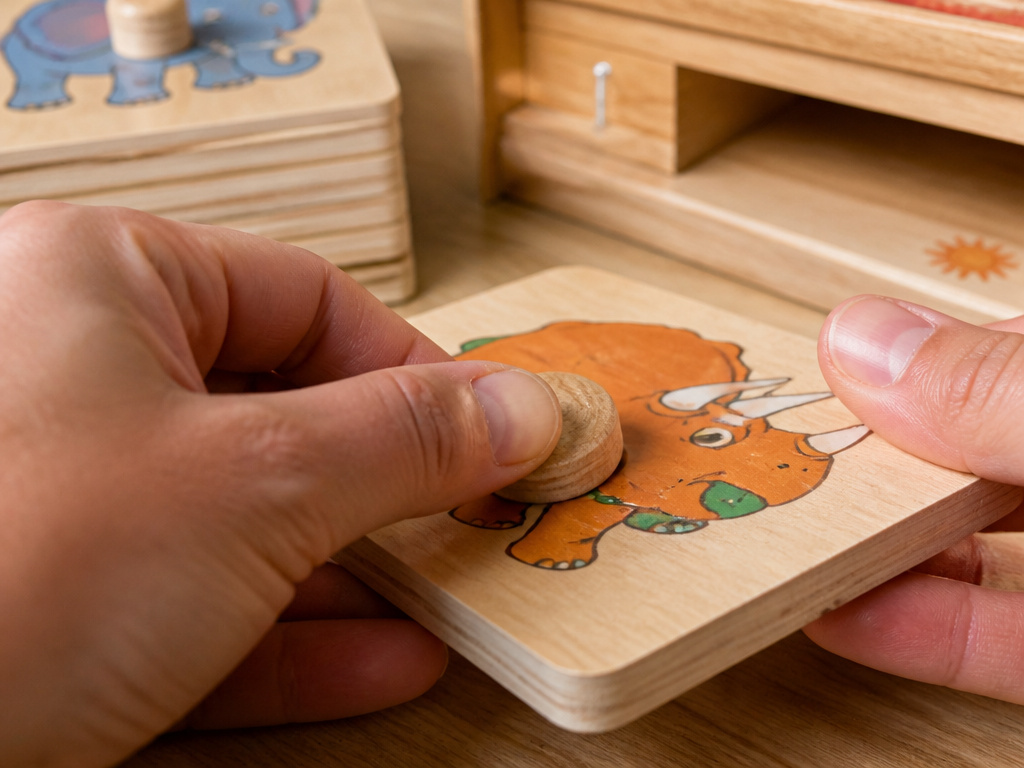
About 7,100 Play Wonder Puzzle Tables went back to Target in a single recall. Two smaller recalls show the other ways a puzzle fails.
Target recalled the table because the handles on the puzzle pieces can come off, which creates a choking hazard. The tips of the nails on the inside shelf could also be exposed, which creates a laceration or puncture hazard. The table holds three nine-piece wooden puzzles and stands about 13 inches high when assembled. The item number is 204/12/0162.
A handle that’s working sits tight against the board. A handle that’s about to come off spins under your thumb.
| Product | Hazard | Status |
|---|---|---|
| Play Wonder Puzzle Table | Detaching handles; exposed nail tips | Recalled; full refund at Target |
| Rolling Ball Pile Rattles Tower Puzzle | Balls broke; parts fit the small-parts cylinder | Listing removed; consumers warned |
| Outad Good Life magnetic chess set | 20 loose magnets; fails the federal toy magnet rule | Recalled 13 June 2024 |
What the Target Recall Got Right
The remedy was clean. Consumers were told to take the product from children immediately and return it to the nearest Target Store for a full refund. Federal law also bars anyone from selling a product under a recall like this one.
The CPSC puzzle table recall notice names the exact failure instead of hiding behind vague wording.
Where Marketplace-Only Recalls Go Wrong
The UK alert on the Rolling Ball Pile Rattles Tower Puzzle is a different animal. That puzzle has 5 bi-colour balls, and it failed the impact test: the balls broke and released elements that fit entirely within the small-parts cylinder.
The alert date was 8 October 2021, with the report published 26 March 2022. The online marketplace removed the listing and warned consumers. The puzzle fell under the Toys (Safety) Regulations 2011.
Marketplace-only listings are the hard case. The Temu chess set and the rolling-ball puzzle were marketplace listings, so a recall depends on the platform cooperating.
The magnet numbers are the part that should stop you cold. CPSC reported roughly 2,400 magnet ingestions treated in US emergency departments between 2017 and 2021, and seven deaths from magnet ingestion since 2005, two of them outside the US. About 2,600 of those chess sets were sold.
Before you start: Check every puzzle in your house against the CPSC recall list before you buy another one. A recalled puzzle can still turn up at a yard sale or in a donation bin, and selling one is illegal. If a handle spins loose or a piece rattles, stop and look up the model number.
Here’s the order I’d work in:
- Find the item number on the packaging or the base of the table. Without it you can’t match a recall, and you’ll end up guessing from a photo.
- Search the CPSC recall database for that exact number. A near match on the product name means nothing, and you’ll talk yourself into a false all-clear.
- Take the item away from kids before you do anything else.
- Return it to the store for a refund instead of reselling it. Reselling a recalled product is against federal law, and that applies to you, not just to retailers.
Why a PLA Puzzle Melts in a Parked Car
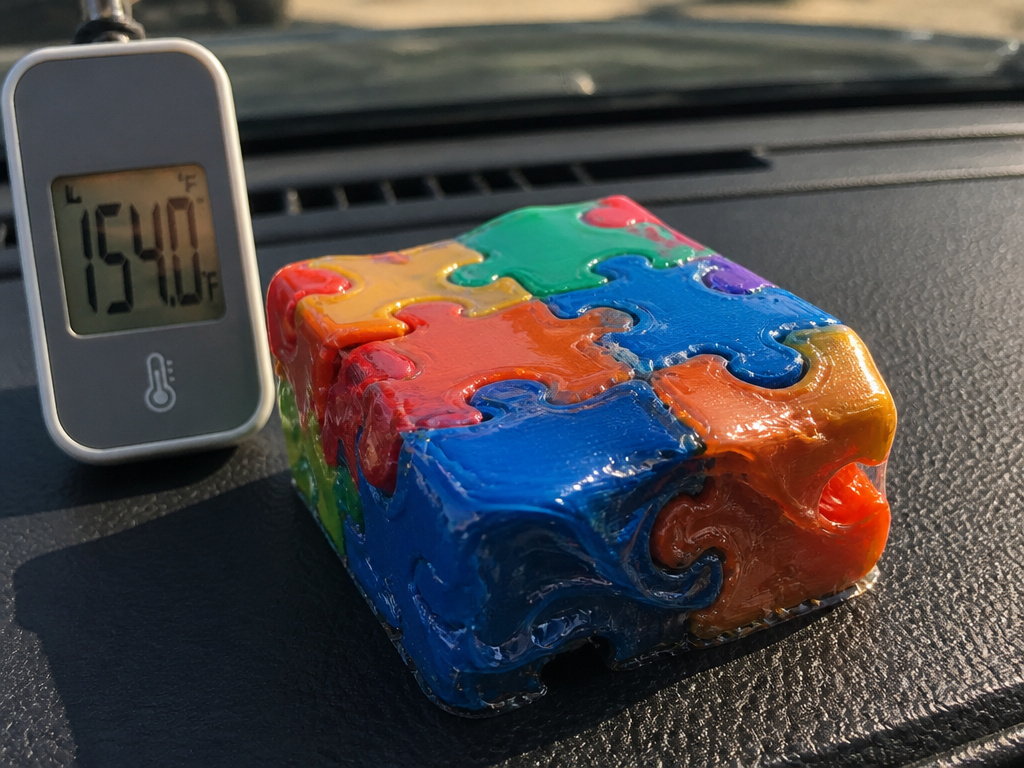
PLA puzzles can fuse or warp in a hot parked car, as Bell’s dashboard experiments showed.
Puzzle designer G. Bell ran the experiment. On 8 July 2022, PLA+ and PETG Flippe Ball puzzles sat on a dashboard for four hours. Bell flagged the PETG result as anomalous, either the peak temperature exceeded 64 C or PETG can fuse below its glass-transition temperature. Both puzzles fused.
| Material | Bell’s result | Verdict |
|---|---|---|
| PLA+ | Fused after 4 hours on a dashboard | Fails |
| PETG | Destroyed despite a temperature below its glass-transition point | Fails |
| PLA, bagged separately | Warped rather than fused | Fails |
| PC Blend | Unaffected | Survives |
A fused puzzle feels like one solid block. You can’t slide the pieces apart, and the seams come out glazed and shiny instead of matte.
The PETG Anomaly Bell Couldn’t Explain
Here’s the part that breaks the material spec sheet. PETG was destroyed at a measured temperature below its own glass-transition point, and Bell flags that result as anomalous in the write-up. Either the peak temperature climbed past 64 C, or PETG pieces fuse at temperatures below the number printed in the spec.
Nobody has settled that one. Treat any PETG puzzle left in a hot car as a coin flip.
Common mistake: Bagging PLA pieces individually to protect them in storage. Bell tested that on 12 August 2022 and both PLA copies were destroyed anyway. The assembled one fused and the bagged pieces warped. Separating the pieces changed the failure mode. The outcome stayed the same.
Bell also notes that puzzle designer Oskar Van Deventer lost shipped PLA puzzles to heat in transit. If a puzzle crosses a hot state in a mail truck, the box won’t save it.
I’d skip PLA entirely for anything that gets shipped or stored in a garage.
Does a Snug Fit Beat the Choking-Hazard Test?
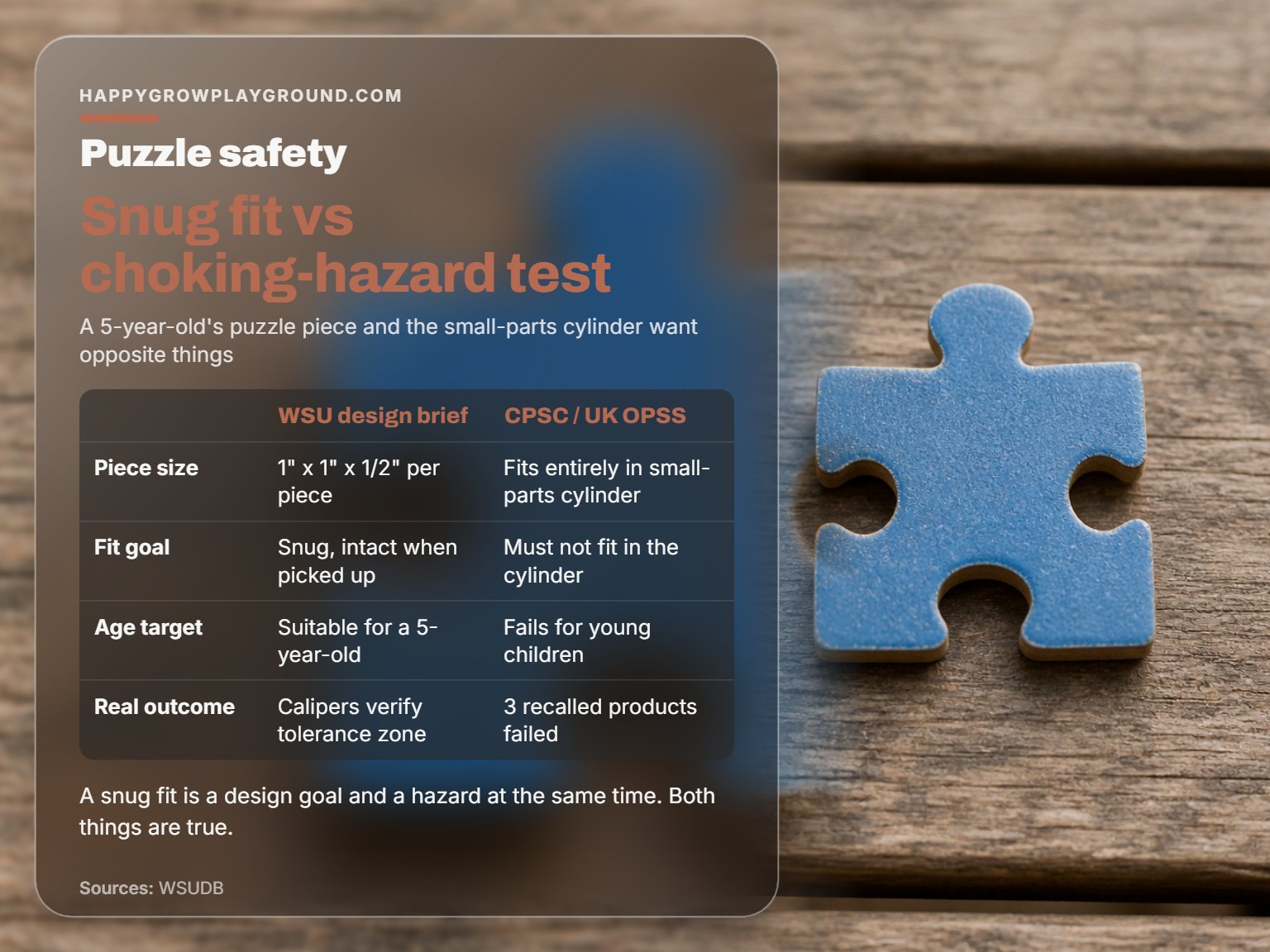
A university design brief and a federal safety test want opposite things from the same puzzle piece.
Washington State University’s mechanical engineering brief asks students to design four interlocking pieces that fit snugly, stay intact when picked up, and suit a 5-year-old. It sets a size limit of 1 inch by 1 inch by half an inch per piece, excluding the connector geometry. Students check the fit with calipers and verify each feature lands inside the tolerance zone.
That’s a useful exercise. It also runs straight into the test that killed all three recalled products.
The small-parts cylinder is the tube regulators use to decide whether a piece is a choking hazard. If a part fits entirely inside it, the toy fails for young children. The Rolling Ball Pile Rattles Tower Puzzle failed exactly that way, and the magnetic chess set failed it too.
Where this goes sideways: A snug-fit 3D-printed puzzle built for a 5-year-old, handed to a 2-year-old. The pieces are small by design, and the fit tolerance that makes them satisfying to snap together is the same property that makes them swallow-sized. Age labels are not a safety feature.
The WSU precision puzzle design guide is clear about the tolerance work and silent on the age question. That gap is where parents get hurt.
So a snug fit is a design goal and a hazard at the same time. Both things are true.
How to Choose a Puzzle That Survives Week Two
Piece count is the number that decides whether a puzzle gets finished or abandoned.
For toddlers, chunky wooden peg puzzles with big knobs and no loose parts still work, because the pictures are simple enough to solve alone. For a preschooler, thick board puzzles with familiar pictures beat a dense landscape, because the pictures are simple enough to solve alone.
For older kids, a step up in piece count holds up better than the cheap board puzzles.
For adults, a puzzle that includes a poster of the finished image matters more than people admit.
- Toddlers: chunky wooden peg puzzles with big knobs and no loose parts
- Preschoolers: thick board puzzles with familiar pictures
- Early elementary: a step up in piece count, and expect to finish the last stretch yourself
- Family table: a poster, a lamp, and a puzzle board so you can move it off the table
If a puzzle has a lot of pieces and no poster, plan on a lamp and a lot of squinting. The poster is what keeps four people working on the same picture instead of arguing about sky.
Picks by Age and Ability
Buying puzzles for kids is a different job than buying puzzles for families, and the piece count drives both. A puzzles for adults pick with a huge piece count is a month-long commitment, not a rainy afternoon.
For a steady supply, puzzle subscriptions solve the storage problem by sending one puzzle at a time instead of a shelf full.
I’d rather hand a kid a puzzle that’s slightly too easy than one that’s slightly too hard.
The Landing Zone Rule That Keeps a Puzzle in Rotation
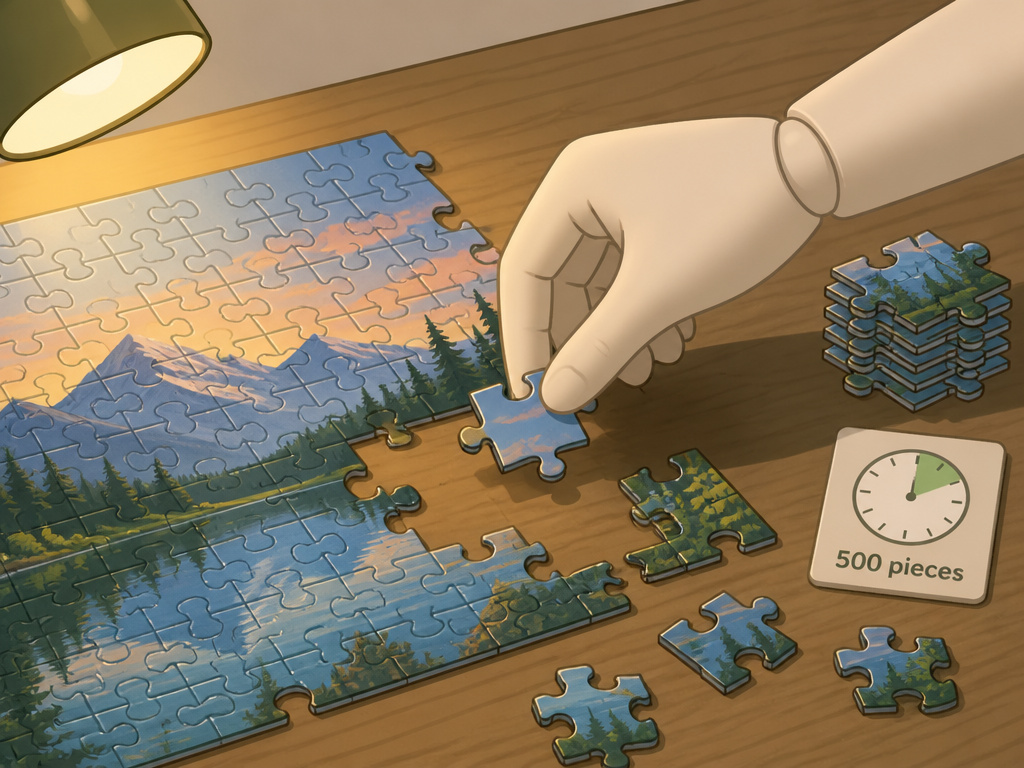
Puzzles have a landing zone as well. It’s the table, the lighting, and the piece count.
Worth knowing before you start: A puzzle that gets abandoned in week one has a difficulty problem. Drop the piece count and try again. The same child who quit a big puzzle will finish a smaller one in a single sitting.
Frequently Asked Questions
Are puzzles good for kids?
Puzzles give kids a task they can finish alone, which is the part that builds persistence. The research on adults is mixed, and nobody has run the same long-term study on children. What you can count on is the fine motor work and the patience.
What age should a child start puzzles?
Start with chunky wooden peg puzzles that have no loose parts, then move up when the child finishes them without help. The label on the box is a rough guide. Watch what your kid actually does with the puzzle, because that tells you more than the packaging.
What are the downsides of puzzles?
Frustration and abandonment top the list, followed by missing pieces and storage. There’s also a real safety side: three puzzle products have been recalled over choking, laceration, and magnet hazards.
Do puzzles actually improve memory?
The evidence is thinner than the marketing suggests. Fissler et al. Found that a 30-day jigsaw intervention produced no measurable improvement in global visuospatial cognition, while lifetime puzzle experience was associated with a higher score. Long-term habits look better than short bursts.
Is a 3D-printed puzzle safe for a young child?
Not without testing. The fit tolerance that makes printed pieces snap together also produces small parts that can fit inside the choking-hazard cylinder. Print for older kids, and keep printed puzzles away from anyone under three.
How do I store a puzzle so it lasts?
Keep it out of hot cars and garages, because PLA softens around 60 C and a dashboard hit 64 C (147 F) in Bell’s test. For paper puzzles, keep the box flat and dry. For printed ones, PC Blend survives heat that destroys PLA and PETG.
Before You Go
If your kid is under three, skip wooden peg puzzles with detachable handles and anything with loose magnets. That’s the threshold. Below it, the choking-hazard cylinder is the only test that matters, and a puzzle that fails it doesn’t belong in the house no matter how good the reviews are.
I get why families reach for the cheap option. Toy budgets are real, and I’m not going to pretend every household can buy the top of the line. But a recalled puzzle is a different category from a cheap one. One is a compromise. The other is a hazard.
I’ll admit my own bias here. I’ve been slow to recommend 3D-printed puzzles at all, and part of that is me not trusting a material I can’t inspect. The heat data backs up the caution, but PC Blend survived a dashboard that destroyed everything else, so the material matters more than the method.
Fair warning, though. The best puzzle in your house this week might be the box the expensive one came in. Kids vote with their feet, and a cardboard box gets more play than a dense landscape every single time.
