
Open Ended Toys Pros and Cons: Which Ones Last?
This post contains affiliate links. As an Amazon Associate, we earn from qualifying purchases.
The open ended toys pros and cons split along one question: who supplies the goal. Open-ended toys hand the plan to the child, and a 10-year study of more than 100 toys found they held attention longer than toys that suggest a single way to play. The con: ambiguity can stall a child who needs a starting point.
That stall point shows up in the research. A peer-reviewed design study on ambiguity found that open-endedness can discourage a child from engaging at all, and that it backfires in urgent or risky settings.
What follows covers what a decade of classroom observation found, the four ways open-ended toys fail on a living room floor, and the specific situations where a defined goal beats a blank canvas.
Key Takeaways
- Open-ended means the child supplies the goal. A puzzle sets the problem; blocks only supply geometry.
- The TIMPANI study ran ten years and covered more than 100 toys, and open-ended toys held attention longer than toys that suggest one way to play.
- Four failure modes explain most duds: single-purpose parts, a licensed character, a pile that’s too large, and a closed loop.
- Forty pieces cycled in and out get more play than 400 pieces permanently available.
- Skip open-ended toys for a child in an urgent or risky setting, or one who can’t yet generate a starting idea.
What Counts as an Open-Ended Toy (and What Only Looks Like One)
The label describes who is in charge of the plan, and in an open-ended toy that person is the child.
An open-ended toy carries no predefined rules, no specific end goal, and no single correct way to be used. A puzzle supplies the goal; blocks supply geometry alone. That single difference is why the same set of blocks becomes a road, a tower, a shop, a birthday cake, and a barricade in the course of a week.
That definition does real work on a store shelf. A plastic set where every piece has one obvious correct slot looks like a construction toy, but every part has one home, which makes it a puzzle in disguise.
Plain hardwood blocks pass the test. So does a cardboard tube, a square of cloth, and a doll with a face and no expression. If you want a starting point, a basic set of wooden blocks covers more ages than anything else in the category.
Cardboard boxes have no correct configuration at all, which is why they beat whatever shipped inside them. That’s the whole idea in one sentence.
The two biggest names in the category draw the line in different places. The TIMPANI researchers specify that the best construction toys are not a kit for making a specific product, even when the kit is sold as construction. LEGO takes the other side, describing its DUPLO 3in1 Dinosaurs on Wheels (10451) set as packed with multiple creative play possibilities for ages 3 to 4.
Both can be true at once. A kit that builds one dinosaur is a puzzle. A box of bricks that happens to include dinosaur parts is not. The best open-ended toys for a first birthday look almost identical to the ones for a fifth.
What the 10-Year TIMPANI Study Actually Found
The TIMPANI Toy Study ran for ten years and examined more than 100 toys in preschool classrooms.
The researchers at Eastern Connecticut State University boiled their findings down to three qualities. The Timpani early childhood toy guide spells them out.
- Simple. A wooden cash register drove buying-and-selling conversation. A plastic one that beeped mostly got its buttons pushed.
- Open-ended. Kids turned hardwood blocks into houses, zoo enclosures, castles, and roads, and pretended single blocks were cell phones, cars, or sandwiches.
- Non-realistic. Building with a basic set of Legos forced children to decide what they were making and then explain it to a playmate.
Notice what’s missing from that list. Nothing beeps.
The attention finding is the one that matters most when you’re deciding what to buy. Open-ended toys in the study held children’s attention for longer stretches than toys that suggest one way to play.
That’s also where construction toys earn their keep. A kit builds one thing once. A pile of bricks builds something new every week.
Why Do Open-Ended Toys Hold Attention Longer?
Because the child is doing the planning, and planning carries the most cognitive load.
Setting a problem, holding it in mind, and revising it when it fails is the work. A toy that already set the problem has taken that work away, however well designed the problem is.
PBS Parents makes the same argument from the parent’s side of the room. Because open-ended toys have infinite uses, kids get bored with them far less quickly than with fixed-use alternatives. That’s the unstructured play principle stated plainly.
The claim isn’t universal, though. A peer-reviewed paper from the Design Research Society logged a toy called Stickz whose open-endedness was limited because constructing became the predominant activity. One play mode swallowed the rest.
That’s the honest version of the attention argument. Open-ended designs hold attention longer on average. They don’t guarantee variety.
Battery toys lose on a different mechanism. The PBS guide to the perfect toy reports that toys which talk, blink, and play sound effects constrict a child’s imaginary involvement, and it cites Penn State research showing that kids playing with electronic toys hold considerably less conversation with the adults and children around them.
TIMPANI saw the same thing in miniature. The plastic cash register that made noise got its buttons pushed. The silent wooden one got a shop built around it.
Blocks versus connector toys is the head-to-head most families face.
The Four Ways Open-Ended Toys Fail in Real Homes
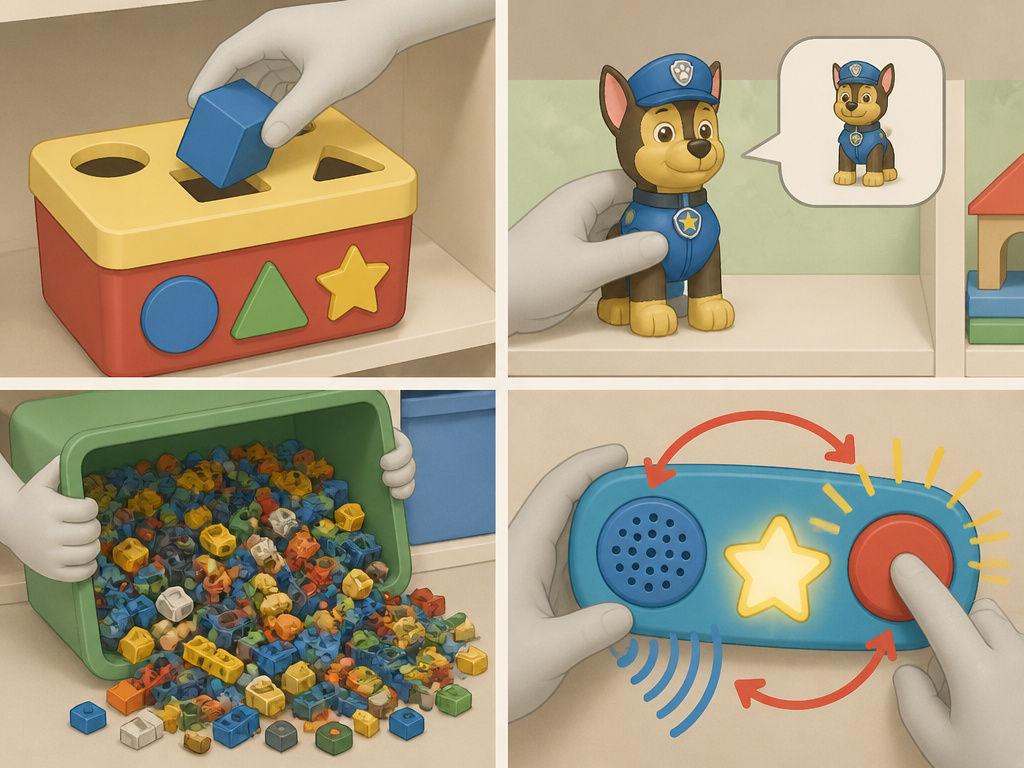
Four failure modes account for most of the duds on a playroom shelf.
Single-Purpose Parts
A plastic set where each piece has one obvious correct slot. It looks like a construction toy. It’s a puzzle in disguise.
The Character That Writes Its Own Script
The moment a toy is a specific character, it carries a story with it. Kids replay that story accurately and often, which is decent pretend play, but it’s a script. The child is performing rather than authoring.
Character toys have their place. They’re just the opposite of what the label claims.
The Pile That’s Too Large
Three hundred mixed pieces is not more open-ended than forty. Past a certain volume the child stops designing and starts raking. A giant bin of loose parts produces dumping, which looks like play and is closer to tidying.
The Closed Loop
Press the button, hear the sound, watch the light. It never becomes anything else. A closed-loop toy announces itself from across the room: the same sound, the same lights, and the same eight minutes of interest before it lands at the bottom of the bin.
Parents read that as a short attention span. It’s a short ceiling on the toy.
| Failure Mode | What It Looks Like | What Actually Fixes It |
|---|---|---|
| Single-purpose parts | Every piece has one correct slot | Swap in blocks or loose parts |
| Licensed character | Child replays one fixed script | Keep it, add blank-costume pieces |
| Pile too large | Dumping and raking, not building | Cut to forty pieces and rotate |
| Closed loop | Button, sound, light, repeat | Pull the batteries or skip it |
What most people get wrong: Buying the 300-piece set because it looks like better value.
The fix for most of these is cheaper than the problem. Fewer pieces, better pieces. If you want a middle ground, connector toys sit between blocks and kits: they hold a structure without dictating what the structure is.
Open Ended Toys Pros and Cons: Where the Research Splits
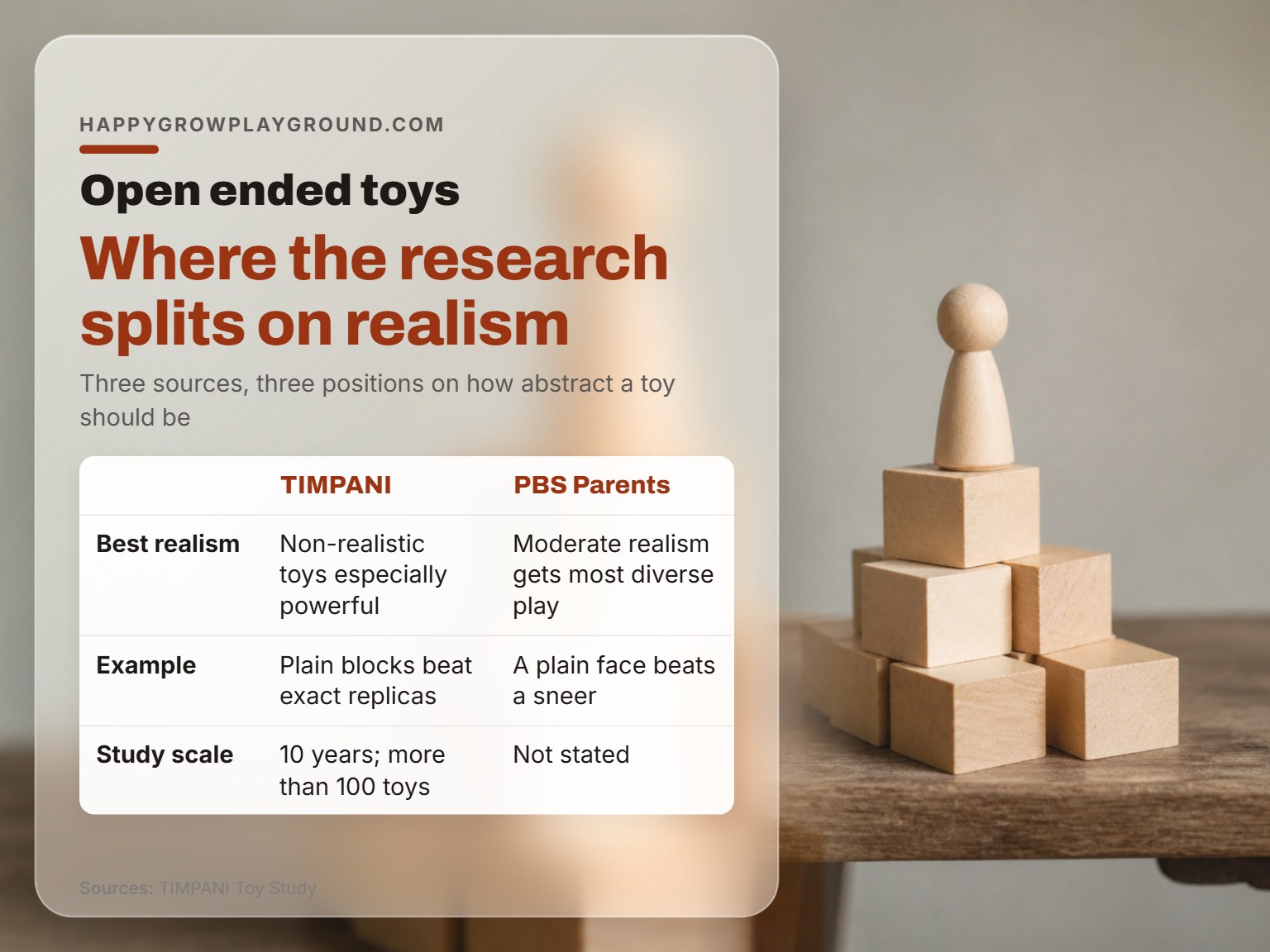
The research does not agree on how abstract a toy should be.
TIMPANI found that non-realistic toys, the ones that don’t look like anything in real life, were especially powerful for creative play. PBS Parents landed somewhere else, reporting that kids had the most frequent and diverse play with toys whose realism sat between abstract and highly detailed.
The CPSC’s age-grading guidance treats the whole thing as a matching problem, where the toy has to fit the child’s developmental stage rather than be abstracted. ISO 8124-1 does the same, with requirements that change by age group from birth to 14.
| Source | Position on Realism | What It Means for You |
|---|---|---|
| TIMPANI (Eastern CT State) | Non-realistic toys especially powerful | Plain blocks beat exact replicas |
| PBS Parents | Moderate realism gets the most diverse play | A plain face beats a sneer |
| CPSC and ISO 8124-1 | Match the toy to the developmental stage | Age grading, not abstraction |
Which one do you follow?
The bigger disagreement is whether open-endedness helps at all. LEGO and PBS Parents both present it as a clear good. The ambiguity and open-endedness research from the Design Research Society doesn’t. That paper warns that ambiguity can discourage a child from engaging in the first place, and that it will work against you in urgent or risky situations and for children who can’t easily reach a creative state.
Where Ambiguity Backfires
How Many Pieces Is Too Many?
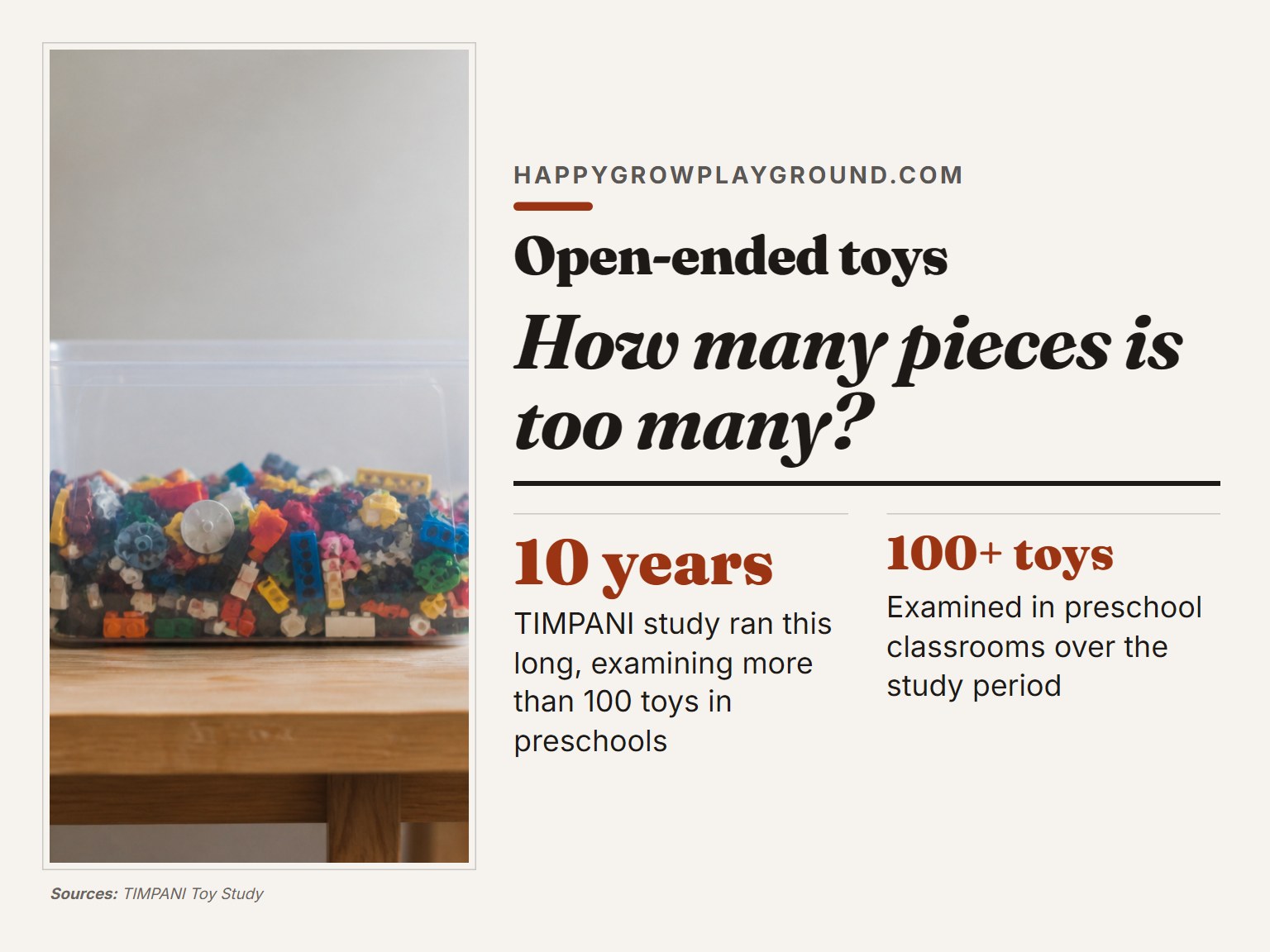
Three hundred mixed pieces is not more open-ended than forty.
That number comes from a commercial toy blog rather than a lab, so treat it as a rule of thumb. The mechanism behind it holds up either way. Past a certain volume the child stops designing and starts raking, and a giant bin of loose parts produces dumping that looks like play and is closer to tidying.
Rotation is the part people skip. The same forty pieces, cycled in and out, get more play than four hundred pieces permanently available.
TIMPANI takes a softer line, specifying that the best construction toys need enough pieces for flexibility. Both positions can be true at once. Enough pieces for a real build, few enough that the child can see what’s there.
- A toddler: chunky pieces only, nothing small enough to swallow.
- A 3- to 4-year-old: one bin, refilled from storage rather than dumped out all at once.
- A 5-year-old: enough for a real build, stored where the pieces stay visible.
Before you start: Loose parts means small parts. Anything that fits through a toilet paper tube is a choking risk for a child under three, and small magnets and button batteries are their own category, because swallowing them can cause serious injury within hours and needs immediate medical attention. Filter the bin yourself before a toddler gets near it.
Sand and water have no correct configuration at all, which makes them the most open-ended material a toddler can be handed and the worst thing to find in the grout lines a week later.
One more constraint gets ignored constantly. An open-ended toy still has to match what a child can actually do. A toy that’s slightly too hard gets abandoned, and then it sits there accusing you.
The loose parts play version of this is the same argument with a different label: the material matters less than the volume you hand over.
When a Defined Goal Beats a Blank Canvas
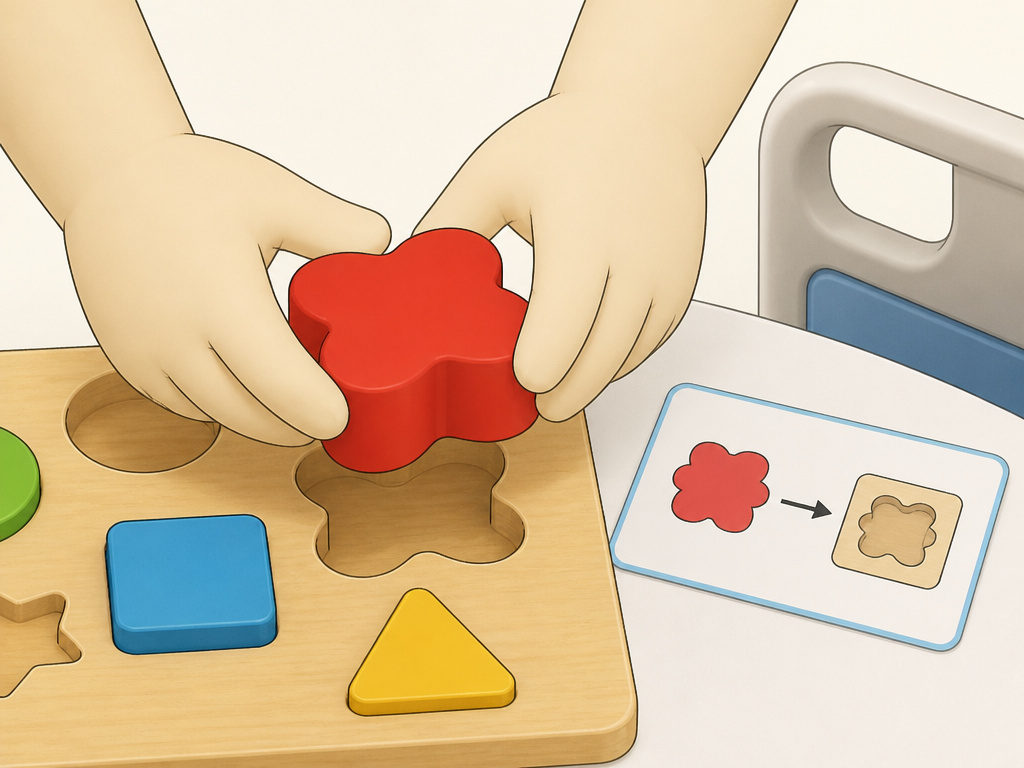
Some kids need a goal handed to them.
The Design Research Society paper names two situations where ambiguity works against you: urgent or risky settings, and children who can’t easily bring about a creative state. A hospital bed is the clearest example. So is a kid who’s already been frustrated twice this afternoon.
- A child in an urgent or risky setting. Ambiguity slows the first move, and the first move is what you need.
- A child who can’t yet generate a starting idea. Give the goal, then step back once it’s running.
- A child who’s already been beaten by a toy. Drop a level. A toy that’s slightly too easy gets played with.
I learned the same lesson outside. That’s scaffolding, and it only works if the ground underneath is actually safe.
The same logic applies to toys. The pros of open-ended play are real, and so are the cons. It only works when the material underneath is matched to the child holding it.
The CPSC which toy for which child guidance is the blunt version of this. Age grading exists because a toy that fits one stage doesn’t fit the next, and ISO 8124-1 changes its requirements by age band for the same reason.
If you want the version of this that builds a skill, problem-solving with toys works better when the toy sets a specific problem first and loosens up later.
Storage, Rotation, and the Hardest Part: Saying Nothing
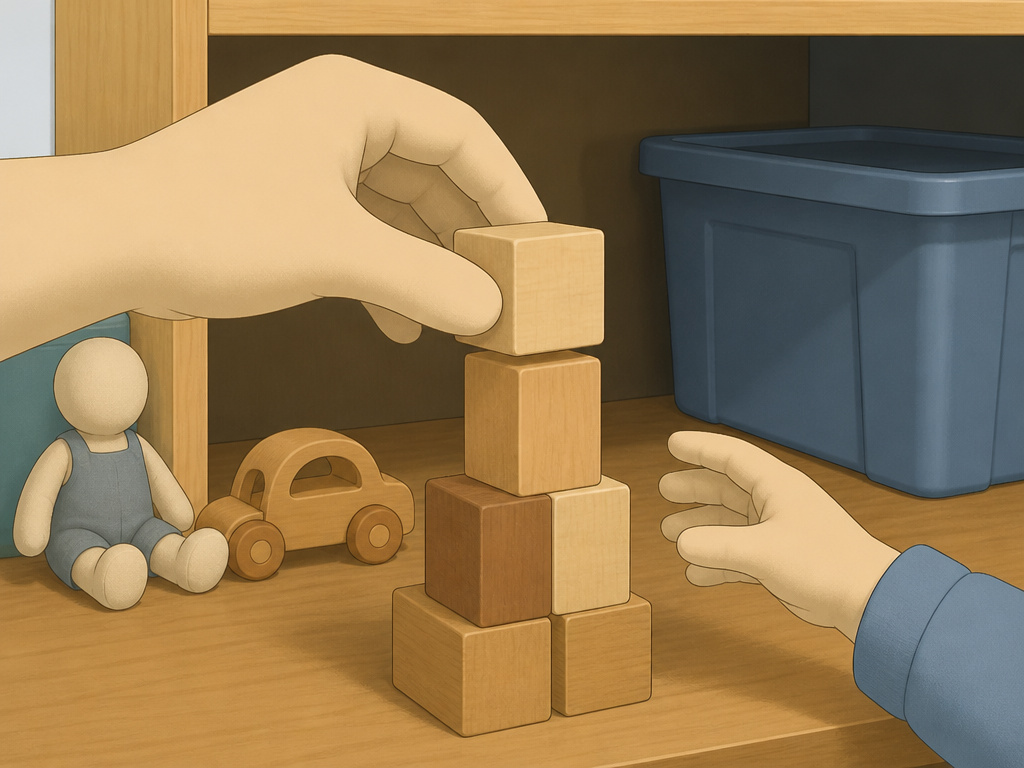
The lidded bin sits in the corner, full, and nobody opens it.
A toy in a lidded bin is a toy nobody plays with. Low, open shelving with a small number of options beats a deep chest holding everything you own, and the fix costs less than one more toy.
- Clear the lid. Move the pieces to open shelving at the child’s eye level. A toy nobody can see is a toy nobody asks for.
- Pick forty pieces. Pack the rest away in a closet, not the bin. Rotate a new set in regularly.
- Put the small stuff up high. Anything that fails the toilet paper tube test leaves the toddler zone entirely.
- Sit down and build something yourself. Say nothing. The child will join in, and the play will be theirs.
- Don’t ask what they’re building. That question hands the goal back with a demand attached.
Step five trips up every parent I’ve met. The instinct to narrate, praise, and direct is strong, and it takes the planning away from the child every time.
PBS Parents says to toss the instructions when a new toy comes out of the box, because independent exploration led to more varied and creative play in the studies it cites. LEGO ships its sets with specific building instructions and age-graded guidance for each one. Both are right about different documents. Toss the play instructions. Keep the assembly manual, or you’ll get a wobbly tower and a second attempt. I’ve done that one.
Longevity is the quiet argument for all of this. A 2025 PLATE conference paper from Aalborg University found that open-ended and emotionally durable toys tend to last longer, and that surface adaptability alone may not extend a toy’s life because it doesn’t change how the toy gets played with. Functional adaptability, where the toy can become a different thing, is the level that matters.
That’s the same conclusion the modularity principles in regenerating toys work at Auburn reaches from the design side: a toy that grows with the child outlasts one that gets outgrown.
If you want one answer for a house with a child between 2 and 6, it’s a small set of hardwood unit blocks, a plain doll, and a low shelf. That covers the large majority of families.
Frequently Asked Questions
Are open-ended toys actually better than regular toys?
Not universally. The TIMPANI study found open-ended toys held attention longer and produced more creative play, and PBS Parents reports that kids get bored with them less quickly. But the Design Research Society research warns that ambiguity can discourage a child from engaging at all, and works against you in urgent or risky settings. Match the toy to the child.
What age should a child start with open-ended toys?
LEGO’s age guidance starts sensory items at 0 to 1, movement toys at 1 to 2, and shape sorters, simple puzzles, and card match-and-sort games at 2 to 3. Blocks and dolls work at any of those ages. The constraint isn’t the age band so much as whether the parts are safe for the child holding them.
How many open-ended toys should be out at once?
Fewer than you think. The same forty pieces, cycled in and out, get more play than four hundred pieces permanently available. Low, open shelving with a small number of options beats a deep chest full of everything.
Do open-ended toys need batteries?
No, and the research is fairly blunt about it. PBS Parents reports that battery-operated toys which talk, blink, and play sound effects constrict a child’s imaginary involvement, and cites Penn State research showing considerably less conversation when kids play with electronic toys. TIMPANI found simpler is better.
Is a LEGO set an open-ended toy?
It depends on the set. The TIMPANI researchers specify that the best construction toys are not a kit for making a specific product, even when the kit is marketed as construction. LEGO describes the DUPLO 3in1 Dinosaurs on Wheels (10451) set as packed with multiple creative play possibilities. A box of loose bricks clears the bar more easily than a kit that builds one model.
Should I throw away the instructions?
PBS Parents says toss them, because kids who weren’t taught how a toy worked showed more varied and creative play and found new features on their own. Keep the assembly manual for anything that needs building. Those are two different documents.
The Bottom Line
The open ended toys pros and cons land in a specific place. The child should supply the goal, and the adult should supply the material and then get out of the way.
Here’s the threshold that decides it. If a child picks up the same toy, looks at it, and puts it down twice in a row, look at the toy’s ceiling before you blame the child’s attention span. A closed loop feels satisfying for about eight minutes and then gets abandoned. A pile of blocks doesn’t run out at all.
The concession: none of this holds if the child is in a hospital bed, in an urgent setting, or already frustrated. In those cases, hand over the goal. A defined problem beats a blank canvas, and you can loosen it later.
Start with one thing this week. Clear the lid off the toy bin, pull everything that fails the toilet paper tube test, and put forty pieces on a low shelf where a kid can reach them without asking. Then sit down, build something, and say nothing.
