
How to Encourage Outdoor Play: Permission, Space, Time
This post contains affiliate links. As an Amazon Associate, we earn from qualifying purchases.
To encourage outdoor play, work the four levers the evidence actually supports: parental encouragement, permission, space, and time. A 2021 review of 107 studies found 111 significant correlates of outdoor play, and 10 of them sit at the parental level. Institutional factors produced zero.
Four levers, and the one that shows up most in the data is the free one. Parental encouragement carried the largest single block of key correlates in the biggest review on the topic, ahead of anything you can install in a yard.
What follows walks the how to encourage outdoor play evidence in the order it matters: what 107 studies found, why the numbers keep falling, and where the research contradicts itself.
Key Takeaways
- Parental encouragement is the highest-yield lever. A 2023 review tied high encouragement to 234 more outdoor minutes per week for younger girls over 5 years.
- Indoor tendencies cost real minutes. Younger boys with high indoor tendencies logged 168 fewer outdoor minutes per week.
- Permission, space, and time support play. A school-grounds pilot found a plain tarmac yard supports running games on its own.
- Loose parts are a play decision, not a fitness one. A 2017 scoping review found a lack of clarity around how loose parts might support the development of active outdoor play and physical literacy skills.
How to Encourage Outdoor Play: What 107 Studies Found
Zero. That’s how many key correlates Lee et al. Identified at the institutional level, out of 111 spread across every other level.
The review required studies to include children aged 3 to 12, report a quantitative measure of outdoor time or play, and carry an analytic sample of at least 100 participants. Of 287 potential correlates of outdoor play, 111 reached significance.
That review is the biggest single map of this topic. It pooled 107 studies covering 188,498 participants, 422 childcare centers, and 29 countries.
Eligibility was tight. Studies had to measure a genuine association with outdoor time or play, not just physical activity at different intensities.
| Level | Key correlates | Why it matters |
|---|---|---|
| Individual | 8 | Hardest to change, easiest to design around |
| Parental | 10 | The biggest block you actually control |
| Microsystem | 9 | Peers and settings set the daily default |
| Macrosystem / community | 3 | Slow to shift, but they shape permission |
| Physical ecology | 3 | Season and rurality change the whole plan |
| Institutional | 0 | Policy did not surface as a key correlate |
The parental block is the largest. That’s the thread to pull.
The benefits of outdoor play run well past physical fitness into sleep, cognition, and social skills. The systematic review of outdoor play correlates holds the raw counts if you want to check the distribution yourself.
The Decline Is Real, and Screens Only Explain Part of It
Screen time takes most of the blame for the how to encourage outdoor play decline. The measured decline is steeper than that one cause can carry.
Over 2 years, the share of children who played outdoors at least 7 times a week fell from 67.4% to 62.1%. The share who played outdoors for 60 minutes or more fell from 53.3% to 38.8%.
The Determinants review, citing Guthold et al., reported that among 1.6 million 11- to 17-year-olds from 146 countries, 77.6% of boys and 84.7% of girls were insufficiently active.
The 2023 review documents a suppressor that has nothing to do with screens: sun safety messaging that discouraged midday activity reduced outdoor time.
Common mistake: Treating screen time as the only lever. Sun safety campaigns cut outdoor time in the 2023 review, and that doesn’t show up in a screen-time conversation.
Season matters too. Outdoor time is consistently higher in warmer seasons, which means a January plan and a July plan can’t be the same plan.
What a child does once they’re out there counts as much as the going, and independent play is where most of that practice happens. Those 2-year figures come from the determinants of outdoor time in youth review, which tracked 55 studies.
How Do You Get a Kid Outside When They’d Rather Stay In?
Indoor tendencies are the clearest single signal in the 2023 review, and the numbers are large enough to plan around.
For younger boys, high indoor tendencies were associated with 168 fewer minutes of outdoor time per week. For older boys, medium indoor tendencies cost 215 minutes a week and high indoor tendencies cost 324.
For younger girls, medium indoor tendencies ran at 188 fewer minutes a week and high indoor tendencies at 247 fewer.
The reverse holds. Older boys with high outdoor tendencies gained 123 minutes a week over 5 years, and younger boys with high social opportunities gained 170. Older girls with medium outdoor tendencies gained 200.
So what’s actually pulling them in?
- A screen that’s already on when they walk through the door
- Snacks within arm’s reach of the couch
- A sibling who’d rather stay in, which removes the social pull entirely
- Nothing outside that’s ready to use without setup
The fix is making the outside option the path of least resistance before anyone asks the question.
Peers show up repeatedly in the correlate counts, which is why social play is worth supporting. Set it up before they get home.
Permission, Space, Time: What a School-Grounds Pilot Found
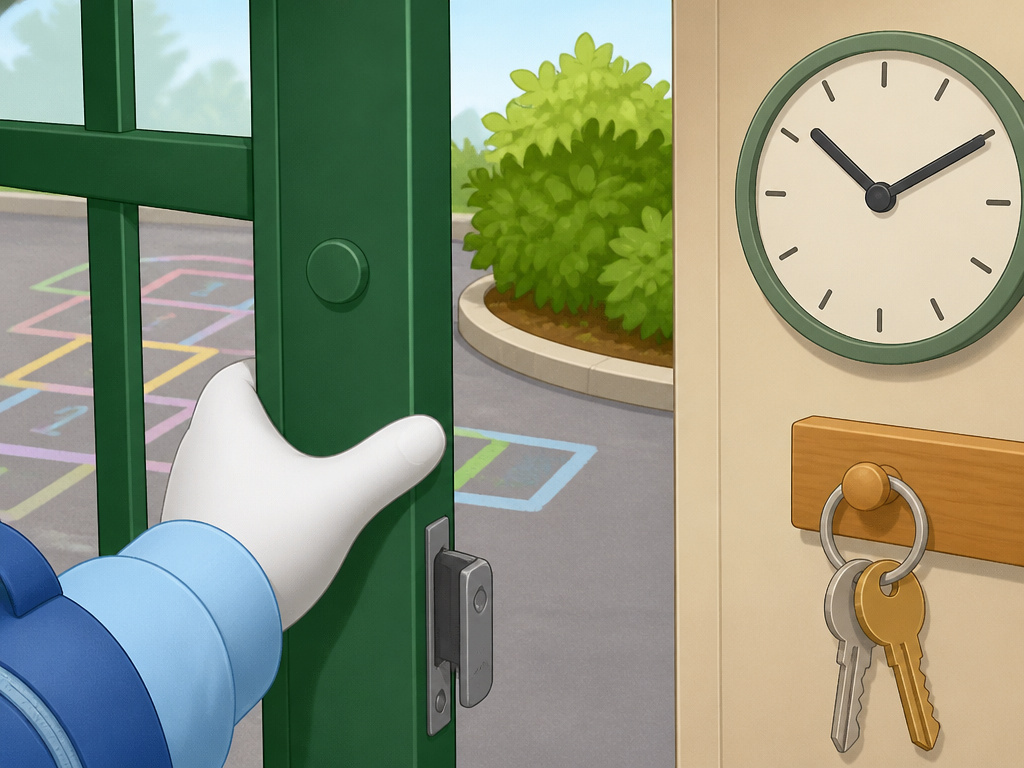
Play Wales runs a pilot that opens school grounds after the bell, and the whole framework reduces to three words: permission, space, and time.
Parents involved in the pilot reported that restrictions on children’s time and space prevent play.
Permission: the lever you already hold
Permission is the piece parents and schools control directly, and it’s the piece most often withheld by default. A locked gate and an unwritten rule about staying off the grass do the same work.
Space: what a tarmac yard can actually do
Some schools assume their grounds have little to offer without fixed play equipment. The pilot found otherwise.
A tarmac area supports active running games and sports on its own, and a landscaped green space adds places to hide and explore.
Time: the stretch right after the bell
Having time to play with friends immediately after school contributed to children’s fun, relaxation, health, and wellbeing in the pilot.
Three moves, in this order:
- Open the space first. Decide where they’re allowed to go before you decide when.
- Set the window second. Give children time to play with friends immediately after school.
- Hand over the agenda last. The sessions are child-led, meaning children can follow their own ideas and interests.
Frequently Asked Questions
Does the weather really change how much time children spend outside?
Yes, but not as much as most parents assume. The physical ecology level of the 107-study review produced only three key correlates, and season and rurality were among them. That means weather shifts the baseline rather than determining the outcome. Rain gear, covered spaces, and a standing plan for wet days keep the habit intact when conditions turn.
Should I buy play equipment to get my child outdoors?
The evidence does not point that way. Institutional factors, which include built facilities and formal programs, produced zero key correlates in the largest review on the topic. A school-grounds pilot found that a plain tarmac yard generated running games without any added structures. What children need is a place to be and an adult who says yes.
How long does it take to see a change in my child’s outdoor habits?
Expect months, not days. The 2023 review that linked high parental encouragement to 234 extra outdoor minutes per week measured that gap over five years. Smaller shifts show up sooner, but the durable change comes from a routine that repeats. Consistency matters more than the size of any single outing.
What if my child simply prefers being indoors?
That preference has a measurable cost, so it is worth addressing directly. Younger boys with high indoor tendencies logged 168 fewer outdoor minutes per week in the same body of research. Start with short, low-demand trips outside and let your child choose the activity. Encouragement, not pressure, is what the data supports.
