
How to Disinfect Wooden Toys: Where the Advice Splits
This post contains affiliate links. As an Amazon Associate, we earn from qualifying purchases.
To clean wooden toys, HABA says to wipe with a lightly damp cloth and warm water, then dry it. HABA also warns that alcohol- and bleach-based disinfectants damage the water-based coatings over the stain. NYC Health takes the opposite view: it allows a bleach solution of one tablespoon per gallon of cool water.
That split exists because the two camps are answering different questions. HABA is protecting a coating, a water-based finish that sits on top of the stain and gives way long before the wood itself does. NYC Health is writing rules for a room full of shared toys, and it writes them for the whole category rather than for beech and maple specifically.
What follows is the sequence I actually use: what to reach for on finished wood, what the numbers on a disinfectant label really mean, how often this needs to happen, and the point where a wooden toy stops being worth saving.
Key Takeaways
- Never submerge a wooden toy or run it through a dishwasher. That’s HABA’s rule, and BRIO gives the same reason for wooden tracks: heat and humidity break the material down.
- Bleach is a live disagreement, not a settled rule. NYC Health allows one tablespoon per gallon of cool water; HABA says don’t apply it to wooden toys at all.
- Contact time beats strength. NPIC puts bleach disinfection at a minimum of 2 minutes; NYC Health says at least 1 minute.
- Mouth-contact toys get a clean-water rinse after disinfecting, per NYC Health, to remove chemical residue.
- If a toy can’t be cleaned and disinfected, throw it away. That’s NYC Health’s line, not mine.
Why Water and Disinfectant Damage Wooden Toys
Disinfectants formulated with alcohol or bleach break down the water-based protective coatings applied over the stains and colors beneath.
The National Pesticide Information Center defines “for use on hard non-porous surfaces” as solid materials that do not absorb light or liquids. A wooden block fails that test on the first word. So the spray-and-wipe habit you use on a countertop doesn’t transfer to a toy box.
BRIO puts a number on the risk. FSC wood can deform and even crack when exposed to too much water, high humidity, or high temperatures. That covers storage as much as cleaning.
Long-term wooden toy care is mostly about keeping that coating intact, which is a different job from getting crumbs off it.
The Two Camps: Toy Makers vs. Public Health Agencies
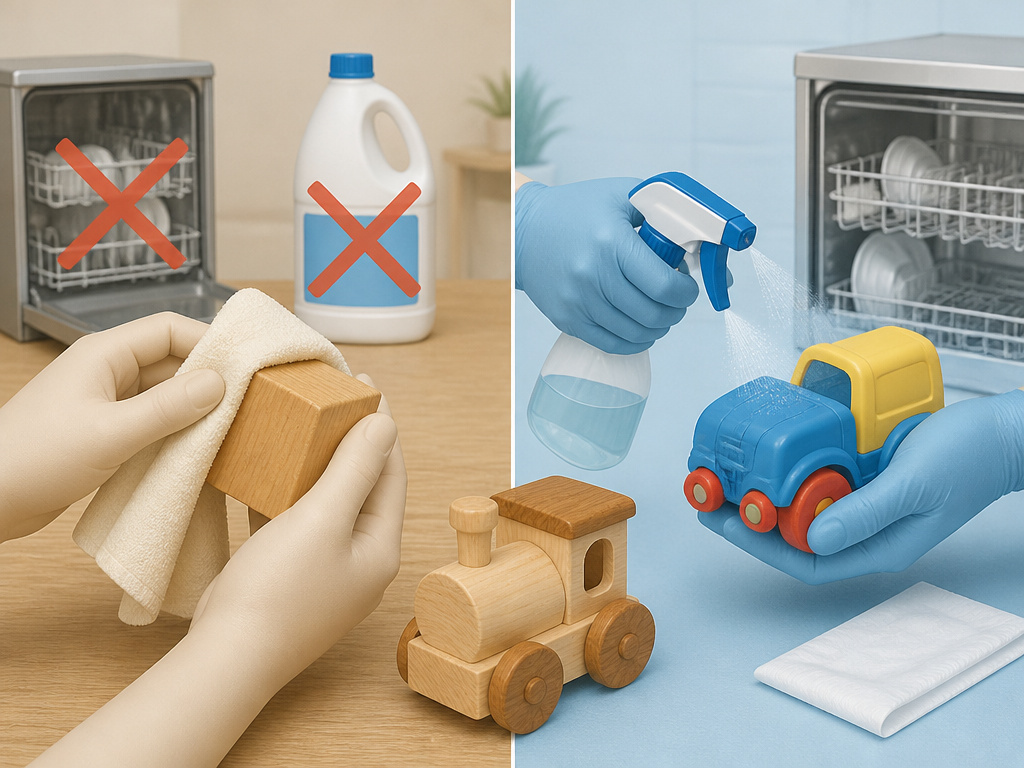
HABA and NYC Health are answering the how to disinfect wooden toys question differently, and that’s why their advice collides.
HABA is protecting a coating on a specific material. NYC Health is protecting a room full of toddlers who share everything. The agencies treat toy as a category. The manufacturers treat wood as a material that fails under the agency protocol.
| Question | Toy makers (HABA, BRIO) | Health agencies (NYC Health, Toronto) |
|---|---|---|
| Water and dishwasher | Never submerge; no dishwasher | Dishwasher or washing machine hot cycle, if water-safe (NYC Health); dishwasher allowed (Toronto) |
| Bleach | Do not apply to wooden toys | 1 tablespoon per gallon of cool water |
| Alcohol wipes | Do not apply to wooden toys | At least 70% alcohol, 5 seconds wet (NYC Health) |
If you want a middle path, there are ways to disinfect toys without bleach that hold up on finished wood.
What Contact Time Actually Means: 1 Minute vs 2 Minutes
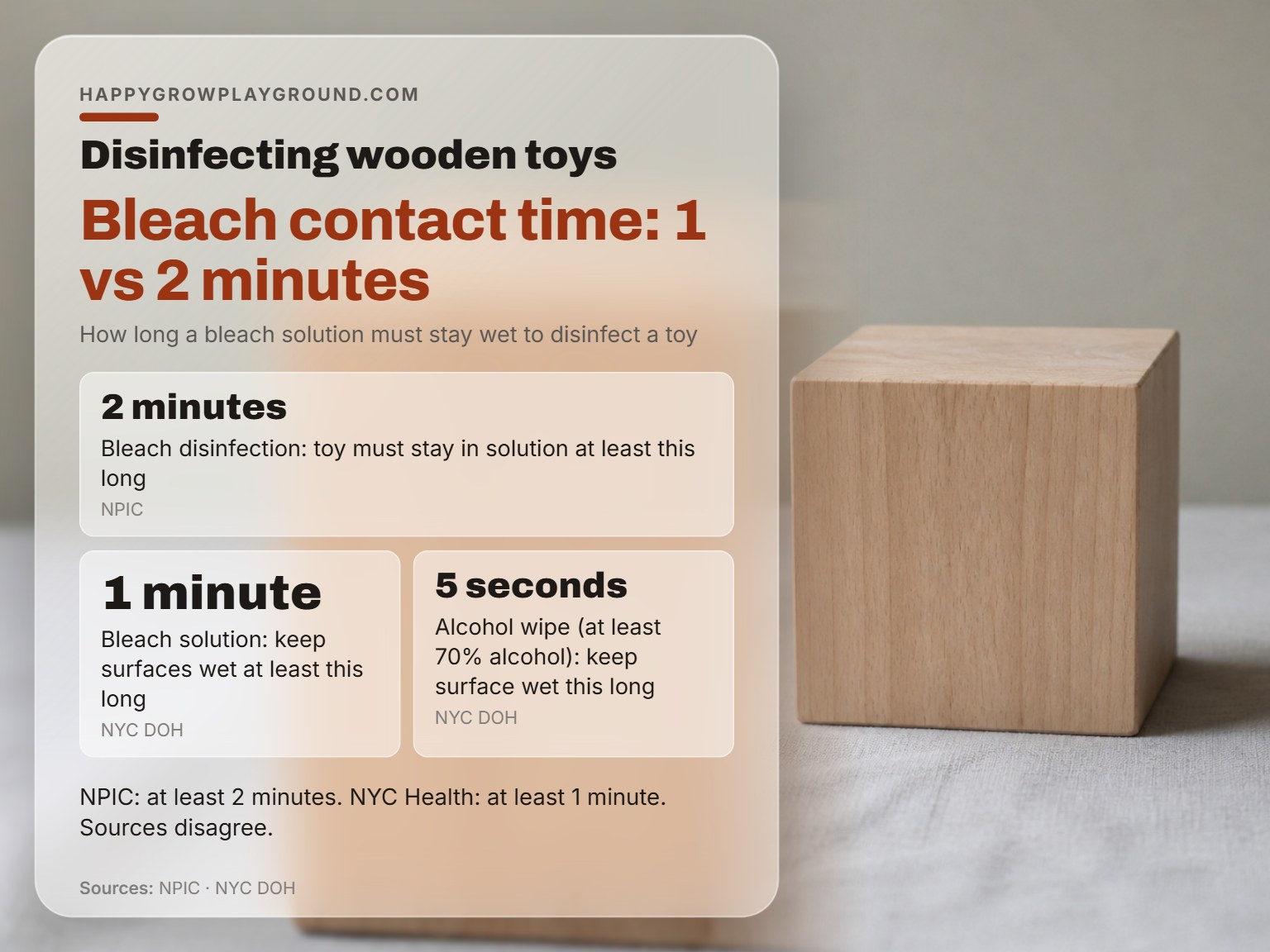
Two minutes. That’s NPIC’s minimum for bleach disinfection, and it’s double what NYC Health asks for.
Contact time is the window the active ingredient needs to work on the surface. Cut it short and you’ve wet the toy, not disinfected it. That’s why the two numbers matter more than the dilution.
| Disinfectant | Dilution or strength | Minimum wet time | Source |
|---|---|---|---|
| Bleach, spray or wipe | 1 tablespoon per 1 gallon cool water | At least 1 minute | NYC Health |
| Bleach | Per the label’s mixing instructions | At least 2 minutes | NPIC |
| Alcohol wipes | At least 70% alcohol | 5 seconds | NYC Health |
Before you start: Wear personal protective equipment (PPE), and clean your hands after removing it. Disinfect according to the manufacturer’s instructions on the label rather than by guesswork. Anything headed for a mouth gets a clean-water rinse afterward.
Sterilizers, disinfectants, and sanitizers are all regulated by the EPA as pesticides, and the NPIC cleaning and disinfecting toys guide sorts out what each one actually does. Sterilizers destroy spores. Disinfectants don’t, but they do destroy infectious bacteria and fungi. Sanitizers just knock the germ count down to a public health standard.
Products that claim only to clean carry no pesticidal claim and aren’t EPA-registered, which means nobody knows whether they kill or remove germs. The EPA registration number on the label is the tell that someone tested it.
How to Disinfect Wooden Toys With a Damp Cloth
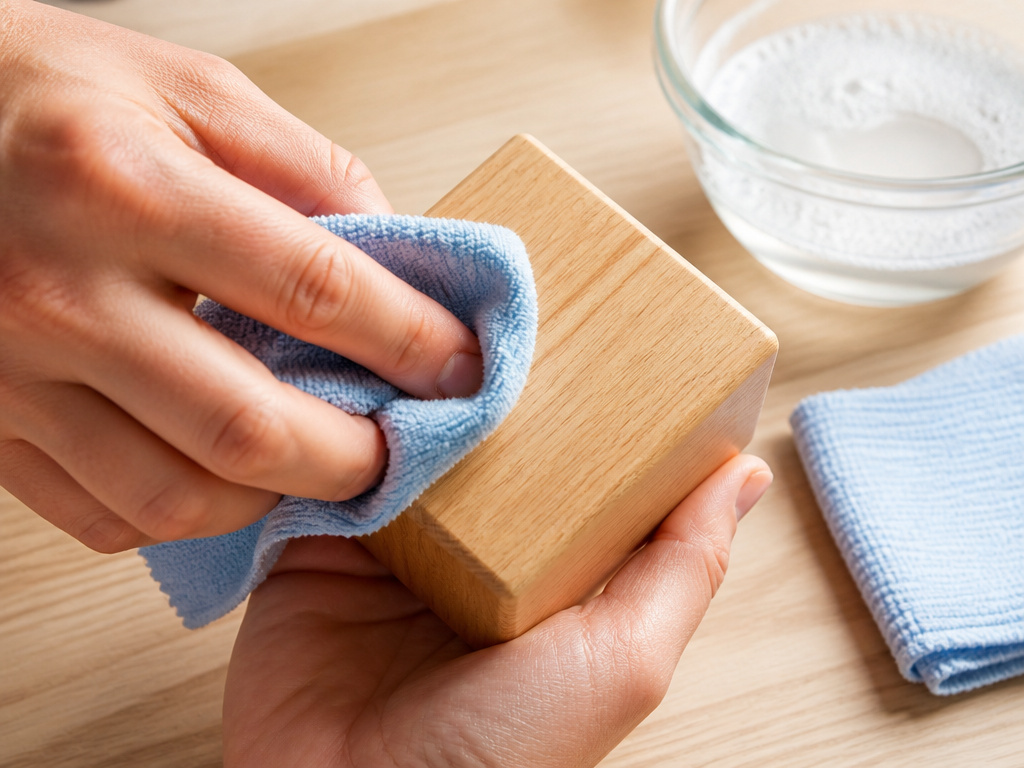
Most wooden toys need a damp cloth. That’s it.
- Wipe with a lightly damp cloth. HABA’s recommendation is a cloth dampened with warm water, not a wet one. A dripping cloth pushes water past the finish and into the end grain, which is where swelling starts.
- If you want a cleaning agent, keep it mild. HABA suggests a small amount of either mild dish soap and water, or a water and vinegar essence mix.
- Wipe it dry with a clean cloth right away.
- Never submerge it, and never use the dishwasher. HABA states this outright. BRIO gives the same reason for wooden tracks: heat and humidity break the material down.
Unpainted Wood: Sand, Don’t Wash
BRIO gives unpainted wooden tracks a different protocol entirely. Sand them with fine sandpaper of at least 120 grit, then wipe with a dry lint-free cloth.
Water is the wrong tool here. BRIO warns that washing wooden tracks, or putting them in a dishwasher, lets heat and humidity break the material down.
The routine cleaning for wooden toys I use is this exact sequence, minus the disinfecting step. And oiling wooden toys is a separate job from cleaning them, though it’s the one that puts a coating back when a finish has started to look dry.
Vinegar on Toys: What It Handles and What It Doesn’t
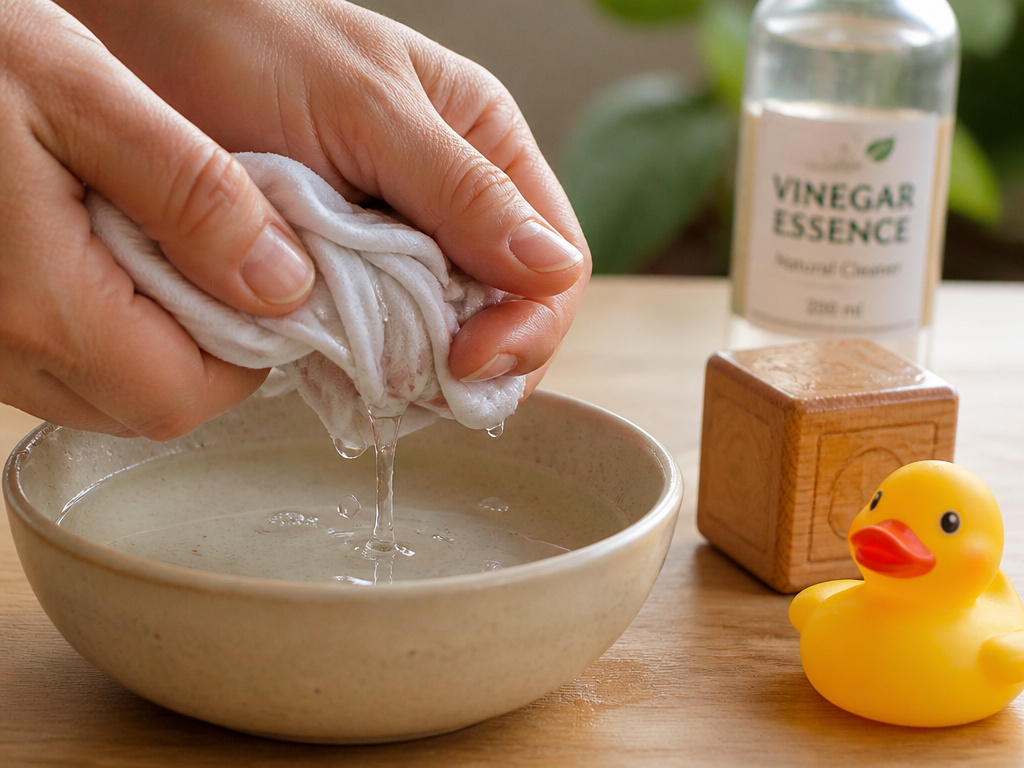
Vinegar on Wood vs. Vinegar on Plastic
That routine is for plastic. On wood, the vinegar version is smaller. HABA suggests a water and vinegar essence mix as a cleaning agent applied with a damp cloth, not a soak. A soak is the one thing HABA says never to do.
A vinegar dilution for toy cleaning is cheap, food-safe, and it works on plastic. It just doesn’t belong in a bucket with wood in it.
How Often Do Wooden Toys Actually Need Cleaning?
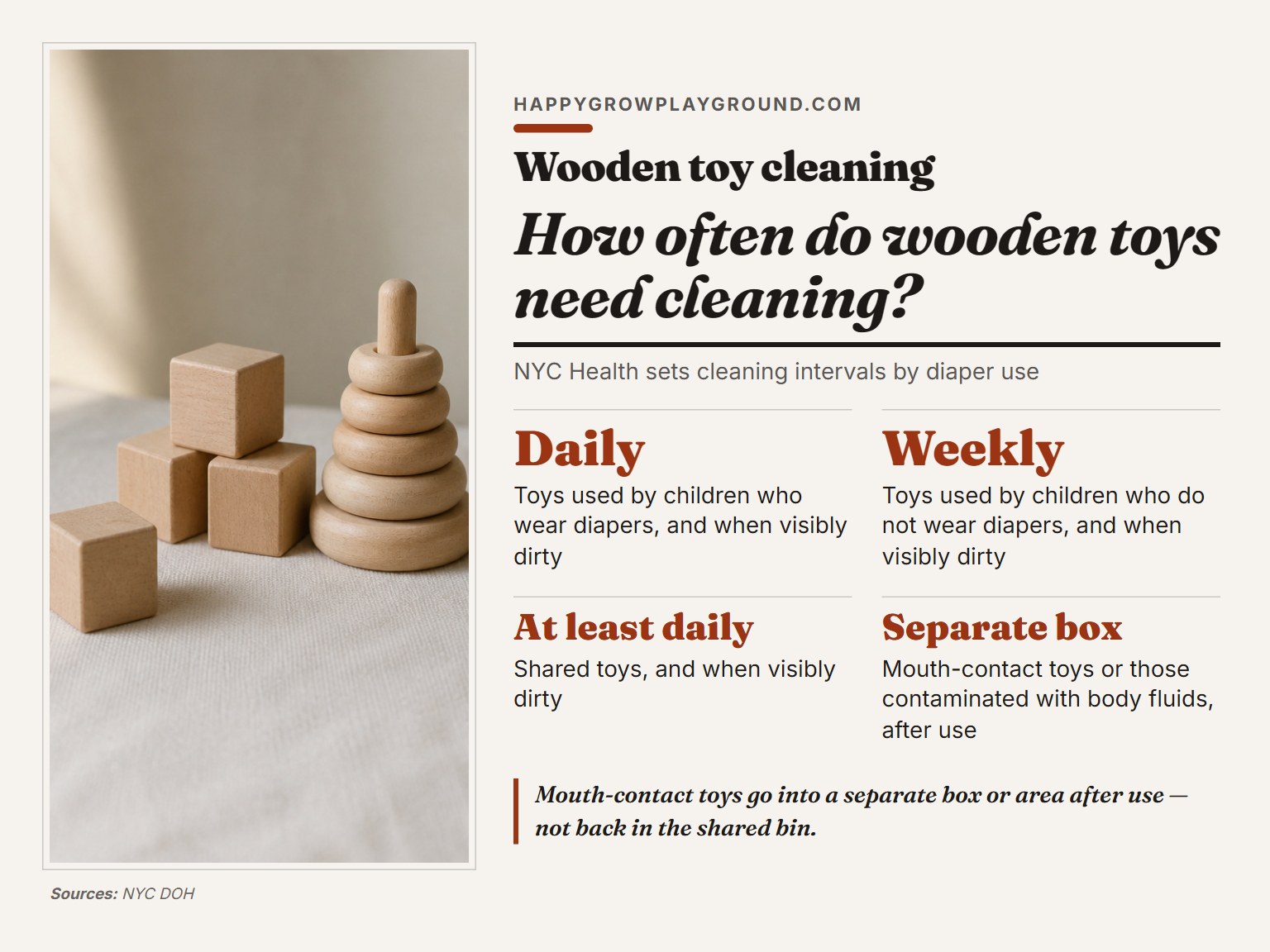
Daily for some toys, weekly for others, and the split comes down to diapers.
NYC Health sets the intervals, and no toy manufacturer publishes anything comparable. Here’s the actual schedule:
- Toys used by children who wear diapers: clean daily, and again whenever they’re visibly dirty.
- Toys used by children who don’t wear diapers: clean weekly, plus whenever they’re visibly dirty.
- Shared toys: at least daily, and whenever they’re visibly dirty.
- Mouth-contact toys, or anything contaminated with body fluids: into a separate box or area after use.
That last one is the rule I see broken most often. A toy that goes straight back into the communal bin after a toddler has chewed it hasn’t been isolated at all.
The NYC Health toy cleaning one-pager is where those intervals come from, and it’s worth reading in full if you run a playgroup or a classroom.
Plastic bins and bath toys fall under a different toy cleaning schedule, mostly because they can take a full wash.
In my own house, the diaper-age line was the one that mattered. Everything else was theory.
What About LEGO, DUPLO, and Wooden Toys With Electronics?
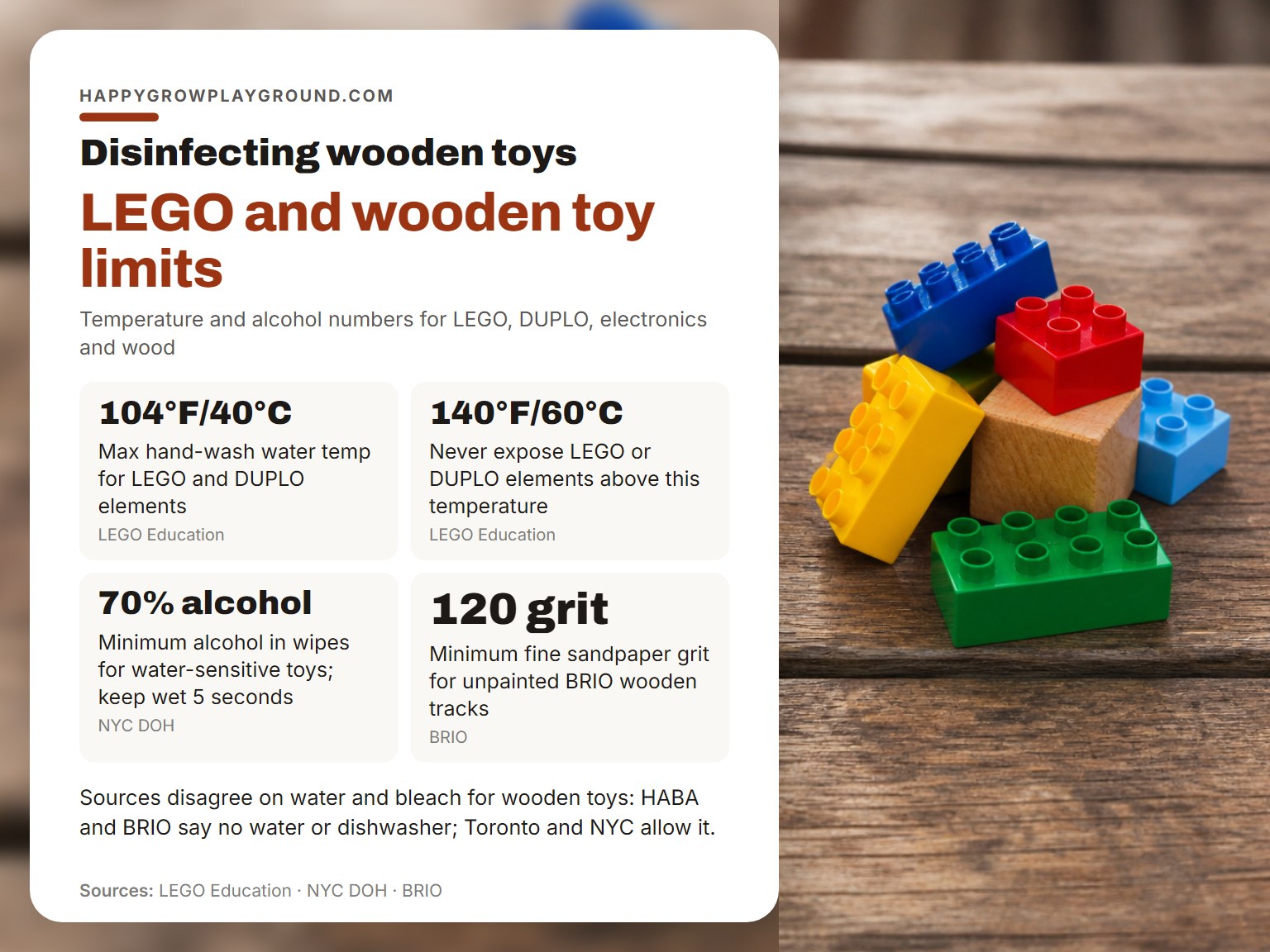
LEGO Education publishes the tightest temperature numbers of any toy maker I’ve read.
LEGO and DUPLO elements are hand-wash only: soap and water at a maximum of 104°F, or 40°C. Never expose them to temperatures above 140°F, or 60°C. That rules out the dishwasher, the washing machine, the oven, the microwave, and the hairdryer, all in one sentence.
Where this goes sideways: Disinfectants can leave transparent LEGO elements hazy, or create cracks and imperfections. A clear brick that goes cloudy after one wipe stays cloudy.
Electronic Elements and Wooden Hybrids
Electronic LEGO elements, the hubs, motors, and sensors, have to be unplugged before cleaning and wiped only. Never submerged, never sprayed. Any wooden toy with embedded electronics inherits the same rule, and it inherits a conflict too.
NYC Health recommends an alcohol wipe with at least 70% alcohol for water-sensitive toys like electronics, windup toys, and books, keeping the surface wet for five seconds. Its own document then notes that alcohol wipes may damage the outside of electronic toys. LEGO flags the same risk from the other direction.
So you have two sources telling you to wipe and two warning you about the wipe. Wipe sparingly, and accept that the finish on a clear brick or a printed panel may not survive it.
The LEGO Education hygiene guidelines are where those temperature limits come from, and they’re written for classrooms rather than living rooms.
When to Stop Cleaning and Throw the Toy Away
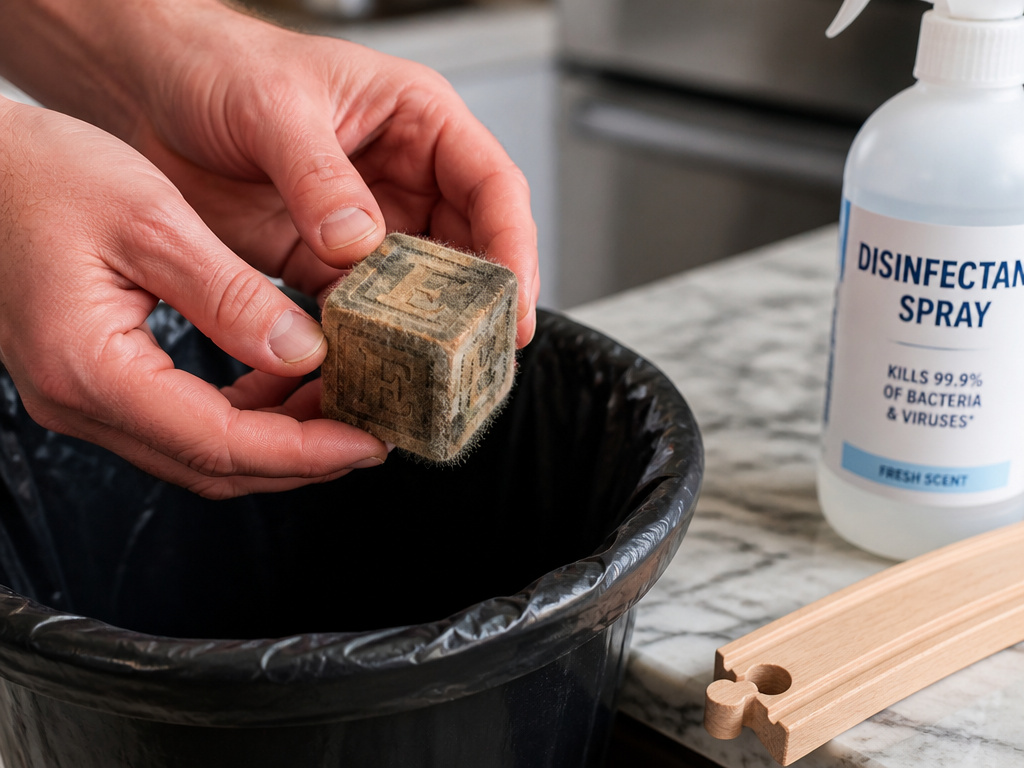
Some toys don’t get saved.
NYC Health is direct about it: any toy that cannot be cleaned and disinfected should be thrown away. That’s a hard line, and it’s the one I’ve argued with myself about.
- Porous toys that can’t take a rinse, like a fabric-covered board book that’s been through a stomach bug.
- Water tables, modeling clay, and finger paint, which NYC Health says should be discontinued unless they’re single-use.
Toys used by a sick child have to be cleaned and disinfected before they’re shared again. That’s the same sequence as above, just done on the way out of the room rather than on a schedule.
If you’re working through a bug that’s already gone through the house, cleaning toys after sickness is a different job from routine upkeep. Do it in one pass rather than piecemeal.
If a wooden toy has gone soft, dark, or fuzzy, you’re not disinfecting a toy anymore. You’re disinfecting a habitat.
I won’t sand a painted toy. Sandpaper takes the finish and the color off together, and what’s left is a bare block with a story. Sanding is for unpainted BRIO track, and that’s the only place I use it.
Frequently Asked Questions
Can I use disinfecting wipes on wooden toys?
HABA says no. Disinfectants, alcohol- or bleach-based, damage the water-based protective coatings that sit over the stains and colors on wooden toys. Once that coating lifts, the color goes with it. A lightly damp cloth and warm water is the safer default.
Is a dishwasher ever safe for wooden toys?
HABA and BRIO both say no. BRIO’s reasoning is that heat and humidity break down FSC wood, which can deform or crack. NYC Health and the City of Toronto allow a dishwasher for toys that won’t be damaged by water, so the disagreement is real. On wood specifically, follow the makers.
How long does bleach need to stay wet to disinfect?
It depends on which source you follow. NYC Health says at least one minute for a solution of one tablespoon of bleach per gallon of cool water. NPIC says the toy must remain in the solution for at least two minutes. When in doubt, use the longer time.
Do I need to rinse a wooden toy after disinfecting it?
NYC Health says yes for any toy a child is likely to put in their mouth, to remove potential chemical residue. Rinse with clean water, then air-dry or dry with a clean cloth. Since most wooden toys end up in a mouth eventually, treat this as the default.
What if a wooden toy has already been soaked?
Look for swelling, a chalky finish, or a crack you can catch a fingernail in. BRIO warns that wood exposed to too much water can deform and crack. If the damage is structural, NYC Health’s rule applies: a toy that can’t be cleaned and disinfected should be thrown away.
The Bottom Line
Here’s what I’d tell a friend: buy the wooden toys, but budget your patience for them rather than your money. They outlast plastic by a wide margin, and they ask for a damp cloth and a little attention in return.
The answer to how to disinfect wooden toys changes the moment there’s a sick child in the house. That’s the point where the agency rules take over from the maker rules, because the question stops being “will this damage the finish” and starts being “will this make somebody else sick.”
And if you take nothing else from this: the label on the bottle is the authority. The EPA registration number means someone tested the product for effectiveness. Everything else, including everything here, is a starting point.
