
10 Best Toys For Building Independence in 2026
This post contains affiliate links. As an Amazon Associate, we earn from qualifying purchases.
The Melissa & Doug Dust Sweep Mop Cleaning Set earns our Best Overall spot because it combines realistic wooden cleaning tools with a storage stand. It lets preschoolers mimic real household chores while building life skills. For focused dressing practice, the Fisher-Price Wood Montessori Dressing Board earns Best Montessori Dressing Skills, and the Lovevery Recipes for Me Mini Kit takes Best Toddler Kitchen Tool Set for introducing cooking concepts to little ones.
Parents want toys that do more than entertain, they want tools that teach kids to do things for themselves. The challenge is finding options that match a child’s developmental stage without overwhelming them with complexity or requiring constant adult involvement.
This guide draws on manufacturer specifications, expert recommendations from Montessori and early-childhood resources, and patterns in owner feedback to identify the ten best toys for building independence. We focused on durability, skill-building potential, and how well each toy encourages self-directed play.
Top 10 Toys For Building Independence in the Market
Certain content that appears on this site comes from Amazon. This content is provided "as is" and is subject to change or removal at any time.
The Best Toys For Building Independence, Reviewed
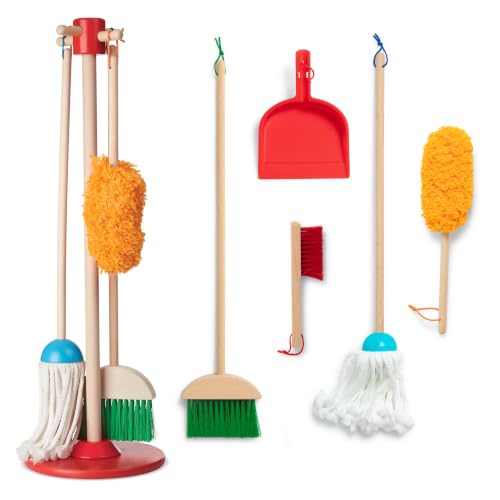
Melissa & Doug Dust Sweep Mop Cleaning Set
What We Like
- Realistic wooden cleaning tools
- Includes storage stand for organization
- Promotes pretend play and life skills
- Kid-sized tools fit small hands
Trade-offs
- Wooden stand adds bulk to storage
- No replacement parts listed for wear
This six-piece wooden cleaning set includes a broom, mop, duster, brush, dustpan that clips onto handles, and a storage stand, so a preschooler can practice sweeping and mopping with tools sized for their hands. The dustpan clips onto the handles, and the stand keeps everything organized, helping kids learn to put away their tools as part of the routine. The set is designed for ages 3 and up, and the included storage stand makes it easy to keep the pieces together.
The 30-inch overall height of this cleaning set makes it feel substantial, which is great for older preschoolers but might be a bit tall for a three-year-old just starting pretend play. The included wooden stand keeps everything organized, though it does require a dedicated spot on the floor. Compared to the Melissa & Doug Build-A-House Toolbox Set, which stores 51 pieces in a house-shaped toolbox, this set needs more room to stand. Still, for parents who want their child to learn tidying through imaginative play, the realistic broom, mop, duster, and dustpan offer a hands-on way to build independence and responsibility.
Fisher-Price Wood Montessori Dressing Board

What We Like
- FSC-certified wood with non-toxic paints
- Includes guided play tip card
- AMS Montessori Seal of Excellence
Trade-offs
- Flat board lacks 3D or stand-up play element
- Only one board limits variety for multiple kids
- No storage or carrying handle included
Nine dressing activities are packed into a single wooden board that weighs just 0.7 pounds, making it easy to move from a shelf to a table or tuck into a travel bag. Preschoolers practice buttons, shoelaces, snaps, buckles, and a zipper, each action building the fine-motor control needed for real independence like tying shoes or fastening a jacket. The board earned the AMS Montessori Seal of Excellence from the American Montessori Society in 2025, and the included tip card offers guided play ideas from the child development experts at the Fisher-Price Play Lab. Parents report that the compact size keeps the activity focused, so a child can repeat one skill without distraction.
The trade-off is that it is a single board, not a set of loose pieces or a freestanding activity center. Kids who crave more physical or imaginative play may lose interest faster than they would with, say, the Melissa & Doug Dust Sweep Mop Cleaning Set, which offers a different kind of pretend play. That board also has no storage or handle, so it lives on a shelf or in a bin rather than traveling easily. If your child thrives on variety and whole-body play, this board may feel too stationary. But if the goal is focused, repeatable practice on real-life fasteners, this is a solid dressing-skills tool.
Product photos
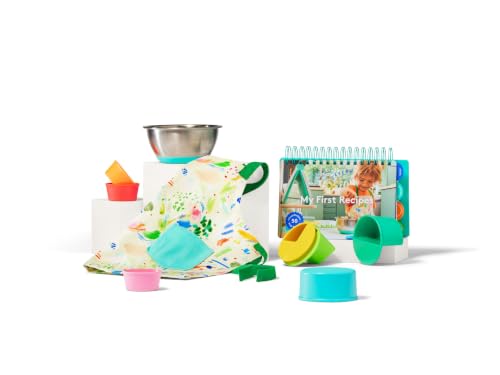
Lovevery Recipes for Me Mini Kit
What We Like
- Visual recipe book fosters early literacy
- Builds independence with toddler-friendly tools
- Introduces counting, measuring, and sequencing
- Compact 5-inch cube stores easily
Trade-offs
- Recipe book has only 5 recipes.
- Tools are plastic, not real kitchen items.
A 5-piece set with a visual recipe book means your toddler can follow along step by step without reading a word, that’s the kind of self-directed play that builds real confidence in the kitchen. Designed for 18 months and up, it pairs counting, measuring, and sequencing with hands-on pretend cooking, so early math sneaks in while they’re busy being your little sous chef. If you want a tool set that lets your child work alongside you rather than just watch, this one hits the mark for focused, independent exploration.
Five pieces won’t stretch far once your child wants more complex scenarios. For the parent who values a compact kitchen tool set that teaches process and patience, this is a focused choice.
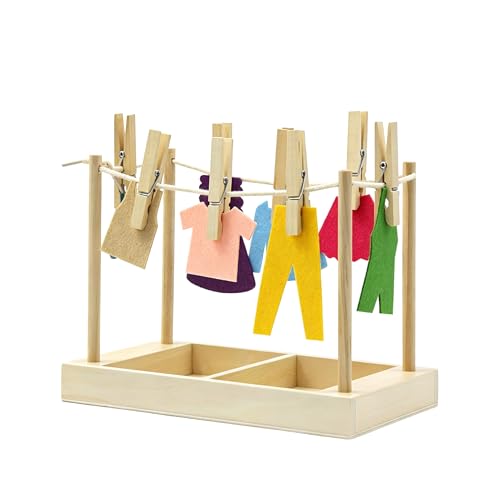
Kiddison Montessori Clothesline Activity Set
What We Like
- Strengthens pincer grip with real clothespins
- Uses natural solid wood and cotton rope
- Safety tested to ASTM F963 standards
- Child-friendly clothespin size for small hands
Trade-offs
- Requires adult assembly before child can use
- Only one activity style limits extended engagement
Real wooden clothespins and felt clothing pieces give children ages 3 and up a purposeful task that builds pincer grip, hand-eye coordination, and concentration. At 0.9 pounds, the set is light enough for a child to carry and set up independently. The natural materials, solid wood, cotton rope, and felt, create a calm, focused look that fits a Montessori home or classroom. Reviewers note that after a brief adult demonstration, children typically master the movement quickly and work on their own, making this a practical choice for families who value independent skill-building through repetition.
Parents need to assemble the base and rope before the child can use this clothesline, which adds a step that some busy families might find less convenient than products that come ready to go. And because the set focuses on one activity, hanging clothes, some children may prefer more variety. But for a child who enjoys order and repetition, this clothesline offers real fine-motor practice with a task that mirrors a genuine household chore.
Product photos
EduLand Montessori Laundry Hanging Activity

What We Like
- 30 double-sided pattern cards for matching
- Clothespin work builds fine motor skills
- Teaches real-life clothing care routines
- Self-directed play fosters independence
Trade-offs
- No storage for cards or clothespins included
- Targets ages 2-6, limited for older kids
Thirty double-sided task cards turn this laundry activity into a matching and sorting game that introduces colors, shapes, and design concepts for children ages two to six. The clothespin clipping and hanging mechanism helps develop fine motor skills and hand-eye coordination, while the four child-shaped cutouts and hat cutouts let kids practice matching clothing and hats. The toy encourages self-directed play and boosts confidence through decision-making, as noted in the product’s learning benefits.
The EduLand Montessori Laundry Hanging Activity measures 11.8 inches long and 7.7 inches tall, so it fits easily on a shelf or in a toy bin between uses. It includes a wooden board with four child-shaped cutouts, a wooden box with cut-out clothes and hats, wooden poles, rope strings, clothespins, and 30 double-sided task cards. The clothespin activity is designed to improve fine motor skills and hand-eye coordination, while the pattern cards introduce matching and sorting challenges that teach colors, shapes, and design concepts.
Product photos
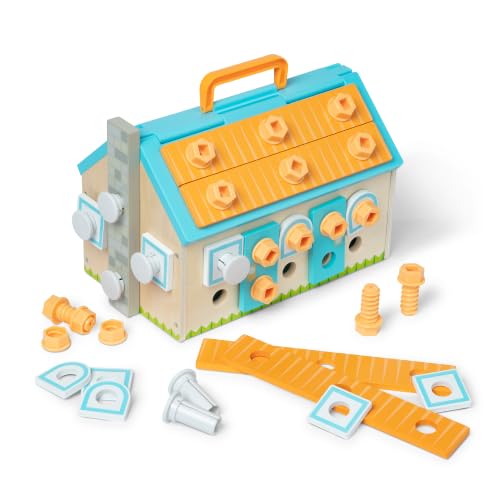
Melissa & Doug Build-A-House Toolbox Set
What We Like
- 51-piece set with 4 kid-friendly tools
- Squeeze-powered drill requires no batteries
- House-shaped toolbox doubles as building surface
- Built-in handle for portable cleanup
Trade-offs
- Drill is squeeze-powered, not motorized (less realistic action)
- No batteries included for any electronic features
Fifty-one building components, four tools, and a house-shaped toolbox that doubles as the construction surface pack a lot of pretend-play engineering into one portable kit. The squeeze-powered drill runs without batteries, so there is no need to find replacements mid-play, and the chunky handles on every tool are easy for little hands to grip. This set works best for a preschooler who wants to attach windows, doors, and shingles to the toolbox panels using nuts and bolts, fostering creative design and imagination. It gives them a hands-on introduction to engineering concepts, encouraging problem-solving, fine motor skills, and hand-eye coordination through constructive play.
The 51-piece set stores entirely inside the house-shaped toolbox, so cleanup is as simple as closing the lid and carrying it by the built-in handle. The squeeze-powered drill requires no batteries, but kids who expect a spinning bit might find the rhythmic squeezing action less immediately engaging. Compared to the Fisher-Price Wood Montessori Dressing Board, which targets early life skills learning, this set focuses on imaginative construction and fine motor coordination through hands-on building.
Yeeammk Montessori Kitchen Knife Set
What We Like
- 13-piece set covers multiple kitchen tasks
- Child-safe serrated edges reduce injury risk
- Includes Y peeler and crinkle cutter for variety
- Non-toxic BPA-free materials throughout
Trade-offs
- Stainless steel knife requires adult supervision
- Plastic knives dull quickly on hard vegetables
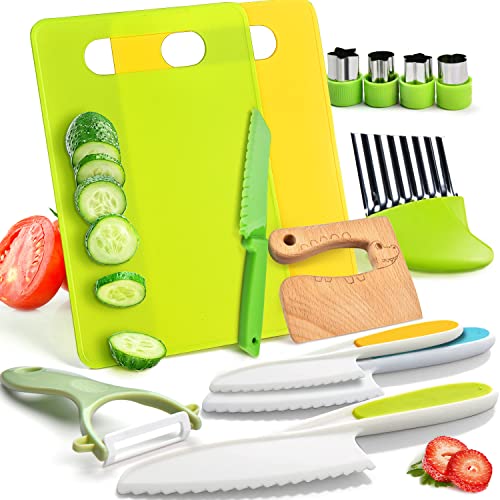
Thirteen pieces in one box means a toddler can chop, slice, peel, and cut shapes without needing extra tools. The set includes two cutting boards, a Y peeler, four sandwich cutters, and a crinkle cutter alongside three serrated-edge knives and a wooden knife. That lets a child practice real cooking tasks that build confidence and fine motor control. This makes it a strong fit for families who want a single purchase that covers multiple kitchen skills rather than buying separate tools one at a time.
The set includes a stainless steel cooking knife, which is not serrated and demands close adult supervision, so it is not a fully independent tool for very young children. Compared to the Lovevery Recipes for Me Mini Kit, which is a smaller set with fewer pieces, this Yeeammk set offers more variety but also more pieces to manage and clean. For a parent who wants to let a child help with real meal prep across different foods, this multi-piece set provides the range, but you will need to stay nearby for the sharper items.
Product photos
Tiny Land Soft Foam Climbing Blocks
What We Like
- 6 modular pieces for endless configurations
- 16.7° gentle slope for safe climbing
- Velcro connection and non-slip bottom
- Machine-washable, removable cover
Trade-offs
- 8.7-inch height limits older toddlers
- Covers require separate machine wash cycle.
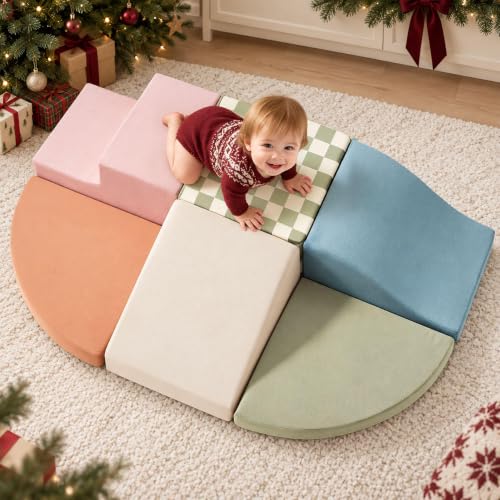
A 16.7° gentle slope and two 5cm-thick base blocks mean this climber stays stable even when your toddler launches themselves at it for the tenth time. That deliberate angle encourages crawling, climbing, and sliding without the tipping hazard you get with steeper foam sets, so your child builds gross motor skills and confidence on their own terms. It suits parents who want a Montessori-inspired indoor playground that lets little ones explore movement independently, without hovering every second.
Height is the limiting factor: at 8.7 inches tall, this set works best for crawlers and early walkers up to about age two, not the three-year-old who wants to scale a mountain. If you have the space and a child under two, it’s a thoughtful way to let them move on their own.
Product photos
Winblo Busy Board Montessori Toy
What We Like
- 28 activities across 7 themes
- Soft felt with no sharp corners
- Built-in storage pouch for pieces
- 8 pages in a single portable book
Trade-offs
- Limited to quiet, seated play only
- No standing or active play possible
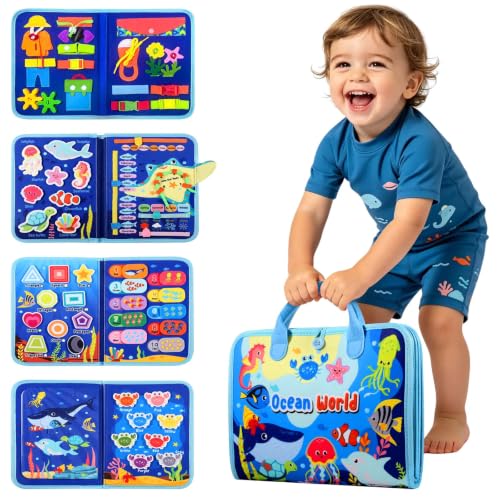
Twenty-eight activities spread across eight pages means this board packs a lot of variety into a compact 11-by-8.6-inch footprint. For a parent trying to keep a toddler occupied on an airplane or in a waiting room, that density of options is the whole point. The felt construction keeps it light and safe, with no hard corners to worry about when your child inevitably drops it or swings it around. It offers life skills like dressing alongside alphabet and number recognition, so it grows a little with the child rather than being outgrown in a month.
Soft felt, while great for portability and safety, may not hold up to heavy wear as well as a wooden board. The Winblo’s built-in storage pouch for all those velcro pieces is a smart touch that keeps the set from becoming a scatter of tiny parts on a plane tray table. For families who need a quiet, self-directed activity that packs flat and goes anywhere, this is a well-designed solution that puts a lot of learning into a small, soft package.
Product photos
MEROCO Montessori Teeth Brushing Model

What We Like
- Includes wooden tray for organized practice
- Comes with dental cognitive cards
- Teaches brushing technique on a model
Trade-offs
- Only includes toothbrush, no floss or toothpaste
- Focuses only on dental care, not other skills
This is the toy that turns a chore into a hands-on lesson, giving toddlers a safe way to master proper brushing and flossing without fighting a real toothbrush.
This set teaches only dental care, not other life skills. If you want a toy that covers dressing or cooking, the Fisher-Price Wood Montessori Dressing Board offers a different focus. But for the specific job of teaching a child to brush properly, the MEROCO model gives them a model to practice on until they get the hang of it.
Product photos
How We Evaluated Toys For Building Independence
Our research-based evaluation started with a review of manufacturer specs and safety certifications for each toy. We then compared each product against Montessori principles and early-childhood development guidelines to assess its ability to teach practical life skills. Owner feedback patterns helped us understand how these toys perform in real homes, which ones hold up to daily use and which ones actually keep children engaged.
We prioritized four criteria for this category. First, the toy must teach a real-world skill that a child can practice independently, like buttoning a shirt or pouring water. Second, the toy must be appropriately challenging, hard enough to teach but easy enough to avoid constant frustration. Third, material quality and safety mattered, especially for toys used in the kitchen or during active play. Fourth, we looked for toys that encourage repetition, since mastery of a skill comes from doing it again and again.
A research-led evaluation has limits. We cannot replicate months of home use in a lab, so our recommendations reflect what the data and expert consensus suggest will work best. We prioritize toys that have clear skill-building goals and strong safety records, but every child develops differently, and the best toy is always the one your child actually wants to use.
What To Look For In Toys For Building Independence
Choosing a toy that builds independence means looking past the packaging to the actual skills it teaches. The best options let a child succeed on their own terms while offering just enough challenge to hold their interest.
Look for toys that teach one concrete skill at a time, use durable materials safe for independent handling, and include visual guides or real-life references that help children connect the play to actual tasks.
Skill Alignment With Developmental Stage
A toy that builds independence must match where your child is developmentally. A 18-month-old needs gross motor challenges like climbing or grasping, while a 4-year-old can handle multi-step tasks like setting a table or sorting laundry. The Tiny Land Soft Foam Climbing Blocks work for infants learning to crawl and climb, while the Kiddison Montessori Clothesline Activity Set targets the pincer grip development of a 2- or 3-year-old. Age recommendations on the box are a starting point, but watch your child’s actual ability to follow the activity without constant help.
Durability and Safety for Solo Use
When a child plays independently, there is no adult hovering to catch a broken piece or redirect unsafe behavior. Materials matter. The Melissa & Doug Build-A-House Toolbox Set uses solid wood and a squeeze-powered drill that won’t pinch fingers. The Yeeammk Montessori Kitchen Knife Set includes child-safe serrated edges but requires adult supervision for the stainless steel knife, a reminder that “independent” doesn’t mean unsupervised for every activity. Look for non-toxic finishes, rounded corners, and construction that survives being dropped, thrown, or sat on.
Real-World Connection
Toys that build independence work best when they mirror real tasks a child sees adults doing. The EduLand Montessori Laundry Hanging Activity uses pattern cards that look like actual clothing, helping children connect the matching game to the real chore of sorting and hanging laundry. The MEROCO Montessori Teeth Brushing Model teaches proper brushing technique on a model before the child tries it on themselves. This real-world link gives the play meaning and motivates kids to practice the skill outside of toy time.
Storage and Portability
A toy that is hard to put away becomes a barrier to independence rather than a tool for it. The Melissa & Doug Dust Sweep Mop Cleaning Set includes a storage stand that teaches organization as part of the play. The Winblo Busy Board Montessori Toy folds into a book with a built-in storage pouch, making it easy for a child to carry and put away. Consider where the toy will live in your home and whether your child can access it and return it without help.
- Can your child reach the toy without climbing or asking for help?
- Does the toy have a designated storage spot that teaches cleanup as part of the routine?
- Are the pieces large enough to avoid choking hazards but small enough for small hands?
- Does the activity require adult setup, or can the child start playing immediately?
- Will the toy still be engaging after the first week of use?
A good rule of thumb: if you cannot imagine your child playing with the toy for a short while without calling for help, it is not independent-play-ready yet.
Toys For Building Independence Compared
The table below compares all ten toys side by side, so you can see at a glance which skills each one teaches, what age range it fits, and where it excels.
| Product | Age Range | Material | Dimensions |
|---|---|---|---|
| Melissa & Doug Dust Sweep Mop Cleaning Set | Ages 3+ | Wood | L 4.2 inches, W 9.7 inches, H 30.0 inches |
| Fisher-Price Wood Montessori Dressing Board | 3+ years | FSC-certified wood, water-based paints | L 10.2 inches, W 11.0 inches, H 0.8 inches |
| Lovevery Recipes for Me Mini Kit | 18+ months | N/A | L 5.0 inches, W 5.0 inches, H 5.0 inches |
| Kiddison Montessori Clothesline Activity Set | Ages 3+ | solid wood, cotton rope, and felt | L 11.0 inches, W 6.3 inches, H 1.8 inches |
| EduLand Montessori Laundry Hanging Activity | 2-6 years | N/A | L 11.8 inches, W 1.4 inches, H 7.7 inches |
| Melissa & Doug Build-A-House Toolbox Set | 3+ | N/A | L 1.4 inches, W 8.8 inches, H 11.9 inches |
| Yeeammk Montessori Kitchen Knife Set | N/A | Wood, polypropylene, stainless steel | L 3.0 inches, W 2.0 inches, H 2.0 inches |
| Tiny Land Soft Foam Climbing Blocks | N/A | 31A high-density foam core, skin-safe fabric | L 57.1 inches, W 35.4 inches, H 8.7 inches |
| Winblo Busy Board Montessori Toy | 1-3 year | Soft felt | L 11.0 inches, W 8.6 inches, H 1.5 inches |
| MEROCO Montessori Teeth Brushing Model | N/A | N/A | L 8.0 inches, W 6.0 inches, H 2.0 inches |
Frequently Asked Questions
What age should a child start using toys that build independence?
Most children show readiness for independent play around the time they begin to imitate adult actions. Simple toys like the Tiny Land Soft Foam Climbing Blocks work for infants, while dressing boards and kitchen tools fit toddlers ages 2 and up. The key is matching the toy’s complexity to your child’s current ability to complete the task with minimal help.
How do Montessori toys differ from regular toys for building independence?
Montessori toys are designed around a single skill or concept, using natural materials and self-correcting features that let the child learn through trial and error. The Fisher-Price Wood Montessori Dressing Board teaches one dressing skill at a time, unlike a doll with many fasteners that can overwhelm a child. Regular toys may include lights, sounds, or multiple functions that entertain but do not teach a specific life skill.
Can building toys help with independence?
Absolutely. Construction toys teach problem-solving and persistence, both essential for independent play. Our guide to building toys for problem-solving covers options that challenge kids to figure things out on their own. The Melissa & Doug Build-A-House Toolbox Set lets children construct a house using real tool actions, building confidence as they complete each step without adult guidance.
What is the difference between independent play and solitary play?
Independent play means a child can engage with an activity without constant adult direction or intervention. Solitary play is one form of independent play, but a child can also play independently alongside others, often called parallel play. Strategies for independent play work best when the toy itself provides enough structure and interest to hold the child’s attention. That way an adult doesn’t have to keep narrating or prompting.
How many toys should I buy at once for building independence?
Start with one or two toys that target different skill areas, one for fine motor work and one for gross motor movement, for example. Adding too many options at once can overwhelm a child and reduce engagement with any single toy. Our selection of open-ended toys shows how a few versatile pieces can support many types of independent play.
The Bottom Line
The Melissa & Doug Dust Sweep Mop Cleaning Set is our Best Overall pick for preschoolers ready to tackle real household chores with tools sized for their hands. It teaches sequencing, organization, and responsibility through the familiar rhythm of sweeping and mopping, activities most children already want to imitate.
If your child needs help with dressing skills, the Fisher-Price Wood Montessori Dressing Board offers focused practice on buttons, zippers, and snaps. For toddlers who want to help in the kitchen, the Lovevery Recipes for Me Mini Kit introduces measuring, pouring, and following a recipe with a compact design that stores easily.
The single most important factor in choosing a toy for building independence is whether your child can succeed at the activity without constant adult intervention. Watch how they play, notice where they get stuck, and choose the toy that meets them at their current skill level, not the one that promises the most future development.
