
10 Best Toys For 11 Month Old in 2026
This post contains affiliate links. As an Amazon Associate, we earn from qualifying purchases.
The VTech Busy Learners Activity Cube is the best overall toy for a baby around one year old. Its five sides of play reward every stage from sitting to crawling, while the motion sensor encourages movement. For families focused on motor milestones, the Baby Einstein 4-in-1 Kickin’ Tunes Play Gym is the best for motor development. The Fisher-Price Glow and Grow Kick & Play Piano Gym earns a spot as a musical playmat.
A baby around one year old is right at the edge of big changes, pulling up, cruising furniture, refining their pincer grasp, and soaking up cause-and-effect. The right toy meets them where they are today and stretches them just enough for tomorrow. Too simple and they lose interest; too complex and they get frustrated.
This guide is based on research. We looked into specifications, manufacturer descriptions, expert round-ups, and patterns in owner feedback to find the toys that best support a baby’s development across motor skills, sensory exploration, and early learning. We made sure every pick earns its spot.
Top 10 Toys For 11 Month Old in the Market
Certain content that appears on this site comes from Amazon. This content is provided "as is" and is subject to change or removal at any time.
The Best Toys For 11 Month Old, Reviewed
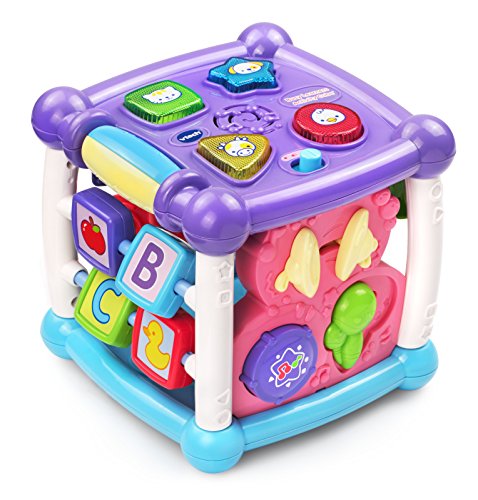
VTech Busy Learners Activity Cube
What We Like
- 5 sides of play encourage exploration
- Motion sensor rewards crawling movement
- 4 light-up buttons teach animals & shapes
- Volume control and auto shut-off included
Trade-offs
- Batteries included are for demo only
- At 6.5 inches tall, limited lap play for older toddlers
Fourteen interactive features packed into a six-inch cube mean this little box does a lot more than sit there. Each of the five sides offers something different: light-up buttons that name animals and shapes, a motion sensor that triggers songs when the cube is moved, and enough tactile surfaces to keep a curious baby busy. They can practice sitting up or crawling toward it. That motion sensor is the smart touch: it rewards the very movement you want to encourage at this age, turning play into a gentle nudge toward mobility.
Its compact size, about 6.2 inches on each side, makes it easy for little hands to grip and carry, so it works well for floor play during the sitting and crawling stages. Compared to the Fisher-Price Laugh & Learn DJ Table, which offers over 100 learning songs and phrases, this cube is more portable and focused on early cause-and-effect play. It’s a deliberate choice for the months when sitting, reaching, and first crawls are the main event.
Baby Einstein 4-in-1 Kickin' Tunes Play Gym

What We Like
- Teaches colors, shapes, numbers in 4 languages
- Machine-washable mat and wipe-clean toys
- Includes 7 sensory toys and tummy time pillow
Trade-offs
- Requires 3 AA batteries (not included) for piano
- At 3.2 pounds, lightweight but large for small spaces
Turning tummy time and lying play into a cause-and-effect game is exactly what this gym does for motor development. Seven sensory toys, including a crinkle medallion, triangle rattle, textured music note, flash cards, self-discovery mirror, piano, and tummy time pillow, give little hands plenty to reach for, grab, and mouth. The audio teaches colors, shapes, and numbers in four languages: English, Spanish, French, and German. That early language exposure is something most play mats skip entirely.
The trade-off is that the piano needs 3 AA batteries (not included), and if you forget them, the whole musical feedback loop goes silent. That’s a small frustration compared to the Fisher-Price Glow and Grow Kick & Play Piano Gym, which also uses batteries and comes with a similar size and toy count. At 3.2 pounds and 34 inches long, this mat is light enough to move room to room but too big to stash in a closet shelf. If you have a tight nursery, measure your floor space first. For families who want a single play gym that supports motor milestones from kicking to sitting to crawling, this is the one that keeps delivering as the baby grows.
Fisher-Price Glow and Grow Kick & Play Piano Gym

What We Like
- 85+ songs, sounds, and phrases
- 5 multi-colored light-up piano keys
- 10 repositionable linkable toys included
- Soft, machine-washable playmat
Trade-offs
- At 36 inches long, needs floor space
- Piano requires batteries (not included)
With 85 songs, sounds, and phrases packed into the playmat, this gym keeps a baby engaged far longer than a simple crinkle toy or teether. The removable piano has five light-up keys that a baby can kick or press to trigger music, and the Smart Stages learning levels grow with them from newborn to toddler. That combination of auditory feedback, visual reward, and physical cause-and-effect makes it a strong choice for parents who want a playmat that does more than just cushion tummy time.
Space is the main trade-off: at 36 inches long and 3.7 pounds, it takes up a decent chunk of a living room floor. The piano attachment can wobble if a baby really gets their legs into it. Compared to the Baby Einstein 4-in-1 Kickin’ Tunes Play Gym, which is similar in size and weight, the Fisher-Price offers more linkable toys (ten versus the Einstein’s fewer) and a machine-washable mat, which matters when a baby is exploring everything mouth-first. Not ideal for tight play areas or parents who prefer a stationary, non-electronic mat.
Product photos
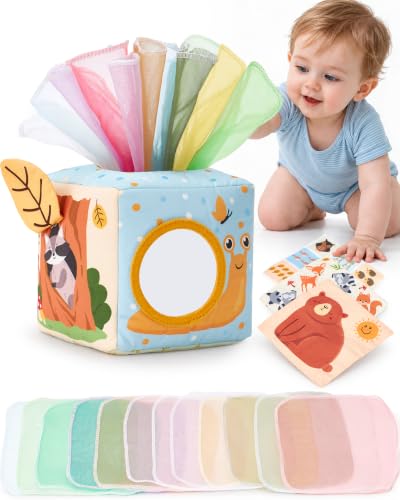
hahaland Baby Tissue Box Toy
What We Like
- Crinkle and squeaky sounds engage hearing
- Bright colors stimulate visual perception
- No small parts for choking safety
Trade-offs
- No lights or electronic feedback for older babies
- No electronic sounds or lights for babies who prefer tech toys
The set includes a soft tissue box, three textured crinkle tissues, and twelve silk scarves, giving a baby over six months plenty to grab, pull, and discover without needing batteries or a power button. The mix of crinkle paper, squeaky sounds, and soft fabric means each pull feels different, which is exactly what drives sensory exploration at this age. It suits parents who want a quiet, self-directed activity that builds fine motor skills and curiosity, all from a box small enough to toss in a diaper bag.
The box itself is compact, 4.7 inches each side, so once your baby pulls everything out, you’ll be stuffing scarves back in repeatedly. Compared to the VTech Busy Learners Activity Cube, which offers lights and songs, this toy is purely tactile and manual; some babies ready for more cause-and-effect feedback may lose interest faster. But for a focused sensory play session without screens or noise, it delivers exactly what the name promises.
Product photos
Fisher-Price Laugh & Learn Mix & Learn DJ Table

What We Like
- 3 Smart Stages levels grow with baby
- Record & play back feature
- Multi-color lights and 8 piano keys
- Teaches colors, shapes, numbers, alphabet, Spanish
Trade-offs
- At 4.5 lb, tipping possible if baby pulls up
- Stationary table limits movement compared to walker toys
Over 100 songs, sounds, and learning phrases packed into 12 activities means this table keeps a baby engaged far longer than a single-function toy. The three Smart Stages learning levels adjust content as your child grows, teaching colors, shapes, numbers, opposites, the alphabet, and even Spanish words. That range makes it one of the few toys that still feels fresh when a baby turns into a toddler. The record-and-playback feature adds a personal twist: your little one can record a message and hear the DJ mix it into a song, which turns cause-and-effect into pure delight.
The trade-off is size and stability. At 4.5 pounds, this table is heavier than most activity cubes, but a pulling-up baby can still tip it if they lean hard. For a stationary sitter who loves lights and sound, it delivers more learning depth than any single cube.
Product photos
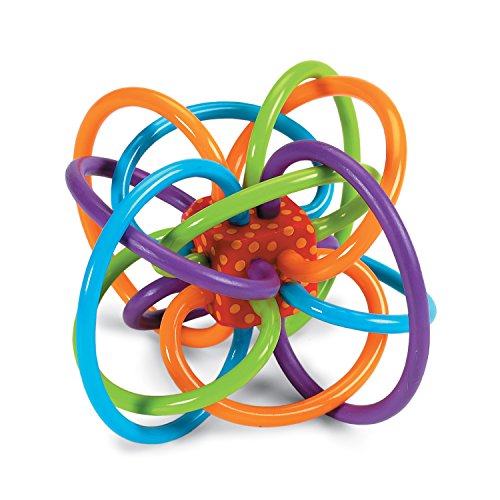
Manhattan Toy Winkel Rattle & Sensory Teether
What We Like
- Lightweight at 0.2 pounds for tiny hands
- BPA-free teething tubes can be refrigerated
- Continuous loop design easy to grasp
- Center cube rattle provides auditory stimulation
Trade-offs
- No electronic sounds or lights for extra engagement
- Rattle sound is quiet, not attention-grabbing
At 0.2 pounds, this toy is light enough for tiny hands to wave around without tiring, and its continuous loop of BPA-free tubes is exactly what sore gums need. The center cube rattles softly when shaken, giving babies a clear cause-and-effect lesson without overwhelming their senses. For a child who is actively teething and learning to grasp, this design hits the sweet spot between soothing and stimulating. It fits easily into a diaper bag and works as a quiet companion during car rides or waiting rooms, making it a practical pick for parents who want a simple, effective teether that also builds motor skills.
The Winkel keeps things intentionally simple, no flashing lights, no electronic songs, just a gentle rattle and soft tubes. If your baby craves more interactive features, this will feel quiet by comparison. But for a child who is easily overstimulated or still mastering two-handed play, the Winkel’s lightweight, easy-to-hold form is a smarter choice. It delivers reliable teething relief and developmental practice in a package that’s hard to drop and easy to love.
Manhattan Toy Deer One Soft Activity Crinkle Book

What We Like
- Crinkle pages and squeaker engage touch and sound
- Attached bunny and mushroom for grasping practice
- Baby-safe discovery mirror for self-exploration
- Teether corner cleans with baby-safe wipes
Trade-offs
- At 0.1 pounds, it lacks the heft for independent propping
- Surface wash only; no machine washing or drying
- Folded size is compact but offers limited visual spread
A crinkle leaf, a squeaker, and a baby-safe mirror packed into six and a half inches of fabric mean this book delivers four distinct sensory experiences in one lightweight package. At just 0.1 pounds, a baby can easily grab, shake, and mouth it without help, while the attached bunny and mushroom give tiny fingers something to pull and tuck back in. That combination of tactile variety and self-contained play makes it a natural pick for tummy time or a stroller ride, where you want engagement without a tangle of loose parts.
That same featherlight build is a double-edged sword: at 0.1 pounds, the book won’t stay propped open on its own during tummy time the way a heavier play mat like the Baby Einstein 4-in-1 Kickin’ Tunes Play Gym would. You’ll need to hold it or lay it flat. The hook-and-loop closure keeps pages tidy, but surface-only cleaning means spit-up or drool requires spot wiping rather than a quick machine wash. For a parent who values portability and sensory variety over a stationary play station, this is a focused, fuss-free tool.
TOHIBEE Baby Montessori Sensory Teething Ball

What We Like
- 12 textured silicone balls for sensory play
- Rattle ring and clicking ball engage curiosity
- BPA-free silicone soothes teething gums
- Lightweight at 0.2 pounds for tiny hands
Trade-offs
- No electronic sounds or lights for varied stimulation
- Simple design offers fewer developmental activities
At just 0.2 pounds and 4.7 inches long, this teething ball is built for the smallest hands, making it easy for a baby to hold and explore. The twelve textured silicone balls provide varied tactile feedback, while the rattle ring and clicking ball add auditory and motor challenges. It’s a straightforward way to introduce sensory play and teething relief for infants who are just beginning to grasp and reach. For parents looking for a simple, functional toy, this ball delivers real developmental value without extra features.
This is a simple, single-purpose toy. The VTech Busy Learners Activity Cube is heavier at 1.4 pounds and larger at 6.2 inches per side, so the TOHIBEE wins on portability. If your baby needs more complex stimulation, this ball might feel too basic. But for teething relief and early sensory exploration, it’s a practical pick.
Product photos
Sassy Stacks of Circles Stacking Ring Set

What We Like
- Straight post builds hand-eye coordination
- Chunky rings easy for baby to grasp
- Different textures and weights aid mouthing
- Beads in clear ring connect sound to sight
Trade-offs
- Only one stacking post limits variety of play
- No sound or light features for extra engagement
At just 0.6 pounds and with a straight post that accepts different sized rings, this set focuses entirely on one thing: helping your baby master the grasp-and-release motion that builds hand-eye coordination and fine motor skills. Each chunky ring has a different texture and weight, so little hands get varied sensory feedback while mouthing, a natural part of learning at this age. The clear ring with colorful beads adds a sound-to-sight connection that keeps curious babies interested. It’s a straightforward, no-frills tool for that crucial developmental step, and the BPA-free construction means you don’t have to worry about chewing.
The simplicity here cuts both ways. Once your baby figures out stacking, there’s no music, lights, or moving parts to extend the play session. Compared to the VTech Busy Learners Activity Cube, which offers multiple sides of buttons, spinning, and sounds, the Sassy set is more limited in scope. That simplicity is also its strength, it forces focused practice on a core skill without overstimulation. Best for parents who want a dedicated, safe stacking toy that targets hand-eye coordination, not for those seeking an all-in-one play center with varied electronic features.
Product photos
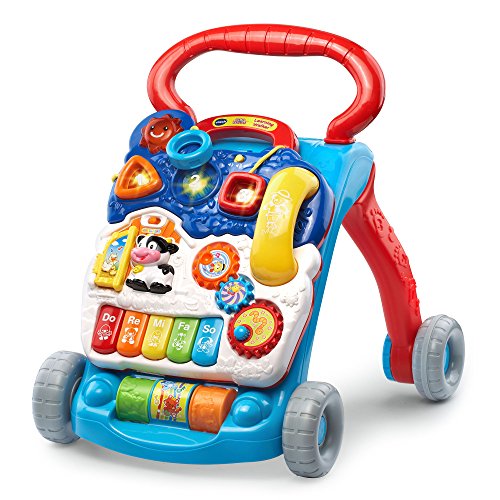
VTech Sit-to-Stand Learning Walker
What We Like
- Detachable activity panel for seated play
- Two-speed control switch grows with baby
- Five piano keys encourage creative role-play
- Shape sorters and spinning rollers build motor skills
Trade-offs
- At 4.6 lb, heavier than a stationary activity toy
- Requires floor space for walker use
A removable activity panel that works both on the floor and attached to the walker means this toy does double duty from sitting to cruising. The two-speed control switch lets you dial down the pace when your baby is still wobbly, then increase it as they gain confidence. That adjustability is rare at this stage, and it keeps the walker from racing ahead before your child is ready. The five piano keys, telephone handset, and shape sorters give you plenty of reasons to keep the panel on the floor for focused play, so the toy stays useful even on days when walking practice feels too ambitious.
Weight is the main compromise here: at 4.6 pounds, this walker is heavier than a lightweight activity cube like the VTech Busy Learners Activity Cube. That heft makes it stable during use but also means it takes up more floor space and isn’t something you toss in a diaper bag. That heft is what allows it to work on both carpet and bare floors without tipping, so for families with mixed flooring, it is a practical compromise. If your priority is purely stationary play, a lighter cube might be easier to move around, but for a child actively pulling to stand and taking first steps, the stability here is worth the extra bulk.
How We Evaluated Toys For 11 Month Old
We started with the manufacturer’s stated age range, developmental claims, and safety certifications for each toy. Then we cross-referenced those claims against patterns in owner feedback, what parents actually saw their babies do with the toy, how long it held attention, and whether it held up over weeks of use. Expert round-ups from child development specialists helped us understand which features genuinely support milestones like sitting, crawling, pulling up, and fine-motor grasping.
Four criteria mattered most for this age. First, developmental match: the toy must align with skills a baby around one year old is actively building, not just entertain passively. Second, safety and durability: no small parts that break off, non-toxic materials, and construction that survives drops and mouthing. Third, engagement range: the best toys offer more than one way to play so they stay interesting as the baby’s abilities grow. Fourth, practicality for caregivers: easy to clean, portable enough to move around the house, and not so large that it dominates the living room.
A research-led evaluation like this can’t replace watching your own baby play. Every child develops at their own pace, and a toy that delights one baby may bore another. We prioritized toys with adjustable features or multiple play modes so you have the best chance of finding a good fit.
What To Look For In Toys For 11 Month Old
A baby around one year old is a whirlwind of emerging skills: sitting independently, crawling, pulling to stand, cruising along furniture, and using their fingers with new precision. The right toy supports exactly these movements without overwhelming them.
Look for toys that invite interaction from multiple positions, sitting, on the belly, and standing. Prioritize cause-and-effect features, varied textures, and safety certifications. Avoid toys with small parts that can break off or long strings that pose a strangulation risk.
Developmental Stage Match
At around one year, most babies are somewhere between sitting well and taking first steps. A toy that only works for one position, say, a floor piano that requires lying down, may be outgrown in weeks. The best picks accommodate at least two stages. The VTech Busy Learners Activity Cube, for example, works for seated play on the floor and rewards crawling with its motion sensor. The Baby Einstein Kickin’ Tunes Play Gym grows from kicking on the mat to sitting and pressing the piano keys.
Sensory Variety and Cause-and-Effect
Babies this age learn by doing: “I shake this, it makes a sound.” Look for toys that offer multiple sensory inputs, lights, sounds, textures, and movement, and connect them to a simple action. The Fisher-Price Glow and Grow Kick & Play Piano Gym gives over 85 songs and phrases triggered by kicking or pressing keys. The hahaland Baby Tissue Box Toy offers crinkle and squeaky sounds from pulling, with no batteries required. Avoid toys that only flash or play noise without the baby needing to do anything.
Safety and Practicality
A baby around one year old puts everything in their mouth. Every toy should be BPA-free, have no small parts that can be removed and swallowed, and be easy to clean. Check for a volume control on electronic toys, your ears will thank you. The Manhattan Toy Winkel Rattle and the TOHIBEE Sensory Teething Ball are both lightweight, BPA-free, and dishwasher-safe or wipe-clean. The Baby Einstein play gym’s mat is machine-washable, which matters when drool and crumbs accumulate.
- Ensure any electronic toy has a secure battery compartment that requires a screwdriver to open.
- Check that fabric toys are machine-washable or at least surface-washable.
- Look for a wide, stable base on any upright toy to prevent tipping when baby pulls up.
- Confirm the toy meets ASTM F963 safety standards (this is standard for US-market toys).
If a toy has a volume control and an auto shut-off, it will last longer in your home, both the toy itself and your patience.
Toys For 11 Month Old Compared
The table below compares all ten picks across key features so you can see at a glance which toy best fits your baby’s current skills and your home’s space.
| Product | Weight | Dimensions | Interactive Features |
|---|---|---|---|
| VTech Busy Learners Activity Cube | 1.4 pounds | 6.2 x 6.2 x 6.5 inches | 14 |
| Baby Einstein 4-in-1 Kickin' Tunes Play Gym | 3.2 pounds | 34 x 27 x 18 inches | 7 toys |
| Fisher-Price Glow and Grow Kick & Play Piano Gym | 3.7 lb | 36 x 27 x 18 in | 10 linkable toys |
| hahaland Baby Tissue Box Toy | N/A | 4.7 x 3.7 x 4.7 inches | Box, 3 tissues, 12 silk scarves |
| Fisher-Price Laugh & Learn Mix & Learn DJ Table | 4.5 pounds | 12.0 x 6.5 x 0.1 inches | 12 activities |
| Manhattan Toy Winkel Rattle & Sensory Teether | 0.2 pounds | 5 x 4 x 3.5 inches | Rattle, teether, sensory tubes |
| Manhattan Toy Deer One Soft Activity Crinkle Book | 0.1 pounds | 6.5 x 6.5 x 2 inches | Crinkle, mirror, teether, squeaker |
| TOHIBEE Baby Montessori Sensory Teething Ball | 0.2 pounds | 4.7 x 3.1 x 2.4 inches | 12 textured balls, rattle, clicking, rotating ball |
| Sassy Stacks of Circles Stacking Ring Set | 0.6 pounds | 4.2 x 4.2 x 8.0 inches | 9 piece set |
| VTech Sit-to-Stand Learning Walker | 4.6 pounds | 16.5 x 14.2 x 18.1 inches | Removable activity panel |
Frequently Asked Questions
What type of toy is best for an 11 month old?
The best toys for a baby around one year old are those that support multiple developmental stages at once, sitting, crawling, pulling up, and fine-motor grasping. Look for cause-and-effect toys with lights, sounds, or textures that reward the baby’s action. The VTech Busy Learners Activity Cube is a strong example because it works from a seated position and encourages crawling with its motion sensor.
Are electronic toys good for 11 month olds?
Electronic toys can be excellent for babies around one year old when they require active participation, not passive watching. A toy that lights up or plays music only when the baby kicks, presses, or crawls toward it teaches cause-and-effect and builds motor skills. Avoid toys that simply play noise or flash lights without the baby needing to do anything.
How many toys does an 11 month old need?
A small rotation of four to six well-chosen toys is more effective than a large pile. A baby around one year old benefits from having one or two toys available at a time that target different skills, a sensory toy, a cause-and-effect toy, and a fine-motor toy. Rotating them every few days keeps interest high without overwhelming the baby.
What are the best sensory toys for an 11 month old?
Good sensory toys for this age offer varied textures, sounds, and visual stimulation without relying on screens. The hahaland Baby Tissue Box Toy provides crinkle and squeaky sounds from pulling, while the Manhattan Toy Deer One Soft Activity Book combines crinkle pages, a squeaker, and a baby-safe mirror. The TOHIBEE Sensory Teething Ball adds 12 different textures for mouthing and grasping.
Should I buy toys for an 11 month old that help with walking?
Toys that encourage pulling up and cruising, like the VTech Sit-to-Stand Learning Walker, can be helpful if your baby is already showing interest in standing. A stable walker with a wide base and adjustable speed gives them something to push while building balance. Skip walkers that are too lightweight or tip easily, and never force walking before the baby is ready.
The Bottom Line
The VTech Busy Learners Activity Cube is a top overall toy for a baby around one year old. It meets babies where they are, sitting, reaching, or crawling, and rewards every movement with cause-and-effect feedback. Its five sides of play, motion sensor, and volume control make it a practical, long-lasting choice for families.
If your baby is still working on tummy time and early motor skills, the Baby Einstein 4-in-1 Kickin’ Tunes Play Gym offers a complete system. It includes a piano that responds to kicks and a machine-washable mat. For families on a budget, the TOHIBEE Baby Montessori Sensory Teething Ball delivers solid sensory play and teething relief at a very accessible price point.
The single most important factor when choosing a toy for a baby around one year old is developmental fit. Pick the toy that matches what your baby is doing right now, not what you hope they’ll do next month, and you’ll almost never go wrong.
