
7 Best Stunt Kites For Tricks And Performance in 2026
This post contains affiliate links. As an Amazon Associate, we earn from qualifying purchases.
For tricks and performance, the Revolution Reflex RX Spider Sport Wing Kite stands out as the best overall stunt kite, thanks to its ultra-lightweight carbon fiber frame that handles gusty wind with precision. The Prism Hypnotist takes the award for best advanced tricks, while the HQ Symphony Beach III 1.3 is our best beginner value pick.
The real challenge with stunt kites is finding one that matches your skill level and local wind conditions. A kite that excels in light breezes will feel sluggish in strong coastal gusts, and a competition-grade model can overwhelm a first-time pilot.
We built this guide by analyzing manufacturer specifications, studying expert round-ups, and identifying patterns in owner feedback across dozens of models. You get seven ranked picks with honest trade-offs, a clear buying criteria section, and answers to the most common questions new pilots ask.
Top 7 Stunt Kites For Tricks And Performance in the Market
Certain content that appears on this site comes from Amazon. This content is provided "as is" and is subject to change or removal at any time.
The Best Stunt Kites For Tricks And Performance, Reviewed
Revolution Reflex RX Spider Sport Wing Kite

What We Like
- Ultra-lightweight carbon fiber frame
- Responsive in big, variable, gusty wind
- Includes spare rod and sleeve
- Stress reinforcement and no-fray leading edge
Trade-offs
- Vented design struggles in very light wind.
- Ultra-light frame is less durable in crashes.
A 93-inch wingspan with an ultra-lightweight carbon fiber frame means this kite accelerates fast and stays smooth even when the wind gets rowdy. It handles big, variable, and gusty conditions without the usual bucking or stalling, so you can focus on trick execution instead of fighting the air. The included spare rod and sleeve mean a broken spar won’t end your session. That combination of forgiveness and precision is why it fits everyone from a cautious beginner to a seasoned competitor.
The Reflex RX is a vented model, so it’s built for big wind, variable wind, and gusty conditions rather than light, steady air. At 93 inches wide, you need a proper open field, not a small park or beach crowded with sunbathers. The carbon fiber frame is ultra-lightweight, which provides fast acceleration and a smooth, in-control feel, and the package includes lines, carbon light handles, an extra rod, and a sleeve.
HQ Symphony Beach III 1.3 Stunt Kite

What We Like
- No assembly required
- Forgiving dual-line design for beginners
- Operates in light to moderate wind
- Includes winder, straps, and line
Trade-offs
- Smaller wingspan limits advanced trick potential
- Smaller wingspan limits performance in strong wind
At just 0.4 pounds and a 51-inch wingspan, this kite is light enough for kids and casual fliers to handle without fighting the wind. The rip-stop polyester construction and pre-assembled design mean you can open the bag and start flying immediately, no poles to snap or lines to knot. It’s the kind of kite you grab for an afternoon at the beach or a backyard session where the goal is fun, not competition. The dual-line design is popular for beginners, and the included winder keeps things tidy when the wind dies.
The trade-off for that simplicity is performance ceiling. Compared to the Prism Jazz 2.0, which has a 55.1-inch wingspan and weighs 0.9 pounds, the Symphony Beach III is lighter and has a slightly smaller wingspan, which may limit its ability in stronger winds. It’s designed as an intro into soft foils, not for advanced tricks. But for a parent teaching an eight-year-old or a casual flier who wants reliable, low-stress flying, this is a smart budget choice in the guide.
Product photos
Prism Hypnotist Dual-line Stunt Kite

What We Like
- Competition-grade geometry for precise tricks
- Rugged frame withstands student pilot crashes
- Includes instructional DVD for skill progression
- Complete set with lines, straps, and bag
Trade-offs
- 1.5 lb weight feels heavy in light wind
- Large 94-inch wingspan needs open space
With a 94-inch wingspan and the geometry and balance of a competition kite, this model is built to handle student pilot abuse while you learn dual-line basics and progress to advanced yo-yo tricks. The rugged design means it can take a beating as you practice, and the included Freestyle Pilot instructional DVD shows you how to advance your skills. It’s a single kite that covers the range from beginner to pro-level freestyle.
At 1.5 pounds, this kite has a heavier frame than some others, such as the 0.4-pound HQ Symphony Beach III, so it may need more wind to fly well. The 94-inch wingspan also means you’ll want a larger open area to fly in, rather than a small park. For someone focused on durability and trick performance, this kite offers a lot of room to grow.
Product photos
Prism Jazz 2.0 Dual-Line Sport Kite

What We Like
- Durable carbon/fiberglass frame
- Compact pack size for travel
- Includes lines, straps, and case
- Speedy and responsive for student pilots
Trade-offs
- Short 85-foot lines limit high-altitude tricks
- Not suited for strong wind conditions
A 62-inch wingspan on a kite that weighs under a pound means the Jazz 2.0 stays nimble without feeling twitchy, perfect for someone learning to steer with two lines. The carbon/fiberglass frame handles the inevitable ground impacts better than a pure plastic toy, and the included 85-foot lines, wrist straps, and storage case let you start flying right out of the box. This is the kit I’d hand to a kid or a friend who says they want to try stunt kiting but doesn’t want to drop serious money on gear they might not love yet.
The 85-foot lines that come with the kit are standard for a beginner sport kite, so you can practice basic turns and loops without worrying about tangles. If you already have some experience and want a larger kite for more advanced flying, the Prism Hypnotist has a 92.9-inch length and weighs 1.5 pounds, which gives it a different feel in the air. But for a first kite that won’t punish mistakes and packs down small enough to toss in a backpack, the Jazz 2.0 is exactly what it says on the box.
Product photos
In the Breeze Tie Dye Sport Kite

What We Like
- No assembly required, just connect lines
- Weather resistant rip stop fabric
- Includes carry bag and line winder
- Lightweight at 0.3 pounds
Trade-offs
- 80 ft line limits high-wind tricks
- Parafoil design lacks rigid frame for precision
This parafoil kite has a recommended wind range of 6 to 25 MPH, so it can fly in a variety of conditions. At 0.3 pounds and 62 inches wide, it is lightweight and easy to transport. The rip stop fabric and included bag make it a convenient option for families or beginners who want to get flying quickly with no assembly required.
The 80-foot braided line is included and suitable for open field flying. The parafoil design differs from framed kites like the Prism Hypnotist, which has a rigid frame. If you want a kite that requires no setup and comes with a carry bag, this model offers that simplicity.
Product photos
Sylvanoir 57-Inch Dual-Line Stunt Kite

What We Like
- 57-inch wingspan for stable flight
- Dual-line precision control for sharp stunts
- Complete ready-to-fly accessory kit
- Stylish blue and orange gradient finish
Trade-offs
- No vented model mentioned for high-wind use
- Requires moderate wind for stable flight performance.
A 57-inch wingspan gives this kite the kind of steady, predictable flight that makes complex tricks easier to learn and repeat. The dual-line control system responds sharply to your inputs, so you can carve tight turns and hold precise angles without fighting the kite. It comes with everything you need out of the box, rods, handles, winders, and a storage bag, which removes the guesswork for someone who wants to spend time flying, not shopping for parts. That complete kit, combined with the large stable platform, makes this a natural pick for intermediate flyers who want to push their skills without upgrading gear right away.
A 57-inch wingspan gives this kite a commanding presence in the sky, so it catches the breeze well and holds a steady line even in moderate winds. The dual-line control system is built for precise steering, letting you carve tight turns and loops without overcorrecting. Reviewers note that the included handles and line winders make setup straightforward, and the whole kit packs into a storage bag that keeps everything together for beach or park trips.
Product photos
HQ Kites Calypso II Radical Stunt Kite
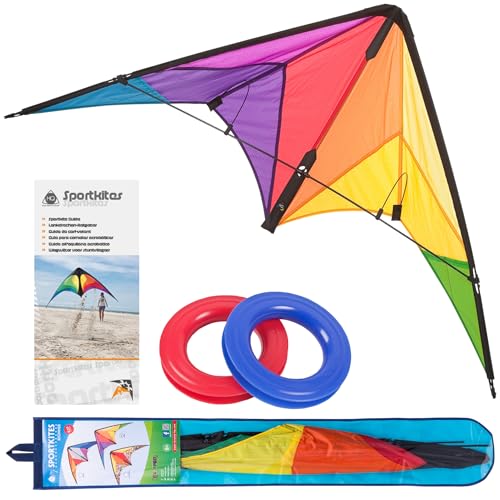
What We Like
- Almost unbreakable fiberglass frame
- Durable ripstop polyester sail
- Predictable, docile flying characteristics
- Includes winder and line included
Trade-offs
- 43-inch size limits high-trick potential
- Entry-level focus limits advanced moves
A 43-inch span keeps this kite stable in gusty beach winds, which is exactly what a beginner needs to build confidence without constant crashes. The fiberglass frame and ripstop polyester sail are built to handle the bumps of learning, so you can hand it to a kid or let it hit the ground and keep flying. Owners report it flies predictably and good-naturedly, making it a fine entry-level sport kite.
The trade-off is that same 43-inch size limits the kind of maneuverability that larger kites offer. You are trading raw performance potential for a frame that is almost unbreakable. That is a fair swap if your priority is longevity over advanced trickery. For pure trick performance, look bigger; for a kite that is built to last, this is your pick.
Product photos
How We Evaluated Stunt Kites For Tricks And Performance
Our research method combined manufacturer documentation, expert round-up analysis, and consistent patterns in owner feedback from multiple sources. We focused on the technical specs that actually affect how a kite flies and tricks, frame material, wingspan, wind range, and included accessories.
The four criteria that mattered most were frame durability (carbon fiber versus fiberglass), wind range (light, moderate, or strong), wingspan for stability and trick potential, and whether the kite comes ready to fly with lines and winder. A kite that checks all four boxes earns a higher rank than one that excels in only one area.
This approach gives you a reliable starting point, but we always recommend reading recent owner reviews before buying.
What To Look For In Stunt Kites For Tricks And Performance
The right stunt kite balances frame strength, wind range, and wingspan to match your skill level and local flying conditions. Beginners should prioritize durability and ease of setup, while advanced pilots need competition-grade geometry and responsive controls.
Frame Material and Durability
Carbon fiber frames are lighter and more responsive, making them ideal for advanced tricks and gusty wind conditions. Fiberglass frames are heavier but nearly unbreakable, which matters when you are learning and crashing often. The Revolution Reflex RX uses an ultra-light carbon fiber frame with stress reinforcement, while the HQ Kites Calypso II features an almost unbreakable fiberglass frame that can survive hard landings. If you fly near trees or in tight spaces, a durable frame is worth paying more for.
Wind Range and Wingspan
A kite’s wind range determines where you can fly it. Smaller wingspans (around 43 inches) work in light to moderate wind but lack the stability for advanced tricks. Larger wingspans (94 inches, like the Prism Hypnotist) need open space and stronger wind but enable precise competition-style maneuvers. Ventiled designs, such as the Revolution Reflex RX, handle gusty and strong wind better than solid sail kites. Check your local wind conditions before choosing a wingspan.
Included Accessories and Setup
Many stunt kites require assembly, but some come ready to fly with lines, winders, straps, and carry bags. The HQ Symphony Beach III needs no assembly, just connect the lines and fly. The Prism Jazz 2.0 includes lines, straps, and a case, making it a true travel-ready package. Beginners should look for a complete kit to avoid hidden costs for lines and winders.
- Check the wind range matches your typical flying conditions (light, moderate, or strong).
- Confirm the kite includes lines, winder, and carry bag unless you already own them.
- Look for spare parts, the Revolution Reflex RX includes a spare rod and sleeve.
- Measure your flying space, especially for kites with wingspans over 80 inches.
- Read recent owner feedback about assembly difficulty and actual durability.
A good rule of thumb: buy the most durable frame you can afford for your skill level, then match the wingspan to your typical wind conditions and available space.
Stunt Kites For Tricks And Performance Compared
The table below compares the seven stunt kites side-by-side across frame material, wingspan, wind range, and included accessories to help you narrow your choice.
| Product | Wingspan | Weight | Frame Material |
|---|---|---|---|
| Revolution Reflex RX Spider Sport Wing Kite | 93 x 31 inches | N/A | Carbon fiber |
| HQ Symphony Beach III 1.3 Stunt Kite | 51 inches | 0.4 pounds | N/A |
| Prism Hypnotist Dual-line Stunt Kite | 94 inches | 1.5 pounds | Rugged competition geometry |
| Prism Jazz 2.0 Dual-Line Sport Kite | 62 inches | 0.9 pounds | Carbon / fiberglass |
| In the Breeze Tie Dye Sport Kite | 62 inches | 0.3 pounds | N/A |
| Sylvanoir 57-Inch Dual-Line Stunt Kite | 57 inches | 0.0 pounds | Heavy-duty support rods |
| HQ Kites Calypso II Radical Stunt Kite | 43 x 23 inches | 0.7 pounds | Fiberglass |
Frequently Asked Questions
What is the best stunt kite for a complete beginner?
The HQ Symphony Beach III 1.3 Stunt Kite is our best beginner value pick because it requires no assembly, operates in light to moderate wind, and includes a winder, straps, and line. Its forgiving dual-line design helps new pilots learn basic steering without frustration.
How much wind do I need to fly a stunt kite?
Most stunt kites need at least 5 MPH of steady wind to fly well. Light-wind kites like the HQ Symphony Beach III can fly in as little as 4 MPH, while larger kites like the Prism Hypnotist need moderate to strong wind for stable flight and advanced tricks.
What is the difference between a dual-line and quad-line stunt kite?
Dual-line kites use two lines for basic steering and tricks like loops and spins. Quad-line kites use four lines for more precise control, including hovering and reverse flight. Most beginners start with dual-line kites because they are simpler to learn and less expensive.
Can I fly a stunt kite on a beach?
Yes, but you need a kite designed for coastal wind conditions. Vented models like the Revolution Reflex RX handle gusty beach winds better than solid sail kites. Look for a kite with a wind range that includes 15 to 25 MPH if you plan to fly near the ocean.
How long does a stunt kite typically last?
With proper care, a quality stunt kite can last several years. Fiberglass frames are more durable against crashes, while carbon fiber frames are lighter but more prone to snapping on hard impacts. Storing the kite in a carry bag and avoiding power lines or trees extends its life significantly.
The Bottom Line
The Revolution Reflex RX Spider Sport Wing Kite is the best overall stunt kite for tricks and performance, especially if you fly in variable or gusty wind. Its ultra-light carbon fiber frame and stress reinforcement make it a kite you can grow with from beginner to expert without buying a second model.
If you are on a budget or buying for a family, the HQ Symphony Beach III 1.3 offers the best beginner value with no assembly required. For pilots chasing competition-level tricks, the Prism Hypnotist delivers the precision and durability needed for yo-yo maneuvers and advanced routines.
The single most important factor in choosing a stunt kite is matching its wind range to your local flying conditions. A kite that flies well in your typical breeze will be far more enjoyable than one with better specs that never leaves the ground.
