
10 Best Stem Toys For Kindergarteners in 2026
This post contains affiliate links. As an Amazon Associate, we earn from qualifying purchases.
For kindergarteners ready to explore science, technology, engineering, and math, the Learning Resources STEM Explorers Brainometry is the best overall pick. Its 34 tactile puzzle blocks and 10 double-sided cards build spatial reasoning through progressive challenges. The Learning Resources Gears Deluxe Building Set earns our Best Interlocking Gear Set award for kids who love motion and mechanics, while the Doctor Jupiter Preschool Science Kit offers over 100 experiments for curious young scientists.
Kindergarten is the sweet spot where fine motor skills are developing fast and abstract thinking begins to click. The right STEM toy meets a five-year-old where they are, not too simple, not too frustrating, and turns play into genuine learning.
We evaluated these picks by studying manufacturer specifications, expert recommendations, and patterns in parent and teacher feedback. This guide covers ten top-rated options across building, circuits, art, and sensory play so you can match the toy to your child’s natural interests.
Top 10 STEM Toys For Kindergarteners in the Market
Certain content that appears on this site comes from Amazon. This content is provided "as is" and is subject to change or removal at any time.
The Best STEM Toys For Kindergarteners, Reviewed
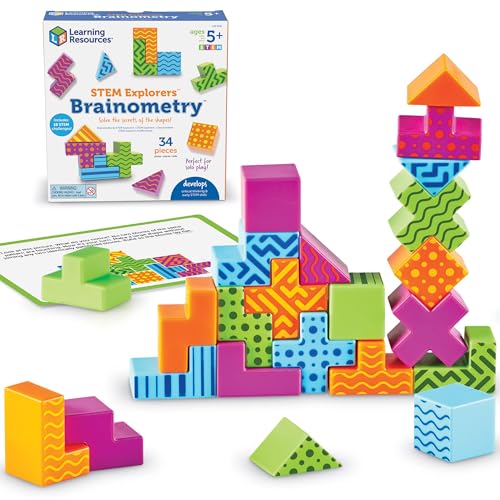
Learning Resources STEM Explorers Brainometry
What We Like
- 34 tactile puzzle blocks for hands-on learning
- 10 double-sided cards with progressive difficulty
- Portable storage box keeps pieces organized
- Screen-free solo play builds concentration
Trade-offs
- Solo play means no built-in cooperative activity
- 5+ age floor excludes younger kindergarteners
The 10 double-sided challenge cards offer progressive difficulty levels, so the toy grows with a child’s thinking skills rather than becoming boring after a few plays. With 34 small puzzle pieces and a portable storage box, it’s easy to take on car trips or to a friend’s house. The screen-free format keeps kids focused on pattern matching and spatial reasoning without needing a tablet.
Compared to the 100-piece Gears Deluxe Building Set, Brainometry’s 34 pieces feel modest, but its strength lies in directed, escalating challenges. Each card demands a specific solution, building persistence and logical thinking in a way free-form building doesn’t always achieve. For a kindergartner who thrives on pattern matching and problem-solving, this is a tighter, more purposeful pick.
Product photos
Learning Resources Gears Deluxe Building Set

What We Like
- 100-piece deluxe building set
- Includes crank handle for motion
- Builds STEM and engineering skills
- Strengthens fine motor skills
Trade-offs
- No motor or power source included
- Requires flat base for stable constructions
A 100-piece set of colorful interlocking gears, pillars, axles, bases, and a crank handle lets kids build machines that spin and move, not just stack. That hands-on cause-and-effect is exactly what makes this click for early engineering: they turn the crank, see which gear turns which way, and start understanding motion through play. It suits kids ages 4 and up who enjoy experimenting and rebuilding.
The set is described as great for STEM challenges, classroom centers, homeschool activities, and independent play, so it can work in group settings. Compared to the Educational Insights Design & Drill Gears Workshop, which adds a power drill for assembly, the Learning Resources set keeps things manual and quieter. Reviewers note it comes in standard retail packaging, making it a ready gift.
Product photos
Doctor Jupiter Preschool Science Kit

What We Like
- 100+ experiments for variety
- Designed for ages 3+
- Includes online manual
Trade-offs
- Kit size is slim at 1.8 inches thick
- Experiments require common household supplies
One hundred plus experiments packed into a box that weighs just a pound and a half means this kit offers an enormous variety of hands-on activities without taking over your shelf.
The trade-off for that many experiments is a slim box, at 1.8 inches thick, you won’t find bulky lab equipment inside. Some activities will need common household items you already have, which is fine for most families but means you can’t just open the box and run every single one. Compared to the Learning Resources Gears Deluxe Building Set, which offers a more open-ended engineering build, this kit is guided and project-based.
Tsomtto 10 in 1 STEM Building Kit

What We Like
- 167 pieces build 10 different models
- Includes step-by-step guide booklet
- Comes with sturdy storage box
- Non-toxic, bright, colorful blocks
Trade-offs
- Build one model at a time only
- Storage box is small for all 167 pieces
With 167 pieces that can be reassembled into 10 different models, from a tower crane to a robot to a rocket car, this kit gives a kind of variety that keeps a curious kindergartener coming back. The step-by-step guide booklet means a child who can follow simple pictures can work independently, while the included storage box makes cleanup straightforward for parents. It’s a strong fit for families who want a single building set that offers multiple projects without needing to buy separate kits for each theme. The non-toxic, colorful blocks hold up well to daily play.
The trade-off is that you can only build one model at a time, so if siblings or friends want to build different things simultaneously, this set won’t stretch that far. For a kindergartener who loves following instructions to create recognizable vehicles and machines, the Tsomtto delivers variety and structure. For a child who craves mechanical action or free-form building, a gear-based set like the Learning Resources Gears Deluxe might be a better fit.
Product photos
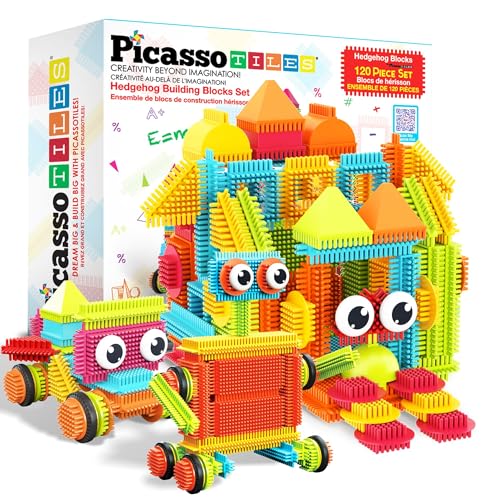
PicassoTiles Hedgehog Bristle Blocks
What We Like
- Soft, rubbery texture for sensory play
- Easy-connect tips for small hands
- BPA-free and lead-safe materials
- Encourages open-ended creative building
Trade-offs
- Bristle tips can trap dust over time
- No storage container included for pieces
A 120-piece set of soft, rubbery bristle blocks means a kindergartener can build everything from a wobbly robot to a spiky car without frustration. The easy-connect tips click together at different angles and release just as easily, so little fingers stay engaged instead of stuck. That forgiving texture also makes this a strong pick for sensory play. The bristles provide gentle tactile feedback that many kids find calming, and the BPA-free, lead-safe plastic gives you one less thing to worry about during floor time.
The 120-piece set is enough for one or two children to build freely, but a preschool classroom with several kids might need two sets to keep everyone engaged. The PicassoTiles blocks connect easily without precise alignment and feel soft to the touch, making them more forgiving for young builders. By contrast, the Learning Resources Gears Deluxe Building Set has 100 interlocking gears in a 2.2-pound box.
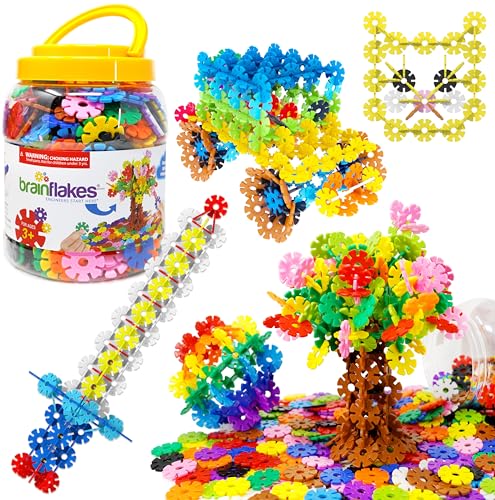
Brain Flakes 500 Piece Interlocking Disc Set
What We Like
- Non-toxic, safety-tested materials
- 500+ pieces in 12 colors
- Includes idea booklet and online resources
- Flexible discs for open-ended building
Trade-offs
- No motor or gear mechanism for motion play
- Discs lack rigid connection for tall vertical structures
Five hundred interlocking discs in twelve colors give a child ages three and up enough pieces to build a flower, a rainbow ball, or a tree using the included idea booklet. The discs click together easily for small hands and are flexible, which allows for creative open-ended building. This set is a strong STEM toy for developing spatial intelligence and thinking, and it works well as a solo or group activity for classrooms, daycares, or home. The online resources provide additional ideas for endless creativity.
The discs are flexible and designed for open-ended building, not for creating moving parts or rigid structures. The Learning Resources Gears Deluxe Building Set includes 100 interlocking gear pieces, which may appeal to children interested in mechanical movement. For a child ages three and up who enjoys colorful, tactile play and needs a screen-free activity that aids fine motor skills, this set works well. It is less suited for someone who wants to build structures with gears or moving components.
Educational Insights Design & Drill Gears Workshop

What We Like
- Electric drill, hand crank, and screwdriver included
- 10 double-sided pattern cards guide building
- Interlocking gears teach cause and effect
- Develops fine motor skills through real drilling
Trade-offs
- Requires 2 AA batteries not included
- Limited to designs on pattern cards without extra pieces
The power drill toy, hand crank, and screwdriver let a child tighten bolts and spin gears, turning a static pattern card into a moving machine. Ten double-sided cards provide guided builds that teach cause and effect as interlocking gears turn together, which supports early STEM and fine motor skill development. This set suits a child who wants to build with working tools.
The 32 bolts and 10 gears are a fixed set, so once a child finishes the pattern cards, they may want more pieces to invent their own designs. This kit has fewer parts than the Learning Resources Gears Deluxe Building Set, which includes 100 pieces. For a child who thrives on following a plan and seeing a clear result, the guided cards are a strength; for one who prefers pure creativity, the limited parts may feel restrictive.
LFACHTER Circuit Building Kit

What We Like
- 220+ projects for long-term engagement
- No soldering or tools required
- Includes color manual and instruction cards
- Teaches parallel and series circuits
Trade-offs
- Requires AA batteries not included
- Manual can be overwhelming for younger children
With 220+ projects and 38 snap-on components that need no soldering or tools, this kit offers a safe, hands-on introduction to basic electronics like parallel and series circuits. The included color manual and instruction cards help kids build confidence as they work through experiments alone or with a parent. It makes a strong pick for families who want a STEM toy that grows with the child from simple lights to more complex logic setups.
The kit packs over 220 projects with 38 circuit components, so a child who enjoys guided building can work through everything from simple circuits to complex logic systems. The box is 15 inches long, and it needs AA batteries you’ll have to buy separately. Reviewers note the illustrated manual and 5 instruction cards help kids follow along, but the sheer number of projects means an adult should plan to sit with younger builders at first.
Product photos
CYOEST Pixel Art STEM Kit

What We Like
- Over 50 patterns with 3 difficulty levels
- Develops fine motor skills for ages 5-12
- Safe, non-toxic materials for young kids
Trade-offs
- Small 5.5-inch base limits large group play
- Only 0.6 inches tall, feels more like a kit than a toy
- No moving parts or building beyond flat designs
Fifty-plus patterns and four types of STEM challenges across three difficulty levels mean this little kit grows with a child rather than collecting dust after one afternoon. That range is exactly what you want for a kindergartner who might need a gentle start today and a real brain-stretcher next month.
At 5.5 inches square and barely thicker than a phone, this is a lap-friendly kit, not a sprawling floor project. It works beautifully for one child or a pair sharing, but if you need something that fills a table for a playdate, the Brain Flakes 500-piece disc set gives you more spread-out space and collaborative building. The CYOEST is best as a portable, screen-free activity that keeps little hands busy, just don’t expect it to anchor a group activity.
Product photos
choopheme 10-in-1 Building Block Kit

What We Like
- 10 different engineering vehicle builds
- 112 pieces with storage box
- Non-toxic, safe materials
- Instructions included for each model
Trade-offs
- Only 112 pieces for 10 models means small builds
- Not suitable for children who want large, complex structures
Ten different models from a single 112-piece set means your kindergartener can build a bulldozer one day and a windmill the next without needing a second box. That variety keeps the engineering curiosity alive longer than most single-build kits manage. The set includes a storage box for quick cleanups, which is a practical feature for any parent. The finished models actually move, so the play doesn’t stop when the last brick clicks into place.
The 112 pieces in this kit build ten different models, so each project is quick and satisfying rather than a sprawling construction. A child who wants to finish a build in one sitting and then move on to a new design will enjoy this set. By contrast, the Learning Resources Gears Deluxe Building Set has 100 pieces for a single build, which may appeal to kids who prefer a larger, more complex project. The choopheme kit is designed to improve children’s science, technology, engineering, and math skills through hands-on play.
Product photos
How We Evaluated STEM Toys For Kindergarteners
This guide is research-based, drawing on manufacturer documentation, expert round-ups from early childhood education sources, and patterns in owner feedback. We prioritized what parents and teachers consistently report works best for this age group.
Four criteria mattered most for this category. First, the toy must engage the specific developmental needs of a five-year-old: spatial reasoning, fine motor control, and sustained attention. Second, the materials and construction must be safe for children ages three to six. Third, the activity should offer either progressive difficulty or open-ended play value so it doesn’t get abandoned after one session. Fourth, we considered storage and portability, a practical factor for classrooms and small homes.
An honest limit: research-led evaluation can’t replicate the way a particular child reacts to a toy. Your kindergartener’s personality matters as much as any spec sheet. The pros and cons of each pick are laid out clearly so you can weigh your own priorities.
What To Look For In STEM Toys For Kindergarteners
The best STEM toys for this age combine hands-on manipulation with a clear learning goal, and they don’t require a tablet or screen to work. Look for pieces sized for small hands, materials that pass safety testing, and an activity that can be done alone or with a partner.
Choose a toy that challenges without overwhelming: progressive difficulty levels, non-toxic materials, and enough pieces for creative exploration. Avoid anything that requires adult setup for every single use.
Progressive Difficulty
The best toys for kindergartners grow with them. A toy with multiple difficulty levels, like the Brainometry’s 10 double-sided cards, keeps a child engaged over months rather than minutes. Look for sets that offer beginner, intermediate, and advanced challenges or that allow open-ended building after guided projects are finished.
Fine Motor Skill Development
Kindergarteners are refining the small muscle control they’ll need for writing. Toys that require pinching, twisting, snapping, or drilling, like the Design & Drill Gears Workshop with its real electric drill, strengthen those hands in ways passive toys cannot. The best options let kids practice without frustration: pieces should connect easily but hold firmly.
Safety and Material Quality
For this age group, non-toxic materials are non-negotiable. Look for BPA-free, lead-safe claims on packaging, and avoid sets with tiny parts that pose a choking risk for younger siblings. The educational toys for kindergarteners in our list all meet standard safety testing for ages three and up.
- Check that all pieces are larger than a toilet paper tube to prevent choking
- Confirm the toy is labeled for your child’s exact age, not just a broad range
- Look for storage solutions, a box or bag, to keep pieces from getting lost
- Read feedback about durability: brittle plastic is a red flag for this age
A good rule of thumb: if you wouldn’t trust the toy to survive a drop from the kitchen table, it won’t survive a kindergartener.
STEM Toys For Kindergarteners Compared
The table below compares the key specs and award categories for our ten picks, size, piece count, and best use case at a glance.
| Product | Age Range | Piece Count | Weight | Dimensions |
|---|---|---|---|---|
| Learning Resources STEM Explorers Brainometry | 5+ | 34 | 0.6 lb | 10.0 x 9.0 x 4.5 in |
| Learning Resources Gears Deluxe Building Set | Ages 4+ | 100 | 2.2 pounds | 12.0 x 10.4 x 4.1 in |
| Doctor Jupiter Preschool Science Kit | 3+ | N/A | 1.5 pounds | 11.6 x 9.8 x 1.8 in |
| Tsomtto 10 in 1 STEM Building Kit | 4-8+ years | 167 pieces | 2.3 pounds | 10 x 6 x 5 inches |
| PicassoTiles Hedgehog Bristle Blocks | Ages 3+ | 120 pieces | 3.0 pounds | 14.1 x 11.8 x 3.4 in |
| Brain Flakes 500 Piece Interlocking Disc Set | Ages 3+ | 500+ | 1.9 pounds | 5.5 x 7.5 x 5.5 in |
| Educational Insights Design & Drill Gears Workshop | N/A | 10 gears, 32 bolts, 3 tools | 1.9 pounds | 15.5 x 9.8 x 8.8 in |
| LFACHTER Circuit Building Kit | 5-12 years | 38 | N/A | 15 x 12 x 2.5 inches |
| CYOEST Pixel Art STEM Kit | 5+ | N/A | N/A | 5.5 x 5.5 x 0.6 inches |
| choopheme 10-in-1 Building Block Kit | 4-8 years | 112 | 1.9 pounds | 10 x 6.1 x 5.1 inches |
Frequently Asked Questions
What is the best STEM toy for a 5-year-old beginner?
The Learning Resources STEM Explorers Brainometry is our top pick for beginners. Its 34 puzzle blocks and 10 double-sided cards introduce spatial reasoning through hands-on challenges that get harder as the child improves. It requires no reading, no batteries, and no adult setup.
Are STEM toys worth it for kindergarteners?
Yes, when chosen well. The benefits of STEM toys include improved problem-solving, fine motor development, and early exposure to engineering and science concepts. The key is matching the toy to the child’s current skill level so it feels like play, not homework.
How many pieces should a STEM toy have for a kindergartener?
Between one hundred and two hundred pieces is a sweet spot for this age. The Brain Flakes 500 Piece Disc Set works well for open-ended play, but smaller sets like the Tsomtto 10-in-1 with 167 pieces are better for kids who need structure. Too many pieces can overwhelm; too few can bore.
What STEM skills should a kindergartener learn?
Spatial reasoning, cause and effect, pattern recognition, and basic engineering principles are all age-appropriate. Circuit kits like the LFACHTER Circuit Building Kit teach parallel and series circuits without soldering, while gear sets demonstrate how motion transfers through connected parts.
Can STEM toys replace screen time?
They can reduce it significantly. Every toy in this guide is screen-free and designed for solo or cooperative play. The STEM toys for kindergarten we selected engage the same problem-solving circuits a tablet would, but with physical feedback from real blocks, gears, and bristles.
The Bottom Line
The Learning Resources STEM Explorers Brainometry is our best overall pick because it meets a kindergartener exactly where they are: ready for a challenge but not a curriculum. Its progressive difficulty, portable storage, and screen-free design make it a reliable choice for both home and classroom.
If your child craves motion and mechanics, the Learning Resources Gears Deluxe Building Set delivers with 100 pieces and a crank handle. For families who want variety, the Doctor Jupiter Preschool Science Kit offers over 100 experiments that use common household supplies. Budget-conscious shoppers should look at the Brain Flakes 500 Piece Disc Set for sheer play value per piece.
The single most important factor is fit. A STEM toy only works if it matches your child’s temperament, structured or open-ended, solo or social, artistic or analytical. Read the best-use notes on each pick, trust what you know about your kindergartener, and you’ll choose well.
