
10 Best Stem Toys For Kids in 2026
This post contains affiliate links. As an Amazon Associate, we earn from qualifying purchases.
The Klutz Lego Gear Bots Science Activity Kit is our pick for best overall STEM toy. It combines real LEGO elements with a 64-page book that teaches how axles, cams, and cranks work through eight guided projects. The Snap Circuits Explorer SC-100 Electronics Kit earns our award for best 100-project electronics set, while the Smartivity Hydraulic Paper Airplane Launcher Kit is our budget-friendly choice for hands-on engineering.
The challenge for most parents isn’t finding a toy labeled “STEM” is finding one that matches how your child actually learns. Some kids need step-by-step instructions to build confidence. Others want open-ended pieces they can rearrange. A few want to launch things across the room. The right STEM toy fits the child, not the box.
This guide ranks ten kits across electronics, robotics, hydraulics, and building sets, each chosen for what it teaches and who it serves. We evaluated every kit against manufacturer specs, expert round-ups, and patterns in owner feedback to help you pick with confidence.
Top 10 STEM Toys For Kids in the Market


Certain content that appears on this site comes from Amazon. This content is provided "as is" and is subject to change or removal at any time.
The Best STEM Toys For Kids, Reviewed
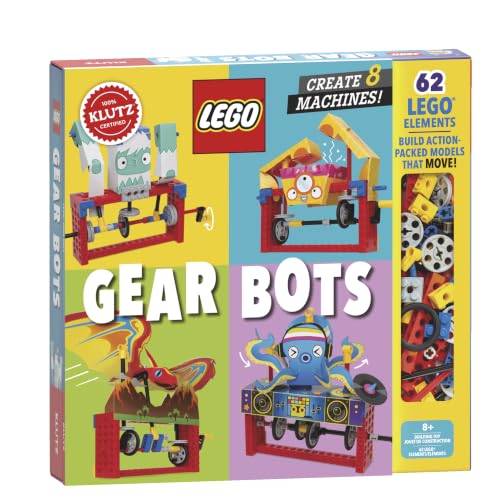
Klutz Lego Gear Bots Science Activity Kit
What We Like
- All LEGO elements included in box
- Teaches axles, cams, cranks
- Step-by-step instructions in 64-page book
- Combines building with papercraft art
Trade-offs
- 8 projects limit replay versus open-ended sets
- Papercraft parts are less durable than all-plastic builds
Building eight physics-driven kinetic creatures from one box means your child gets a clear arc of progress. Each model teaches a different mechanical principle like axles, cams, or cranks, with all the LEGO Technic bricks and papercraft materials included. That makes this kit ideal for a curious 8-to-12-year-old who wants to see exactly how gears and levers make things move, without the frustration of hunting for missing pieces or deciphering vague instructions. The 64-page book includes STEM content about axles, cams, cranks, and engineering in everyday machines, alongside step-by-step instructions, so each build connects to real-world mechanical ideas.
The papercraft pieces are less durable than all-plastic builds, so this kit rewards careful hands more than rough play. The Snap Circuits Explorer SC-100 offers over 100 projects with snap-together parts and a full-color manual, while the Gear Bots kit focuses on mechanical motion using LEGO Technic bricks and papercraft. For a structured introduction to gears and linkages that delivers a finished creature every time, this kit is the better fit.
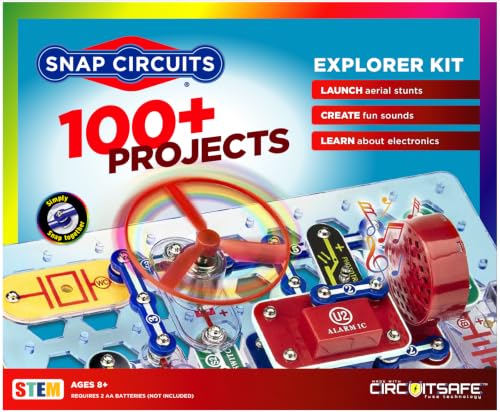
Snap Circuits Explorer SC-100 Electronics Kit
What We Like
- 100+ projects from 28 parts
- No soldering or tools needed
- Color-coded, numbered pieces snap on grid
- Ages 8 to 108 can build
Trade-offs
- Batteries not included, must buy separately
- 28 parts limit project variety compared to larger kits
- Projects are pre-defined, not open-ended building
Building 100+ projects from 28 snap-together parts gives a child a wide range of electronic gadgets to make from one box. The color-coded, numbered pieces click onto the plastic grid without soldering or tools, so a kid who can follow a picture can quickly wire up a flying saucer or a sound alarm. That makes this a strong entry point for an eight-year-old who is curious about how lights and buzzers work but not ready for a breadboard and wire strippers.
The 28 snap-together parts let you build over 100 projects, which is plenty for a first electronics kit but limits how much kids can invent on their own once they finish the manual. Compared to the Thames & Kosmos My Robotic Pet Coding Chameleon, which focuses on a single build with coding and bionic technology, this kit offers more project variety but less depth in any one skill. For a child who wants to design from scratch, other kits with more open-ended building options may be a better fit.
LEGO Technic NASA Artemis Space Launch System Rocket
What We Like
- 3-stage hand-crank separation
- Includes 4 astronaut nanofigures
- Interactive 3D building instructions
Trade-offs
- 632 pieces demand patience and focus
- Tall build needs stable display surface
- No motorized or electronic functions
At 27.5 inches high, this LEGO Technic set makes a dramatic display piece that shows off the real Artemis rocket system developed with NASA and ESA. Turning the hand crank triggers a three-stage separation, solid rocket boosters, core stage, then upper stage with the Orion spacecraft, so kids see how a launch vehicle sheds parts as it climbs. It’s built for space fans who want a working demonstration of staged rocketry, not just a static model.
The trade-off is that 632 pieces and the precise Technic connectors mean this is not a quick afternoon project. Younger builders or those with short attention spans may lose steam before the final stage clicks together. Compared to the Snap Circuits Explorer kit, which offers 100+ projects with snap-together parts, this set rewards methodical assembly over faster, more varied projects. It is a display-piece build first, a toy second, so plan for a dedicated table spot and a few patient sessions.
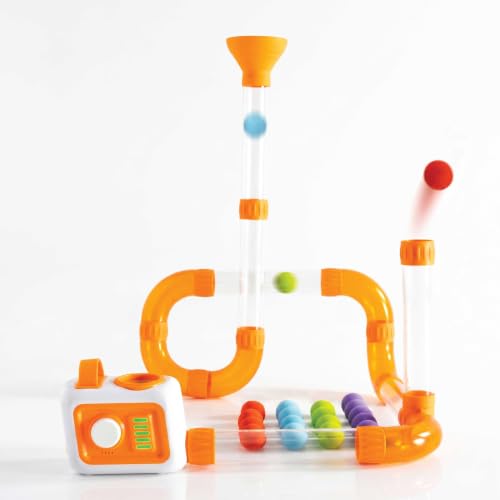
Fat Brain Toys Air Toobz Evo Building Set
What We Like
- Adjustable air speed dial
- Modular tube and connector system
- Auto shut-off prevents battery drain
- Compatible with original Air Toobz parts
Trade-offs
- Does not work while charging
- 45-minute runtime at full speed
A rechargeable fan unit with adjustable speed lets kids control airflow through a modular network of tubes, connectors, and a funnel, turning foam ball launching into an open-ended physics lab. The 15-minute auto shut-off saves battery when little builders walk away, and the grate in front of the fan keeps fingers safe for ages three and up. The set encourages spatial reasoning, creativity, experimentation, problem-solving, and STEM learning through open-ended play, and parents will appreciate the rechargeable system that runs up to two-plus hours on lower speeds.
The battery gives you 45 minutes of runtime at full speed, then needs a two-hour recharge before it works again. On lower speeds, that runtime stretches past two hours, which suits kids who like to experiment at a gentler pace. The fan unit has a 15-minute auto shut-off to prevent battery drain, and it recharges in under two hours.
Product photos
Thames & Kosmos My Robotic Pet Coding Chameleon

What We Like
- No screens or devices required
- Three distinct play modes
- Build realistic articulated movements
- Teaches coding through physical action cards
Trade-offs
- Requires adult help for ages 8-11
- Batteries not included
- Single build limits replay after assembly
A 15-inch robotic chameleon that you build from scratch and then program using colored action cards, no tablet, no phone, no computer needed. That screen-free coding approach makes this kit a rare find for parents who want STEM learning without adding more screen time. The three play modes (Coding, Wild, and Pet) let kids switch between programming sequences, watching the chameleon camouflage to match its surroundings, or having it react to touch. It is best suited for a child who enjoys building and is ready for a guided introduction to coding logic, especially with a patient adult nearby for the initial assembly.
After assembly, the chameleon is a single model, so there is no rebuilding into different creatures. That focus allows the 15-inch-long robotic reptile to include articulated eyes, torso, and leg joints that simulate realistic movements. The trade-off means owners get one carefully engineered pet rather than multiple simpler builds. Reviewers note that the single-model design lets the instruction manual dive deep into how each component works, from the color sensor to the infrared sensor and RGB LEDs. For a child interested in bionic technology and coding, this concentrated build provides a thorough introduction to how nature inspires engineering solutions.
Smartivity Hydraulic Paper Airplane Launcher Kit
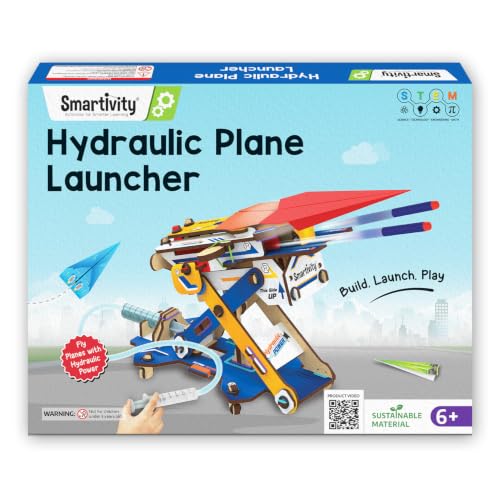
What We Like
- Water-powered hydraulic launch mechanism
- No glue or screws needed for assembly
- Free lifetime replacement for lost or broken parts
- Teaches hydraulics, aerodynamics, and scissor mechanics
Trade-offs
- Requires water refill between launches
- Paper airplane sheets are consumable (10 included)
A water-powered syringe and scissor lift mean this launcher uses real hydraulic pressure to fling paper planes and foam darts, no batteries, no motors, just a plunger and physics. That hands-on cause-and-effect is exactly what makes it a smart buy for families who want screen-free engineering for kids ages 6 to 14. The laser-cut wooden parts snap together without glue or screws, so a child can build it solo. It also covers three distinct STEM concepts, hydraulics, aerodynamics, and the scissor mechanism, which is a lot of learning packed into one kit.
Each launch needs a fresh syringe of water, so it’s not a set-it-and-forget-it toy; younger kids may need help refilling between flights. And while the 10 paper airplane sheets and two foam darts get you started, you’ll eventually need more paper or your own designs to keep the fun going. For a kit that rewards tinkering and teaches real mechanical principles, this is a solid starting point.
Product photos
Thames & Kosmos Hydraulic Boxing Bots Set
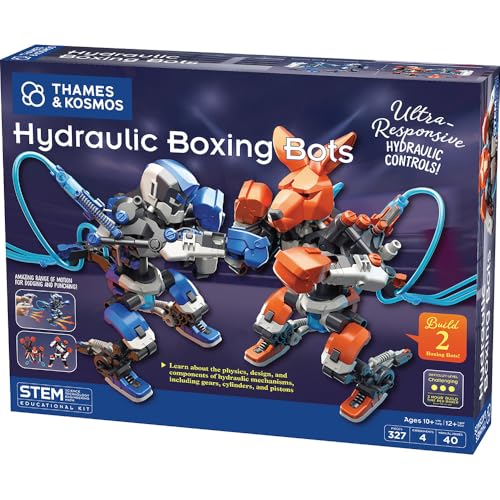
What We Like
- Two-player head-to-head hydraulic battles
- Teaches gears, cylinders, and pistons
- Independent upper and lower body movement
- Includes scoreboard for structured play
Trade-offs
- Requires water to operate the hydraulics
- Only two bots included, no expansion
Building two water-powered boxing robots that dodge, jab, and punch independently means this kit turns a solo project into a head-to-head challenge. You assemble both bots from the same box, learning how gears, cylinders, and pistons transfer force through hydraulics. The upper and lower body move independently to simulate real-life movements, as stated in the product description. The scoreboard adds structure, turning a science lesson into a tournament.
The hydraulics need water, so you cannot just pull this off a shelf and play instantly. You have to fill the system, which means a little setup and cleanup. The Snap Circuits Explorer SC-100 offers snap-together electronic projects with 28 parts, while this kit requires filling the hydraulic system before play. It is best for kids who enjoy building and want a two-player game that teaches real hydraulic engineering. Not ideal for children who prefer instant play with no setup or water involved.
Snap Circuits Flight Deck Paper Airplane Launcher
What We Like
- Five distinct STEM projects in one kit
- Teaches circuits, motors, and aerodynamics
- Works with paper airplanes, flying saucers, and balls
- Award-winning Snap Circuits brand quality
Trade-offs
- Batteries required but not included in box
- No projects for kids under age 8
Five separate projects, launching paper airplanes, flying saucers, balls, creating spinning art patterns, and levitating balls with air pressure, means this single kit covers electricity, motion, and aerodynamics in one compact box. It’s a smart pick for an 8-year-old eager to build something that actually moves, not just snap lights together. The included directions are designed for independent work, so a curious kid can figure out circuits and airflow without needing a parent hovering over every step.
Five different projects, launching paper airplanes, flying saucers, balls, creating spinning art, and levitating balls over a fan, let kids explore circuits, motors, and aerodynamics in one afternoon. But you’ll need to supply four AA batteries before anything flies. Compared to the Smartivity Hydraulic Paper Airplane Launcher Kit (ages 6-14, 0.4 pounds), this Snap Circuits kit offers more variety across those five projects but requires that extra power source. If your child wants to cycle through multiple physics tricks in a single play session, this is the better bet.
Product photos
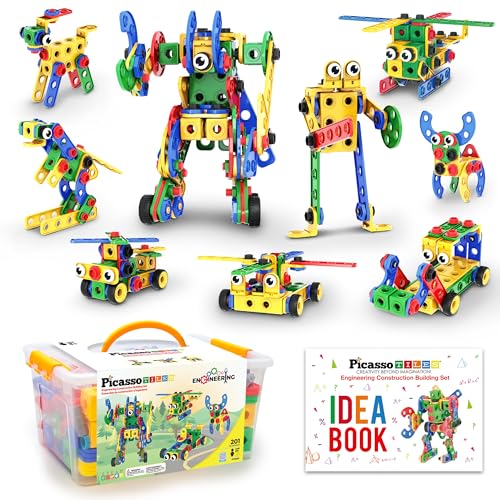
PicassoTiles 201pc STEM Building Kit with Power Drill
What We Like
- Free idea book with 50+ designs
- Battery-powered drill for interactive building
- Teaches STEM through tactile play
- Safe BPA-free and lead-free materials
Trade-offs
- Batteries for drill not included
- No battery charger included with the set
A 201-piece set with a battery-powered drill means this kit turns building into a hands-on, tool-driven experience that feels more like real construction than stacking blocks. The included idea book with over 50 designs gives kids a clear starting point, while the clickable ratchet and wrench let them practice fine motor skills as they bolt pieces together. It suits preschoolers and early elementary kids who are ready to move beyond basic stacking and want to build 2D or 3D structures with moving parts, all while picking up geometry and problem-solving through play.
The drill requires batteries you have to supply yourself, so keep extras handy if your child gets into a long building session. For a three-year-old keen on driving screws and inventing their own robots, this set is a good fit for early STEM play. It’s not ideal for a child who prefers a fixed, single-project model, but the non-toxic ABS plastic makes it safe for younger kids.
Product photos
Smartivity DIY Pinball Machine Kit

What We Like
- No glue or screws needed for assembly
- Free lifetime replacement parts if any piece goes missing or breaks
- Built from sustainable engineered wood
Trade-offs
- At 14.6 inches long, needs tabletop space during play
- Flippers can be stiff for smaller hands
The trade-off is size: at nearly fifteen inches long, it needs a clear spot on a table or desk, so it is not a lap-friendly travel toy. Compared to the Klutz Lego Gear Bots kit, which has smaller dimensions, this pinball machine demands more space. But that footprint is what makes it feel like a real arcade game rather than a craft project. Best for a child who loves building and then playing hard; less ideal if you need something compact for travel or tight shelves.
Product photos
How We Evaluated STEM Toys For Kids
This ranking was built from manufacturer documentation, expert round-ups, and patterns that emerged from thousands of owner reviews. It is based on careful reading of what each kit includes, what it demands from a child, and what families report after assembly.
Three criteria mattered most. First, teachable depth: does the kit explain the science behind the play, or just let kids follow steps? Second, age honesty: a kit labeled for eight-year-olds that needs adult help for every step is a different buy than one a child can manage independently. Third, replay value: how many times can a kid use this before the projects run out or the consumables run dry?
A research-led evaluation has limits. We can tell you a kit’s part count and project list, but we cannot tell you how it feels in a child’s hands or whether the papercraft survives a younger sibling. For that, we leaned hard on the community, the patterns in what owners praise and what they warn about. For a deeper look at how these categories work, check our comprehensive STEM toy guide for the full breakdown.
What To Look For In STEM Toys For Kids
Before you buy, understand that the best STEM toy teaches one thing well rather than ten things poorly. Look for kits that match your child’s patience level, reading ability, and interest in following instructions versus inventing their own builds.
Choose a STEM toy by matching its teaching style to your child’s learning style: guided projects for kids who follow steps, open-ended pieces for kids who invent, and consumable kits for kids who love launching or testing.
Teaching Depth vs. Open-Ended Play
A kit that walks a child through eight projects teaches engineering principles like gear ratios and lever mechanics. A set of loose building pieces teaches creativity and iteration. Neither is better; they serve different minds. The Klutz Lego Gear Bots kit leans guided, with a book that explains every mechanism. The PicassoTiles 201pc STEM Building Kit leans open-ended, with a power drill and over 50 design ideas but no step-by-step manual. Know your child’s style before you pick.
Age Appropriateness and Adult Help
Age labels on STEM kits are optimistic. A kit marked for ages 8+ that requires adult help for every single step is a different experience than one an eight-year-old can build alone. The Thames & Kosmos My Robotic Pet Coding Chameleon, for example, needs adult help for ages 8-11. The Snap Circuits Explorer SC-100 needs no adult help for the same age range. Read the fine print on who holds the screwdriver. For younger builders, our STEM toys for toddlers list covers kits designed for smaller hands.
Consumable Parts and Replay Value
Some kits give you one build and done. Others give you 100 projects. A few give you consumables, paper airplane sheets, water, batteries, that run out and need replacing. The Smartivity Hydraulic Paper Airplane Launcher includes 10 paper sheets and needs water between launches. The Snap Circuits Flight Deck Paper Airplane Launcher gives five projects but needs batteries. If your child wants to build once and play forever, choose a kit with no consumables. If they love launching and rebuilding, consumables are fine, just budget for refills.
Screen-Free vs. App-Required Play
Many STEM kits now require a tablet or phone app to work. Some, like the Thames & Kosmos My Robotic Pet Coding Chameleon, use physical action cards instead of screens. If your family limits screen time, check whether the kit works without a device. The LEGO Technic NASA Artemis Space Launch System uses interactive 3D building instructions through an app, but the rocket’s hand-crank separation works without it.
- Check the parts list for batteries: many kits do not include them
- Look for lifetime replacement parts policies: some offer free replacements if pieces go missing
- Compare the number of projects to your child’s attention span
- Read the age label and the “requires adult help” line separately
A good rule of thumb: the best STEM toy is the one your child will actually sit down with after the first day’s excitement fades.
STEM Toys For Kids Compared
The table below compares all ten kits side by side on build style, age range, and what each teaches, so you can see at a glance which fits your child’s learning style.
| Product | Age Range | Builds / Projects | Power Source |
|---|---|---|---|
| Klutz Lego Gear Bots Science Activity Kit | 8-12 years | 8 kinetic creatures | N/A |
| Snap Circuits Explorer SC-100 Electronics Kit | 8+ | 100+ projects | Batteries required |
| LEGO Technic NASA Artemis Space Launch System Rocket | 9+ | 3-stage separation | N/A |
| Fat Brain Toys Air Toobz Evo Building Set | 3+ years | N/A | Rechargeable |
| Thames & Kosmos My Robotic Pet Coding Chameleon | Ages 8+ | 3 (Coding, Wild, Pet) | Duracell batteries recommended |
| Smartivity Hydraulic Paper Airplane Launcher Kit | 6-14 years | N/A | Water-powered syringe |
| Thames & Kosmos Hydraulic Boxing Bots Set | 10+ | 2 boxing bots + scoreboard | Hydraulic (water-powered) |
| Snap Circuits Flight Deck Paper Airplane Launcher | 8+ | five unique projects | Batteries: Not included |
| PicassoTiles 201pc STEM Building Kit with Power Drill | 3+ | 50+ designs, 33 step-by-step builds | Battery-powered drill (batteries not included) |
| Smartivity DIY Pinball Machine Kit | 8-99 Years | N/A | N/A |
Frequently Asked Questions
What is the best STEM toy for a beginner?
The Snap Circuits Explorer SC-100 Electronics Kit is the best starting point for most kids. It requires no soldering, no tools, and no adult help for ages 8 and up. The 28 color-coded pieces snap onto a grid and build 100+ projects from a light switch to a flying fan. It teaches basic circuitry without frustration.
What is the difference between STEM toys and regular toys?
STEM toys are designed to teach science, technology, engineering, or math principles through play. A regular toy might spin because a motor makes it spin. A STEM toy shows the child how the motor connects to the battery, how the switch controls the circuit, and what happens when you reverse the polarity. The learning is built into the play.
What age should kids start using STEM toys?
Children can start with simple STEM toys around age 3 with sets like the Fat Brain Toys Air Toobz Evo, which teaches airflow through modular tubes. By age 5, most kids can handle basic building kits. By age 8, they can manage electronics kits and coding robots. The key is matching the kit’s reading and dexterity demands to the child’s actual ability, not the box label. For age-specific recommendations, see our STEM toys for 5-year-olds guide.
What is the best STEM toy for a 10-year-old?
The Thames & Kosmos Hydraulic Boxing Bots Set works well for 10-year-olds because it combines building with two-player head-to-head play. It teaches gears, cylinders, and pistons through a game, which holds attention longer than a solo build. The LEGO Technic NASA Artemis rocket also suits this age with its 632-piece build and real rocket staging mechanism.
How do I know if a STEM toy is safe for my child?
Check the material safety certifications first, look for BPA-free and lead-free labels like the PicassoTiles set offers. Then check for small parts that could be a choking hazard for younger siblings. Finally, read owner reviews for complaints about sharp edges, fragile pieces, or parts that break during normal use. A kit’s age label is a safety guideline, not a learning readiness label. Our STEM toy buying guide covers safety checks in detail.
The Bottom Line
The Klutz Lego Gear Bots Science Activity Kit is the best overall STEM toy for kids because it teaches real mechanical engineering through guided projects that actually work. The 64-page book explains axles, cams, and cranks in a way an eight-year-old can follow, and every LEGO piece comes in the box. It is the right pick for any child who enjoys building with a purpose.
For families on a budget, the Smartivity Hydraulic Paper Airplane Launcher Kit delivers real engineering lessons for a fraction of the cost of larger sets. It teaches hydraulics and aerodynamics through a water-powered launch mechanism, and the free lifetime replacement parts policy means one lost piece won’t end the fun. For electronics beginners, the Snap Circuits Explorer SC-100 remains the gold standard for no-solder, no-tools circuitry.
The single most important factor in choosing a STEM toy is matching the teaching style to your child’s learning style. Guided builders need a book and a plan. Open-ended creators need loose parts and room to experiment. Launchers need consumables and space. Know your child first, and the right kit becomes obvious.
