
10 Best Science Toys in 2026
This post contains affiliate links. As an Amazon Associate, we earn from qualifying purchases.
The Snap Circuits Explorer SC-100 STEM Kit is the best overall science toy because it gives kids a real electronics lab experience without a single drop of solder. For a destructive physics lesson, the CrunchLabs The Crunchinator STEM Kit offers satisfying cause-and-effect play, while the Klutz Lego Gear Bots STEM Kit excels at teaching mechanical engineering.
Choosing a science toy means sifting through kits that are either too simple or too advanced. The right one meets a child where they are developmentally, not where a box says they should be.
We built this guide by analyzing manufacturer specs, studying expert round-ups, and identifying patterns in thousands of owner experiences. You get ten distinct picks so you can match a kit to a specific interest or learning style.
Top 10 Science Toys in the Market
Certain content that appears on this site comes from Amazon. This content is provided "as is" and is subject to change or removal at any time.
The Best Science Toys, Reviewed
Snap Circuits Explorer SC-100 STEM Kit
What We Like
- No soldering or tools needed
- Color-coded snap-together pieces
- Award-winning educational design
Trade-offs
- Requires batteries (not included)
- Projects are pre-defined, not open-ended
- Plastic grid limits custom layouts
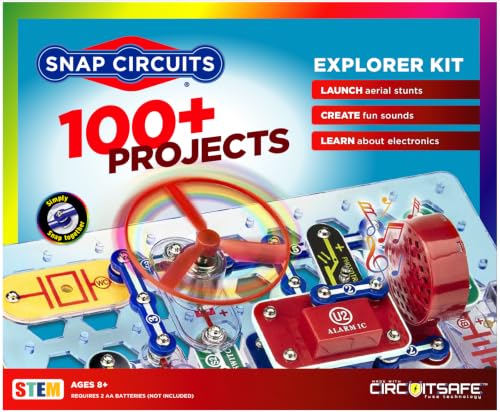
A hundred-plus projects from just 29 snap-together parts means this kit turns one box into dozens of working gadgets, a flying saucer, an alarm, a light switch, without a single drop of solder. That sheer project density is why it lands at the top of the guide: it gives an eight-year-old real circuitry lessons without the frustration of loose wires or hot irons. The numbered, color-coded pieces click onto a plastic grid, so a kid who can follow a picture book can build a working siren in minutes. Parents who want a toy that teaches without needing to hover will appreciate how little setup it demands.
The trade-off is that every build follows the manual’s script. You get 100 guided projects, but there’s no room to experiment with your own layouts unless you buy additional kits. Compare that to the CrunchLabs The Crunchinator, which gives you three interchangeable plates and a contained chamber for tinkering, fewer projects but more freedom to mess around. The Snap Circuits kit is the better choice if your child thrives on clear steps and visible progress. If they prefer to break the rules and see what happens, you might find yourself buying expansion packs sooner than you planned.
CrunchLabs The Crunchinator STEM Kit
What We Like
- 3 interchangeable plates for varied crushing
- Contained chamber for easy cleanup
- Phone holder to record every crunch
- QR code video with Mark Rober
Trade-offs
- At 2.6 lb, it's heavier than most kits here
- Limited to destructive play, not open-ended building
- Messy objects must be supplied separately
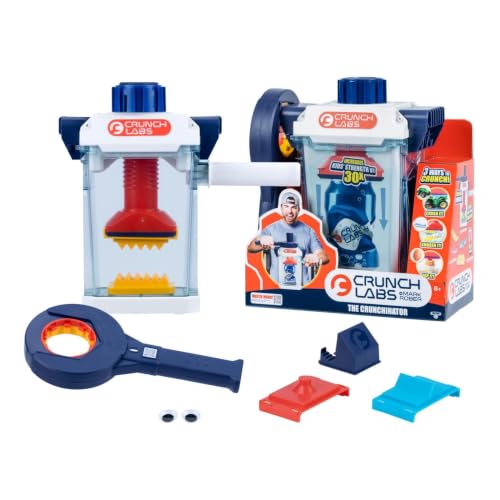
The Crunchinator uses a crank that multiplies a child’s strength by 30x, letting them crush objects with satisfying force while everything stays inside a contained chamber. Three interchangeable plates let you crunch, smoosh, or pop items, so one toy offers different effects without extra parts. The included phone holder and QR code video from Mark Rober turn each crush into a shareable moment, making this a focused, sensory-rich experience for kids who enjoy watching things get squished.
The Crunchinator weighs 2.6 pounds, making it heavier than the Klutz Lego Gear Bots kit at 1.0 pound, so it’s less portable for travel or small shelves. Compared to the Snap Circuits Explorer SC-100, which builds over 100 different electronics projects, this kit focuses on a single activity: crushing objects. For a kid who enjoys cause-and-effect physics and a satisfying sensory outlet, this is a blast.
Klutz Lego Gear Bots STEM Kit
What We Like
- Teaches axles, cams, cranks
- Includes all LEGO elements needed
- Builds 8 kinetic creatures
- Step-by-step instructions in book
Trade-offs
- Only 8 builds limit replay variety
- No motor: creatures are hand-powered
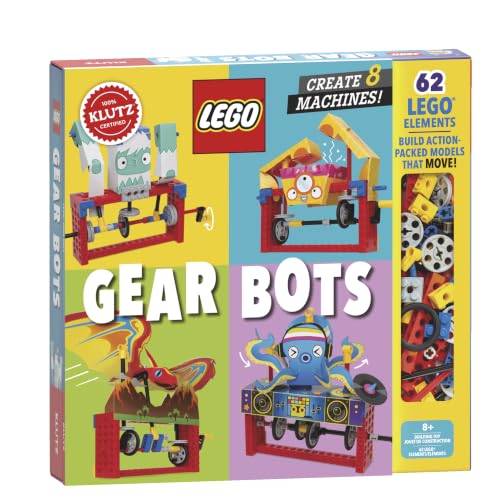
Eight physics-driven creatures means your child gets eight separate chances to see axles, cams, and cranks in action, not just read about them. Each build turns a LEGO Technic skeleton into a moving papercraft animal, so the engineering lesson sticks because they’re the ones making it walk or flap. This kit suits a kid who asks ‘how do gears work?’ and wants to touch the answer, not just watch a video. The 64-page book walks them through every step, which keeps frustration low and understanding high.
The papercraft shell keeps the kit light at one pound, which makes it easy for small hands to handle and carry from shelf to table. Unlike the Snap Circuits Explorer SC-100 with 100 projects, this kit focuses on eight builds using LEGO Technic bricks and papercraft. The 64-page book covers axles, cams, and cranks, so a child gets step-by-step instructions for each creature. It suits a kid who wants to build moving machines from included parts, not a general electronics project.
Thames & Kosmos Coding Chameleon Robot

What We Like
- No screen or software required
- Three distinct play modes
- Teaches coding with physical action cards
- 48-page manual guides assembly and learning
Trade-offs
- Requires adult help for ages 8-11
- Batteries not included (Duracell recommended)
The robot uses a color sensor and infrared sensor with RGB LEDs, and kids program it with physical colored action cards, no screen, no software, or device needed. That means a child learns sequencing and cause-and-effect through physical cards, not a tablet. The 48-page manual guides assembly step by step and covers how nature inspires engineering design. The catch is that assembly needs adult patience for ages 8-11, and batteries (Duracell recommended) are sold separately. Unlike the Snap Circuits Explorer, which offers over 100 projects with snap-together parts, this kit focuses on one character-driven build that fires its tongue and changes color.
Assembly requires adult patience for the 8-11 crowd, and the robot needs batteries you’ll have to buy separately. If your child wants a companion they can program to fire its tongue and change colors, this delivers. If they want to build a dozen different gadgets from one box, the Snap Circuits path might be a better fit.
Thames & Kosmos Hydraulic Boxing Bots
What We Like
- Builds two robots for head-to-head play
- Independent upper and lower body movement
- Includes scoreboard for structured battles
Trade-offs
- Requires water to power the hydraulics
- Only one project type (boxing bots)
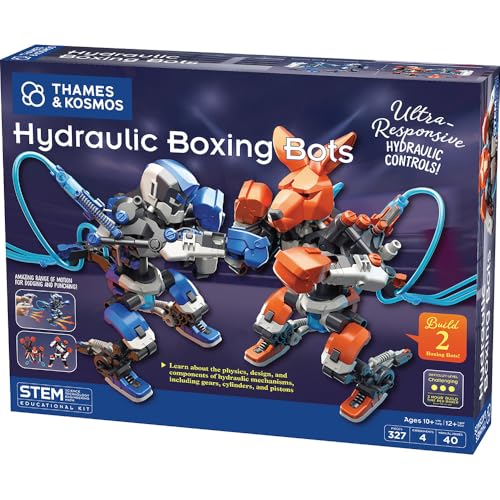
With two complete robots and a scoreboard in the box, this kit turns hydraulic learning into a head-to-head challenge right out of the gate. You build both bots from the same set of gears, cylinders, and pistons, so the lesson in water-powered mechanics is baked into every step of assembly. The independent upper and lower body movement means each bot can dodge and jab with real coordination, which makes the physics lesson stick because you see it work in action. This kit introduces important physics and engineering lessons through a fun, hands-on building project with a big punch.
The kit requires water to power the hydraulics, so you’ll need to dry things off after each match, and once both robots are built, the construction phase is over. Unlike the Snap Circuits Explorer SC-100, which lets you build over a hundred different projects, this set focuses entirely on one type of build. If a child wants to construct a boxing robot and then actually spar with a friend, this kit delivers that specific experience. But if they prefer switching between many projects, the Snap Circuits kit offers more variety.
Blue Marble NGMEGACHEMAR Science Toy

What We Like
- 100+ experiments from one kit
- Includes real lab tools (test tubes, beakers, pipettes)
- Bonus guide uses common household items for bonus experiments
Trade-offs
- Only 15 experiments include all materials
- Bonus experiments require additional household items
- Heavier than some other kits (1.8 lbs)
Over a hundred experiments from a single box means this kit keeps curious minds busy long after the first crystal tree grows. The fifteen included setups cover hands-on chemistry with real lab tools like test tubes and pipettes, so kids aren’t just watching, they’re measuring, mixing, and making things bubble and glow. That makes it a natural fit for families who want a science kit that grows with their child’s interest rather than collecting dust after one afternoon.
Only fifteen of the experiments in this kit include all the materials you need. The other eighty-five require common household items like baking soda or vinegar, so you’ll need to stock up to keep the fun going. That gives you a huge range of activities, but it’s less grab-and-go than the Snap Circuits Explorer SC-100, which builds over 100 projects with just the included parts. If you want a set that doesn’t demand extra supplies, that Snap Circuits option might be a better fit.
Product photos
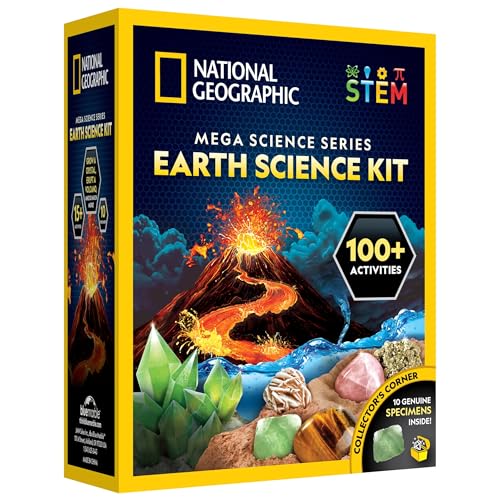
Blue Marble NGMEGAEARTH Science Toy
What We Like
- 15+ experiments in one kit
- Includes volcano, crystal, and dig kits
- Full-color Learning Guide included
Trade-offs
- At 2.6 lb, heavier than some single-project kits
- Requires adult help for several experiments
Fifteen-plus experiments in one box means this kit covers more ground than most single-project science sets. You get a volcano that erupts, a crystal you grow yourself, two geologic dig kits, and even dueling water tornadoes. That range makes it a natural fit for the kid who wants to try a little bit of everything rather than drill down on one discipline. The full-color Learning Guide walks them through the science behind each activity, so the mess has a point. For a family with one curious 8-to-12-year-old or siblings who need to share, this is the kind of all-in-one starter that keeps boredom at bay for weeks.
The trade-off for all that variety is that each experiment gets a smaller share of the supplies and instruction depth than a dedicated kit would offer. If your child is already obsessed with volcanoes or crystals specifically, a focused set like the Thames & Kosmos Hydraulic Boxing Bots gives them a different kind of challenge. But if you want a single gift that delivers multiple wow moments without requiring you to buy separate volcano, crystal, and rock kits, this Blue Marble set does exactly that. The weight (2.6 pounds) means it has enough material to feel substantial, though it is heavier than the Klutz Lego Gear Bots.
Product photos
Learning Resources Magnet Movers Set

What We Like
- 10 guided activity cards for structured play
- Teaches attraction, repulsion, and motion
- Child-sized tools built for repeated use
Trade-offs
- No advanced topics like electromagnetism included
- Limited to magnetism only, no broader physics concepts
The ten guided challenge cards turn this into a structured introduction to magnetism, walking kids through attraction, repulsion, and motion step by step. That framework is exactly what a curious child needs to start exploring without feeling lost. The tools are sized for small hands and built to survive repeated drops, so the set works just as well on a kitchen table as it does in a classroom. For anyone looking to spark that first ‘why does it stick?’ moment, this kit keeps the focus tight and the frustration low.
You’re getting a focused introduction, not a broad science lab. Once your child masters the ten challenges, there’s no built-in path to electromagnetism or more advanced physics. That’s where something like the Snap Circuits Explorer SC-100 picks up with over 100 projects. But for introducing magnetism to the youngest learners, the Magnet Movers set does exactly what it sets out to do: build foundational understanding through play that feels like discovery, not homework. The durable construction and low weight (0.8 pounds) make it easy to tuck into a bag for visits to grandparents or quiet time at a cafe.
Product photos
UNGLINGA 150 Experiments Science Kit

What We Like
- 150 experiments across multiple science topics
- Easy-to-follow illustrated manual included
- High-quality lab tools and goggles provided
- Uses common household items for many projects
Trade-offs
- Some experiments require additional household items not included
- Not suitable for kids under 8 due to small parts
With 150 experiments covering earth science, chemistry, physics, and surface tension, this kit offers a wide variety of activities in one box. The step-by-step illustrated manual and included goggles let families start experimenting right away, and many projects use common household items to keep costs low. For a family that wants to explore multiple science topics without buying separate kits, this set delivers plenty of options.
Not every project is fully self-contained, some experiments require items like vinegar or baking soda from the pantry. That is a small trade-off for the number of activities included. Compared to the National Geographic Amazing Chemistry Set (100+ experiments), this UNGLINGA kit covers a broader range of topics, so it suits families who want to try different fields rather than focusing on chemistry alone.
Product photos
Bottleboom 13-in-1 Solar Robot Kit

What We Like
- 13 buildable robot designs from one kit
- Solar powered, no batteries needed
- Non-toxic ABS with smooth edges
- Includes gears, plates, tires, shafts
Trade-offs
- Solar-only power limits indoor or cloudy-day use
- No electronic or coding elements
Thirteen different robot builds from a single box of parts means this kit keeps going long after the first model is done. Kids split and reassemble gears, plates, tires and shafts to create machines that crawl on land or paddle on water, all powered by sunlight alone. That solar-only design is the real hook here: no batteries to hunt for, no charging cords, just direct sun and curiosity. It suits the child who enjoys methodical assembly and wants to see clean energy in action, especially a budding engineer who likes taking things apart as much as putting them together.
The limitation is obvious the moment clouds roll in or you try to test a robot indoors. Unlike the Snap Circuits Explorer SC-100, which offers over 100 projects with snap-together parts and a full-color manual, this kit needs bright sunlight to move. That limitation can turn a rainy afternoon into a waiting game. But for families who value the lesson behind the toy, the trade is worth it. The kit teaches children to use solar energy instead of electric energy, and the non-toxic, smooth-edged ABS parts mean you can hand to an eight-year-old without hovering. Just keep a sunny windowsill handy.
Product photos
How We Evaluated Science Toys
Our evaluation is research-based: we combed through product documentation, reviewed patterns in owner feedback across multiple retail platforms, and studied expert recommendations from educational toy specialists. We focused on what actually helps a child learn independently. We considered age-appropriate complexity, the ratio of included materials to required extras, and the durability of components for repeated use.
Three criteria mattered most. First, educational depth, does the kit teach a real scientific principle or just flashy effects? Second, replay value, a kit with 150 experiments offers a longer learning arc than a single build. Third, frustration ceiling, the best kits let a child succeed without constant adult rescue.
A research-led evaluation has limits. We cannot replicate every experiment in a lab, and a kit that works perfectly in a quiet living room may behave differently in a classroom. What we can do is surface the patterns that predict a good experience for most families.
What To Look For In Science Toys
The best science toys for kids balance genuine learning with genuine fun, a kit that teaches real chemistry versus one that just bubbles over.
Match the kit to the child’s actual interest, a magnetism set for a beginner, a 150-experiment chemistry lab for a future chemist, and a solar robot for a solar enthusiast.
Age Fit and Skill Level
A box that says “ages 8+” tells you safety, not readiness. The Snap Circuits Explorer SC-100 works for an 8-year-old who can follow a manual, but a 10-year-old who hates instructions will find it restrictive. Look at the project count and the tool list. Kits that need scissors, tape, or baking soda from your pantry aren’t failures, they just assume you have a stocked kitchen. The best science toys for kids explicitly state what is and isn’t included.
Project Variety vs. Depth
A kit with 150 experiments like the UNGLINGA 150 Experiments Science Kit covers biology, chemistry, and physics in one box. That breadth comes at a cost, you get a taste of each field, not mastery. A single deep project like the Thames & Kosmos Hydraulic Boxing Bots teaches hydraulics through a single, repeatable build. Pick the shape that matches the child’s attention span.
Power and Materials Requirements
Batteries are the silent budget trap in electronics kits. The Snap Circuits Explorer SC-100 needs two AA batteries you supply. The Bottleboom 13-in-1 Solar Robot runs on sunlight alone but fails on cloudy days. Water is the power source for the Hydraulic Boxing Bots, mess is guaranteed. Check the power column before you buy, not after.
- Does the kit require household items you don’t keep in the pantry?
- Are batteries included, or is that a separate trip to the store?
- How many builds does the kit actually support before it’s done?
- Is the manual written for a child or an adult?
A rule of thumb: if the required-supply list is longer than the included-supply list, the kit will sit unfinished.
Science Toys Compared
The table below lines up all ten kits by their project count, power source, and best use so you can compare them at a glance before reading the detailed cards.
| Product | Age Range | Projects/Activities | Weight | Dimensions |
|---|---|---|---|---|
| Snap Circuits Explorer SC-100 STEM Kit | 8+ | 100+ | 1.4 pounds | L 12.0 inches, W 9.5 inches, H 1.8 inches |
| CrunchLabs The Crunchinator STEM Kit | 8-13 | N/A | 2.6 pounds | L 4.6 inches, W 9.4 inches, H 11.0 inches |
| Klutz Lego Gear Bots STEM Kit | 8-12 | 8 creatures | 1.0 pounds | L 10.0 inches, W 1.5 inches, H 10.0 inches |
| Thames & Kosmos Coding Chameleon Robot | 8+ | 3 play modes | 1.5 pounds | L 10.0 inches, W 4.7 inches, H 11.0 inches |
| Thames & Kosmos Hydraulic Boxing Bots | 10+ | 2 boxing robots + scoreboard | 1.8 pounds | L 14.8 inches, W 3.0 inches, H 11.3 inches |
| Blue Marble NGMEGACHEMAR Science Toy | 8-12 | 100+ experiments | 1.8 pounds | 8.8 x 3.2 x 11.9 inches |
| Blue Marble NGMEGAEARTH Science Toy | 8-12 | 15+ experiments | 2.6 pounds | 8.7 x 3.1 x 12.0 inches |
| Learning Resources Magnet Movers Set | N/A | 10 guided challenges + tools | 0.8 pounds | 8.3 x 8.1 x 2.8 inches |
| UNGLINGA 150 Experiments Science Kit | N/A | 150 | N/A | L 11.4 inches, W 8.7 inches, H 3.9 inches |
| Bottleboom 13-in-1 Solar Robot Kit | 8-12 | 13 robot types | 0.9 pounds | L 0.2 inches, W 0.2 inches, H 0.2 inches |
Frequently Asked Questions
What is the best science toy for a 7-year-old beginner?
For a young child new to science kits, the Learning Resources Magnet Movers Set is a strong starting point. It uses no batteries, no messy liquids, and the guided activity cards teach attraction and repulsion through structured play that a younger child can manage independently.
Are expensive science toys worth the money?
Value depends on how many times the kit gets used. A single-build kit that costs more than a 150-experiment chemistry set is a poor value if the child finishes it in one afternoon. Multi-project kits like the Blue Marble NGMEGACHEMAR Science Toy offer better long-term engagement.
What science toy teaches coding without a screen?
The Thames & Kosmos Coding Chameleon Robot teaches coding logic using physical action cards instead of a tablet or computer. The robot reads the card sequence and moves accordingly, making it a screen-free introduction to programming concepts for children who respond to tactile learning.
How do I choose between a chemistry set and a physics kit?
Match the kit to what the child already shows interest in. A child who asks why the sky is blue is a chemistry-and-earth-science candidate. One who takes apart old remote controls will engage more with a physics or electricity kit like the Snap Circuits Explorer SC-100.
Can two kids share a science toy?
Some kits are designed for solo work, others for head-to-head play. The Thames & Kosmos Hydraulic Boxing Bots builds two robots specifically for two-player battles. Multi-experiment kits like the UNGLINGA 150 Experiments Kit work well for siblings who can take turns picking the next project.
The Bottom Line
The Snap Circuits Explorer SC-100 is the best overall science toy for parents and educators who want a structured, frustration-free introduction to electronics for a child age 8 and up. It requires no soldering, tools, or prior knowledge, just snap, connect, and learn.
If your child craves destruction with a side of physics, the CrunchLabs The Crunchinator delivers controlled chaos and a cameo from Mark Rober. For families who want maximum experiments per dollar, the UNGLINGA 150 Experiments Kit or the Blue Marble NGMEGACHEMAR Science Toy cover the most ground.
The single most important factor is age-appropriate complexity. A kit that perfectly matches the child’s current skill level will get used. One that overshooting their patience will collect dust.
