
10 Best Play Food For Toddlers in 2026
This post contains affiliate links. As an Amazon Associate, we earn from qualifying purchases.
The best play food for toddlers is the Melissa & Doug Food Groups Wooden Play Food because it covers all five food groups with sturdy wooden pieces and sorting crates that teach nutrition. For structured color learning, the Learning Resources Farmer’s Market Color Sorting Set excels, while the Fajiabao Wooden Play Food Cutting Fruit Set delivers the best sensory cutting experience.
Any parent knows that toddlers put everything in their mouths, throw things, and lose pieces. The real challenge is finding play food that survives those behaviors while actually teaching something, colors, food groups, or fine motor skills, rather than just adding to the toy box clutter.
This guide draws on manufacturer specifications, expert round-ups, and patterns in owner feedback across many sets. We break down the top options by what they do best, so you can match a set to your child’s play style and your priorities for durability and learning.
Top 10 Play Food For Toddlers in the Market
Certain content that appears on this site comes from Amazon. This content is provided "as is" and is subject to change or removal at any time.
The Best Play Food For Toddlers, Reviewed
Melissa & Doug Food Groups Wooden Play Food

What We Like
- Covers all five food groups
- Includes four sorting crates
- Sturdy wooden construction
- Teaches nutrition and sorting
Trade-offs
- No cutting or slicing action
Twenty-one pieces covering dairy, produce, grains, and meat let your toddler build a full pretend meal from the five food groups. The four wooden crates keep everything sorted and stored, making cleanup straightforward. This set is designed for families who want a durable, educational toy that introduces basic nutrition and grouping skills. At 13.6 inches tall, the box is substantial and fits on a playroom shelf.
The trade-off is that none of the pieces cut or slice, which some toddlers love. If your child is all about chopping action, the Fajiabao Wooden Play Food Cutting Fruit Set offers that experience. But for a complete, organized introduction to healthy eating that lasts through years of play, this Melissa & Doug set delivers a solid value. The crates make sorting a natural activity, and the sturdy wood holds up to enthusiastic little hands.
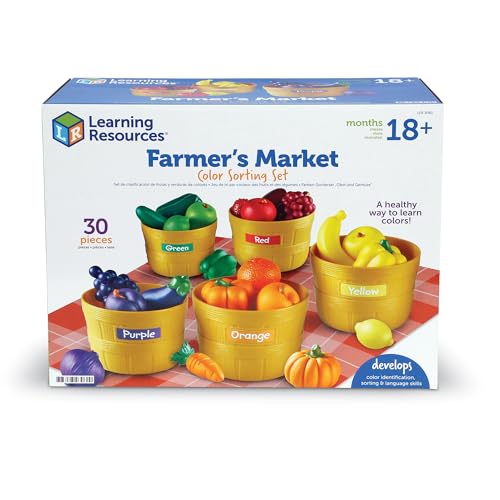
Learning Resources Farmer's Market Color Sorting Set
What We Like
- Color-coded baskets for sorting
- 25 pieces in 5 colors
- Includes activity guide and stickers
- Plastic fruit and vegetable toys
Trade-offs
- No cutting or food-prep play included
- Baskets take up counter space
Twenty-five pieces of play food in five distinct colors, each with a matching bushel basket, turn color recognition into a hands-on game. That built-in sorting system is what sets this set apart from simpler pretend food collections: toddlers learn to group by color while they play, and the baskets make cleanup part of the activity. It’s a natural fit for parents who want a toy that quietly builds preschool readiness, matching, naming foods, and organizing, without feeling like a lesson. The included activity guide and stickers give you easy ways to extend the play, so it stays fresh longer than a basic fruit basket.
The pieces are plastic, not wood or fabric, so they lack the natural feel of some other play food sets. They also don’t include a knife or cutting board, which means no chopping play for toddlers who love that action. If your child is more into pretend meal prep than color sorting, a set like the Fajiabao Wooden Play Food Cutting Fruit Set offers a different experience with its tray and toy knife. But for a toddler who’s still learning colors and needs a structured, rewarding way to practice, this set delivers exactly that focus.
Product photos
Learning Resources New Sprouts Munch It Food Set

What We Like
- Soft, durable material resists cracking
- Realistic textures support sensory exploration
- Builds vocabulary through pretend meals
Trade-offs
- Small set compared to larger play food bundles
- No cutting or assembly play included
At just 1.0 pounds, this play food set is light enough for toddlers to carry around, and the soft, durable materials hold up to enthusiastic play without cracking like typical plastic toy food. The realistic textures support multi-sensory exploration, helping little ones build curiosity and confidence as they learn food names and serving actions. Parents report it introduces nutritious foods from 18 months onward while expanding vocabulary through pretend meals.
For comparison, the Melissa & Doug Food Groups set includes 21 wooden pieces, which are heavier and less forgiving if dropped. The Learning Resources set focuses on softness and realistic textures, making it a practical choice for families who prioritize sensory-safe materials over having a large number of pieces.
Product photos
Fajiabao Wooden Play Food Cutting Fruit Set

What We Like
- Satisfying Velcro crunch when cutting
- 18-piece set with tray and knife
- Solid wood with smooth, rounded edges
- Water-based paint for safety
Trade-offs
- Only 8 fruits to slice, fewer than some sets
- No storage bag or basket included
Eight sliceable fruits with satisfying Velcro connections mean your toddler gets the full chopping experience without any real mess. The set includes 16 fruit pieces, a wooden tray, and a toy knife, all crafted from natural solid wood with smooth, rounded edges and water-based paint. That makes it a safe, tactile choice for little hands just learning to coordinate their movements. It’s especially good for ages 2-6, with play that naturally grows from simple color matching to cooperative pretend cooking.
You only get eight fruits to cut, so if your child wants a bigger variety or you’re looking for a set that includes vegetables or proteins, you might find this limited. The 21-piece Food Groups set, for comparison, offers pieces covering multiple food groups, which could better suit a child who loves sorting and categorizing. But for a focused, high-quality wooden cutting experience that feels solid and sounds satisfying, this set delivers exactly what it promises.
Product photos
Hape Toddler Bread Basket

What We Like
- Soft felt fabrics safe for toddlers
- Basket encourages storage habits
- Develops fine motor skills
Trade-offs
- Small basket limits pretend variety
- Not suitable for children under 18 months
At just 0.2 pounds and made from felt and soft fabrics, the Hape Toddler Bread Basket is designed for tiny hands just starting pretend play. The squishy textures let toddlers explore safely while developing fine motor skills and hand-eye coordination, and the included basket makes cleanup a natural part of play, perfect for building organizational habits early. This set suits families who want a lightweight, gentle introduction to play food for children as young as 18 months.
The felt-and-fabric construction keeps this bread basket lightweight for tiny hands, but it also means fewer pieces than wooden sets like the 21-piece Food Groups set. For a first bread-themed playset focused on sensory exploration and easy storage, this is a thoughtful choice, just know it’s designed for gentler play.
Product photos
LAUGIGLE 78-Piece Pretend Play Food Set

What We Like
- 78-piece set for huge variety
- Hook-and-loop splits for cutting play
- BPA-free with smooth edges
- Includes storage bag for portability
Trade-offs
- Storage bag is not a hard case for stacking
- Plastic construction lacks the durability of wooden sets
With 78 pieces, this set includes pizza, burgers, desserts, fruits, veggies, seafood, and more, giving toddlers plenty of options for pretend kitchen play. The hook-and-loop splits let them practice cutting, peeling, and de-shelling safely, and the included storage bag makes cleanup and travel easy. The BPA-free plastic has smooth edges, so it’s safe for children, and the variety keeps play engaging without needing extra props.
All pieces are plastic rather than wood, so they won’t have the same heft or natural feel as some wooden sets, but the BPA-free plastic is durable and smooth-edged. The 78-piece set offers a wide range of foods in one box, which can be convenient for families who want many options without buying multiple sets. If your child enjoys sorting through many items and you don’t mind a lightweight feel, this set provides a large variety at a reasonable cost.
Product photos
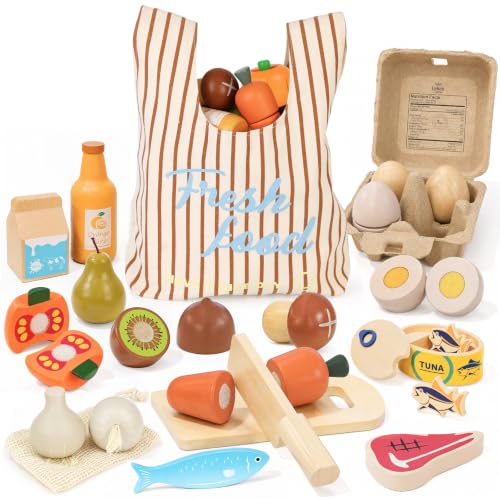
Lehoo Castle Wooden Play Food Set
What We Like
- FSC-certified wood and non-toxic paint
- Upgraded large eggs with 4-slot carton
- Realistic details like marbled steak
- Canvas bag for play and storage
Trade-offs
- 23 pieces is fewer than some larger sets
- No cutting action or Velcro pieces
FSC-certified wood and non-toxic water-based paint mean this set skips the plasticky feel and questionable finishes you sometimes see in pretend food. The 23-piece collection covers fruits, vegetables, proteins, and dairy, with upgraded textures like marbled steak and an openable tuna can that make grocery-store role-play feel a little more real. The canvas bag doubles as a shopping prop and storage, so cleanup is straightforward for a 3-to-5-year-old.
At 23 pieces, this set is smaller than some other options, so you won’t have as much variety for a full grocery haul. There’s also no cutting action here, unlike some sets that include a knife and board for pretend prep. That makes the Lehoo Castle set better suited for kids who enjoy sorting, stocking, and serving rather than slicing. For a family focused on sustainable materials and realistic food details, this is a thoughtful pick.
Product photos
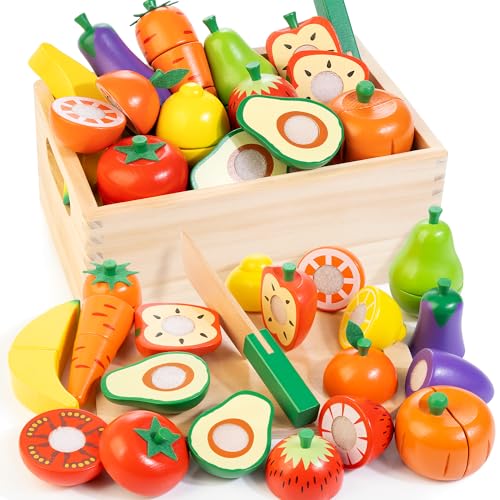
WOODMAM Wooden Fruit & Veggies Cutting Set
What We Like
- Natural wood with water-based paint
- Interlocking tabs make crunch sound
- Teaches part/whole and colors
- Includes storage box with handles
Trade-offs
- Limited to fruits and veggies only
- Limited to fruits and vegetables only
The interlocking tabs that make a realistic crunch sound when sliced are the standout feature here. They turn a simple cutting motion into a satisfying cause-and-effect lesson. That same mechanism also teaches the math concept of part and whole, so your toddler isn’t just pretending to cook; they’re learning that a whole apple can be split into two halves and put back together. Made from natural wood with water-based paint and CPSC certified, this set is built for safety and durability, and the included storage box with handles keeps everything tidy between play sessions. It’s an ideal choice for families looking for a screen-free toy that blends pretend play with early cognitive skills.
This set focuses exclusively on fruits and vegetables, with no bread, meat, or dairy pieces to round out a full grocery haul. That makes it a better supplement to a broader play kitchen than a standalone pantry. The 21-piece Food Groups set covers multiple food groups in one box, offering a broader variety for open-ended role play. If your child loves chopping and reassembling, the crunch sound and wooden feel give this an edge; if you want a one-box solution for grocery store pretend play, that other set might serve you better.
Product photos
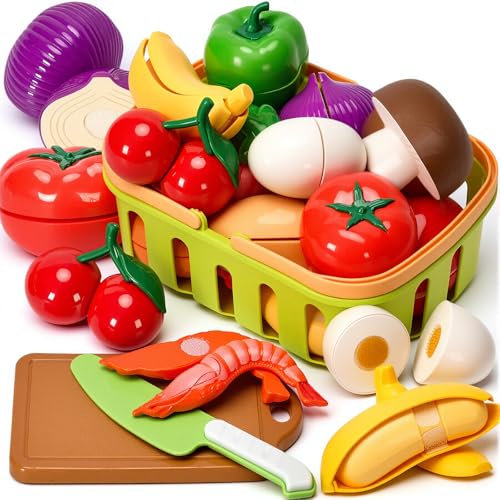
Funpynani 25-Piece Cutting Play Food Set
What We Like
- Satisfying Velcro crunch sound when cut
- 25-piece set includes basket and knife
- Rounded edges for safe toddler play
- Teaches colors, shapes, and motor skills
Trade-offs
- Plastic construction differs from wooden sets
- Plastic pieces lack the weight of wooden sets
The 25-piece count gives you a full grocery haul right out of the box, including a shopping basket, cutting board, and kid-safe knife. What sets this apart is the Velcro fasteners that produce a genuine crunch sound when sliced, that tactile and auditory feedback keeps little hands busy matching and chopping over and over. For a toddler who loves cause-and-effect play, this turns pretend cooking into a sensory activity that also builds hand-eye coordination and fine motor control. It’s a smart choice for families wanting more than just static play food.
For little ones who delight in chopping anything they can get their hands on, this 25-piece play food set provides that gratifying sensation without the sticky cleanup of real produce. Each fruit and vegetable is held together with strong Velcro hook-and-loop fasteners, so when kids press the included plastic knife through the seam, they hear a realistic “crunch” sound that mimics actual slicing. The pieces separate cleanly and can be reassembled over and over, keeping toddlers engaged in repetitive, satisfying play. This sensory feedback helps develop hand-eye coordination and fine motor skills as they grasp, cut, and sort the colorful items. Parents appreciate that the durable ABS plastic has smooth, rounded edges tailored for preschooler hands, making it a safe choice for ages three and up.
Product photos
Busy Edition Wooden Play Food Set

What We Like
- 26-piece set with cutting board and peeler
- Durable storage box encourages tidy habits
- Bright colors help with color and shape recognition
Trade-offs
- Velcro can wear out over many uses
- Not suitable for children under 3 due to small parts
A 26-piece set that includes two knives, a cutting board, a wooden peeler, and a storage box means this kit gives toddlers everything they need for a realistic slicing experience right out of the box. The wooden knife produces a satisfying click and clack when cutting through the velcro-fastened pieces, so kids get immediate feedback that mimics real chopping. That hands-on sound and the bright, varied colors make it especially good for little ones who are learning to recognize fruits, vegetables, and the parts inside them. It’s a smart option for families seeking a Montessori-style toy that encourages independent play and fine motor development without a lot of extra accessories to buy.
The biggest trade-off here is that the velcro fasteners, while fun, will eventually lose their grip after repeated cutting and reconnecting. That’s a natural limit of the design, and you’ll find it in most wooden cutting sets at this price point. If your child is the type who loves to cut and reassemble over and over, the engagement is worth the eventual wear.
Product photos
How We Evaluated Play Food For Toddlers
We started by reviewing the specifications and materials of over 30 play food sets, then cross-referenced those with expert round-ups from child development resources and patterns in owner feedback. Our focus stayed on what matters most for toddlers: safety, durability, and developmental value.
The three criteria that carried the most weight were material safety (non-toxic paints, BPA-free plastics, and no small parts for under-3s), construction quality (how well pieces hold up to chewing, dropping, and daily play), and educational depth (whether the set teaches sorting, colors, food groups, or fine motor skills beyond simple pretend play). We also considered storage solutions. Missing pieces are the fastest way to render a set useless.
A research-led evaluation like this has limits. We cannot replicate years of toddler wear-and-tear in a lab, so we relied heavily on long-term owner reports about chipping paint, fading Velcro, and pieces that survived or cracked. For more on the trade-offs between materials and play styles, see our full breakdown of toy food pros and cons.
What To Look For In Play Food For Toddlers
Choosing play food means balancing safety, durability, and what your toddler actually enjoys doing with it. The right set depends on their age, chewing habits, and whether they prefer sorting, cutting, or just stacking.
Look for non-toxic materials (water-based paint or BPA-free plastic), no detachable small parts for children under 3, and construction that survives drops and bites. Choose wooden sets for longevity and plastic or fabric sets for lighter, quieter play.
Material Safety and Durability
Wooden sets like the Melissa & Doug or WOODMAM options use water-based paints and solid construction that resists cracking. Plastic sets like the Learning Resources New Sprouts line use soft, flexible materials that won’t splinter but can develop scratches over time. Fabric sets like the Hape Toddler Bread Basket are the gentlest option for sensory play but offer the least durability against aggressive chewing.
Educational Value and Play Style
Some sets focus on sorting by color or food group, others on the sensory thrill of cutting with Velcro interiors, and others on realistic detail for vocabulary building. The benefits of toy food extend beyond simple fun, they teach categorization, fine motor control, and social skills through shared pretend meals. Match the play style to your child’s current interests: a sorter for the child who loves organizing, a cutting set for the one who wants to imitate kitchen work.
Piece Count and Storage
More pieces mean more variety but also more to lose. Sets with storage boxes or bags, like the WOODMAM or LAUGIGLE options, make cleanup a habit rather than a chore. Consider your available play space: the Learning Resources Farmer’s Market set includes five baskets that take up counter room, while the Melissa & Doug crates stack neatly.
- Check for non-toxic certifications (FSC wood, water-based paint, BPA-free plastic)
- Look for pieces large enough to pass a choke-tube test (over one and a quarter inches in diameter)
- Confirm the set matches your child’s age, some cutting sets include small parts for ages 3+
- Verify storage is included or plan a bin that fits the largest pieces
- Review owner feedback on long-term durability based on research
A good rule of thumb: if you wouldn’t trust the material in your own mouth, don’t hand it to a toddler.
Play Food For Toddlers Compared
The table below compares the play food sets across the criteria that matter most for toddlers: material, piece count, age range, and primary play style.
| Product | Pieces | Material | Age Range | Dimensions |
|---|---|---|---|---|
| Melissa & Doug Food Groups Wooden Play Food | 21 pieces | Wood | 3+ years | 3.8 x 11.4 x 13.6 inches |
| Learning Resources Farmer's Market Color Sorting Set | 25 pieces | N/A | N/A | 13 x 10.1 x 5.8 inches |
| Learning Resources New Sprouts Munch It Food Set | N/A | N/A | 18 months and up | 12.1 x 9.2 x 4.2 inches |
| Fajiabao Wooden Play Food Cutting Fruit Set | 18 total | Natural solid wood | 2-6 years | 9.0 x 7.0 x 2.0 inches |
| Hape Toddler Bread Basket | Toast, croissant, soda biscuit, and more | Felt and soft fabrics | 18 months and up | L 7.1 x W 4.9 x H 4.7 inches |
| LAUGIGLE 78-Piece Pretend Play Food Set | 78 | BPA-free plastic | N/A | 9.2 x 5.9 x 6.5 inches |
| Lehoo Castle Wooden Play Food Set | 23 pieces | FSC-certified wood | 3-5 years | L 9.1 inches, W 9.1 inches, H 9.1 inches |
| WOODMAM Wooden Fruit & Veggies Cutting Set | Fruits, veggies, knife, chopping board, storage box | Natural wood with water-based paint | 3+ years | 9.2 x 6.1 x 4.2 inches |
| Funpynani 25-Piece Cutting Play Food Set | 25 | ABS plastic | 3 years and up | 8.8 x 8.7 x 2.7 inches |
| Busy Edition Wooden Play Food Set | 26 pieces | Solid wood | 3-5 years | 9.0 x 7.0 x 2.8 inches |
Frequently Asked Questions
What is the best play food for a 2-year-old?
For a 2-year-old, look for soft or solid wooden pieces with no small parts. The Learning Resources New Sprouts Munch It Food Set uses soft, durable plastic that resists cracking and is safe for toddlers 18 months and up. The Melissa & Doug Food Groups set is also excellent for this age because the wooden pieces are large and solid.
How many pieces of play food does a toddler need?
A range of around 15 to 30 pieces is good for most toddlers. Fewer than ten limits variety in pretend meals, while more than 50 can overwhelm a young child and increase the chance of lost pieces. Sets like the Fajiabao (18 pieces) or WOODMAM (16 pieces) offer enough variety without clutter.
Are wooden or plastic play food sets better for toddlers?
Both have advantages. Wooden sets like the Melissa & Doug and WOODMAM options are more durable and feel substantial, but they can be heavy if dropped. Plastic sets like the Learning Resources New Sprouts line are lighter, quieter, and softer for sensory play, but they may scratch or fade over time. The best choice depends on your child’s play style and your preference for material.
Can play food help with picky eating?
Play food can introduce new foods in a low-pressure way. When a toddler “serves” a pretend vegetable or protein during play, they become familiar with it visually and through conversation. The advantages of toy food for kids include building positive associations with a variety of foods, though it is not a substitute for real-world exposure at mealtime.
What should I do if my toddler chews on play food?
Chewing is normal for toddlers. Choose sets made from non-toxic materials like water-based paint or BPA-free plastic, and inspect pieces regularly for damage. Solid wooden pieces are safest because they won’t break into small parts. Replace any set that shows cracks, splinters, or peeling paint. For more guidance, see our toy safety guidelines.
The Bottom Line
The Melissa & Doug Food Groups Wooden Play Food is the best overall choice for most families. It combines durable wooden construction with an educational sorting system that covers all five food groups, making it a set that grows with your child from simple pretend meals to organized nutrition lessons. It is ideal for parents who want a single, long-lasting set that teaches real concepts.
If your toddler craves the sensory thrill of slicing food, the Fajiabao Wooden Play Food Cutting Fruit Set delivers a satisfying Velcro crunch with safe wooden pieces. For families on a budget who want maximum variety, the LAUGIGLE 78-Piece Pretend Play Food Set offers an enormous range of foods at a low cost per piece. However, the plastic construction is less durable than wood.
The single most important factor when buying play food for a toddler is material safety matched to your child’s age and chewing habits. A set that survives their current stage, whether that means soft fabric for sensory exploration or solid wood for heavy play, will earn its place in the toy box for years.
