
10 Best Interactive Toys For 3 Year Olds in 2026
This post contains affiliate links. As an Amazon Associate, we earn from qualifying purchases.
The LeapFrog 2-in-1 LeapTop Touch is the best overall interactive toy for 3 year olds. It adapts to how a child actually plays, switching between a keyboard and a tablet-style activity panel without taking up extra space. For dedicated writing practice, the LeapFrog Mr Pencil’s Scribble Write and Read stands out, while the VTech Race and Discover Driver wins for kids who love pretend driving.
A three-year-old’s brain is building connections faster than at almost any other age, and the right interactive toy meets them where they are: curious, mobile, and hungry for cause-and-effect feedback. The challenge is finding something that holds attention, teaches real skills, and doesn’t frustrate a child who expects a screen to behave like a screen.
This guide is research-based, drawing on manufacturer specifications, expert round-ups on child development, and patterns in owner feedback. We’ve organized ten picks by specific needs so you can match the toy to your child’s current interests and your family’s space and budget.
Top 10 Interactive Toys For 3 Year Olds in the Market

Certain content that appears on this site comes from Amazon. This content is provided "as is" and is subject to change or removal at any time.
The Best Interactive Toys For 3 Year Olds, Reviewed
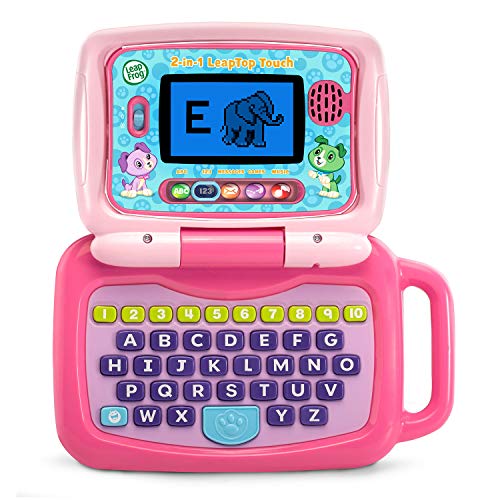
LeapFrog 2-in-1 LeapTop Touch
What We Like
- 2-in-1 laptop and tablet design
- Keyboard with A–Z and 1-10 keys
- Five learning modes cover multiple skills
- Screen flips to switch modes
Trade-offs
- Batteries included only for demo use
- Tablet mode uses button presses, not a touchscreen
A screen that flips from keyboard to tablet mode gives a three-year-old two distinct ways to play without needing a second toy. The LeapTop Touch covers ABCs, numbers, games, music, and messages, so a child can cycle through letter practice, counting, and silly tunes in one sitting. That variety keeps little fingers busy longer than a single-mode toy, and the familiar laptop shape makes them feel grown-up while they learn. For a parent who wants a single, durable electronic that grows with a child from age two to five, this is the one that delivers the most play per square inch of shelf space.
The LeapFrog 2-in-1 LeapTop Touch flips from a keyboard to a tablet, so a preschooler can switch between typing letters and numbers and tapping on a touch-style screen. It weighs just 1.3 pounds and measures about 10 inches wide, making it easy to tuck into a bag or carry from room to room. Five learning modes cover ABCs, numbers, games, music, and messages, which keeps a 2-to-5-year-old engaged without needing a parent’s phone.
LeapFrog Mr Pencil's Scribble Write and Read

What We Like
- Teaches uppercase and lowercase letter writing step-by-step
- Transforms letters into animated animals and objects
- Customizable name entry for personalized practice
- Sound-it-out bar lights up for phonics support
Trade-offs
- Requires 3 AA batteries for regular use
- No built-in storage for the stylus
The step-by-step letter tracing with instant animation rewards turns practice into a game. That built-in sound-it-out bar lights up as Mr. Pencil slides across the screen, so a child hears each letter sound while they trace. For a three-year-old just starting to grip a pencil, this makes the connection between writing and reading feel like play, not work. It also lets you enter a child’s first, middle, and last name, which gives them a personal stake in getting it right.
Three AA batteries are required for regular use, and the included demo batteries are only for initial demonstration. That’s a small trade-off for a device that focuses entirely on teaching handwriting through step-by-step guidance. If building pre-writing skills with a patient, animated instructor is your priority, this tool delivers exactly that, just keep a fresh set of batteries handy.
VTech Race and Discover Driver

What We Like
- 20 games, races, and road trips
- Turn signals, horn, gear shift
- Counting, spelling, problem-solving games
- Three racetracks with hazards
Trade-offs
- Requires 4 AA batteries for regular use
- Batteries not included for regular use
Twenty built-in games, races, and road trips mean this driving toy keeps a 3-year-old engaged far longer than a simple steering wheel. The colorful game screen gives visual feedback as kids practice using turn signals, the horn, and gear shift, while dashboard buttons let them pretend to take calls and check maps. That mix of role-play and structured activities builds counting, spelling, and problem-solving skills without feeling like a lesson. It’s a natural fit for a child who loves cars and wants more than just a wheel to spin.
The trade-off is battery life: four AAs are needed for regular play, and the demo batteries won’t last long, so you’ll want fresh ones ready. At 2 pounds, it’s heavier than a lap-sized toy like the LeapTop Touch, so it stays put on a table or floor rather than being carried around. That stability actually helps during the three racetrack challenges, where kids dodge hazards and race for first place. For a preschooler who craves driving simulation with real controls, this delivers the most interactive experience in the guide.
Chuckle & Roar Pop It Book

What We Like
- Bilingual English & Spanish color learning
- Screen-free sensory and fine motor play
- Quiet mode option for quieter play
Trade-offs
- Only covers colors, not numbers or letters
A bilingual color book that doubles as a pop-it toy means your three-year-old gets two kinds of engagement in one sturdy package. For a kid just starting to learn colors in both English and Spanish, this is a practical way to turn fidgeting into language practice.
This book focuses exclusively on colors, so if your child is already past that stage or you want numbers and letters too, you’ll need another toy to fill that gap. Compared to the Melissa & Doug Poke-a-Dot Old MacDonald’s Farm, which offers farm-themed counting and color matching, this one covers only colors in two languages. Best for families who want a durable, screen-free way to reinforce color vocabulary in English and Spanish while keeping little hands busy.
Product photos
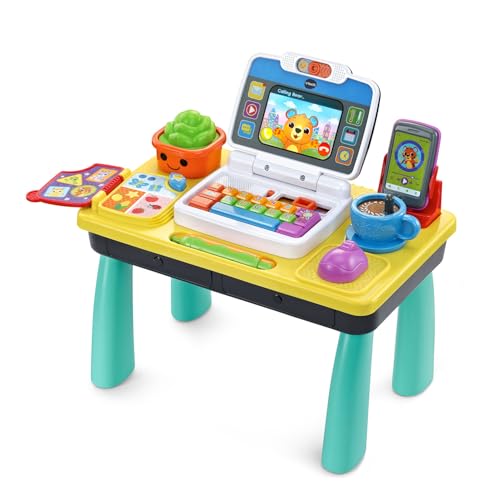
VTech Little CEO Learning Desk
What We Like
- Multiple hands-on activities keep little fingers busy
- Introduces numbers, letters, and music playfully
- Phone and mouse encourage imaginative role-play
- Sing-along music and melodies included
Trade-offs
- At 3 pounds, it's heavier than some portable options
- 0.1-inch thickness suggests a flat panel, not a desk shape
- Age range ends at 36 months, so 3-year-olds are at the limit
A desk that fits kids from 9 to 36 months means you get a toy that grows with your toddler through the critical early years, not something they outgrow in a season. With a tippy keyboard, a phone to pick up, a mouse to scroll, and even a coffee cup to stir, it turns pretend office work into a full sensory experience. That range of activities keeps a 3-year-old’s curiosity fed without overwhelming them, and the sing-along melodies add a calm layer for quieter moments.
The real trade-off here is weight: at 3.0 pounds, this desk is noticeably heavier than the LeapTop Touch (1.3 pounds), so moving it from room to room isn’t as easy. That bulk comes from having more physical parts, the phone, mouse, book, and peekaboo plant all add play value but also add heft. For a stationary play area, that’s fine; for a toy that travels to grandma’s house, the lighter LeapTop might be a better fit. But if your little one loves having their own ‘office’ corner, the extra weight is a fair trade for the variety.
Melissa & Doug Poke-a-Dot Old MacDonald's Farm

What We Like
- Satisfying pop sounds on every press
- Builds number recognition and fine motor skills
- Durable board book for small hands
- Travel-friendly compact design
Trade-offs
- Limited to farm theme and counting down from 10
- Only counts down from 10, not up
A 20-page board book with built-in buttons that pop with each press turns reading into a hands-on sensory experience. That pop sound is surprisingly satisfying for little fingers, and it keeps them engaged while they count down from 10 cows to 1 rooster. It’s sized just right for small hands to poke independently, and the sturdy pages hold up to repeated use. For a toddler who loves farm songs and counting, this book builds number recognition and fine motor skills through interactive play.
The 2.0-pound weight makes this book more of a lap activity than something a toddler will carry around independently. It’s best for kids who enjoy sitting with an adult or older sibling and poking along to the farm theme. Not ideal for children who prefer electronic screens or need a lightweight, solo-carry toy.
Product photos
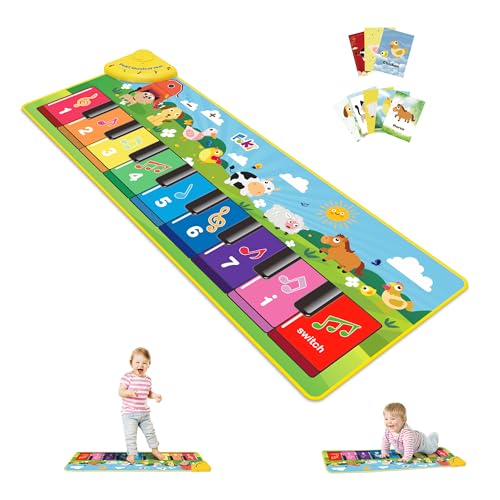
FOKI Floor Piano Mat
What We Like
- 5 play modes with 32 sounds
- Screen-free sensory musical play
- Easy to fold and wipe clean
- Includes 8 animal music cards
Trade-offs
- Requires 3 AA batteries not included
- At 39 inches, needs floor space
With 32 sounds spread across five distinct play modes, this floor piano mat turns a toddler’s natural urge to stomp and dance into a genuine musical experience. Standard mode delivers piano notes, while Simulation mode introduces eight animal sounds. Chorus Mode adds a playful twist, letting an animal sing along after a piano key starts a melody. Melody and Performing modes round out the options, offering 16 children’s melodies to explore. The screen-free design encourages shared discovery with an adult, helping little ones build rhythm, listening skills, and movement coordination. At just 0.9 pounds and folding neatly for storage, it travels easily for playdates or family visits.
This mat needs floor space: at 39 inches long, it requires a clear area to spread out, so it’s not a lap toy or a small-apartment solution. By contrast, the LeapTop Touch is compact and portable, but it doesn’t offer the same full-body, gross-motor engagement. The FOKI mat also requires three AA batteries that aren’t included, so you’ll want to have those on hand before the box arrives. For a child who needs to move, stomp, and explore sound physically, this mat delivers a rich, open-ended musical playground that a laptop-style toy simply can’t match.
Product photos
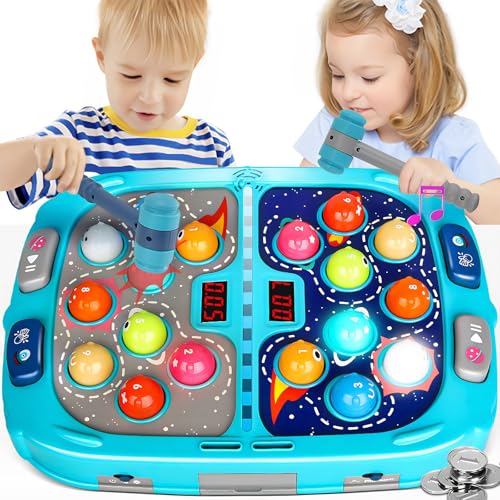
ANNKIE Whack Game Mole
What We Like
- Three interactive modes for varied play
- Includes two soft-tip hammers
- Large 16×12 inch play surface
- Suction cups keep it stable
Trade-offs
- Requires 4 AA batteries not included
- Large size needs floor space to set up
With a 16-by-12-inch play surface and two soft hammers, this pounding game gives two kids room to compete without bumping elbows. The three modes. Solo, PK, and Super, let a child practice alone, challenge a friend, or ramp up through 45 difficulty levels and 9 speeds, so the challenge grows as their reflexes improve.
This toy is big and needs four AA batteries you have to buy separately, so it’s not something you toss in a diaper bag for the car. Compared to the LeapTop Touch, which is smaller and lighter, the ANNKIE requires more space and setup. But for a playdate or a rainy afternoon at home, the competitive pounding action and flashing lights can keep little hands busy for a while.
GaHoo Electronic Alphabet Wall Chart
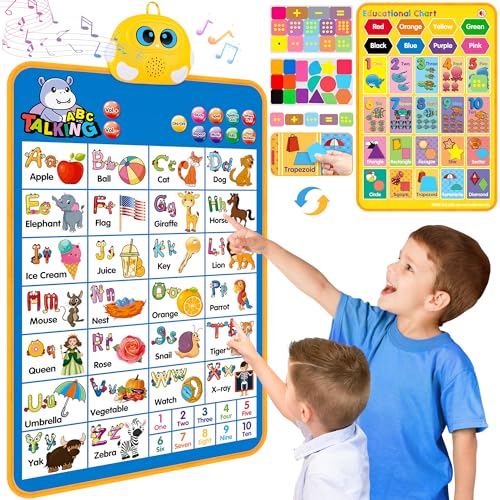
What We Like
- Touch-activated speaker for easy use
- Includes shapes, colors, and counting
- Lightweight and portable for travel
- Auto-off preserves battery life
Trade-offs
- Back side has no sound, only visual
- Requires 3 AAA batteries not included
At 24 by 16 inches, this wall chart covers a good chunk of wall without overwhelming a playroom. Its touch-activated speaker means little fingers just press the picture or letter to hear it, no finicky buttons to fumble. That direct response helps children aged 1 to 6 stay engaged while learning ABCs, numbers, shapes, and colors. It brings interactive learning into a room without adding clutter, and the portable design lets you take it on car trips or to grandma’s house. For families who want a no-fuss, educational wall toy that grows with a child from 1 to 6, this chart delivers solid value without the frills.
The biggest trade-off is that the back side is purely a visual reference chart, no sound, no interaction, so half the poster is passive. That’s fine for quiet review, but if your child craves constant audio feedback, the front side is where the action lives. For a wall-mounted option that teaches letters, numbers, and songs in a straightforward way, the GaHoo chart is a smart pick for parents.
Product photos
Melissa & Doug Vroom & Zoom Interactive Dashboard
What We Like
- FSC-certified wood construction
- Interactive lights and sounds
- Multiple tactile features
- Encourages independent pretend play
Trade-offs
- No quiet mode for lights/sounds
- Heavier than similar toys at 2.8 pounds
The Melissa & Doug Vroom & Zoom Interactive Dashboard is made with FSC-certified materials, which supports responsible forestry. At 2.8 pounds and 14.6 inches tall, it’s a substantial toy that stays put during play, yet its height is accessible for preschoolers. The key-start, gearshift, scrolling GPS, horn, radio, and gas cap all provide hands-on sensory engagement that encourages storytelling and fine motor development, exactly the kind of open-ended, screen-free play that helps kids build coordination and problem-solving skills on their own terms.
At 2.8 pounds, this dashboard is heavier than the 2.0-pound VTech Race and Discover Driver, making it less convenient to toss in a bag for car trips. The lights and sounds lack a quiet mode, so it’s not suited for naptime play in shared spaces. But if you want FSC-certified materials and a sturdy feel, this toy delivers an engaging pretend driving experience.
Product photos
How We Evaluated Interactive Toys For 3 Year Olds
We started by reviewing manufacturer specifications and learning claims for dozens of toys marketed to children ages 3 to 4. From there, we cross-referenced expert round-ups on developmental milestones. We focused on what skills (letter recognition, fine motor control, cause-and-effect reasoning) each toy actually targets, and looked for consistent praise or complaints in owner feedback across multiple retail platforms.
Three criteria mattered most. First, skill alignment: does the toy teach something a three-year-old is developmentally ready to learn, or is it either too simple (boring) or too advanced (frustrating)? Second, durability and safety: three-year-olds are not gentle, so we favored toys with solid construction, no small parts, and materials that survive drops and yanks. Third, play value per square foot: most homes have limited floor and table space, so we prioritized toys that offer multiple modes or activities without requiring a dedicated playroom.
A research-led evaluation has honest limits.
What To Look For In Interactive Toys For 3 Year Olds
The best interactive toy for a three-year-old balances genuine learning with the kind of open-ended play that keeps a child coming back. Look for toys that offer multiple modes or difficulty levels, use durable materials, and match your child’s current attention span and motor skills.
Choose toys with at least two play modes or difficulty levels so the toy grows with your child. Prioritize solid construction (no sharp edges, battery compartments secured with screws) and avoid toys that require a tablet or phone to function, standalone toys win for independence.
Skill Alignment With Developmental Milestones
A three-year-old is typically working on letter and number recognition, fine motor control (turning pages, pressing small buttons), and basic problem-solving. The best toys target these skills without demanding precision a child that age doesn’t yet have. The LeapFrog Mr Pencil’s Scribble Write and Read, for example, teaches letter formation step-by-step with a light-up sound bar, which matches a three-year-old’s emerging ability to trace shapes. By contrast, a toy that expects a child to type full words or follow multi-step instructions will likely end up ignored.
Physical Interaction and Sensory Feedback
Three-year-olds learn through touch and movement. Toys that offer satisfying physical feedback, popping buttons, clicking gears, vibrating steering wheels, hold attention longer than passive screens. The Melissa & Doug Poke-a-Dot book works because each press produces a loud pop that rewards the action immediately. The FOKI Floor Piano Mat works because it turns whole-body stomping into music. Look for toys that engage at least two senses (hearing and touch, sight and movement) to reinforce the learning loop.
Battery Life and Setup Realism
Most interactive toys require batteries, and the fine print matters. Several picks in this guide include batteries only for demo use, meaning you’ll need fresh ones within hours. Check whether the toy uses standard sizes (AA, AAA) and whether the battery compartment is secured with a screw (required for safety).
Also consider whether the toy has an auto-off feature, the GaHoo Electronic Alphabet Wall Chart has one, which saves you from changing batteries every week. If battery-free play is a priority, the Melissa & Doug Vroom & Zoom Interactive Dashboard uses wood construction with lights and sounds that still run on batteries, but the Poke-a-Dot book needs none at all.
- Does the toy have at least two play modes or difficulty settings?
- Are the batteries included for regular use, or only for demo?
- Is the toy designed for independent play, or does it require adult setup each time?
- Can the toy be easily cleaned (wiped down, machine-washable parts)?
- Does the toy fit in your available floor or table space without becoming a tripping hazard?
A toy that needs new batteries every three days will not stay fun for long. Prioritize auto-off features and standard battery sizes.
Interactive Toys For 3 Year Olds Compared
The table below compares all ten interactive toys across the features that matter most for a three-year-old: learning focus, play style, power requirements, and physical footprint.
| Product | Dimensions | Weight | Age Range |
|---|---|---|---|
| LeapFrog 2-in-1 LeapTop Touch | 10.1 x 6.1 x 2.0 inches | 1.3 pounds | 2-5 years |
| LeapFrog Mr Pencil's Scribble Write and Read | 2.0 x 7.7 x 8.6 inches | 0.9 pounds | 3+ years |
| VTech Race and Discover Driver | 13.4 x 9.7 x 5.4 inches | 2.0 pounds | 3-6 years |
| Chuckle & Roar Pop It Book | 11.5 x 2.2 x 0.1 inches | 1.4 pounds | 1-4+ |
| VTech Little CEO Learning Desk | N/A | 3.0 pounds | 9-36 months |
| Melissa & Doug Poke-a-Dot Old MacDonald's Farm | 1.4 x 7.3 x 9.3 inches | 2.0 pounds | 3 to 7 years |
| FOKI Floor Piano Mat | 39.3 x 14.1 x 0.4 inches | 0.9 pounds | 3 Months to 5 Years |
| ANNKIE Whack Game Mole | 16.0 x 12.0 x 2.5 inches | N/A | 3-12 Year Old |
| GaHoo Electronic Alphabet Wall Chart | 24 x 16 inches | N/A | 1-6 years |
| Melissa & Doug Vroom & Zoom Interactive Dashboard | 9.2 x 7.2 x 14.6 inches | 2.8 pounds | 3+ |
Frequently Asked Questions
What is the best interactive toy for a 3 year old who is not interested in letters?
The FOKI Floor Piano Mat is a strong choice because it teaches cause-and-effect and musical concepts through full-body movement rather than academic skills. The Chuckle & Roar Pop It Book also works well for color recognition and sensory play without requiring any letter knowledge.
How much parent involvement do these toys require?
Most are designed for independent play once the initial setup is done. The LeapFrog Mr Pencil’s Scribble Write and Read benefits from occasional parent guidance during the letter-tracing phase, while the VTech Little CEO Learning Desk and ANNKIE Whack Game Mole are largely self-directed.
Are interactive toys with screens bad for a 3 year old?
None of the toys in this guide use an LCD or LED screen that mimics a tablet. The LeapFrog 2-in-1 LeapTop Touch uses a physical keyboard and button-based tablet mode, not a touchscreen, so it provides the feel of a device without the passive screen time.
What should I do if my child loses interest in an interactive toy quickly?
Look for toys with multiple play modes or difficulty levels, like the VTech Race and Discover Driver with its 20 games and races. Rotating toys out of sight for a few weeks can also renew interest, three-year-olds often rediscover toys as if they were new.
Can interactive toys replace traditional learning tools like books and puzzles?
No. Interactive toys are excellent supplements that reinforce skills through repetition and feedback, but they work best alongside hands-on activities like building blocks, puzzles, and picture books. The Melissa & Doug Poke-a-Dot Old MacDonald’s Farm bridges both worlds as a durable board book with interactive pops.
The Bottom Line
The LeapFrog 2-in-1 LeapTop Touch is the best overall pick for most families because it packs five learning modes into a compact, two-in-one design that teaches letters, numbers, and music without taking over the playroom. It works for the child who wants a laptop one day and a tablet the next, all without a real screen.
If your child is already showing interest in writing, the LeapFrog Mr Pencil’s Scribble Write and Read is worth paying more for. It teaches uppercase and lowercase letter formation with step-by-step guidance that most toys at this price point skip. For active kids who need to move, the FOKI Floor Piano Mat or ANNKIE Whack Game Mole turn play into a full-body activity.
The single most important factor is whether the toy matches your child’s current developmental stage, not their age in years. A toy that is slightly too advanced will frustrate; one that is too simple will bore. Choose the mode of play, keyboard, writing, driving, music, or movement, that your child already gravitates toward, and the learning will follow naturally.
