
10 Best Glue For Model Kits in 2026
This post contains affiliate links. As an Amazon Associate, we earn from qualifying purchases.
The Tamiya Extra Thin Cement Fine Tip is the best overall glue for model kits, winning on capillary-action precision that creates clean bonds on tight-fitting plastic parts. For fast assembly, the Testors Plastic Cement Fast-Drying sets in two hours, while the Revell Contacta Professional Glue delivers pinpoint accuracy for tiny details.
Every modeler knows the frustration of a glue blob ruining a seam or fogging a clear canopy. The right adhesive for your specific plastic and build style makes the difference between a crisp model and a messy one. Factors like drying speed, applicator type, and chemical compatibility matter more than brand loyalty.
We evaluated these ten glues by analyzing manufacturer specifications, expert round-ups, and patterns in owner feedback across thousands of builds. This guide covers the best options for styrene kits, ABS parts, and specialty plastics so you can match the right cement to your next project.
Top 10 Glues For Model Kits in the Market
Certain content that appears on this site comes from Amazon. This content is provided "as is" and is subject to change or removal at any time.
The Best Glues For Model Kits, Reviewed
Tamiya Extra Thin Cement Fine Tip

What We Like
- Fine tip for precise application
- Extra-thin formula flows by capillary action
- Ideal for gluing fitted plastic parts
- Smooth bonding without excess glue
Trade-offs
- Not for porous or non-plastic materials
- Requires parts to fit snugly for capillary action
The fine-tip applicator delivers extra-thin cement exactly where you want it, and the formula’s capillary action pulls it into the tightest seams between fitted plastic parts. That means clean, strong bonds without messy puddles or visible glue lines, which is why this is the go-to for scale modelers who value precision and a clean finish. It suits anyone assembling plastic model kits who wants a reliable, easy-to-control adhesive that works with the natural fit of the parts.
The trade-off is that this cement works best on parts that fit together snugly, so it won’t fill gaps or work on porous materials the way a thicker glue might. If your kit has loose-fitting parts or you’re working with resin or metal, you’ll need a different adhesive. But for standard plastic model assembly where parts mate cleanly, the capillary action and fine tip make application precise and controlled.
Testors Plastic Cement Fast-Drying

What We Like
- Dries in only 2 hours
- Strong, lasting adhesion
- Includes 4 precision tips
- Works on polystyrene and ABS
Trade-offs
- Not for non-polystyrene or non-ABS plastics
- Only works with polystyrene and ABS plastics
A two-hour drying time means you can assemble a model and move on to the next step the same evening, without waiting overnight for the joint to set. This fast-drying plastic cement is formulated for polystyrene and ABS plastics, the most common materials in model kits, so it bonds the parts that actually need bonding. The package includes four gluing tips for precise application, which helps you avoid messy overflow on visible seams. It’s a straightforward, no-nonsense adhesive for anyone who wants a strong hold without the fuss of a slow cure.
This cement is formulated specifically for polystyrene and ABS plastics, so if you work with other materials like styrene or resin, you’ll need a different adhesive. The two-hour drying time means you can position parts without rush, but it won’t wick into seams as quickly as some thinner cements. For modelers who prefer a thicker, controlled bead that stays put without running, this Testors formula delivers reliable strength without clamping.
Tamiya Plastic Cement 20ml

What We Like
- Trusted TAMIYA brand for model kits
- Classic cement formula for strong bonds
- 20ml bottle offers ample supply
Trade-offs
- No fine tip applicator for precision work
- Requires separate applicator for detailed work
A solvent-based bond that melts plastic parts together at the joint is what you get with this 20ml bottle of Tamiya Plastic Cement, making it the classic choice for assembling scale model kits. It’s the go-to formula for reliable, permanent assembly, and the brush-in-cap application gives you control over where the glue goes. Modelers who want a traditional approach will find it suits their needs without any fuss.
The trade-off here is that you don’t get a fine-tip needle applicator like you do with some other plastic cements, which means precise placement on small parts takes a steadier hand. If you’re working on tiny aircraft canopies or delicate photo-etched details, a precision applicator might save you frustration. But for general model assembly, tanks, cars, ships, and figures, this classic cement delivers a strong bond in a 20ml bottle.
Product photos
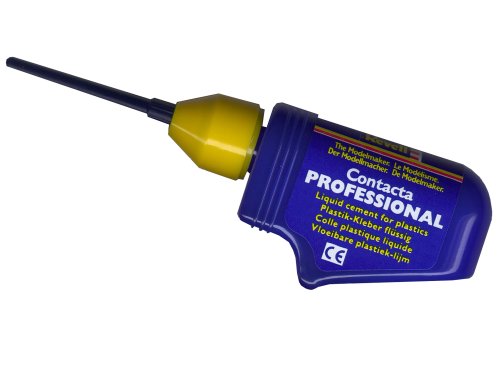
Revell Contacta Professional Glue
What We Like
- Precision applicator with extra-fine hollow needle
- Pin-point accurate bonding for tiny details
- Micro-fine gluing of clear part edges
Trade-offs
- Liquid cement works only on plastic models
- Not suitable for porous materials like wood or metal
The extra-fine hollow needle on this liquid cement lets you place a single drop with surgical precision, so you can glue tiny antennae or clear canopy edges without flooding the part. That makes it the go-to for anyone who builds detailed scale models and needs precise adhesive placement. It suits modelers who value precision over speed and don’t mind a slower, more deliberate workflow.
The 25g bottle is compact, so if you’re assembling a large kit with lots of long seams, you might find yourself reaching for a bigger bottle like the Tamiya Extra Thin Cement Fine Tip before you finish. The extra-fine hollow needle lets you place micro-drops exactly where needed, which is ideal for tiny details and clear part edges.
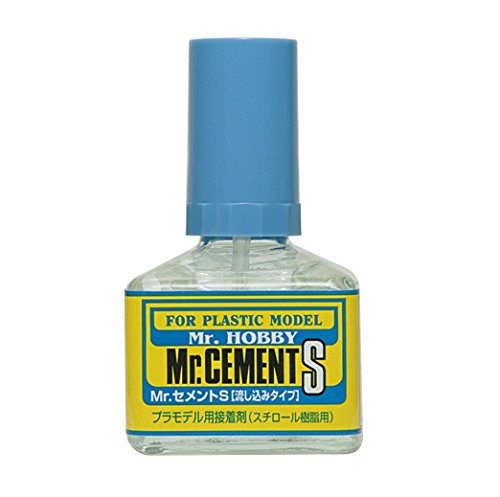
GSI Creos Mr. Cement S
What We Like
- Applies via capillary action into gaps
- Dries quickly for fast sanding and painting
- Workable time shorter than MC124 and MC127
Trade-offs
- Small bottle size limits large builds
- Short workable time limits repositioning
A liquid cement that seeps into tight seams through capillary action means you can bond parts without smearing glue across the surface. That quick-dry formula lets you sand and paint sooner than conventional plastic cements, which is a real time-saver when you are assembling a kit with many small joints. This glue suits modelers who want precision and speed, especially on fine detail work where excess adhesive would ruin the finish.
A shorter workable time for repositioning compared to GSI’s own MC124 and MC127 means you need to get the alignment right on the first try. If you prefer a slower bond that lets you adjust parts, this may not be your first choice, but for clean, fast joins it is hard to beat.
Mr. Hobby Cement For Plastic Model

What We Like
- Quick-drying formula saves waiting time
- Strong bond for plastic models
- Works with acrylic, polycarbonate, ABS
- Dries clear for smooth finish
Trade-offs
- No built-in applicator for precision placement
- Runny liquid can pool without careful handling
The 40ml bottle holds enough glue for several kits, and the liquid formula wicks into tight joints for a strong bond on acrylic, polycarbonate, and ABS plastics. The quick-drying formula saves waiting time, so you can move from one seam to the next without tapping your fingers on the bench. If you build multiple kits in a session or just hate watching paint dry, this cement keeps your workflow steady.
The liquid consistency can be runny without a precision applicator, so you’ll want a steady hand or a fine brush to avoid excess pooling. Still, if speed is your priority and you don’t mind adding your own applicator, this cement delivers exactly what it promises: a fast, reliable bond that gets you to the next step sooner.
Product photos
Testors Non-Toxic Plastic Cement

What We Like
- Non-toxic low odor formula
- Fast drying for quick assembly
- Strong lasting adhesion
- Works on polystyrene and ABS
Trade-offs
- Small 0.625 oz bottle runs out fast
- Not formulated for non-plastic materials
A low-odor, non-toxic formula means you can glue parts together in a room without needing a respirator or opening every window. Testors designed this cement to bond polystyrene and ABS plastic quickly, so you can move on to the next step without waiting around. That makes it a natural pick for hobbyists working in shared spaces, apartments, or with kids nearby who want to build models without the chemical headache.
At 0.625 fluid ounces, it’s a small tube that will run out faster than larger options if you build frequently. If you’re building a single kit, that’s fine, but for larger projects or frequent use you’ll be buying refills sooner. The small volume means it’s better suited for occasional modelers than someone who builds multiple kits a week.
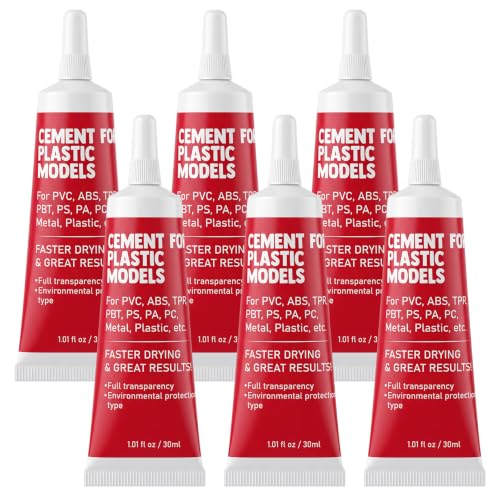
Dunzoom 6 Pack Cement Plastic Glue
What We Like
- Six bottles in one pack
- Precision nozzle for controlled application
- Works on ABS, PVC, and hobby plastics
- Dries clear with no residue
Trade-offs
- Requires careful storage to keep cap sealed tightly
- Not suitable for polystyrene or styrene plastics
Six bottles of 1.01 fl oz each means you can keep one at the bench, one in the kit bag, and still have spares for group builds or long projects without running dry mid-assembly. That kind of volume makes this pack a smart buy for anyone who goes through plastic cement faster than a single bottle can keep up, especially if you work on multiple models at once or tend to misplace tubes mid-project. The precision nozzle helps you place glue with control, so you’re not flooding a seam or wasting adhesive on surrounding parts.
The formula is built for ABS, PVC, and general hobby plastics, but if your primary material is styrene, you may want to consider a cement specifically designed for that. Still, if you work across a mix of plastics and want a big supply that won’t dry out between sessions, this set covers a lot of ground without the premium price tag.
Product photos
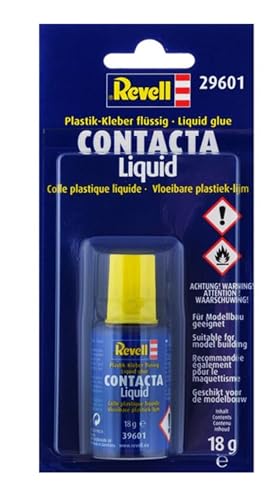
Revell Contacta Liquid Modelling Glue
What We Like
- Made in Germany
- Made of high quality raw material
Trade-offs
- No fine tip applicator included
- Not suitable for children under 3 years
The bottle has no fine-tip applicator, so you’ll need to use a brush or a needle to apply glue into tight joints. Compared to the Tamiya Extra Thin Cement Fine Tip, which includes a fine tip for capillary action, the Revell requires more manual control. If you build large aircraft or ship models, the small bottle may not last through a single project, but for a single small kit it’s perfectly adequate.
GRAS Art Bundles bdl-0558 Glue

What We Like
- Fine tip applicator for precision
- 10 foam brushes in 5 sizes
- Capillary action erases seam lines
- Firm yet adjustable bond
Trade-offs
- 24-hour full cure slows assembly
- Only for plastic models
The bundle includes Tamiya Extra Thin Cement with a fine tip applicator and ten Pixiss foam brushes in five sizes. The cement’s thin consistency uses capillary action to draw into narrow gaps, bonding plastic parts and erasing seam lines for a professional finish. The set time is 10-15 minutes, with a full cure in 24 hours, allowing you to adjust parts before the bond sets. This makes it a practical choice for modelers working on plastic miniatures or scale models who want precision and the right tools in one package.
Because the cement is extra thin, it is designed for tight seams and plastic-to-plastic bonding rather than filling larger gaps or adhering non-plastic materials. For projects that require gap-filling or bonding metal parts, a different adhesive would be needed. The included foam brushes are suited for applying the cement precisely, and the fine tip applicator helps with intricate work. Plan for the 24-hour full cure time when scheduling your assembly sessions.
Product photos
How We Evaluated Glues For Model Kits
Our research began with manufacturer data sheets to verify chemical composition, drying times, and material compatibility. We cross-referenced these specs with expert round-ups from scale modeling communities and hobby publications to see which formulas consistently earned praise for specific use cases.
Three criteria mattered most: application precision, bond strength, and drying speed. A glue that flows by capillary action into tight seams works differently than a thick cement meant to fill gaps, so we matched each formula to its ideal job. We also looked at applicator design, fine metal needles, brush caps, and precision tips, because control is everything on small parts.
A research-led evaluation has limits. We did not build identical kits with every glue side by side. Instead we relied on documented owner experiences and verified technical claims to identify patterns: which glues fog clear parts, which shrink as they cure, and which work reliably across multiple plastic types.
What To Look For In Glues For Model Kits
Choosing the right glue starts with understanding your kit’s plastic type and how much working time you need. Thin cements flow into seams, while tube glues fill gaps, each has a place on your bench.
Pick a glue that matches your kit’s plastic (styrene, ABS, or PVC) and your build style, capillary-action thin cements for tight seams, thick cements for gap filling, and fast-drying formulas for impatient builders.
Plastic Compatibility
Not all glues work on all plastics. Polystyrene and ABS, the most common materials in injection-molded kits, bond well with solvent-based cements that chemically weld the plastic. PVC and acrylic kits need different formulas. Check the bottle before you buy. The Dunzoom 6 Pack Cement Plastic Glue works on ABS, PVC, and hobby plastics but not polystyrene, while the Testors Plastic Cement Fast-Drying is formulated specifically for polystyrene and ABS.
Applicator Design
A fine applicator makes the difference between a clean joint and a mess. The Tamiya Extra Thin Cement Fine Tip uses a small brush in a metal cap for controlled flow. The Revell Contacta Professional Glue has an extra-fine hollow needle for pin-point accuracy on tiny details. If you build mostly large surfaces, a standard brush cap works fine. For cockpit details or photo-etched parts, invest in a precision applicator.
Drying and Working Time
Fast-drying glues save time but leave no room for repositioning. The GSI Creos Mr. Cement S sets quickly for fast sanding and painting, ideal for experienced builders. The GRAS Art Bundles bdl-0558 Glue takes 24 hours to fully cure, giving you time to adjust parts. Beginners should lean toward a medium-drying formula that balances speed with forgiveness.
- Match the glue to your kit’s plastic type, check the label for polystyrene, ABS, or PVC compatibility
- Choose an applicator that fits your part size, fine needles for details, brush caps for large seams
- Consider your patience level, fast-drying formulas save time but demand confidence in placement
- Store solvent cements upright with caps tight to prevent evaporation and clogging
A thin cement with capillary action is the safest choice for most plastic model kits because it creates strong bonds without excess glue.
Glues For Model Kits Compared
The table below compares our top picks side by side, highlighting their best use cases and key trade-offs so you can find the right glue for your next build.
| Product | Type | Volume/Size | Applicator |
|---|---|---|---|
| Tamiya Extra Thin Cement Fine Tip | Extra-thin liquid cement | 40ml | Fine tip |
| Testors Plastic Cement Fast-Drying | N/A | 1.75 Fl Oz | 4 gluing tips included |
| Tamiya Plastic Cement 20ml | N/A | 20ml | N/A |
| Revell Contacta Professional Glue | Liquid Cement for Plastics | 25g | Extra-Fine Hollow Needle |
| GSI Creos Mr. Cement S | Liquid cement | N/A | N/A |
| Mr. Hobby Cement For Plastic Model | N/A | 40ml | N/A |
| Testors Non-Toxic Plastic Cement | Plastic cement | 0.625 Fl Oz | N/A |
| Dunzoom 6 Pack Cement Plastic Glue | N/A | 1.01 fl oz (30 ml) | Precision fine tip |
| Revell Contacta Liquid Modelling Glue | N/A | N/A | N/A |
| GRAS Art Bundles bdl-0558 Glue | Extra thin cement | 4 oz | Fine tip + 10 foam brushes |
Frequently Asked Questions
What glue is best for plastic model kits?
The Tamiya Extra Thin Cement Fine Tip is the best overall choice for plastic model kits that have tight-fitting parts. Its thin formula flows into seams by capillary action, creating clean bonds without excess glue. For non-polystyrene plastics like PVC, choose a cement specifically formulated for those materials.
Can I use super glue on model kits?
Cyanoacrylate (super glue) works on resin, metal, and photo-etched parts but is not ideal for polystyrene model kits. Solvent-based plastic cements chemically weld styrene plastic, creating a bond as strong as the surrounding material. Super glue leaves a brittle joint that can snap under stress.
How long does model glue take to dry?
Drying times vary widely by formula. Fast-drying cements like the Testors Plastic Cement Fast-Drying set in about two hours. Thin capillary-action glues dry in minutes but may need 24 hours for full cure. Thicker tube cements can take several hours to set and longer to reach full strength.
What is the difference between tube glue and liquid cement?
Tube glue is a thick, paste-like cement that fills gaps and works on loose-fitting parts. Liquid cement is thin and flows by capillary action into tight seams, creating clean bonds without visible residue. Liquid cement is preferred for precision work, while tube glue is better for filling gaps or bonding porous surfaces.
Is model glue toxic?
Most solvent-based plastic cements contain chemicals like acetone or butanone that produce strong fumes. Work in a well-ventilated area and avoid skin contact. The Testors Non-Toxic Plastic Cement offers a low-odor, non-toxic formula for builders who want a safer option for occasional use in shared spaces.
The Bottom Line
The Tamiya Extra Thin Cement Fine Tip is the best overall glue for model kits because its capillary-action formula and fine applicator give you precise control on tight-fitting plastic parts. It is the right choice for modelers who build styrene kits and want clean, professional-looking seams without excess glue.
If you need a fast-drying adhesive for quick assembly, the Testors Plastic Cement Fast-Drying sets in two hours and works on polystyrene and ABS. For builders on a budget or those working with mixed plastics, the Dunzoom 6 Pack Cement Plastic Glue offers six bottles for various hobby plastics at a low per-bottle cost.
The single most important factor when buying model glue is matching the formula to your kit’s plastic type. A solvent cement designed for polystyrene will not bond PVC or acrylic, and a thick tube glue will ruin the clean fit of a precision-engineered kit. Check the label first, then choose your applicator.
