
10 Best Fine Motor Toys in 2026
This post contains affiliate links. As an Amazon Associate, we earn from qualifying purchases.
The best fine motor toy for most families is Learning Resources Spike The Hedgehog, because its chunky peg-shaped pieces are easy for small hands to grasp while teaching color recognition and counting. For a classic threading activity, the Melissa & Doug Primary Lacing Beads offer open-ended play. And if you need dedicated shoe-tying practice, the Melissa & Doug Deluxe Lacing Sneaker builds a real-life skill.
When you are shopping for fine motor toys, the real challenge is finding something that matches your child’s current skill level without being too simple or too frustrating. A toy that is too easy gets ignored, and one that is too hard collects dust. The best options grow with your child, offering just enough challenge to keep them engaged.
This guide is research-based. We looked at manufacturer specifications, expert round-ups from occupational therapy and early childhood development sources, and patterns in owner feedback to find the ten best fine motor toys for toddlers and preschoolers. We focused on what actually helps little hands get stronger and more coordinated.
Top 10 Fine Motor Toys in the Market
Certain content that appears on this site comes from Amazon. This content is provided "as is" and is subject to change or removal at any time.
The Best Fine Motor Toys, Reviewed
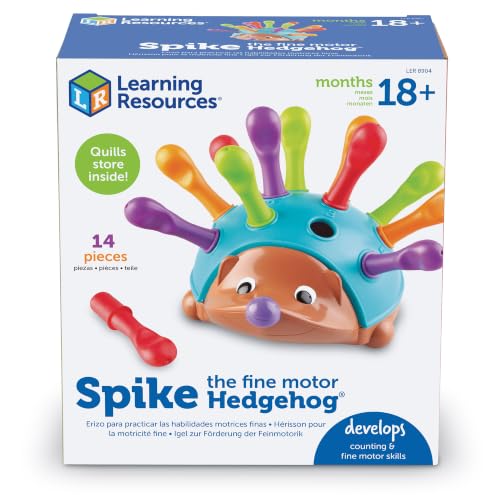
Learning Resources Spike The Hedgehog
What We Like
- Chunky peg-shaped pieces for small hands
- Builds color recognition, sorting, and counting
- Quills store inside hedgehog for easy cleanup
- Includes activity guide for structured play
Trade-offs
- Only 12 quills limits variety for older toddlers
- No threading or lacing component for advanced fine motor work
Twelve chunky, peg-shaped quills that fit into the back of a friendly hedgehog give little fingers exactly the kind of grip-and-release practice they need to build fine motor control. The pieces are just the right size for toddler and preschool hands, so you won’t watch your child struggle with parts that are too small or too slippery. That straightforward action, pushing each quill into its hole, also sneaks in color sorting and counting, turning what feels like a game into a solid developmental exercise.
Once a child masters pushing those twelve quills in and out, there isn’t much more complexity to grow into. For a child already ready for sequencing and hand-eye coordination work, a product like the Melissa & Doug Primary Lacing Beads offers a different kind of challenge. Still, for the toddler years, especially if you’re looking for something that stores neatly, this hedgehog delivers exactly what it promises.
Product photos
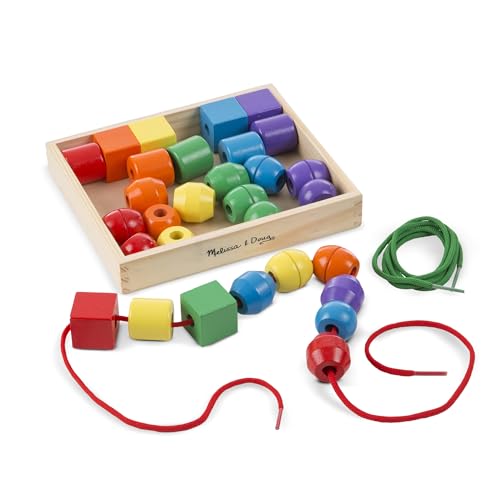
Melissa & Doug Primary Lacing Beads
What We Like
- 30 colorful wooden beads for variety
- 5 shapes easy for small hands
- Includes storage case for tidy play
- Develops fine motor and hand-eye coordination
Trade-offs
- Only 2 laces can limit group play
- No shoe-tying practice like the Deluxe Lacing Sneaker
Thirty painted wooden beads in five distinct shapes give a toddler plenty of variety to sort, grasp, and thread, exactly the kind of repetitive practice that builds fine motor control and hand-eye coordination. The set includes two laces and a wooden storage case to keep everything contained when playtime ends. This set suits parents who want a classic activity that helps build fine motor, cognitive, and visual perception skills through fun, hands-on play for children ages 3 to 5.
The Melissa & Doug Primary Lacing Beads set comes with 30 colorful wooden beads in assorted shapes, giving preschoolers plenty of variety for threading and sorting play. The thin laces fit through each bead easily, so little hands can grasp and thread them without frustration. However, the set includes only two laces, which means if more than one child wants to play at the same time, they’ll have to take turns or you’ll need to buy extra laces separately.
Melissa & Doug Deluxe Lacing Sneaker

What We Like
- Wooden high-top shoe for durability
- Extra-long lace for easy practice
- Teaches real-life shoe tying skill
- Encourages independence and fine motor skills
Trade-offs
- Single-skill toy focuses only on lacing and tying
- Wooden shoe is not adjustable for different foot sizes
A wooden high-top sneaker with an extra-long lace gives kids a sturdy, realistic platform to master shoe tying. The solid construction means it won’t slide around or collapse like a flimsy fabric trainer, so little fingers can focus on loops and pulls without fighting the shoe. This is the pick for families who want a dedicated, no-nonsense tool for that specific milestone, especially if your child is determined to learn but keeps getting frustrated with floppy sneakers.
This wooden sneaker focuses on one skill: shoe tying. It does that well, but it won’t offer the variety of, say, the Melissa & Doug Primary Lacing Beads, which let kids practice threading with different shapes and colors. If your goal is broader fine motor development beyond knot tying, you might want a more versatile option. But for focused shoe tying practice, this wooden sneaker delivers exactly what it promises.
Fat Brain Toys SpinAgain Stacker

What We Like
- Chunky rainbow discs for small hands
- Spinning action builds hand-eye coordination
- Reversible wobble base adds challenge
- Lift pole for clattering reset play
Trade-offs
- Only 6 discs limit stacking variety
- Base wobbles on uneven surfaces
Six graduated discs that spin down a corkscrew pole give toddlers a satisfying cause-and-effect loop that builds fine motor skills with every drop. The chunky pieces are sized for small hands, and the reversible wobble base keeps the challenge fresh whether they stack big-to-small or small-to-big. This is a toy that rewards repetition without boring the adult who has to watch it happen. The clatter when you lift the pole off the base resets the whole thing in one motion, so play can start again immediately. It suits curious one-year-olds who are ready for more than a simple ring stacker but still need something safe and BPA-free.
The six discs are a focused set, which means children who want a larger variety of pieces might find it limited. The coated ABS plastic is easy to clean, but it does not have the natural feel of wood. The SpinAgain’s spinning motion and reset feature are unique among the products in this guide, offering a cause-and-effect experience that other stackers do not provide. For a toddler who enjoys watching objects spin and hearing them fall, this toy provides a repeatable activity that supports coordination development.
Product photos
TOP BRIGHT Magnetic Bird Feeding Game

What We Like
- Two play modes for extended engagement
- Non-toxic paint and smooth edges
- Builds hand-eye coordination and finger control
- Teaches color recognition and counting
Trade-offs
- Only one magnetic woodpecker limits group play
A 7.5-inch wooden tree with magnetic worms lets a toddler sit comfortably and practice hand-eye coordination and finger control without stretching or frustration. The woodpecker tool encourages precise wrist movement and finger control, exactly the kind of dexterity work that helps develop fine motor skills. Two play modes keep the activity fresh: upright for standard retrieval and upside-down for a new angle challenge. This is a focused, screen-free fine motor workout disguised as a nature story, ideal for a 2- to 4-year-old who needs structured play with a clear goal.
This compact, skill-focused toy measures 7.5 inches long and weighs just 1 pound, so it’s easy to tuck into a diaper bag or store on a shelf. Because it comes with a single magnetic woodpecker, it’s best for one child at a time, ideal for quiet, parent-guided play rather than keeping two toddlers busy simultaneously. Compared to the Melissa & Doug Primary Lacing Beads set, which includes 33 pieces, the bird game is more about targeted fine-motor practice than open-ended group activity.
Product photos
Fat Brain Toys Tobbles Neo Stacker

What We Like
- Weighted spheres wobble and spin
- Encourages sensory exploration and coordination
- Safe, BPA-free ABS plastic
- Wipe-clean maintenance
Trade-offs
- Largest sphere only 4 inches diameter
- No storage case for keeping spheres together
Six weighted spheres that wobble, spin, and stack mean this toy turns every little push into a lesson in cause and effect. The largest sphere measures 4 inches across, so tiny hands can wrap around it easily, while the weighted bases keep each piece from rolling away too fast. For babies starting at six months, it builds fine motor control through pure play, no batteries, no screens, just the satisfying wobble of a sphere that refuses to stay still. That sensory feedback is exactly what developing brains need to connect action with reaction, and the ABS plastic construction holds up to the inevitable drops and throws.
The weighted spheres wobble and spin, so a baby can knock them over and watch them rock, which teaches balance and spatial awareness through movement. The plastic surface wipes clean easily, a practical benefit for a toy that will be drooled on and dropped. While a wooden lacing set offers a different kind of play, this stacker’s dynamic motion is something a static toy simply can’t provide.
Product photos
Learning Resources Fine Motor Feeding Friends

What We Like
- Strengthens pincer grasp with tweezers
- Supports counting, sorting, and matching
- 39-piece set for varied play
- Suitable for home, classroom, and therapy
Trade-offs
- Tweezers require fine motor control some toddlers lack
- Small pieces pose choking hazard for children under 3
The 39-piece set includes animal bowls, colorful food pieces, and fine motor tweezers that help children build the pincer grasp as they pick up food. That repeated motion strengthens hand coordination and dexterity through a feeding activity that supports fine motor development. It also encourages counting, color recognition, and shape matching, so early math skills get a workout alongside motor skills. For parents or therapists looking for a tool that combines fine motor work with imaginative play, this set offers a structured way to build those skills.
The tweezers require a fair amount of control, so a child who still struggles with basic grasping may get frustrated before they build up to it. Compared to the Melissa & Doug Primary Lacing Beads, which involve threading and lacing, this set focuses on the pincer grip through a feeding game. If your child enjoys pretend feeding, this will likely engage them; if they need a simpler fine motor activity, you might consider a different option.
Product photos
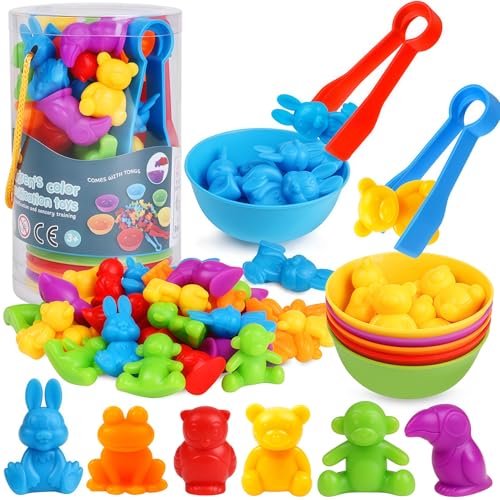
Skrtuan Counting Animals Sorting Set
What We Like
- 36 colorful forest animals included
- Soft rubber material is washable and durable
- Comes with 2 large tweezers for grasping practice
- Stimulates color recognition and early math skills
Trade-offs
- Tweezers require developed hand strength for effective use
- No included storage bag or lid for the box
With 36 different colored forest animals, six sorting bowls, and two oversized tweezers, this set turns color matching and counting into a hands-on challenge that builds fine motor control. The rubber material is softer and more durable than typical plastic, and it’s washable, a practical detail when toys end up in sticky hands or on the floor. It’s especially suited for preschoolers who need practice with picking up, grasping, and releasing small objects, and the bright animal shapes keep them engaged while they learn to sort and count. The set comes in an easy-to-store box, so it works well for both classroom centers and home playrooms.
Because the set’s many small pieces demand supervision around toddlers who still mouth objects, and the tweezers require a fair amount of hand strength, some three-year-olds may need help at first. For a child who’s ready to work on pincer grasp and early math concepts together, it’s a well-rounded pick that keeps them coming back to the bowl.
Product photos
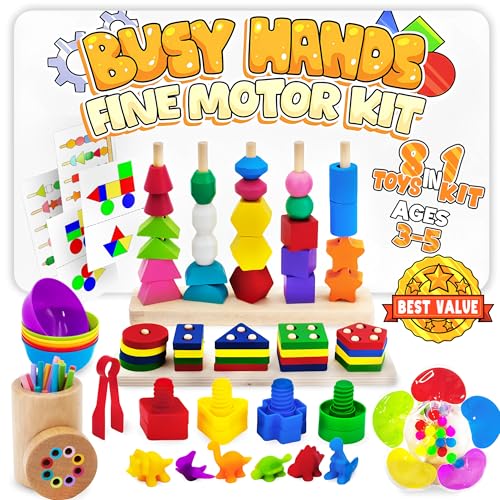
WIZZLY 8-in-1 Busy Hands Fine Motor Skills Kit
What We Like
- 8 distinct Montessori activities in one set
- Natural wood with non-toxic BPA-free paints
- Builds logic, sequencing, and spatial awareness
- Includes color sorting, stacking, and shape puzzles
Trade-offs
- Small pieces require adult supervision for younger toddlers
- Compact 5-inch box limits play surface for larger builds
Eight activities in one wooden set give you sorting, stacking, shape puzzles, and a string toy, so you don’t need to buy separate toys for each skill. The natural wood with non-toxic paints is safe for kids and holds up to regular play. For parents who want a single box that covers multiple fine-motor and early STEM skills, this kit offers a lot of variety in a small package.
The compact size means the pieces are small, so they’re best for focused tabletop play with a child who’s ready for matching bolts by hole count or stacking by color. The set delivers a wide range of activities in a small footprint, making it a good choice for families with limited space.
Product photos
Oomloid Counting Animals Montessori Toys

What We Like
- 36 colorful animals in 6 types
- 2 tweezers for pincer grasp practice
- Storage bucket for easy cleanup
- Non-toxic, washable materials
Trade-offs
- Only 2 tweezers limit group play
- Bowls are plastic, not textured
With 36 animals, 6 sorting bowls, and 2 tweezers, this set gives you enough pieces to keep a preschooler busy matching colors and counting while building the pincer grip that leads to better handwriting. The tweezers are a tool for picking up the animals, which helps develop fine motor skills through repeated grasping. Parents and teachers report it works well as a structured activity that feels like a game.
The tweezers are the main draw, and there are only two of them. If you’re running a small classroom or have siblings playing together, you’ll want to rotate turns or grab an extra pair. The included bucket helps with storage, but it’s still a set that works best when you have a dedicated play space and a little patience for cleanup.
Product photos
How We Evaluated Fine Motor Toys
We started with the basics: what does the toy actually ask a child to do? We examined specifications like piece size, material, and the specific hand motion required, pincer grasp, palmar grasp, twisting, threading, or stacking. Manufacturer documentation told us the intended age range and safety certifications. Then we cross-referenced those claims with patterns in owner feedback to see which toys held up in real homes.
Three criteria mattered most. First, the toy had to target a specific fine motor skill, whether that was the pincer grasp, hand-eye coordination, or bilateral coordination. Second, the pieces needed to be sized appropriately for the target age; a toy for a one-year-old should have chunky pieces that are impossible to choke on, while a toy for a four-year-old can include smaller parts. Third, we looked for replay value. Toys that offer multiple ways to play or that can be used in structured and unstructured settings fit the bill.
An evaluation like this one has honest limits. We cannot report on long-term durability or how a specific child will react. What we can do is synthesize the information to help you narrow down your options. If you want to see more curated options, our guide to fine motor toys for toddlers covers additional picks for that specific age group.
What To Look For In Fine Motor Toys
Choosing the right fine motor toy means matching the activity to your child’s developmental stage and your family’s play style. Here is what matters most.
Look for toys that target one specific hand motion, pincer grasp, palmar grasp, or bilateral coordination, and match the piece size to your child’s age. Avoid sets with too many small parts for toddlers under three.
Skill Target and Hand Motion
Every fine motor toy works a different muscle group. A pincer grasp toy, like the tweezers in the Learning Resources Fine Motor Feeding Friends set, strengthens the thumb and index finger for writing readiness. A palmar grasp toy, like the chunky discs on the Fat Brain Toys SpinAgain Stacker, builds whole-hand strength. Bilateral coordination toys, like lacing beads, require both hands to work together. Pick the skill your child needs most right now.
Piece Size and Safety
Choking hazard rules are not arbitrary. For children under three, every piece must be larger than a toilet paper tube. The Learning Resources Spike The Hedgehog passes this test easily with its twelve oversized quills. The Skrtuan Counting Animals Sorting Set, by contrast, includes small animal figures that require supervision for younger toddlers. Always check the manufacturer’s age recommendation and the physical size of the smallest piece before buying.
Replay Value and Open-Ended Play
The best fine motor toys offer more than one way to play. The WIZZLY 8-in-1 Busy Hands Fine Motor Skills Kit includes eight distinct Montessori activities, from color sorting to shape puzzles, so a child can return to it for weeks. Open-ended toys like the Melissa & Doug Primary Lacing Beads let children create their own patterns and sequences. A toy that only does one thing will be abandoned faster than one that invites creativity.
- Check that the toy’s smallest piece is larger than your child’s fist if they are under three.
- Look for toys with multiple play modes or activity guides to extend engagement.
- Choose materials that match your cleaning tolerance, wood wipes down, rubber washes in the sink.
- Read owner feedback for notes on durability, especially for toys with moving parts or small connectors.
- Consider whether the toy works for solo play, group play, or both, based on your household.
A good rule of thumb: if you cannot think of three different ways your child might play with a toy, keep looking.
Fine Motor Toys Compared
The table below compares all ten fine motor toys side by side, so you can see at a glance which ones target the skills your child needs most.
| Product | Age Range | Pieces | Dimensions | Weight |
|---|---|---|---|---|
| Learning Resources Spike The Hedgehog | Toddler and preschool | 12 quills, 2-piece hedgehog | 10 x 10 x 4 inches | 0.1 pounds |
| Melissa & Doug Primary Lacing Beads | Ages 3-5 | 30 painted wooden beads, 2 laces | 8.8 x 7.3 x 1.3 inches | 1.3 pounds |
| Melissa & Doug Deluxe Lacing Sneaker | Ages 3+ | Wooden shoe, extra-long lace | 5.1 x 3.6 x 8.3 inches | 0.8 pounds |
| Fat Brain Toys SpinAgain Stacker | 12 months and up | 6 discs, wobble base, corkscrew pole | 16.5 x 6.8 x 6.8 inches | 1.4 pounds |
| TOP BRIGHT Magnetic Bird Feeding Game | 2-4 years | N/A | 7.5 x 4.3 x 3.3 inches | 1.0 lb |
| Fat Brain Toys Tobbles Neo Stacker | 6 months+ | 6 weighted spheres + base | 5.9 x 5.1 x 11.0 inches | 1.5 pounds |
| Learning Resources Fine Motor Feeding Friends | 3+ years | 39 | 10 x 8 x 3 inches | 1.4 pounds |
| Skrtuan Counting Animals Sorting Set | 3-5 years | 36 animals + 6 bowls + 2 tweezers | 3.7 x 3.7 x 6.3 inches | 0.7 pounds |
| WIZZLY 8-in-1 Busy Hands Fine Motor Skills Kit | 3-5 years | N/A | 5.0 x 3.0 x 1.0 inches | N/A |
| Oomloid Counting Animals Montessori Toys | 3-5, 4-8 years | 36 animals, 6 bowls, 2 tweezers | 5.9 x 3.1 x 3.1 inches | N/A |
Frequently Asked Questions
What are fine motor toys?
Fine motor toys are playthings designed to strengthen the small muscles in a child’s hands and fingers. They typically involve grasping, pinching, threading, stacking, or twisting motions that build coordination and dexterity. Examples include lacing beads, peg puzzles, stacking rings, and tweezers games.
At what age should I start fine motor toys?
Babies as young as six months can start with sensory stacking toys like the Fat Brain Toys Tobbles Neo Stacker, which encourages grasping and coordination. By twelve months, most children can handle chunky peg toys. Around age three, children are ready for tweezers-based games and lacing activities that require more precise finger control.
What is the difference between fine motor and gross motor skills?
Fine motor skills involve small muscle movements in the hands, fingers, and wrists, things like writing, buttoning, and picking up small objects. Gross motor skills involve large muscle groups for activities like running, jumping, and climbing. Both are important for child development, but fine motor toys specifically target hand dexterity and coordination.
How do I know if a fine motor toy is too hard for my child?
If your child becomes frustrated and gives up within a minute or two, the toy may be too advanced. A good sign of the right difficulty level is when your child tries repeatedly, sometimes asking for help, but keeps coming back to the toy. You can also look for toys with adjustable difficulty, like the two play modes on the TOP BRIGHT Magnetic Bird Feeding Game.
Can fine motor toys help with handwriting readiness?
Yes. Toys that strengthen the pincer grasp, the same motion used to hold a pencil, are especially helpful for handwriting readiness. Tweezers-based games like the Learning Resources Fine Motor Feeding Friends and the Oomloid Counting Animals Montessori Toys directly build the thumb-and-index-finger coordination that writing requires. For more on this, see our guide to toys for fine motor skills.
The Bottom Line
For most families, the Learning Resources Spike The Hedgehog is the best overall fine motor toy because it combines chunky, easy-to-grasp pieces with color recognition and counting in a single self-contained set. The quills store inside the hedgehog, which means no lost pieces and no mess. It is ideal for toddlers who are just beginning to build hand strength and coordination.
If your child needs more targeted practice, the Melissa & Doug Deluxe Lacing Sneaker is the best choice for mastering shoe tying. The Fat Brain Toys SpinAgain Stacker offers a unique spinning motion that builds hand-eye coordination. For older preschoolers, the WIZZLY 8-in-1 Busy Hands Fine Motor Skills Kit provides enough variety to keep a three- to five-year-old engaged across multiple sessions.
The single most important factor when buying a fine motor toy is matching the hand motion to your child’s current skill level. A toy that targets the right muscle group at the right difficulty will hold their attention long enough to actually build strength and coordination. If you are still unsure where to start, our guide to how to choose toys walks through the decision process step by step.
