
10 Best Educational Toys For 7 Year Olds in 2026
This post contains affiliate links. As an Amazon Associate, we earn from qualifying purchases.
The LeapFrog Magic Adventures Globe is our Best Overall pick for 7-year-olds because it combines BBC video content with interactive quiz games that make geography genuinely engaging. For kids who need math practice, the Clever Fox Play Number Hunter Math Board Game earns Best Math Skills Builder, while the Learning Resources STEM Explorers Brainometry takes Best Brain Teaser for spatial reasoning.
Seven-year-olds are at a sweet spot where they can handle more complex rules and longer attention spans, but they still need play to feel like play. The best educational toys for this age build on classroom skills without feeling like homework.
We built this guide by analyzing manufacturer specifications, expert round-ups, and patterns in owner feedback across ten top contenders. Each pick earned its award for a specific learning strength, so you can match the toy to your child’s interests and needs.
Top 10 Educational Toys For 7 Year Olds in the Market
Certain content that appears on this site comes from Amazon. This content is provided "as is" and is subject to change or removal at any time.
The Best Educational Toys For 7 Year Olds, Reviewed
LeapFrog Magic Adventures Globe

What We Like
- BBC video content on globe
- Interactive quiz games
- Stylus for touch exploration
- Covers cultures and habitats
Trade-offs
- Requires 4 AA batteries for use
- 2.8-inch screen is small for group viewing
- Demo batteries included; new ones needed
A 2.8-inch video screen built into a globe lets kids aged 5 and up watch BBC clips about cultures, animals, and habitats while tapping the stylus on countries. That combination of touch exploration and visual content turns geography into an engaging activity rather than a dry lesson. It’s designed for children who want to learn about the world through facts and videos, going beyond just memorizing capitals.
The 2.8-inch screen is best for one or two kids at a time, so it’s a solo or one-on-one activity rather than something a group can crowd around. You’ll want fresh AA batteries ready, since the ones in the box are just for demo. Compared to the ThinkFun Roller Coaster Challenge, which focuses on building and physics, this globe offers a screen-based geographic experience with interactive games. It suits a child who enjoys learning through videos and facts.
Clever Fox Play Number Hunter Math Board Game
What We Like
- Teaches addition, subtraction, even/odd numbers
- Screen-free, hands-on STEM play
- Easy to learn with dice and challenges
- Durable, non-toxic materials
Trade-offs
- Game board is 9.2 inches square, small for group play
- No expansion or advanced math levels included
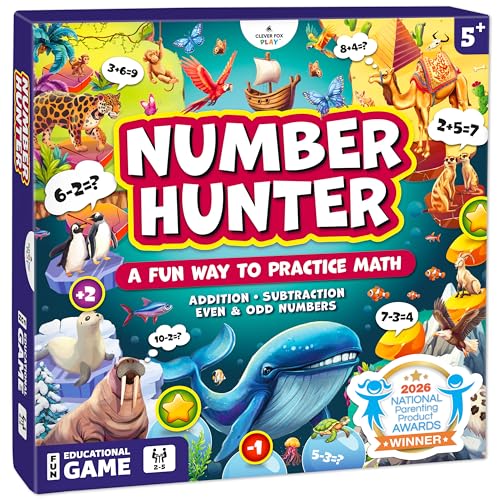
At just 9.2 inches square and 1.4 pounds, this board game is compact enough to toss in a bag for a road trip or pull out on a rainy afternoon. It turns addition and subtraction into a race around the world, with dice rolls and star-tile challenges that keep kids moving and thinking. For a 7-year-old who still needs to build fluency with basic math facts, the Number Hunter game offers a playful, stress-free way to practice without the groan factor of worksheets. It’s a natural fit for homeschool setups or family game night, where the goal is learning through doing rather than drilling.
The trade-off is that the math stays at a 5-to-7-year-old level, so a 7-year-old who’s already confident with basic addition and subtraction might find the challenges too easy after a few rounds. Compared to ThinkFun Math Dice Junior, which uses dice to create more flexible number combinations, this game is more structured and less open-ended. If your child needs repetition to lock in those basics, the Number Hunter board delivers. But if they’re ready to stretch into mental math or multi-step problems, you’ll want something that scales up. For the right kid, though, it’s a solid, screen-free way to build early STEM skills.
Learning Resources STEM Explorers Brainometry
What We Like
- 34 tactile puzzle blocks for hands-on learning
- 10 double-sided challenge cards with progressive difficulty
- Portable storage box keeps pieces organized
- Solo screen-free play builds concentration
Trade-offs
- Solo play means no built-in multiplayer or group mode
- Only 10 challenge cards limit variety after solving
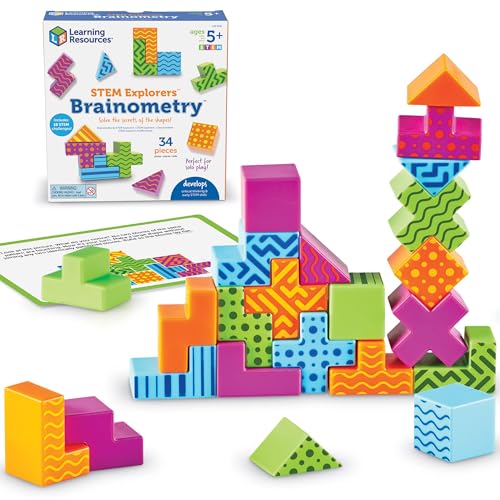
The 10 double-sided challenge cards offer progressive difficulty, so the puzzles stay engaging as kids develop their thinking skills rather than becoming too easy after a few tries. The 34 tactile puzzle blocks encourage hands-on pattern matching that builds spatial understanding and fine motor skills, all without a screen. It’s a focused, solo activity that rewards patience and logic, making it a strong fit for kids who enjoy working through a puzzle at their own pace.
While the ThinkFun building game is for ages 6 and up, this set is a solo puzzle activity that uses tactile blocks and double-sided challenge cards. The 34 pieces are sturdy and lightweight, and the included storage box keeps everything organized for travel or classroom use. Reviewers note that the progressive difficulty on the 10 cards helps children build spatial understanding and fine motor skills without needing a screen. It’s a focused brain game that encourages critical thinking and logic through pattern matching, making it a quiet, independent option for kids as young as 5.
Product photos
Learning Resources Pixel Art Challenge
What We Like
- 40 progressive challenges build skills
- 400 durable foam pieces included
- Teaches coding concepts without screens
- Strengthens fine motor skills
Trade-offs
- Small 5.5-inch tray limits large designs
- No storage for loose pieces included
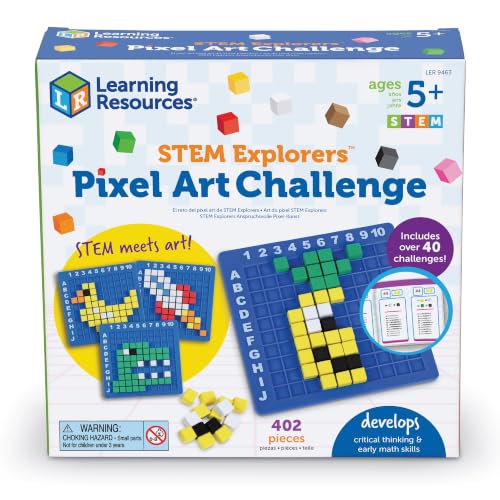
The 40 progressive challenges mean your child starts with simple patterns and works up to more complex puzzles. This builds spatial reasoning and problem-solving step by step. It teaches coding concepts and math skills through tactile play, not a glowing screen. With 400 foam pieces and a sturdy tray, it’s built for repeat use, and the fine motor workout from placing those little squares is a bonus for any child ages 5 and up still refining their dexterity.
The tray is only 5.5 inches square, so your kid can’t build sprawling pixel art or multi-board designs without frustration. If you’re comparing it to the ThinkFun building set, that game offers a different building experience, but the Pixel Art Challenge focuses on screen-free logic practice. It’s best for kids who enjoy puzzles and patterns; not ideal for those who prefer free-form building or need a bigger canvas to stay engaged.
Product photos
ThinkFun Roller Coaster Challenge

What We Like
- Builds engineering, reasoning, and planning skills
- Combines logic game and building set
- Trusted brand with over 50 million sold
Trade-offs
- Requires adult setup for younger kids
This set blends a logic puzzle with a building experience, making it a natural fit for a child who enjoys figuring out how things work. The game board, posts, tracks, and car click together to form a working coaster, so the payoff is both solving the challenge and watching the car race down the track you built. Playing through the challenges builds engineering, reasoning, and planning skills without feeling like homework, which is exactly the kind of stealth learning parents appreciate.
Forty challenges, while solid, can be finished over time. Once your child works through all of them, the building set still offers open-ended play, but the structured puzzle element is done. Compared to something like the LEGO Classic Large Creative Brick Box, which has 790 pieces and no fixed endpoint, this is a more guided experience. That makes it a better choice for kids who thrive on clear goals and step-by-step problem solving, rather than pure free building. If your child loves logic puzzles and wants a tangible, moving result, this is a smart pick.
Osmo Creative Starter Kit for iPad

What We Like
- Teaches drawing, physics, and problem solving
- Real-time audio and visual feedback
- No WiFi needed for gameplay
- Includes Osmo Base and reflector
Trade-offs
- Requires an iPad (not included)
- Only works with iPads running iOS 15 or later
The Osmo Creative Starter Kit turns an iPad into a hands-on learning station where a child’s drawings come to life on screen. Three included apps. Monster, Newton, and Masterpiece, cover creative drawing, early physics, and step-by-step art instruction, so a 7-year-old gets a mix of storytelling and problem solving. The included Osmo Base and reflector let the iPad see and react to real-world movements, which means no WiFi is required during play. This makes it a strong pick for families who already own a compatible iPad and want a screen-based toy that still involves physical pieces and fine motor skills.
The biggest catch is the iPad requirement: if your child doesn’t already have access to one, you’ll need to factor that into your decision. The kit works only with iPads running iOS 15 or later. That said, the real-time audio and visual feedback and range of difficulty levels (beginner to expert) let children learn through experimentation in a stress-free environment. It’s a blend of digital engagement and tangible creativity.
ThinkFun Math Dice Junior Game

What We Like
- Enhances mental math skills
- Award-nominated educational tool
- Easy to learn with clear manual
Trade-offs
- Only dice-based, no physical pieces
- Limited to math skills, not creative play
At just 0.3 pounds and small enough to fit in a backpack, Math Dice Junior is the kind of game you can toss in a bag for a restaurant wait or a road trip without thinking twice. Designed for kids aged 6 and up, it focuses on mental math and cognitive agility through simple dice rolls and quick calculations. The clear instruction manual means you can start playing right away. The Toy of the Year nomination signals that educators and parents have taken notice. For a family looking to sneak in arithmetic practice without the groan factor, this is a smart, portable option that delivers real skill-building in a compact package.
The game is entirely dice-based, so there are no cards, boards, or physical pieces to manipulate, which might leave some kids wanting more tactile engagement. Compared to the Clever Fox Play Number Hunter game, which focuses on addition and subtraction, Math Dice Junior strips things down to dice rolls and quick calculations. That makes it ideal for on-the-go learning but less suited for a child who craves a hands-on, multi-component experience. If your seven-year-old thrives on quick mental challenges and you value portability, this is a lean, effective tool that delivers real skill-building.
LeapFrog LeapMove Active Learning Video Game System

What We Like
- 25 preloaded games and adventures
- Three learning levels for math and spelling
- Body movement as controller
- No batteries required
Trade-offs
- Upper age limit of 7 years
- Requires a TV with HDMI port
- Two-player games are additional downloads
With 25 preloaded games, a child can switch from soaring through numbers to catching letter orbs without ever needing a cartridge or download. The LeapMove system uses the child’s own body as the controller, flapping arms, jumping, and dodging, so learning happens through full-body movement rather than thumb taps. That physical engagement is a key reason it stands out in this guide: it works on math, spelling, and phonics across three difficulty levels. For a child who still has energy to burn after school, this bridges the gap between sitting still with a workbook and running around outside.
The system is intended for ages 4-7, so it’s a focused tool for preschoolers and kindergarteners rather than something that extends into later elementary years. Compared to the ThinkFun building game for ages 6 and up, the LeapMove requires a TV and HDMI connection, so it’s best for home use rather than on-the-go play. Still, for families who already have a television and want to channel a wiggly child’s love of video games into actual skill-building, this delivers exactly that: no batteries required, just plug in the included HDMI and USB cables and start playing.
Product photos
LEGO Classic Large Creative Brick Box
What We Like
- 790 pieces for open-ended building
- 33 colors encourage creative play
- Includes windows, doors, and wheels
- Storage bin keeps pieces organized
Trade-offs
- No step-by-step instructions for guided builds
- Lacks themed pieces for specific models
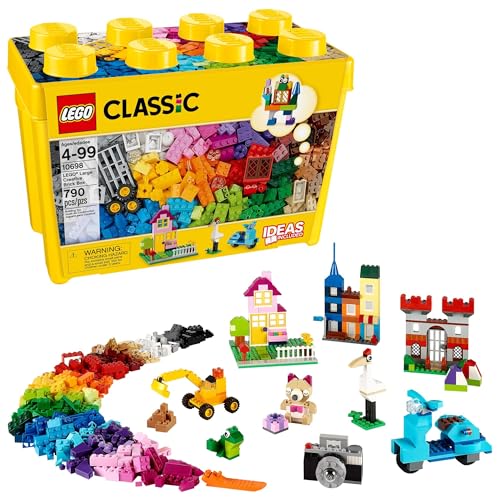
With 790 pieces in 33 different colors, this set gives a seven-year-old enough raw material to build anything from a castle to a scooter without running out of bricks mid-project. The mix of windows, doors, green baseplates, and wheel sets means the creations can actually look finished and functional, which keeps kids engaged longer than a box of plain blocks. It suits the child who prefers inventing their own designs over following a manual, and the included storage bin makes cleanup less of a battle for parents.
With 790 pieces in 33 colors, this set gives kids the freedom to build anything they can imagine, from a toy house to a scooter, without being tied to a single model. Unlike the LEGO Creator 3 in 1 Space Shuttle, which provides step-by-step instructions for specific builds, this box relies on a child’s own creativity and patience. It’s ideal for young builders who enjoy making up their own designs rather than following a guide.
Product photos
LEGO Creator 3 in 1 Space Shuttle

What We Like
- Three builds in one set
- Includes posable astronaut with jetpack
- Opening hatch with extendable satellite
- Digital building guide via app
Trade-offs
- At 0.2 lb, feels lightweight in hand
- 144 pieces limit the size of each model
Three distinct builds from a single box of 144 bricks means this set keeps a 7-year-old engaged long after the first model is finished. The space shuttle’s opening hatch reveals a removable satellite, and the alternate spaceship and posable astronaut each offer their own play scenarios. That variety suits kids who love to rebuild and imagine new missions, making it a smart pick for a space-themed gift that doesn’t get stale after one assembly.
The piece count is 144, which is lower than some other LEGO sets, so a child who builds quickly might finish all three options in a short time. But for a builder who wants a manageable project with multiple play possibilities, this set works well. The LEGO Builder app lets kids zoom, rotate, and view a digital version of their model on a smartphone or tablet as they build.
Product photos
How We Evaluated Educational Toys For 7 Year Olds
Our research method started with manufacturer specifications and documentation for each toy, then cross-referenced those claims with patterns found in expert round-ups and extensive owner feedback. We looked for toys that actually teach something, whether that is math facts, coding logic, spatial reasoning, or geography, rather than toys that just claim to be educational.
The three criteria that mattered most were skill alignment, replay value, and age fit. A toy that teaches addition is useless if a child has already mastered it, and a puzzle with only ten challenges gets solved and abandoned. We also checked whether each toy matched the developmental range of a typical 7-year-old, not a younger or older child.
An evaluation has honest limits. Individual results vary with every kid. What we can tell you is which toys consistently deliver on their educational promises based on the evidence available, and which trade-offs you should know about before buying.
What To Look For In Educational Toys For 7 Year Olds
The best educational toy for a 7-year-old matches their current skill level, holds their attention through genuine fun, and teaches something you want them to practice more.
Look for toys that align with what your child is learning in school, offer enough variety to stay interesting, and fit your family’s screen-time preferences.
Skill Alignment And Challenge Level
A toy that is too easy gets ignored; one that is too hard causes frustration. The best picks for 7-year-olds target first through third grade skills, addition and subtraction, basic coding logic, map reading, and simple engineering principles. The Clever Fox Play Number Hunter Math Board Game focuses on addition, subtraction, and even/odd numbers, which matches typical second-grade math. The ThinkFun Roller Coaster Challenge introduces engineering and planning at a level most 7-year-olds can grasp with a little adult help.
Replay Value And Variety
Kids this age solve puzzles quickly, so a toy with limited content gets shelved fast. Look for progressive difficulty, multiple modes, or enough pieces to create new challenges each time. The Learning Resources Pixel Art Challenge includes 40 progressive challenges and 400 foam pieces, giving plenty of room to grow.
The LEGO Classic Large Creative Brick Box offers 790 pieces and 33 colors with no fixed instructions, so every session is different. On the other hand, a set with only ten challenge cards, like the Learning Resources STEM Explorers Brainometry, may feel complete after a few sittings.
Screen Time And Format Preference
Some families want screen-free play, while others are comfortable with guided digital interaction. The Osmo Creative Starter Kit for iPad requires a compatible iPad and uses the screen as a feedback tool for drawing and physics lessons. The LeapFrog LeapMove Active Learning Video Game System connects to a TV and gets kids moving as they learn. For completely screen-free options, the ThinkFun Math Dice Junior Game and the LEGO Creator 3 in 1 Space Shuttle deliver learning without any display.
- Check whether the toy requires batteries, a tablet, or a TV before you buy.
- Look for storage solutions, some sets include bins or boxes, others leave you to supply your own.
- Read the age range on the box; a toy labeled for ages 6 and up may be too simple for a 7-year-old who is ahead.
- Consider whether the toy works for solo play, group play, or both, depending on your child’s social setting.
A toy your child actually wants to play with teaches more than one they feel forced to use.
Educational Toys For 7 Year Olds Compared
The table below compares all ten educational toys for 7-year-olds across key features, so you can see at a glance which one fits your child’s learning style and your family’s setup.
| Product | Age Range | Weight | Dimensions |
|---|---|---|---|
| LeapFrog Magic Adventures Globe | 5+ years | 2.9 pounds | L 11.1 inches, W 10.2 inches, H 0.0 inches |
| Clever Fox Play Number Hunter Math Board Game | 5-7 years | 1.4 pounds | 9.2 x 9.2 inches |
| Learning Resources STEM Explorers Brainometry | 5+ | 0.6 pounds | 10.0 x 9.0 x 4.5 inches |
| Learning Resources Pixel Art Challenge | Ages 5+ | 0.6 pounds | L 8.0 inches, W 8.0 inches, H 2.5 inches |
| ThinkFun Roller Coaster Challenge | 6 and Up | 1.3 pounds | L 11.0 inches, W 2.8 inches, H 11.6 inches |
| Osmo Creative Starter Kit for iPad | 5-10+ | 2.2 pounds | L 3.2 inches, W 12.0 inches, H 9.6 inches |
| ThinkFun Math Dice Junior Game | 6+ | 0.3 pounds | 5.1 x 1.8 x 7.0 inches |
| LeapFrog LeapMove Active Learning Video Game System | 4-7 years | 0.6 pounds | 2.8 x 2.6 x 2.6 inches |
| LEGO Classic Large Creative Brick Box | Ages 4-99 | 2.2 pounds | L 14.6 inches, W 10.3 inches, H 7.1 inches |
| LEGO Creator 3 in 1 Space Shuttle | 6+ | 0.2 lb | L 7.5 inches, W 5.6 inches, H 1.8 inches |
Frequently Asked Questions
What is the best educational toy for a 7-year-old who loves geography?
The LeapFrog Magic Adventures Globe is our Best Overall pick for geography-loving kids. It uses BBC video content and interactive quiz games accessed through a stylus to teach about countries, cultures, and habitats. The globe covers a wide range of topics that go beyond basic map skills.
Are there good educational toys for 7-year-olds that do not use screens?
Yes, several of our picks are completely screen-free. The Clever Fox Play Number Hunter Math Board Game and ThinkFun Math Dice Junior Game teach math through dice and cards. The Learning Resources STEM Explorers Brainometry and Learning Resources Pixel Art Challenge build logic and coding concepts with physical pieces only.
What math skills should a 7-year-old practice with toys?
Most 7-year-olds are working on addition, subtraction, and beginning to understand even and odd numbers. The Clever Fox Play Number Hunter Math Board Game targets exactly these skills through dice rolls and challenges. The ThinkFun Math Dice Junior Game is a simpler, portable option for quick mental math practice anywhere.
How do I choose between a building toy and a logic puzzle for a 7-year-old?
It depends on your child’s play style. Building toys like the LEGO Classic Large Creative Brick Box and LEGO Creator 3 in 1 Space Shuttle appeal to kids who enjoy open-ended construction. Logic puzzles like the ThinkFun Roller Coaster Challenge and Learning Resources STEM Explorers Brainometry suit children who prefer solving specific problems with clear goals.
What educational toys work well for siblings or group play?
The Clever Fox Play Number Hunter Math Board Game works as a family game with dice and challenges for multiple players. The LeapFrog LeapMove Active Learning Video Game System gets kids moving together, though two-player games require additional downloads. The LEGO Classic Large Creative Brick Box is great for collaborative building when multiple kids share the pieces.
The Bottom Line
The LeapFrog Magic Adventures Globe is the best overall educational toy for 7-year-olds because it turns geography into an interactive video experience that rewards curiosity. It is ideal for a child who loves facts, maps, and exploring the world from home. If your child needs math practice, the Clever Fox Play Number Hunter Math Board Game delivers screen-free repetition that actually feels like a game.
For families on a budget, the ThinkFun Math Dice Junior Game offers portable math practice for a low cost. Active kids who need to move will love the LeapFrog LeapMove Active Learning Video Game System, while builders will get the most mileage from the LEGO Classic Large Creative Brick Box.
The single most important factor is matching the toy to your child’s current skill level and natural interests. A toy that aligns with what they are learning in school and genuinely excites them will get played with, and that is where the real learning happens.
