
10 Best Educational Toys 18 Month Old in 2026
This post contains affiliate links. As an Amazon Associate, we earn from qualifying purchases.
The LeapFrog Learning Friends 100 Words Book earns our Best Overall spot because it builds vocabulary through expert-chosen, age-appropriate words in both English and Spanish, all without a screen. For hands-on play, the Fisher-Price Little People Caring for Animals Farm Playset delivers 45+ songs and learning levels, while the VTech Chomp and Count Dino strengthens fine motor skills through cause-and-effect feeding play.
An 18-month-old’s brain is wiring language, motor control, and social understanding at a staggering pace. The right toy meets them where they are, offering repetition, sensory feedback, and just enough challenge to hold attention without causing frustration.
This guide is research-based. We analyzed manufacturer specifications, expert recommendations on early childhood development, and patterns in owner feedback to find the 10 best educational toys for 18 month olds. Each pick targets a specific skill or play style so you can match the toy to your child’s current needs.
Top 10 Educational Toys For 18 Month Olds in the Market
Certain content that appears on this site comes from Amazon. This content is provided "as is" and is subject to change or removal at any time.
The Best Educational Toys For 18 Month Olds, Reviewed
LeapFrog Learning Friends 100 Words Book
What We Like
- 100+ age-appropriate words chosen by experts
- Bilingual English & Spanish mode
- Touch pages play words, sounds, and facts
- Light-up star button plays songs
Trade-offs
- Requires 2 AA batteries for regular use
- No physical moving parts for active play
- Screen-free but limited to book format
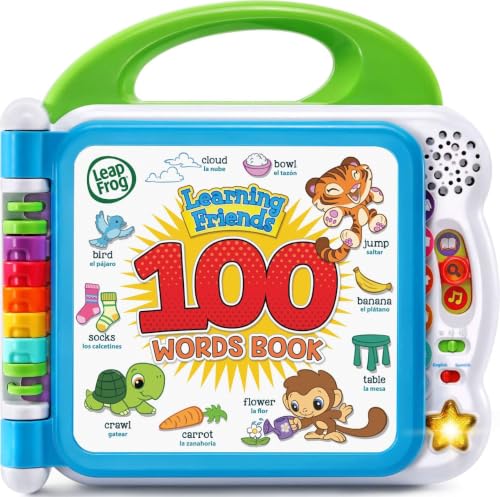
The LeapFrog Learning Friends 100 Words Book introduces more than 100 age-appropriate words chosen by learning experts, covering categories like pets, animals, food, colors, opposites, and more. Touching the words on the pages plays the word, a sound effect, and a fun fact, so each tap teaches something new without feeling like a lesson. The light-up star button plays the Learning Friends theme song and a ‘My Favorite Word’ jingle, giving a quick reward that keeps a toddler flipping back for more. Words, songs, and instructions are available in both English and Spanish for a full bilingual experience.
Weighing just 1.5 pounds, this book is light enough to toss in a diaper bag, so it’s easy to take along for vocabulary practice anywhere. It’s a sit-down, lap-friendly toy, not something a toddler chases around the room, but for focused word learning that also works in Spanish, it delivers. The bilingual mode supports families who want both languages from the start, and the durable build holds up to daily use.
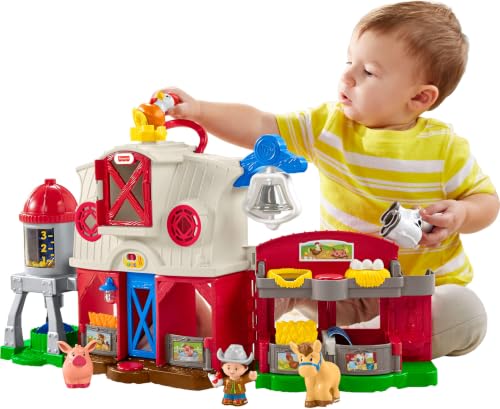
Fisher-Price Little People Caring for Animals Farm Playset
What We Like
- 45+ songs, sounds, and phrases
- 3 Smart Stages learning levels
- Multiple interactive play points
- Includes 1 farmer, 4 animals, 2 food pieces
Trade-offs
- Large footprint at 23.4 inches wide
- Only 1 farmer figure included
With over 45 songs, sounds, and phrases packed into one playset, this farm keeps little hands and ears busy. The 3 Smart Stages learning levels mean it grows with your child, teaching counting, opposites, animal sounds, and colors through fresh content at each stage. The multiple play points give plenty of variety to encourage pretend play for toddlers and preschool kids ages 1 to 5 years old. These include pressing the barn door button, dropping figures through the hayloft, turning on the barn light, hatching chicks, and popping corn in the spinning silo.
At 23.4 inches wide, this playset demands a fair amount of floor space, something to consider if your play area is tight. But for families with room, the interactive barn door button, hayloft drop, and spinning silo offer plenty of toddler-friendly play. The included farmer, four animals, and two food pieces are sized for small hands, which helps strengthen fine motor skills during pretend feeding and care.
Product photos
VTech Chomp and Count Dino
What We Like
- Pull-along design builds gross motor coordination
- 5 shape buttons teach shapes and numbers
- Volume control and auto shut-off included
Trade-offs
- Demo batteries included; replace for regular use
- No storage compartment for loose pieces
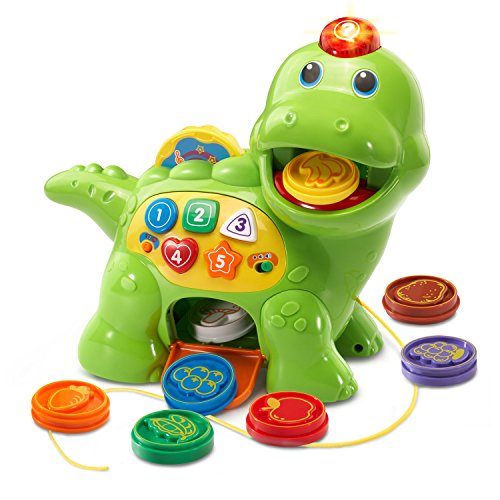
With 130+ songs, melodies, sounds and phrases inside a pull-along dinosaur, this toy turns feeding into a cause-and-effect learning game. The pull-along feature adds gross motor practice while the shape buttons and spinning disc keep little hands busy. It’s a well-rounded early learning center for a child who’s just starting to connect actions with outcomes, and the volume control means you can keep the noise level manageable.
The toy relies on just eight food pieces, so after a few sessions the novelty of feeding the dino might wear off faster than with a toy that offers more interchangeable parts. If your child loves cause-and-effect toys and is ready to practice grasping, dropping, and pulling, this is a strong pick. Not ideal for toddlers who need open-ended, less structured play or who tend to lose small pieces quickly.
Melissa & Doug Ms. Rachel Letter Number Blocks

What We Like
- 30 wooden blocks for varied play
- 14 double-sided activity cards included
- Embossed blocks help tactile learning
Trade-offs
- Cardboard storage box less durable than wood
- Blocks too small for some younger toddlers
With 30 wooden blocks and 14 double-sided activity cards, this set gives an 18-month-old plenty to explore without overwhelming them. The embossed letters and numbers add a tactile layer that helps little fingers connect shape to symbol, and the Ms. Rachel tie-in means the activities align with early speech and social-emotional milestones. It’s a sturdy, thoughtfully designed option for parents who want a classic block set that also supports language development and turn-taking during play.
The 30 wooden blocks include 26 embossed letter and number blocks plus 4 activity blocks, so the cards do a lot of the teaching work. Caregivers who enjoy sitting down and guiding play will get the most out of the set, since the learning relies on the 14 double-sided activity cards rather than any electronic feedback. It’s a hands-on choice for adults who want to be part of the play session.
Melissa & Doug First Bead Maze

What We Like
- Suction base keeps toy steady
- 18 beads and 3 rings for variety
- Soft-coated wires for safe play
- Strengthens fine motor control
Trade-offs
- Suction base needs smooth, flat surface
- Limited to bead maze play only
Four looping wires with 18 beads and 3 rings give little ones plenty to push, pull, and spin, building fine motor control and hand-eye coordination through simple cause-and-effect play. The suction cup base holds it steady on a high chair tray or table, so beads stay in reach and frustration stays low. For a classic toy that introduces shapes and colors without batteries or noise, this is the one that keeps little hands busy and learning naturally.
The bead maze is a single-activity toy, so once your toddler masters the beads, there’s no next level or new mode. Compared to other toys that offer varied play, the bead maze is quieter and more focused on physical skill. Best for parents who want a durable, screen-free option that strengthens dexterity and stays put during mealtime or floor play.
Learning Resources Snap-n-Learn Matching Dinos
What We Like
- Builds hand strength and dexterity
- Teaches color recognition through play
- Chunky pieces perfect for small hands
- Includes sturdy storage bucket
Trade-offs
- Only 9 pieces limit long-term engagement
- No sound or music features for auditory learning
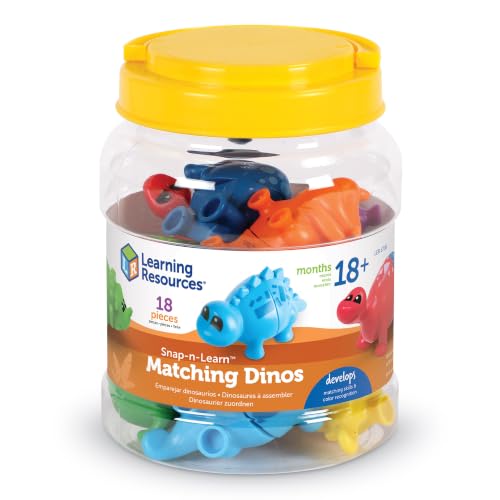
Nine colorful dinosaur halves that snap together make this a focused tool for teaching color matching and fine motor control. Each chunky piece is sized for 18-month-old hands to grip and pull apart, so little ones build hand strength naturally while sorting. The set reinforces color vocabulary through play, as described in the product features.
Nine dinosaurs keep the focus tight: color sorting and fine motor skills. Once a child masters matching, mixing the halves adds a little variety, but the activity stays narrow. This is a targeted skill builder, not an open-ended playset.
Product photos
VTech Touch and Teach Sea Turtle Book

What We Like
- 225+ songs, melodies, sounds and phrases
- Teaches letters, numbers, colors and weather
- Eight piano keys for music exploration
- Take-along size for on-the-go learning
Trade-offs
- Demo batteries included; new ones needed for regular use
- At 1.9 pounds, heavier than some portable toys
With over 225 songs, melodies, sounds and phrases packed into its interactive pages, this sea turtle book gives an 18-month-old a deep-sea full of vocabulary without needing a screen. The Explore, Letter, and Music modes cover letters, numbers, colors, weather, and a music scale on eight piano keys, so a single toy can grow with a toddler’s curiosity from first words to early counting. It suits families who want a durable, button-driven toy that rewards exploration with instant audio feedback, and the take-along size makes it easy to bring along for car rides or waiting rooms.
The VTech Touch and Teach Sea Turtle Book weighs 1.9 pounds, so it’s a bit heavier than the 1.5-pound LeapFrog Learning Friends 100 Words Book. But it offers eight piano keys for music play and covers sea creatures, weather, letters, numbers, and colors across multiple modes. Parents should plan on buying fresh AA batteries, since the included ones are only for demo use.
SMALL FISH Wooden Fine Motor Sorting Toy

What We Like
- Sturdy beechwood with smooth edges
- Bright rainbow colors for engagement
- Canvas drawstring bag for portability
- Develops fine motor and color sorting
Trade-offs
- Only one activity type (stick insertion)
- Noisy when sticks drop onto hard surfaces
The premium beechwood construction and smooth edges make this sorting toy safe for toddlers, with no sharp corners or burrs. The bright rainbow sticks are just right for little hands to grasp and push into the slots. This builds pincer grip and hand-eye coordination through a simple, repetitive motion that 18-month-olds genuinely love. It’s a straightforward tool for focused play that supports fine motor and color sorting skills.
This wooden toy focuses on a single skill: inserting sticks into matching slots. Once your child masters that motion, the novelty may fade faster than with a multi-play set like the Tiny Land Montessori 7-in-1 Adventure Kit, which offers shape sorting, lacing, and nesting dolls for variety. For a wooden option that nails the basics of fine motor development and color recognition, this is a smart pick. Not ideal for parents seeking a multi-activity set with longer-term engagement.
Product photos
Tiny Land Montessori 7-in-1 Adventure Kit
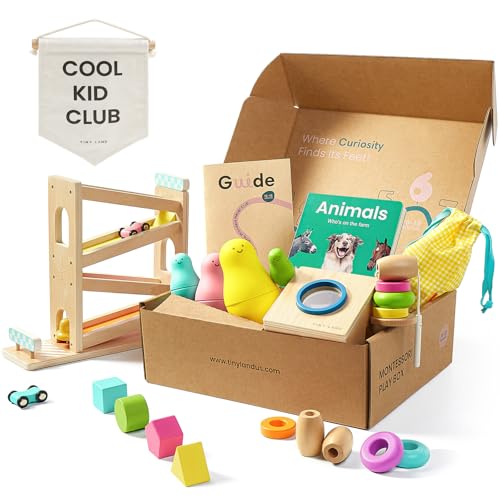
What We Like
- 7 diverse Montessori activities in one kit
- Includes shape sorting and color matching box
- Comes with a comprehensive parenting manual
- Designed for ages 16-18 months
Trade-offs
- No single toy for focused skill practice
- Includes a parenting manual, not a toy
This kit packs seven Montessori-inspired activities into one box, including a ramp race track, shape sorting and color matching box, lacing beads set, and an animals board book, all designed for toddlers 16 to 18 months old. That breadth lets a toddler rotate through different challenges without getting bored, and the included parenting manual gives you strategies to guide each activity. For a parent who wants a single, comprehensive set that covers multiple developmental areas, this kit delivers variety without cluttering the playroom.
No single activity in this set is as deep as a dedicated toy. The ramp race track, for instance, is one of seven pieces, so if your child becomes obsessed with cause-and-effect rolling, a standalone track might hold their attention longer. This kit spreads its focus across motor, sensory, and cognitive skills, making it ideal for a family that values variety over specialization and wants one box to grow with their toddler through the 16-18 month stage.
Product photos
WOODMAM Wooden Montessori 9-in-1 Play Kit

What We Like
- 9 diverse Montessori games in one box
- Natural wood with non-toxic water paint
- Develops motor skills, colors, shapes, music
- Encourages group play and language skills
Trade-offs
- At 5.7 lb, it's heavy for a toddler to carry
- 9 separate pieces can mean more cleanup
Nine distinct play activities packed into a single wooden box means this kit covers more developmental ground than most single-purpose toys. You get a coin box, carrot harvest game, color matching sticks, pounding bench, xylophone, shape sorter, stacking blocks, animal book and fruit book, all targeting the 13-18 month window when hand-eye coordination, color recognition, and problem-solving are taking off. The natural wood construction and non-toxic water paint give it a sturdy, safe feel that matches the Montessori approach of real materials over plastic. For a parent who wants one gift that rotates through different skills without buying five separate toys, this kit delivers variety in a single box.
The trade-off is weight and complexity. At 5.7 pounds, this is not a toy your 18-month-old will carry around the house, it lives where you set it, and you’ll be the one picking up the nine pieces after each session. Compared to the LeapFrog Learning Friends 100 Words Book, which is lighter and more portable for car rides or waiting rooms, this kit stays put but offers hands-on manipulation. If your child prefers dumping and sorting over tapping buttons, the WOODMAM gives them objects to grasp, pound, and match. Just plan for supervised play and a dedicated shelf.
Product photos
How We Evaluated Educational Toys For 18 Month Olds
We started with the developmental milestones typical for this age: emerging language, pincer-grasp refinement, cause-and-effect understanding, and the beginnings of pretend play. From there, we cross-referenced manufacturer claims with expert round-ups on developmental toys for 18-month-olds and patterns in parent-reported engagement. A toy that looked good on paper but consistently bored toddlers after one session didn’t make the cut.
Our four main criteria were skill targeting (does it teach something specific?), durability (can it survive a drop or a teething mouth?), engagement depth (does it reward repeat play?), and safety (no sharp edges, no choking hazards, non-toxic materials). For electronic toys, we also considered volume control and auto shut-off features.
A research-led evaluation has limits: we didn’t put these toys in front of a panel of toddlers. What we can do is synthesize what experts say about how children learn at this age with what thousands of owners report about real-world use. That combination gives you a reliable starting point for your own decision.
What To Look For In Educational Toys For 18 Month Olds
The best toy for an 18-month-old is one that targets a specific skill they’re working on: language, fine motor control, or cause-and-effect. It also needs to be durable enough to survive daily use and safe enough to leave within reach.
Look for toys that target one or two skills deeply rather than ten skills shallowly. An 18-month-old learns through repetition, so a simple toy they can master is better than a complicated one they ignore.
Skill Focus and Developmental Match
At 18 months, most toddlers are building vocabulary rapidly, refining their pincer grasp, and starting to understand simple sequences. A toy that teaches colors, shapes, or animal names aligns with their natural curiosity. The LeapFrog Learning Friends 100 Words Book, for example, uses touch-activated pages to reinforce word-object association, a method backed by early language development research.
Avoid toys that require skills your child hasn’t developed yet, like complex puzzles or multi-step instructions. Frustration shuts down learning. Stick to toys that offer a clear, simple interaction, press a button, drop a shape, pull a string, and reward it with immediate feedback.
Durability and Safety
Eighteen-month-olds test toys in ways engineers never anticipated: throwing, dropping, chewing, and stomping. Look for rounded edges, non-toxic finishes, and construction that won’t splinter or crack on impact. Wooden toys like the Melissa & Doug Ms. Rachel Letter Number Blocks should have smooth, sealed surfaces. Electronic toys should have secure battery compartments.
The SMALL FISH Wooden Fine Motor Sorting Toy uses sturdy beechwood with smooth edges, which is exactly what to look for. Avoid anything with small parts that could become choking hazards, and check that paint or finishes are labeled non-toxic.
Engagement and Longevity
A toy that holds attention for more than a few minutes is worth its weight in gold at this age. The best educational toys offer multiple ways to play, like the VTech Touch and Teach Sea Turtle Book with 225+ songs and phrases, so the toy doesn’t get boring after one session. But engagement doesn’t always mean electronic: the Melissa & Doug First Bead Maze uses a simple cause-and-effect loop that toddlers find mesmerizing.
- Does the toy offer more than one way to play?
- Can it grow with the child over several months?
- Is the interaction simple enough for independent play?
- Does it encourage repetition without becoming annoying to parents?
- Are there no small parts that could be swallowed?
If a toy doesn’t grab their attention in the first 30 seconds, it probably won’t get a second chance. Choose toys with bright colors, sounds, or movement to hook them immediately.
Educational Toys For 18 Month Olds Compared
The table below compares all 10 picks side-by-side so you can see at a glance which toy matches your child’s current needs and your family’s space and budget.
| Product | Age Range | Weight | Dimensions |
|---|---|---|---|
| LeapFrog Learning Friends 100 Words Book | 18+ months | 1.5 pounds | 9.4" x 9.2" x 1.9" |
| Fisher-Price Little People Caring for Animals Farm Playset | 1 to 5 years | 1.0 pounds | 23.4 x 5.3 x 7.3 inches |
| VTech Chomp and Count Dino | 1 to 3 years | 1.6 pounds | 11.4 x 10.0 x 4.9 inches |
| Melissa & Doug Ms. Rachel Letter Number Blocks | 18 months+ | 2.1 pounds | 3.1 x 9.1 x 10.3 inches |
| Melissa & Doug First Bead Maze | Ages 1+ | 1.2 pounds | 8.7 x 8.1 x 4.1 inches |
| Learning Resources Snap-n-Learn Matching Dinos | 18 months+ | 1.1 pounds | 5.7 x 5.7 x 7.5 inches |
| VTech Touch and Teach Sea Turtle Book | 12-36 months | 1.9 pounds | 2.6 x 14.2 x 10.5 inches |
| SMALL FISH Wooden Fine Motor Sorting Toy | 18 month old+ | N/A | N/A |
| Tiny Land Montessori 7-in-1 Adventure Kit | 16-18 months | N/A | 12.0 x 10.0 x 5.0 inches |
| WOODMAM Wooden Montessori 9-in-1 Play Kit | 13-18 months | 5.7 lb | 16.3 x 5.6 x 8.8 in |
Frequently Asked Questions
What is the best educational toy for an 18 month old?
The LeapFrog Learning Friends 100 Words Book is our Best Overall pick because it teaches over 100 age-appropriate words in English and Spanish through touch-activated pages, all without a screen. It’s ideal for quiet-time learning and vocabulary building.
What kind of toys help an 18 month old learn?
Toys that target specific developmental skills, language, fine motor control, cause-and-effect, or color recognition, are most effective. Look for interactive books, shape sorters, pull-along toys, and simple playsets with multiple learning levels, like the Fisher-Price Little People Caring for Animals Farm.
Are electronic toys good for 18 month olds?
Yes, when used appropriately. Electronic toys that teach letters, numbers, or animal sounds through touch and repetition can support language development. The key is choosing toys with volume control, auto shut-off, and screen-free interaction, like the VTech Touch and Teach Sea Turtle Book.
What is the difference between Montessori and traditional toys for toddlers?
Montessori toys emphasize self-directed, hands-on learning with natural materials, often focusing on one skill at a time. Traditional toys may include more electronic features and guided play. Both approaches have merit; the Tiny Land Montessori 7-in-1 Kit and the WOODMAM Wooden 9-in-1 Play Kit are good examples of Montessori-style options.
How many toys does an 18 month old need?
Quality matters more than quantity. A few well-chosen toys that target different skills, language, motor skills, pretend play, are more valuable than a large collection of similar items. Rotating toys every few weeks can also keep your child engaged without needing to buy more.
The Bottom Line
The LeapFrog Learning Friends 100 Words Book is the best educational toy for an 18-month-old who is ready to build vocabulary and explore language in a screen-free format. Its bilingual mode and expert-chosen word list make it a standout for parents who want intentional, quiet-time learning.
If your toddler needs active, whole-body play, the Fisher-Price Little People Caring for Animals Farm Playset offers 45+ songs and three learning levels that grow with them. For fine motor practice, the VTech Chomp and Count Dino turns cause-and-effect feeding play into a skill-building game.
The single most important factor in choosing an educational toy at this age is matching the toy to the specific skill your child is working on right now. Pick one area, words, motor control, or pretend play, and choose a toy that does that one thing well.
