
10 Best Card Games For Kindergarteners in 2026
This post contains affiliate links. As an Amazon Associate, we earn from qualifying purchases.
For kindergarteners, the Regal Games 272 Card Games set is our best overall pick because it packs six different games with extra-large cards that tiny hands can actually manage. For parents of younger three-year-olds, the Mattel Games UNO Junior Card Game offers animal-based matching, while Asmodee Spot It! Bluey Card Game is the top themed choice for fans of the show.
The challenge with this age group is finding a game that holds attention without frustrating a child who can’t yet read. Kindergarteners need clear visual cues, simple rules, and cards that survive being dropped, bent, or chewed.
We built this guide by researching manufacturer specifications, reviewing expert round-ups on early childhood play, and analyzing patterns in parent feedback. The result is a focused list of ten games that balance learning value with pure fun.
Top 10 Card Games For Kindergarteners in the Market
Certain content that appears on this site comes from Amazon. This content is provided "as is" and is subject to change or removal at any time.
The Best Card Games For Kindergarteners, Reviewed
Regal Games 272 Card Games

What We Like
- Six different games in one set
- Extra big cards for little hands
- Vibrant colors and easy symbols
- Builds memory and matching skills
Trade-offs
- No single game stands out for depth
- Pack is bulkier than single-deck options
Six classic games in one box means you get Old Maid, Go Fish, Slap Jack, Crazy 8’s, War, and Silly Monster Memory Match without buying separate decks. That variety alone makes this the most versatile pick for a kindergartener who’s still figuring out which games click. The extra-big cards are a real help for small hands that fumble with standard-sized decks, and the bright colors and simple symbols keep frustration low while they learn numbers, colors, and reading through play.
The trade-off is that the set’s contents can vary, so you might not get the exact mix you expect every time. Compared to Mattel’s UNO Junior, which offers a single game with three difficulty levels, this pack gives you more raw variety but less depth per game. It’s ideal for families who want a grab-and-go collection for road trips or sleepovers, where swapping games keeps things fresh. Just don’t expect each game to have the polish of a standalone title.
Mattel Games UNO Junior Card Game

What We Like
- Animal illustrations help non-readers match cards
- Three difficulty levels grow with the child
- Lightweight at 0.1 pounds for small hands
- Simplified UNO rules for ages 3+
Trade-offs
- Only 2-4 players limits larger groups
- Levels require adult setup to advance
- Action cards only appear at Level Two
The animal illustrations on every number card mean a child who hasn’t learned to count yet can still match colors and creatures. So the game works for a wider age range than most preschool card games. Three built-in levels let you start with simple color matching, then introduce action cards, and finally add penalty cards when the child is ready for more challenge. This design removes the reading barrier while keeping the core UNO turn-taking and matching that helps build early social skills.
The player count tops out at four, so it’s perfect for a small family or a playdate pair, but a larger preschool group will need something like Spot It! Bluey that handles up to eight. You’ll need to manage the level progression yourself, there’s no automatic ramp-up, so an adult decides when to add the action cards. For a first card game that grows with a child’s skills, this one fits the bill.
Product photos
Asmodee Spot It! Bluey Card Game

What We Like
- Fast-paced matching with Bluey characters
- Includes Bluey, Bingo, Bandit, and Chilli
- Comes in a collectible tin box
- Quick to learn for ages 4+
Trade-offs
- Tin box adds weight for small hands
The 15-minute playtime is just right for a kindergarten attention span, long enough to engage but short enough to avoid frustration. This fast-paced matching game uses symbols from Bluey and friends, so kids who love the show will immediately recognize Bingo, Bandit, and Chilli. The tin box edition makes it easy to toss in a bag for travel or store neatly on a shelf, and the simple rules mean you can explain it in under a minute. For families who want a themed game that actually gets played, not just displayed, this is a fun option.
The tin box edition makes this easy to toss in a bag for travel, though it adds a bit of heft compared to a standard card deck. While the Hoyle 6-in-1 pack gives you multiple classic games, Spot It! Bluey focuses on one matching mechanic but uses a popular theme that appeals to young fans. For a quick, themed matching game that plays up to eight players and lasts about 15 minutes, this is a fun option that won’t overstay its welcome.
Product photos
Hoyle 6-in-1 Kids Card Game Pack

What We Like
- Six classic games in one box
- Builds memory and matching skills
- Quick 15-minute rounds keep focus
- Simple rules for immediate play
Trade-offs
- No unique theme to stand out from singles
- Small box can be easy to misplace
Six classic games. Go Fish, Memory, Old Maid, Crazy Eights, Slap Jack, and Matching, come in one box, so you don’t need separate decks for each. Each game takes 15 minutes or less, which keeps young attention spans intact and makes cleanup quick. Simple instructions let kids start playing right away, and the variety prevents play from getting stale. The set is designed for classroom activities, travel, or game nights at home.
The set sticks to classic card games like Go Fish, Memory, and Old Maid, so there are no themed characters or monsters to hook a reluctant player. For families who want one box that covers multiple quick rounds, it’s a practical option. The compact size fits easily in a bag or drawer, but it’s small enough to misplace if you don’t keep a designated spot.
Big Monster Games Trash Monsters Card Game
What We Like
- Easy to learn in minutes
- Thick, durable cards for kids
- Vibrant original monster artwork
- Includes video tutorial
Trade-offs
- Only up to 4 players
- Number sequencing only 1-10
- Single game, not a multi-game pack
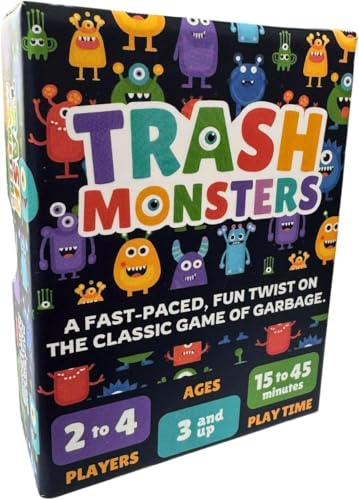
A number sequencing game that a three-year-old can learn in minutes makes this a rare card game that works for the youngest players. The thick, durable cards survive the inevitable drops and bends that come with little hands, and the vibrant monster artwork gives each card its own personality, so kids stay engaged while practicing counting. Families who want a fast-paced, no-fuss game that kids, teens, parents, and grandparents all love will find the video tutorial helpful for the first round.
The game supports up to four players and focuses on a single number-sequencing mechanic, so larger groups or kids seeking variety may outgrow it. Unlike the Regal Games 6-set pack, which includes multiple classic card games, Trash Monsters offers a dedicated experience centered on one simple, easy-to-learn rule set. Families who enjoy a repeatable game that’s quick to pick up will find it a good fit.
Exploding Kittens Monster Match

What We Like
- Builds counting and pattern skills
- Includes Monster Tower for dice rolling
- Designed for small hands
- Engaging for both kids and adults
Trade-offs
- Requires dice rolling, not purely card-based
- Only 50 cards, so limited variety for repeat play
Rolling dice into a Monster Tower to match silly monster parts is a hands-on way to teach counting and pattern recognition. The set includes 50 cards and two Monster Dice, and the tower is designed for small hands, so it’s accessible for four-year-olds. This matching game feels like active play while building preschool skills, making it a good fit for families who want learning woven into fun.
With 50 cards, the deck is smaller than some alternatives like the 56-card School Zone Slapjack Farm set, but Monster Match focuses on dice rolling and matching rather than just card play. That active element can keep kids engaged who enjoy movement during games. For families looking for a quick, pattern-based game that appeals to both children and adults, this one works well.
Product photos
School Zone Slapjack Farm Card Game

What We Like
- 56 cards for varied play
- Teaches counting and matching
- Farm animal theme engages young kids
- Compact size for travel
Trade-offs
- Only one game mode included
- Limited to ages 4 and up only
With 56 game cards focused on farm animals, counting, and matching, this deck gives kindergarteners targeted practice in early math and vocabulary without the distraction of multiple rule sets. The farm theme is a natural hook for little ones who already love barnyard animals, turning a fast-paced reaction game into a low-key learning moment. It’s a straightforward pick for parents who want a no-fuss card game that builds early number and word recognition while keeping the fun in the action.
The School Zone Slapjack Farm Card Game is a focused deck that plays exactly one game: Slapjack. If your child craves variety, the Hoyle six-in-one pack includes Slapjack along with five other games for a similar footprint. But for a family that wants a single, clean slapjack experience with a cohesive farm theme, this School Zone deck delivers exactly that without extra cards or instructions to sort through. Just be aware that the cards measure 3.2 by 6.2 inches, which is a compact size that some young players might find a bit small to hold.
DSS Games Farting Unicorns Go Fish
What We Like
- 13 hilarious card categories
- 5-15 minute rounds for quick replays
- Works for early and non-readers
- Pocket-sized for travel
Trade-offs
- Limited to 2-6 players
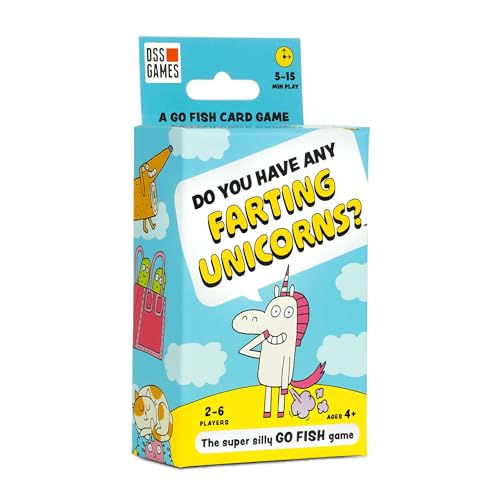
With 13 silly card categories like Farting Unicorns and Talking Toilets, this Go Fish variant adds a fresh twist to a classic game. Rounds last just 5-15 minutes, so you can play several in a row without losing attention spans. The bold illustrations let non-readers join in easily, making it a great pick for mixed-age groups or holiday travel where you want screen-free fun that everyone can follow.
The game’s 13 hilariously silly card types, like Farting Unicorns and Talking Toilets, make Go Fish outrageously fun, but the humor is squarely aimed at kids who love potty jokes. Compared to the Hoyle six-in-one Kids Card Game Pack, which offers six classic games like Go Fish and Old Maid, this one focuses on a single absurd twist rather than variety. If your family enjoys that specific flavor of silliness, it delivers quick 5-15 minute rounds that keep everyone giggling.
Product photos
School Zone Memory Match Farm Card Game

What We Like
- 56 cards for extended play
- Supports early reading and counting
- Includes vocabulary building
- Designed for ages 3 and up
Trade-offs
- Only one game mode (matching)
- Small card size for tiny hands
The School Zone Memory Match Farm Card Game comes with 56 cards in a deck that measures 3.2 by 6.2 inches, so it’s small enough to toss in a bag for on-the-go play. The farm theme ties into the listed skills, early reading, counting, matching, and vocabulary, making it a straightforward activity for preschoolers and kindergarteners. Parents looking for a quick, screen-free option will find it fits neatly into a diaper bag or on a coffee table, ready for a short round whenever a child needs a calm moment. It’s a focused matching game that does exactly what the box says, without extra frills.
The trade-off is that this deck is dedicated solely to memory matching. So if your child craves variety, they might tire of the single game mode faster than they would with a multi-game pack like the Hoyle six-in-one. The cards measure 3.2 inches in length, which some very young children may find a bit small to handle easily. But for a farm-themed memory challenge that targets the skills listed on the box, this deck delivers a straightforward experience.
Pressman Charades for Kids Card Game

What We Like
- Picture clues need no reading
- Three levels for mixed ages
- Gets kids moving and acting
- Fun for whole family together
Trade-offs
- Requires at least 3 players
- No reading practice for older kids
Picture-based clues mean even a four-year-old who hasn’t cracked a single letter can jump in and act out a charade alongside older siblings. That no-reading design is the whole point here: it lets non-readers participate fully while still sneaking in early reading reinforcement as they match pictures to words. Three levels of play keep it from being too easy for a six-year-old or too hard for a preschooler, so the same deck works across a wide age range during family game night. The game gets kids moving around as they have fun acting out clues, which is a nice break from sit-still card games.
You need at least three players to play, so this isn’t the game for a one-on-one afternoon with your child. But if you’ve got a group of kids ages four and up, the picture-based clues mean even non-readers can join in without frustration, while early readers still get a boost. It’s a clever way to get everyone laughing and moving together.
Product photos
How We Evaluated Card Games For Kindergarteners
Our research combined a close look at manufacturer documentation, insights from child development experts on early learning through play, and common themes in parent reviews. We cross-referenced what experts say about skill-building with what real families report about replay value and durability.
Three criteria mattered most. First, card size and durability: kindergarteners have small hands and limited fine motor control, so we prioritized games with oversized or thick cards that are easy to pick up and hard to tear. Second, visual independence from reading: every game on this list uses pictures, colors, or symbols so non-readers can play without an adult interpreting every card. Third, age-appropriate complexity: we looked for games with adjustable difficulty or very simple single-step rules, avoiding anything that requires counting above ten or multi-turn strategy.
A research-led evaluation has honest limits. We cannot speak to how a specific deck feels after fifty shuffle cycles, nor can we predict which silly theme will make your particular child laugh. What we can tell you is which games consistently earn praise for their construction and which ones families report playing again and again. For a broader look at what’s available, our guide to card games for kids covers more options for various age ranges.
What To Look For In Card Games For Kindergarteners
Finding the right card game for a kindergartener means balancing their current abilities with just enough challenge to keep them interested. The best games feel like play first and learning second.
Look for games with large, thick cards, picture-based matching instead of text, simple one- or two-step rules, and a theme your child already loves. Adjustable difficulty levels are a bonus for growing with the child.
Card Size and Durability
Standard playing cards are too small and too flimsy for most five-year-olds. The best kindergarten card games use cards that are at least 3 inches tall and made from thick stock or coated paper. This makes them easier to pick up, less likely to bend, and harder to lose under the couch. Games like the Regal Games 272 Card Games set use extra-big cards specifically designed for small hands.
Visual Design and Reading Independence
A kindergartener who cannot yet read should still be able to play independently. Look for games that use color-coded categories, animal illustrations, or simple symbols instead of written instructions. The Mattel Games UNO Junior Card Game replaces numbers with animal pictures so a three-year-old can match by sight. This independence builds confidence and reduces the need for an adult to interpret every turn.
Age Range and Difficulty Scaling
The best games grow with your child. Some sets offer multiple difficulty levels, like UNO Junior’s three stages, while others keep rules simple enough for a three-year-old but engaging enough for a six-year-old. Avoid games that require reading, complex scoring, or multi-turn strategy. If you are looking for more challenging options for when your child is ready, our list of card games for 7-year-olds covers the next step up.
- Check the recommended age on the box, but also read parent feedback about whether the game actually works for younger kids in that range.
- Look for games with at least 50 cards so there is enough variety for repeat play.
- Consider whether the game needs adult setup or if a child can grab it and start playing alone.
- Think about player count: many games cap at four players, which can leave a fifth child waiting.
A good rule of thumb: if the game takes longer to explain than to play, it is too complex for a kindergartener.
Card Games For Kindergarteners Compared
The table below compares all ten games at a glance, covering player count, age range, and the primary skill each game builds.
| Product | Age range | Players | Card size / dims |
|---|---|---|---|
| Regal Games 272 Card Games | 4 and up | 2-6 players | Extra big for small hands |
| Mattel Games UNO Junior Card Game | 3+ | 2-4 | L 0.8 inches, W 3.6 inches, H 5.7 inches |
| Asmodee Spot It! Bluey Card Game | Ages 4+ | 2-8 players | 3.5 x 6.8 x 1.0 inches |
| Hoyle 6-in-1 Kids Card Game Pack | 3+ | N/A | L 3.2 inches, W 8.8 inches, H 0.6 inches |
| Big Monster Games Trash Monsters Card Game | Ages 3 and up | Up to 4 players | 4.0 x 3.0 x 1.2 inches |
| Exploding Kittens Monster Match | 4+ | 2-6 | L 5.0 inches, W 3.0 inches, H 7.9 inches |
| School Zone Slapjack Farm Card Game | Ages 4+ | N/A | 3.2 x 0.9 x 6.2 inches |
| DSS Games Farting Unicorns Go Fish | 4+ | 2-6 | N/A |
| School Zone Memory Match Farm Card Game | 3+ | N/A | 3.2 x 0.9 x 6.2 in |
| Pressman Charades for Kids Card Game | 4 and up | 3 or more | 3.5 x 3.5 x 6.0 in |
Frequently Asked Questions
What card games can a kindergartener play alone?
Games with picture-based matching, like School Zone Memory Match Farm Card Game or Asmodee Spot It! Bluey Card Game, work well for solo play. These games rely on visual recognition rather than reading, so a child can flip cards or spot matches without needing an adult to interpret rules.
How many players do kindergarten card games need?
Most games on this list accommodate two to four players. The DSS Games Farting Unicorns Go Fish supports up to six, while Pressman Charades for Kids Card Game requires at least three. Check the player count before buying if you have a larger group or a single child who will play alone.
Are card games good for kindergarten learning?
Yes, card games build several kindergarten-ready skills. Matching games strengthen visual memory and concentration. Number-based games like Big Monster Games Trash Monsters Card Game reinforce counting from one to ten. Games with categories, like Go Fish variants, teach sorting and classification. For more structured learning tools, our guide to educational toys for kindergarteners offers additional options.
What is the easiest card game for a three-year-old?
The Mattel Games UNO Junior Card Game is designed for ages three and up, using animal illustrations instead of numbers so non-readers can match by sight. Its three difficulty levels let you start with the simplest rules and add complexity as the child grows. School Zone Slapjack Farm Card Game is another strong option for younger children.
Can kindergarteners play regular card games like Go Fish?
Yes, with some adaptation. Traditional Go Fish requires reading numbers, but many kindergarten-friendly versions replace numbers with pictures. The DSS Games Farting Unicorns Go Fish uses thirteen illustrated categories. That way a child can ask for a “farting unicorn” instead of a “seven.” For more family card games that work across age groups, see our full guide.
The Bottom Line
For most families, the Regal Games 272 Card Games set is the best starting point. Its six games, extra-large cards, and focus on memory and matching give a kindergartener variety without overwhelming them. It works for ages four and up and keeps multiple children engaged with different games in one box.
If your child is on the younger end of the spectrum, the Mattel Games UNO Junior Card Game offers a gentler introduction with its animal-based matching and three difficulty levels. For Bluey fans, the Asmodee Spot It! Bluey Card Game delivers fast, portable fun that requires no reading at all. Budget-conscious families will find strong value in the Hoyle 6-in-1 Kids Card Game Pack, which packs six classic games into one small box.
The single most important factor is whether your child can play independently. A game that needs an adult to read every card or explain every turn will sit on the shelf. Focus on picture-based, large-card games with simple rules, and you will find one your kindergartener reaches for again and again. For more ideas, our roundup of the best card games covers a wider range of ages and play styles.
