
7 Best Building Toys For Kids in 2026
This post contains affiliate links. As an Amazon Associate, we earn from qualifying purchases.
The 790-piece collection in 33 colors gives kids the freedom to build nearly anything they imagine, without being locked into a single theme. That’s why the LEGO Classic Large Creative Brick Box takes the Best Overall spot. For toddlers just starting out, the LEGO DUPLO Brick Box offers larger, safer pieces, while the MAGNA-TILES Classic 32-Piece Magnetic Construction Set introduces a different kind of building logic for ages 3 and up.
Every parent knows the struggle: you buy a toy, and within a week the kid has lost interest. Building toys avoid that trap because they change every time the child picks them up. What matters most is matching the piece size, quantity, and complexity to your child’s age and attention span. A 2-year-old needs chunks they can grasp, while a 7-year-old needs enough pieces to make something they’re proud of.
We built this guide by comparing specifications, reading manufacturer documentation, and looking at patterns in what owners actually say after months of play. We focused on safety, developmental fit, storage, and how well each set grows with a child. These seven picks cover the range from first blocks to serious builders.
Top 7 Building Toys For Kids in the Market

Certain content that appears on this site comes from Amazon. This content is provided "as is" and is subject to change or removal at any time.
The Best Building Toys For Kids, Reviewed
LEGO Classic Large Creative Brick Box
What We Like
- 790 pieces in 33 colors
- Includes windows, doors, baseplates, wheels
- Compatible with all LEGO sets
- Storage bin included
Trade-offs
- No minifigures or specialty pieces included
- 790 pieces can overwhelm younger kids without guidance
- Small bricks not suitable for children under 4
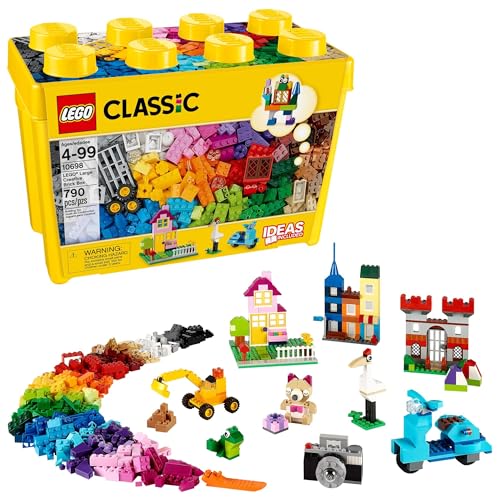
With 790 pieces across 33 colors, this set gives you the raw material for almost anything a kid can dream up, houses, vehicles, castles, you name it. The included windows, doors, two green baseplates, and wheel sets mean you don’t have to buy extra parts just to get started on a proper build. That breadth makes it the go-to starter kit for families who want one box that covers years of play, not just a single afternoon.
The trade-off is that you get quantity over specialization: no minifigures, no themed elements, just bricks and basic parts. The LEGO DUPLO Brick Box uses larger bricks for toddlers ages 1.5+, while this set’s standard-sized pieces are designed for ages 4-99, so it’s better suited for kids who have outgrown toddler building toys. For the piece count and included storage bin, this set provides a broad foundation for creative play.
LEGO DUPLO Brick Box
What We Like
- 65 larger bricks for little hands
- Includes car, figures, and flowers
- Number bricks teach 1-2-3
- Storage box keeps pieces tidy
Trade-offs
- Only 65 pieces limits large builds
- No advanced pieces for older kids
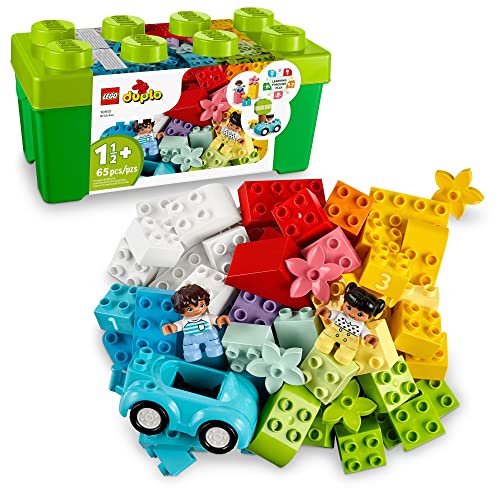
This 65-piece DUPLO set is designed for toddlers ages 18 months and up, with larger bricks that are easy for small hands to handle. It includes a toy car with moving wheels, windows, flowers, two figures, and number-learning bricks for 1-2-3. The set encourages imaginative play, helping build skills like hand-eye coordination, spatial awareness, and problem-solving. For a child just past their first birthday, this box provides a safe and engaging introduction to building.
The 65-piece count keeps builds simple, which is appropriate for the target age range of 18+ months. As children grow, they may want more pieces for larger creations. The LEGO Classic Large Creative Brick Box, with 790 pieces, offers more variety for older kids, but its recommended age starts at 4 years. For the toddler years, this DUPLO box is designed to be a safe and fun building experience.
Melissa & Doug 100 Wooden Building Blocks

What We Like
- 100 solid wood blocks
- 4 colors and 9 shapes
- Includes storage box with handle
Trade-offs
- Cardboard box less durable than plastic bins
- No instructions for guided builds
One hundred solid wood blocks in four colors and nine classic shapes means this set gives toddlers and preschoolers the raw material for towers, bridges, and whatever else they dream up. This is the set I’d point a parent toward who wants open-ended, screen-free play that builds fine motor skills and early math concepts like counting and sorting without any batteries or instructions.
The storage box is made of sturdy cardboard rather than plastic, so if a toddler sits on it or drags it around daily, it won’t hold up as long as the blocks. The LEGO Classic Large Creative Brick Box includes 790 pieces and a hard plastic bin, but for a child just learning to stack and knock down, the simplicity and natural materials of this set are a good fit.
Product photos
MAGNA-TILES Classic 32-Piece Magnetic Construction Set
What We Like
- Original magnetic building brand
- Certified STEAM toy for development
- Food-grade, non-toxic MABS plastic
- Pieces compatible with all MAGNA-TILES sets
Trade-offs
- Only 32 pieces limit larger builds
- No storage bag or box included
The 32-piece set includes translucent geometric shapes in six colors, offering just enough variety to introduce magnetic construction without overwhelming a three-year-old. The pieces are made from food-grade, non-toxic MABS plastic, so if a tile ends up in a mouth, there’s no panic. According to Dr. Gummer’s Good Play Guide, this certified STEAM toy supports fine motor skills, bilateral coordination, and cognitive development, all while kids just think they’re playing. For a first magnetic set, it strikes a balance between simplicity and open-ended creativity.
With only 32 pieces in the box, builders can quickly exhaust the supply once they master the basic shapes. Many families find themselves adding the 100-piece set soon after, particularly when multiple children want to collaborate on larger structures. The translucent geometric tiles come in six colors and include squares, equilateral triangles, right triangles, and isosceles triangles, so even this starter set offers variety for early creations. Parents report that the magnetic connections make assembly satisfyingly quick, which encourages repeated play but also accelerates the desire for more pieces. The set is certified as a STEAM toy for developing fine motor skills and creativity, making it a purposeful introduction to magnetic building.
MEGA BLOKS First Builders Deluxe Building Bag

What We Like
- 150 big blocks for open-ended play
- Easy to grip and stack for toddlers
- Includes storage bag for cleanup
- Special shapes add variety
Trade-offs
- Only 150 pieces limits complex builds
- Blocks are basic shapes, no figures or themed pieces
150 big blocks designed for little hands means a toddler can actually grip, stack, and pull them apart without frustration. That’s the whole point at this age, not intricate structures, but the sheer joy of connecting and knocking down. The set includes a storage bag for easy cleanup and special shapes to add variety, supporting open-ended play and fine motor development for children ages 1 and up.
Piece count and complexity are the main trade-offs here. With 150 blocks, you’ll run out of steam faster than with the 790-piece set aimed at ages 4 and up. For a toddler who still puts things in their mouth, the larger block size is the safer bet. You’re trading long-term expandability for immediate, age-appropriate usability, and for the first year or two of building, that’s exactly the right call.
Product photos
MAGNA-TILES Classic 100-Piece Magnetic Set

What We Like
- 100-piece set in 6 colors
- Food-grade, non-toxic MABS plastic
- STEAM-certified developmental toy
- Lattice prevents cracking, rivets secure magnets
Trade-offs
- 7.0 pounds is heavy for young kids to carry
- Only 4 large squares limit big base builds
- No storage box included for 100 pieces
With 100 translucent geometric shapes in six colors, this is the set that started the magnetic-tile craze, and it still holds up for families who want more than a starter kit. The food-grade MABS plastic is free of BPAs, phthalates, and latex, so it’s safe for kids who put pieces in their mouths. The lattice design prevents cracking, and the rivets keep those magnets locked inside, which adds durability during active play. It’s also STEAM-certified, meaning it’s been vetted for building fine motor skills, bilateral coordination, and creative thinking, not just a pile of shiny parts.
The trade-off? At 7.0 pounds, this isn’t a set a three-year-old carries to the table by themselves. And with only four large squares in the box, you’ll run out of big base pieces before you finish that castle, you’ll either supplement with another set or get creative with small squares. Compared to the PicassoTiles 100-piece set, which is lighter at 5.5 pounds, the MAGNA-TILES feel more substantial, but that weight is a real factor for little arms. If you’ve got multiple kids or a classroom, this is the set to start with.
Product photos
PicassoTiles 100 Piece Magnetic Tiles
What We Like
- Scalable builds with no limit
- Teaches colors, shapes, and magnetic polarity
- Easy to construct and store
- Great for solo or group play
Trade-offs
- At 5.5 lb, heavier than some tile sets
- Heavier than the 2.7-pound MAGNA-TILES 32-piece set
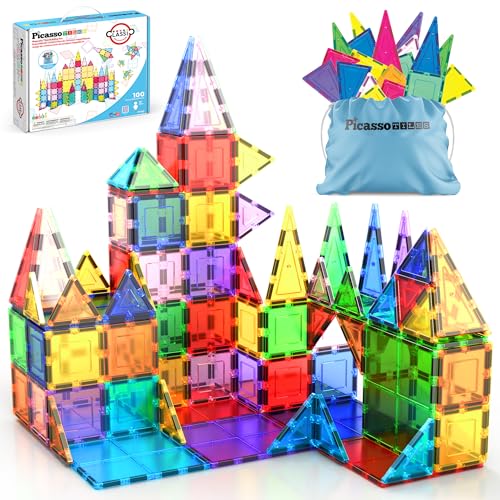
100 magnetic tiles give you a solid foundation for open-ended building without the premium price tag of smaller sets. The clear 3D blocks snap together with satisfying polarity, letting kids explore geometry and color recognition while they stack towers, houses, or abstract sculptures. For families who want a versatile starter set that scales up if you buy more, this hits the sweet spot between quantity and cost. It’s easy to put away, works for solo or group play, and encourages creativity without screens or batteries.
The box weighs 5.5 pounds, which is heavier than the 2.7-pound MAGNA-TILES 32-piece set, so it’s less convenient for tossing in a bag for trips or moving from room to room. For families who want a lighter, more portable option for on-the-go play, the MAGNA-TILES 32-piece set is easier to pack.
Product photos
How We Evaluated Building Toys For Kids
Our research started with the raw numbers, piece counts, material safety certifications, age recommendations, and storage solutions. We read manufacturer descriptions closely for details like brick compatibility, magnet security, and whether the set includes guides or relies on open-ended play. For each toy, we looked at how owners described the real-world experience: does the storage box survive a drop? Do the magnets stay put after a year of use?
The four criteria that mattered most were safety and durability, developmental stage fit, open-ended play value, and storage practicality. Safety comes first for any toy a child will put in their mouth, which is why we paid close attention to materials and age labeling. Developmental fit means the pieces are neither too frustrating nor too simple for the intended age. Open-ended value determines whether the set gets played with for weeks or abandoned after one build. Storage matters because loose blocks on the floor are a hazard and a headache.
A research-led evaluation has limits, we haven’t watched a hundred families play with these sets for months. But by cross-referencing specs, expert round-ups, and the patterns in owner feedback, we can identify which toys reliably deliver what they promise. The pros and cons of each type of building toy become clear when you look at enough data.
What To Look For In Building Toys For Kids
Choosing the right building toy means thinking about where your child is developmentally, not just how old they are. The best set is one they can use today and still enjoy next year.
Look for age-appropriate piece sizes, enough pieces for satisfying builds, material safety, and storage that keeps the set organized. A good building toy grows with the child through open-ended play rather than a single prescribed model.
Age-Appropriate Piece Size
The single most important factor is whether the child can physically handle the pieces. For toddlers 18 months to 3 years, bricks need to be large enough that they won’t be a choking hazard and chunky enough for small hands to grip and stack. The LEGO DUPLO and MEGA BLOKS lines excel here with pieces that are roughly twice the size of standard bricks.
For kids 4 and up, standard-size bricks like those in the LEGO Classic box become manageable, and magnetic tiles with their easy-connect edges work well for ages 3 and up. A 2-year-old handed a set of tiny bricks will get frustrated; a 6-year-old handed toddler blocks will get bored.
Piece Count and Build Potential
More pieces don’t automatically mean a better toy, but too few pieces limit what a child can build. For toddlers, around 65 to 150 pieces is plenty, they’re still learning stacking and knocking down. For preschoolers and older kids, 100 pieces allows for recognizable structures like houses and towers, while more than 500 pieces opens up elaborate creations.
The trade-off is that high piece counts can overwhelm younger children who need guidance. When you’re choosing building toys for a toddler, a smaller, curated set with a few special pieces often works better than a massive bin of identical bricks.
Material Safety and Durability
Children put toys in their mouths, drop them on hard floors, and occasionally throw them. Look for sets made from non-toxic materials, food-grade plastics like the MABS plastic used in MAGNA-TILES, or solid wood with non-toxic finishes like the Melissa & Doug blocks. Check that magnets are securely encased so they can’t come loose, and that wooden blocks are sanded smooth with no splinters. The best building toys use materials that survive years of play without chipping, cracking, or fading.
- Check the age label on the box, it’s there for safety reasons, not just marketing.
- Look for rounded edges on magnetic tiles and wooden blocks.
- Make sure storage containers have secure lids that a child can open independently.
- Verify that all pieces are dishwasher-safe or easy to wipe clean.
- For magnetic sets, confirm the magnets are fully enclosed in the plastic.
A building toy that passes the drop test, the mouth test, and the sibling test is one you’ll keep for years.
Building Toys For Kids Compared
The table below compares all seven picks at a glance, showing piece counts, age ranges, and the key trade-off for each set so you can narrow down your choices quickly.
| Product | Pieces | Ages | Material |
|---|---|---|---|
| LEGO Classic Large Creative Brick Box | 790 | 4-99 | N/A |
| LEGO DUPLO Brick Box | 65 | 18+ months | N/A |
| Melissa & Doug 100 Wooden Building Blocks | 100 | 2+ | Solid wood |
| MAGNA-TILES Classic 32-Piece Magnetic Construction Set | 32 | 3+ | Food-grade MABS plastic |
| MEGA BLOKS First Builders Deluxe Building Bag | 150 | 1+ | N/A |
| MAGNA-TILES Classic 100-Piece Magnetic Set | 100 | N/A | Food-grade MABS plastic |
| PicassoTiles 100 Piece Magnetic Tiles | 100 | 3+ | Magnetic Tiles |
Frequently Asked Questions
What is the best building toy for a 2-year-old?
For a 2-year-old, the LEGO DUPLO Brick Box or MEGA BLOKS First Builders Deluxe Building Bag are the safest choices. Both use large pieces that won’t pose a choking hazard and are easy for small hands to stack. The DUPLO set includes number bricks and figures for early learning, while the MEGA BLOKS bag offers 150 pieces and a storage bag.
How many pieces should a building toy have for a 5-year-old?
A child around age 4 typically does well with 100 pieces. This range gives them enough bricks to build houses, vehicles, and towers without being so many that they feel overwhelmed. The LEGO Classic Large Creative Brick Box with 790 pieces works well for this age if a parent helps organize and suggests small projects to start.
Are magnetic building toys safe for toddlers?
Magnetic building toys are generally safe for children ages 3 and up, provided the magnets are fully enclosed in the plastic. Brands like MAGNA-TILES use food-grade, non-toxic MABS plastic with rivet-secured magnets. For children under 3, the small parts and magnet strength can be a risk, so always follow the manufacturer’s age recommendation.
What is the difference between LEGO Classic and LEGO DUPLO?
LEGO Classic uses standard-size bricks that measure about 8mm tall, while DUPLO bricks are twice as large in every dimension. DUPLO sets are designed for children ages 18 months to 3 years, with bigger pieces that are safe and easy to grasp. LEGO Classic sets target ages 4 and up and offer far more pieces and compatibility with all other LEGO sets.
Which building toy is best for open-ended play?
Open-ended play means the child creates their own designs rather than following instructions for a single model. The LEGO Classic Large Creative Brick Box, Melissa & Doug 100 Wooden Building Blocks, and MAGNA-TILES sets all encourage open-ended building. These sets have no prescribed outcome, the child decides what to build each time.
The Bottom Line
The LEGO Classic Large Creative Brick Box is the best overall choice for families who want one set that works for years. Its 790 pieces in 33 colors, plus windows, doors, baseplates, and wheels, give kids the raw materials for almost any creation. It’s ideal for children ages 4 and up who have the attention span to manage a large collection and the imagination to build without a guide.
If your child is younger than 4, the LEGO DUPLO Brick Box or MEGA BLOKS First Builders Deluxe Building Bag are the right starting points. Both use big, safe pieces that build confidence before the child is ready for standard bricks. For families who want to try magnetic building, the MAGNA-TILES Classic 32-Piece Set is a safe, developmental introduction, while the PicassoTiles 100 Piece Magnetic Tiles offer the best value for larger builds.
The single most important factor in choosing a building toy is matching the piece size and complexity to your child’s current abilities. A toy that’s too simple bores them; one that’s too complex frustrates them. Get that match right, and you’ve bought a toy they’ll reach for again and again.
