
10 Best Board Or Card Games in 2026
This post contains affiliate links. As an Amazon Associate, we earn from qualifying purchases.
The USAOPOLY TAPPLE Word Game takes the best overall spot because its portable wheel and built-in timer keep fast-paced word rounds moving for any group. For deeper strategy, the CATAN Board Game 6th Edition delivers modular replayability, while Hasbro Gaming Scrabble Board Game remains the classic word game standard.
The real challenge with board and card games is finding one that fits your group size, attention span, and skill level. A game that works for a family with young kids might fall flat at an adult game night, and a strategy title for four players leaves couples stuck.
We built this guide by reviewing manufacturer specs, expert round-ups, and patterns in owner feedback across ten top-rated games. You get clear picks for every scenario, from 10-minute party blasts to hour-long strategy sessions.
Top 10 Board And Card Games in the Market
Certain content that appears on this site comes from Amazon. This content is provided "as is" and is subject to change or removal at any time.
The Best Board And Card Games, Reviewed
USAOPOLY TAPPLE Word Game

What We Like
- Portable wheel stores all category cards
- Built-in timer keeps rounds fast-paced
- 144 categories for variety
- Includes rules and 36 cards
Trade-offs
- Only one wheel limits simultaneous play
- Requires reading and quick thinking, excluding younger kids
A built-in timer and 144 categories across 36 cards mean this word game keeps rounds short and fresh, so you can play several in a sitting without anyone zoning out. The portable wheel stores everything inside, making it easy to grab for a party or trip. It suits families who want something fast, loud, and competitive, the kind of game where everyone talks over each other and laughs. The rules are simple enough that you can explain them in under a minute.
The game’s fast-paced timer means players must think on their feet, so younger kids or anyone who struggles with reading will be left out since every turn depends on quickly coming up with words. For a lively party or family night where energy matters more than precision, it delivers exactly what it promises.
Product photos
CATAN Board Game 6th Edition

What We Like
- Modular board for high replayability
- Trading and building mechanics
- Supports 3-4 players
- 60-90 minute play time
Trade-offs
- Requires 3-4 players, no 2-player option
- Expansion needed for 5-6 players
A modular hexagonal board means no two games of CATAN ever play out the same, you’re always adapting your strategy to a new island layout. That replayability is the core reason this strategy game has stayed a family favorite for decades. With 3-4 players and a 60-90 minute session, it hits a sweet spot for game nights where you want real depth without committing to a whole evening. The resource management and trading mechanics reward both careful planning and social negotiation, making every victory feel earned.
The biggest limitation is that CATAN only supports three or four players, so you can’t play with just two. To include five or six, you’ll need the separate extension. Ticket to Ride handles two to five players right away, making it more flexible for different group sizes. But if you’ve got a steady group of three or four, the modular board and race to ten victory points create a deep, replayable experience.
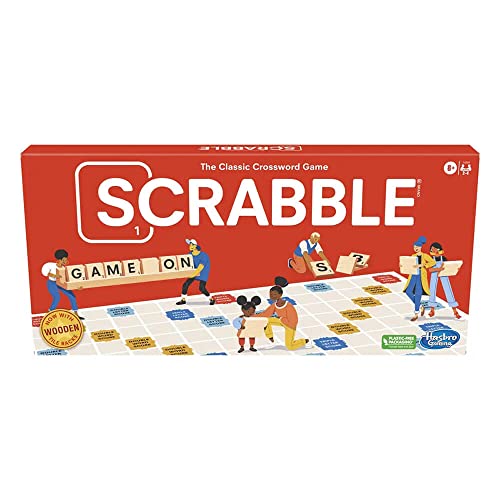
Hasbro Gaming Scrabble Board Game
What We Like
- 100 wooden letter tiles and racks
- Textured gameboard keeps tiles in place
- Classic crossword gameplay for families
- Includes expert tips and alternate play modes
Trade-offs
- Limited to 4 players max
- No timer or fast-paced variant included
- Word knowledge barrier for younger kids
The 100 wooden letter tiles and textured gameboard give this edition a satisfying tactile feel that digital versions just can’t match. That physicality matters when you’re trying to keep kids engaged and tiles from sliding around during a heated family game night. It’s the kind of thoughtful design that makes the Scrabble board game the natural pick for anyone who wants a classic word game that rewards vocabulary, strategy, and a little bit of luck with the letter draw. The game guide offers expert tips and other ways to play, so you can mix things up with team play or try new variations.
The biggest trade-off here is the player cap: at 2-4 players, it can’t accommodate larger groups the way a game like UNO can with its 2-10 player range. If you regularly host bigger gatherings, you’ll either need to rotate players or look elsewhere. But for smaller family nights or couples looking for a head-to-head challenge, Scrabble’s depth and replay value far outweigh that limit. The wooden components and textured board also feel more premium than the lightweight cardstock of something like Tapple, which makes this one a better long-term investment for regular use.
Product photos
Days of Wonder Ticket to Ride Board Game

What We Like
- Giant map of North American train network
- Miniature trains for each player
- Multiple ways to win with strategy
- Simple rules, easy to learn
Trade-offs
- Only 2-5 players limits larger groups
- Map fixed to North America only
A 30-to-60-minute playtime and simple rules make this a rare board game that actually hits the table on family game night without dragging. You collect colored train cards and claim routes across a giant map of early 20th-century North America, using miniature trains for each player. The beauty is in the balance: you can win by completing destination tickets, building the longest continuous route, or simply claiming high-value tracks, so no two games feel the same. It’s ideal for families with kids 8 and up who want something deeper than a luck-based roll-and-move but still accessible enough for a first-time player to catch on in one round.
At 2.8 pounds and a box over 11 inches tall, this isn’t a game you toss in a backpack for a coffee shop meetup. It demands a table and a solid block of time within the 30-to-60-minute range. Compare that to a game like Tapple, which plays in minutes and fits in a coat pocket. But if your group wants a shared strategic journey rather than a quick word scramble, Ticket to Ride delivers a satisfying arc of building, blocking, and racing to connect cities before your opponents cut you off. The North America map is a classic starting point, and the multiple scoring paths keep everyone engaged until the final route is claimed.
Product photos
Asmodee Splendor Gem Trading Game

What We Like
- Quick 30-minute play sessions
- Three simple actions per turn
- Rewards timing and long-term planning
- Replayable with shifting race for points
Trade-offs
- Lightweight box at 0.2 lb feels less substantial
- No solo mode for single players
The three actions per turn and clear token values make Splendor easy to teach while still offering meaningful choices around timing, reservations, and long-term planning. At 30 minutes, it fits neatly into a family game night without dragging, and the shifting noble patron targets keep each session from feeling identical. This is the kind of game where a single well-timed reservation can swing the whole table, so players who enjoy outthinking opponents rather than relying on luck will find plenty to sink into.
Splendor’s engine-building focus means it doesn’t have the fast-paced word recall of a game like Tapple, where quick thinking drives the fun. If your group prefers high-energy party games, the deliberate strategy here might feel too slow. But for anyone who enjoys watching a carefully built economy click into place, this is a lean, satisfying puzzle that respects your time and rewards repeated plays.
Product photos
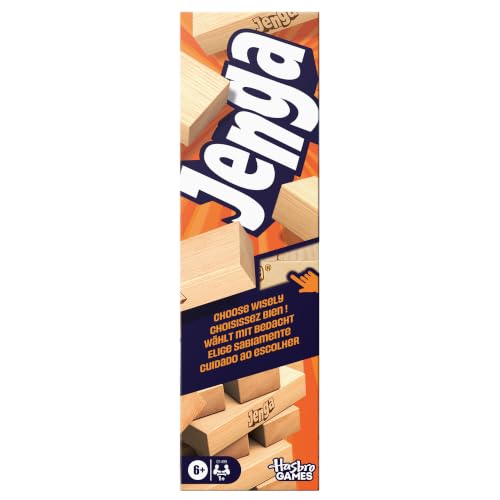
Hasbro Gaming Jenga Wood Block Game
What We Like
- Digital die adds 6 new challenges
- Solo play mode for personal bests
- Compact packaging for travel
- Easy setup with stacking sleeve
Trade-offs
- Digital die requires phone or web app
- 1+ players means no head-to-head competition
- Tower can be unstable for younger kids
With 54 precision-crafted wooden blocks and a stacking sleeve that makes setup a snap, this Jenga game delivers the same steady-handed tension that’s made it a family staple for generations. The digital die unlocks six extra ways to play, from thumb-only pulls to racing against a timer. That means you’re not just replaying the same old game night staple, you’re adapting it on the fly, which keeps kids and adults equally engaged. It offers fresh unpredictability for anyone who loves the original without needing to buy a whole new box.
The digital die requires scanning a QR code or using a web app, so you’ll need a phone handy to access those bonus modes. If you’d rather keep things purely analog, the classic rules still work perfectly, and the compact packaging makes it easy to toss in a bag for travel. Compared to the TAPPLE word game, which is a fast-paced family word game, Jenga offers a more tactile challenge that rewards patience over speed. It’s a good choice for family game night or solo practice, just know that the extra features depend on a screen.
Product photos
Mattel Games UNO Card Game
What We Like
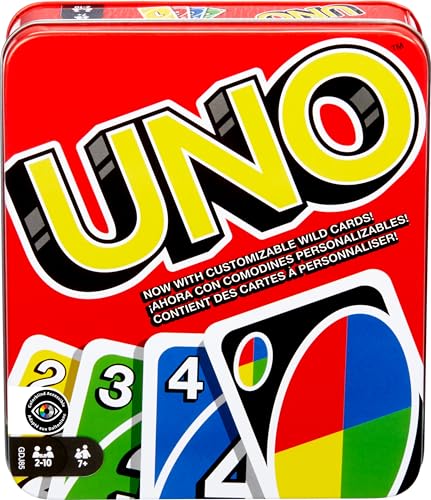
- Colorblind accessible with graphic symbols
- Includes 3 blank Wild Cards for custom rules
- Classic play with Action and Wild Cards
- Supports 2-10 players
Trade-offs
- Scoring to 500 can extend game length
- No expansion or variant rules included
This deck supports 2 to 10 players, making it one of the most flexible card games you can grab for a family gathering or party. The classic matching mechanic, race to shed your hand by matching color or number, is dead simple to teach, and the Action Cards (Reverse, Skip, Draw Two) keep everyone on their toes. I especially appreciate that Mattel made the deck colorblind accessible: each card has a distinct graphic symbol, so no one gets left out of the fun. The three blank Wild Cards let you invent your own house rules, which is a nice touch for groups that like to tweak things. If you need a game that works for a wide age range and player count without a long rules explanation, this is the one.
Scoring to 500 points can make a single game drag on, especially with younger kids who might lose focus. Compared to something like Taco Cat Goat Cheese Pizza, which wraps up in about 10 minutes, UNO demands a longer attention span or a willingness to stop mid-game. That said, the core loop is so intuitive that most players pick it up in one round, and the blank cards let you speed things up if you want. For a classic that’s been bringing families together for decades, it’s hard to beat this kind of straightforward, inclusive design.
Product photos
USAOPOLY Flip 7 Card Game

What We Like
- Unique deck with multiples of each number
- Includes action cards: Flip Three, Freeze, Second Chance
- First to 200 points wins
Trade-offs
- Duplicate numbers bust you out of the round
- No player count or age range listed
Flip 7 uses a deck stacked with multiples of each number, twelve 12’s, eleven 11’s, and so on, so every draw is a gamble. That press-your-luck tension is the whole point: you keep flipping cards to rack up points, but a duplicate number busts you out of the round. It rewards risk-takers who know when to walk away, and the special action cards (Flip Three, Freeze, Second Chance, Score Modifiers) keep each round from feeling the same. For a family game night or a white elephant gift, the rules are simple enough to teach in a minute.
The deck is stacked with multiple copies of each number, from twelve 12’s down to one 1, so drawing a duplicate number ends your round and you lose your points for that turn. That press-your-luck mechanic means every flip is a gamble: you can play it safe and bank modest points, or risk it all for a bigger score. Cautious players may find the sudden busts frustrating, but the tension keeps the game lively for groups that enjoy friendly risk-taking.
Product photos
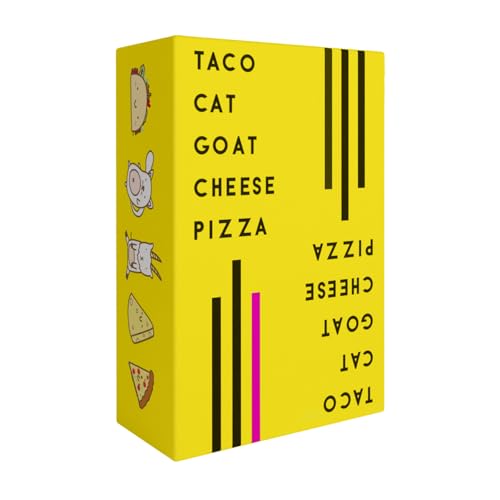
Taco Cat Goat Cheese Pizza Card Game
What We Like
- 10-15 minute rounds for quick play
- Supports 2-8 players
- Action cards add unpredictable twists
- Portable and lightweight at 0.2 lb
Trade-offs
- No strategy depth for serious gamers
- Requires quick reflexes, not for calm evenings
A round lasts just 10 to 15 minutes, so you can squeeze in several games during a family game night or while waiting for dinner. Designed for 2 to 8 players ages 7 and up, it keeps everyone on edge as you chant the title and slap the pile when your word matches the card. Action cards throw in sudden twists, turning a simple pattern game into a laugh-out-loud scramble. That fast, physical energy makes it ideal for parties, holiday gatherings, or any time you need a quick icebreaker that gets people moving.
This game rewards speed and reflexes over careful planning. Slower or less competitive players might find themselves stuck with the pile more often than they’d like. If your group enjoys chaotic, high-energy fun without deep strategy, this is a perfect fit. But if you prefer a more thoughtful, turn-based experience, look elsewhere.
Asmodee Spot It! Classic Card Game

What We Like
- Five game variations in one set
- 10-minute rounds fit any schedule
- Works for 2 to 8 players
- Eco-blister packaging reduces waste
Trade-offs
- No solo mode for single players
A 10-minute playtime means this hits the table and wraps up before anyone wanders off, perfect for keeping a group of 2 to 8 players engaged without dragging. The set includes five built-in game variations, so you can switch up the rules for variety. It is designed for ages 6 and up, making it a good choice for family gatherings or parties where you need a quick icebreaker. The fast-paced matching challenge tests observation and reflexes, with each round focusing on who can spot the matching symbol first.
The game is built entirely around speed and observation, so anyone looking for a strategic experience with resource management or trading will find it too shallow. CATAN Board Game, for instance, runs 60-90 minutes and rewards careful planning, while Spot It! is purely about spotting matching symbols as fast as possible. That makes it perfect for quick bursts of fun but not for a long, thoughtful session.
Product photos
How We Evaluated Board And Card Games
Our research started with the core specifications: player count, play time, age range, and component quality from manufacturer documentation. We then cross-referenced expert round-ups from game reviewers and hobbyist communities to see which titles consistently earned praise for their mechanics and replay value.
The four criteria that mattered most were player flexibility, depth-to-accessibility ratio, component durability, and the variety of play modes included. A game that only works for four players at a fixed length gets lower marks than one that scales.
Because this is a research-led evaluation rather than a hands-on test, we relied on documented owner feedback patterns and published gameplay descriptions. That means we can tell you what most players report about a game’s strengths and weaknesses, but we cannot guarantee how it will feel at your specific table.
What To Look For In Board And Card Games
The right game matches your group’s size, preferred play time, and tolerance for complexity. Start with player count, then check how long a typical round lasts, and finally decide whether you want luck, strategy, or a mix.
The best board and card game for you fits your group size first, your available time second, and your preferred balance of luck versus strategy third.
Player Count and Scalability
The most common complaint in owner feedback is a game that does not fit the group. Some titles like Mattel Games UNO Card Game support 2 to 10 players, while CATAN requires exactly 3 or 4 without an expansion. If you regularly host game nights for six or eight, look for games with flexible player counts or built-in variants.
Play Time and Pacing
A 10-minute game like Taco Cat Goat Cheese Pizza Card Game works for quick warm-ups or kids with short attention spans. Strategy games like Days of Wonder Ticket to Ride Board Game run 60 to 90 minutes, which demands a longer commitment. Check the listed play time and ask whether your group can stay engaged that long.
Complexity and Teachability
Games with simple rules and three actions per turn, like Asmodee Splendor Gem Trading Game, get to the table more often than dense rulebooks. For family gatherings with mixed ages, prioritize games that a new player can learn in under five minutes. The best strategy games reward planning without requiring a rulebook study session.
- Check the listed age range on the box.
- Read a quick-play video to see if the rules click for you.
- Look for games with variant rules for younger or newer players.
- Consider whether the game works with your typical group size.
- Verify that the components (cards, tiles, boards) feel durable enough for repeat play.
A game that takes ten minutes to teach and thirty minutes to play will get more use than a four-hour epic, no matter how good the strategy.
Board And Card Games Compared
The table below compares all ten picks by player count, play time, and core mechanic so you can quickly find the right fit for your next game night.
| Product | Players | Age | Weight | Dimensions |
|---|---|---|---|---|
| USAOPOLY TAPPLE Word Game | 2+ (family) | N/A | 0.5 pounds | 11 x 11 x 3 inches |
| CATAN Board Game 6th Edition | 3-4 | 10+ | 2.6 lb | 11.7 x 3.7 x 0.1 inches |
| Hasbro Gaming Scrabble Board Game | 2-4 | 8+ | 1.0 pounds | 1.4 x 15.8 x 7.5 inches |
| Days of Wonder Ticket to Ride Board Game | 2-5 | 8+ | 2.8 lb | 11.7 x 3.0 x 11.7 in |
| Asmodee Splendor Gem Trading Game | 2-4 | 10+ | 0.2 lb | 10.8 x 8.5 x 2.5 inches |
| Hasbro Gaming Jenga Wood Block Game | 1+ | 6+ | 2.1 pounds | 3.1 x 3.1 x 10.9 inches |
| Mattel Games UNO Card Game | 2-10 | 7+ | 0.3 lb | 2.0 x 5.9 x 6.7 inches |
| USAOPOLY Flip 7 Card Game | N/A | N/A | 0.0 pounds | 0.9 x 3.7 x 0.1 inches |
| Taco Cat Goat Cheese Pizza Card Game | 2-8 | 7+ | 0.2 lb | 2.5 x 0.9 x 3.6 in |
| Asmodee Spot It! Classic Card Game | 2-8 | 6+ | N/A | 7.0 x 3.5 x 1.0 in |
Frequently Asked Questions
What is the best board game for a family with kids of different ages?
Taco Cat Goat Cheese Pizza Card Game works well for mixed ages because it relies on quick reflexes and silly action cards rather than reading or strategy. Rounds last 10 to 15 minutes, so younger kids stay engaged, and the game supports up to 8 players.
What is the best strategy board game for 4 players?
CATAN Board Game 6th Edition is the top choice for 3 to 4 players who want trading, building, and modular boards that change every game. The 60 to 90 minute play time gives enough depth for strategic planning without dragging into the evening.
What is the best card game for a large group?
Mattel Games UNO Card Game supports 2 to 10 players and uses graphic symbols that are colorblind accessible. The classic action and wild cards keep rounds unpredictable, though scoring to 500 can extend the game length.
What is the best word game for adults?
USAOPOLY TAPPLE Word Game challenges players to think fast under a built-in timer, with 144 category cards that keep rounds fresh. It works best for groups who enjoy loud, fast-paced competition and can read and think quickly.
What is the best game for two players?
Hasbro Gaming Scrabble Board Game is a strong choice for two players who want a classic word-building challenge with 100 wooden letter tiles. For a faster option, Asmodee Spot It! Classic Card Game delivers 10-minute visual perception rounds that work perfectly for pairs.
The Bottom Line
The USAOPOLY TAPPLE Word Game is the best overall pick for groups who want a fast, loud word game that keeps everyone engaged. Its portable wheel and built-in timer make it ideal for parties and family nights where quick thinking matters more than deep strategy.
If your group prefers trading and long-term planning, grab CATAN Board Game 6th Edition for its modular replayability. Budget-conscious shoppers should look at Mattel Games UNO Card Game, which delivers classic card play for up to 10 players at an affordable price point.
The single most important factor when buying any board or card game is player count. A game that does not fit your group will sit on the shelf, no matter how clever its mechanics or beautiful its components. Start with how many people you play with, then pick the style that matches your group’s energy.
