
Battery Operated Toys Pros and Cons: Are They Worth It?
This post contains affiliate links. As an Amazon Associate, we earn from qualifying purchases.
Battery operated toys pros and cons split cleanly in two. The upside is real engagement and skill-building. The downside is button battery ingestion risk, charger hazards, and a monthly charging routine most families never read. CPSC estimates 92 percent of button battery victims are children between 6 months and 5 years old.
That monthly charging line is where the quiet damage happens. Lead-acid ride-on packs sit in garages and basements for months, and a pack left flat comes back with less capacity. The Mattel Power Wheels BCK92 manual says to charge before storing and at least once a month even if nobody has touched the car.
What follows: the benefits worth paying for, the button battery numbers that should change how you shop, a charging table that settles where two manuals disagree, and a short list of what to buy and what to walk past.
Key Takeaways
- Battery compartments on toys with replaceable button cells must need a tool or at least two independent and simultaneous hand movements to open under 16 CFR part 1263.
- 92 percent of button battery victims are 6 months to 5 years old, and 81 percent swallowed the battery or put it in their mouth.
- Charge lead-acid ride-on packs monthly, not just when the car dies. Mattel’s BCK92 manual warns that a battery left discharged gets ruined.
- Fisher-Price’s Power Wheels recall covered up to 10 million ride-ons over electrical components that could overheat and wiring that could keep a vehicle from stopping.
- A battery toy with one button gets shelved by week three. Open-ended play outlasts the novelty almost every time.
What Battery Operated Toys Actually Get Right
Batteries buy motion, sound, and feedback. That’s the whole value proposition, and it’s a real one.
A battery-operated toy pairs a DC power source with a motor, lights, or a speaker, and the safety standard treats that circuit as a system. Under ANSI/UL 4200A-2023, the battery compartment must require a tool or at least two independent and simultaneous hand movements to open, and the compartment must hold the cell through use-and-abuse testing.
Motion teaches cause and effect faster than anything static. A toddler presses a pedal, the car moves, and the lesson lands in about a second. That feedback loop is why a ride-on holds attention long after a push toy gets boring.
Battery toys also open doors for kids who can’t do the physical work yet. A child with low muscle tone can drive a car with one foot. A child who can’t form letters can trigger a talking book with a finger tap.
What batteries genuinely add:
- Immediate feedback. Press a button, something happens, every single time.
- Independence for kids with motor delays, who can drive or trigger a toy long before they can run or write.
- Repeatable practice. A talking toy says the same word the same way on the hundredth press.
- Movement. A ride-on is exercise a kid actually asks for.
The Evenflo Porsche Macan Turbo RC (W416AC-RC) is an example of a battery toy that stays honest about itself. It runs a 6V 7AH battery and a 6V 20W motor, tops out at 4 km/h (2.5 mph), and carries a 35 kg (77 lb) weight limit. Nothing on that spec sheet is flashy, and that suits a 3-year-old fine.
That’s the case for batteries. The case against starts with the battery itself.
Why 92 Percent of Button Battery Victims Are Under 5
CPSC’s injury estimates put 92 percent of button cell and coin cell victims between the ages of 6 months and 5 years old. That single number explains why the rules around button cells are so strict.
The same estimate found that 81 percent of victims swallowed a button cell or coin cell battery or put one in their mouth. Of the 185 sample cases behind those figures, none were fatal. Most kids went home the same day: 81 percent were treated in an emergency department and released, 16 percent were admitted for hospitalization, and 3 percent were held for observation.
Easy to miss: Zinc-air button cells are outside 16 CFR part 1263 entirely, so a hearing-aid battery sitting in a toy isn’t covered by the compartment rule. Check the chemistry before you assume the standard applies.
What 16 CFR Part 1263 Actually Requires
Reese’s Law pushed CPSC to write a mandatory standard for button cells. The result is 16 CFR part 1263, which incorporates ANSI/UL 4200A-2023 and applies to consumer products containing button or coin cells manufactured or imported on or after October 23, 2023. CPSC later granted enforcement discretion, so the requirements landed on products made or imported after March 19, 2024.
The standard asks five things of a product:
- A compartment that needs a tool or at least two independent simultaneous hand movements to open.
- No access to the cell after use-and-abuse testing.
- A warning on the packaging.
- A warning on the product itself, where practical.
- All applicable warnings in the instructions and manual.
Two carve-outs matter here. Zinc-air cells sit outside the rule. And by statute, a toy marketed as a plaything for children under 14 is exempt if it complies with the battery accessibility and labeling rules in 16 CFR part 1250, which pulls in ASTM F963.
CPSC isn’t satisfied with that exemption. In a 2024 proposed rule, the agency argued that ASTM F963-23 doesn’t set adequate requirements for toys containing button cells, and proposed adding its own performance and labeling requirements. The Federal Register button cell toy rule lays out the full reasoning.
The proposed drop test is stricter than the toy standard in one way and looser in another. CPSC proposes 4.5 ft (137 cm) for toys for children aged 0 to 18 months and 3.0 ft (91 cm) for all other toys, dropped onto vinyl tile on concrete, consistent with the test surface currently used for toy drop testing in ASTM F963-23. UL 4200A-23 specifies a drop height of 1.0 m (100 cm, 3.3 ft).
Manufacturers get the full checklist from the CPSC button cell business guidance, which spells out the certification citations required on a Children’s Product Certificate.
The button battery safety rules matter most on toys with a replaceable cell, because that’s where a screwdriver or a two-handed latch shows up.
How Long Should You Charge a Ride-On Battery?
What’s the right charging window for a 6V ride-on pack? Depends which manual you read, and sometimes which page.
Before you start: Lead-acid ride-on packs contain lead and lead components, and the Evenflo manual says not to open the battery. If electrolyte reaches skin, the manual instructs giving water or milk, and never inducing vomiting. Charge on a hard, dry surface away from water, because moisture around the charger housing causes short circuits.
| Question | Evenflo W416AC-RC | Mattel Power Wheels BCK92 |
|---|---|---|
| First charge | 8-12 hours | At least 18 hours |
| Routine charge | 8-12 hours after each use | Before storing, then monthly |
| Maximum charge | 20 hours in one section, 30 in another | 30 hours |
| Storage state | Disconnect battery before storing | Store charged, never discharged |
| Storage temperature | No limit stated; ventilated area | Above -10°F (-23°C), below 75°F (24°C) |
The Evenflo manual contradicts itself, which is worth knowing before you follow it to the letter. One section says to charge for at least 8-12 hours but no more than 20 hours. The troubleshooting section says never to charge for more than 30 hours. Both sentences are printed in the same document.
Mattel’s BCK92 manual sets a floor and a ceiling: at least 18 hours on the first charge, and never more than 30 hours. The gap between the two brands isn’t sloppiness. Evenflo’s pack is a 6V 7AH unit and Mattel’s is a 6V 3.2 Ah sealed lead-acid pack, so the charge windows land in different places.
That’s the manufacturer telling you what overcharging does.
Charger quality isn’t a side detail either. The Fisher-Price Power Wheels recall notice covers up to 10 million ride-on vehicles pulled over electrical components that could overheat and wiring that could keep a vehicle from stopping.
Evenflo’s manual calls slight heating normal and sets the line at 71°C / 160°F, at which point you unplug it and call customer service.
If you’re shopping for one of these, the battery operated ride-on toys worth your money all share one trait. Their manual states a charge window in plain numbers.
First Charge vs Routine Charge: Where the Manuals Split
Mattel and Evenflo disagree on the first charge, and neither is wrong. Mattel wants at least 18 hours before the first use. Evenflo wants 8-12 hours immediately after each use, starting with the first one.
Follow the manual in the box, and don’t average the two.
What the Power Wheels and Tek Nek Recalls Still Teach Us
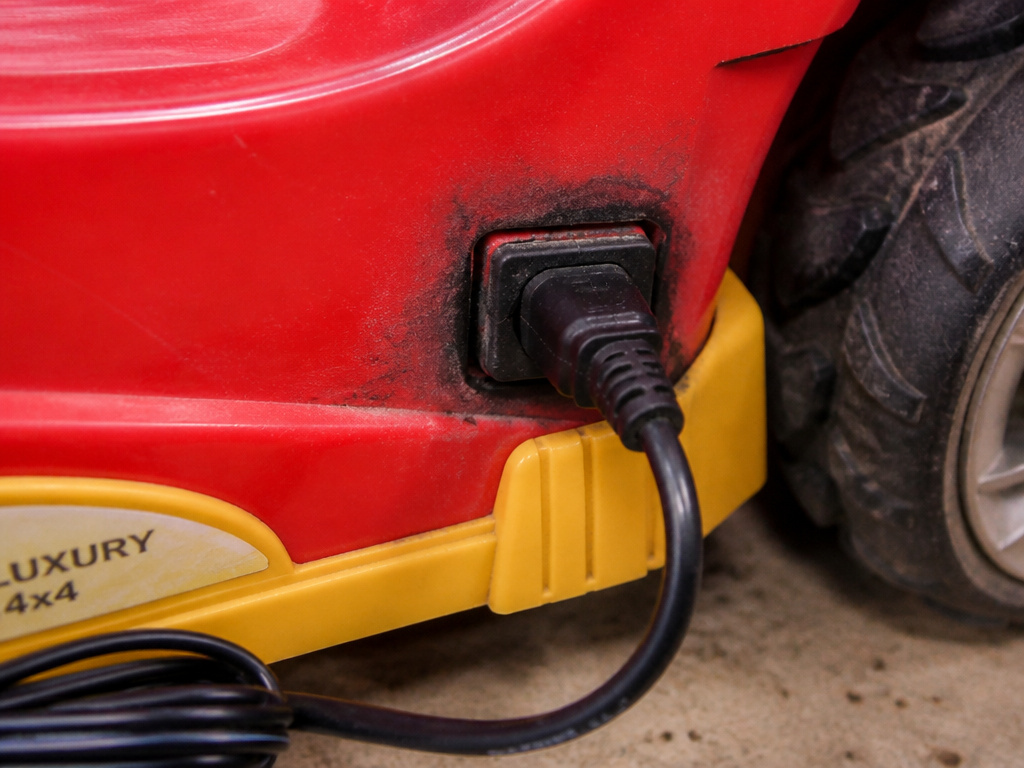
A charger sits on a garage floor overnight, plugged in, with a kid’s car parked next to it. That’s the exact scene behind two CPSC recalls.
CPSC and Tek Nek recalled about 294,000 battery-powered riding vehicles to replace battery chargers. The agency and the company had received 17 reports of chargers and wires overheating while vehicles were charging, and two consumers burned their hands while unplugging or charging.
Tek Nek’s vehicles ran on one 6-volt battery and were made before April 2000. CPSC told owners to stop using the vehicles immediately and to stop charging them until a new charger arrived.
The Tek Nek Toys recall announcement describes the failure in order: heat first, then a burn, then a recall.
The Fisher-Price recall was bigger. CPSC and Fisher-Price covered up to 10 million battery-powered Power Wheels cars and trucks. Those vehicles were built for children 2 to 7 years old and ran 1 to 5 mph depending on the model.
CPSC staff’s guidance for battery-powered products reads like a system checklist, and it applies to toys as much as to power tools. Staff recommends a system approach covering thermal protection, charge and discharge protection, and use in the product. Battery packs should have a Battery Management System with charge control, short-circuit protection, and cell balancing. Cells, battery, charger, and finished product should be tested together.
The hazards CPSC lists for this category:
- Overheating and fire.
- Electrical shock from a battery charger.
- Thermal burns.
- Exposure to alkaline battery electrolytes.
- High-velocity ejection of internal battery components.
Reports to CPSC show incidents happening while a product is in use, in storage, and during charging. Storage is the one families forget, because nothing looks wrong.
An overheating charger warns you before it fails.
The CPSC battery standards overview lists the voluntary standards staff works from, including ANSI/UL 4200A for button cells and UL 2054 for household batteries.
Supervision is the other half of this. The Evenflo manual requires an adult to always directly supervise the vehicle and never to leave a child unsupervised in it. That’s scaffolding, not recklessness.
Do Battery Toys Beat Traditional Toys for Development?
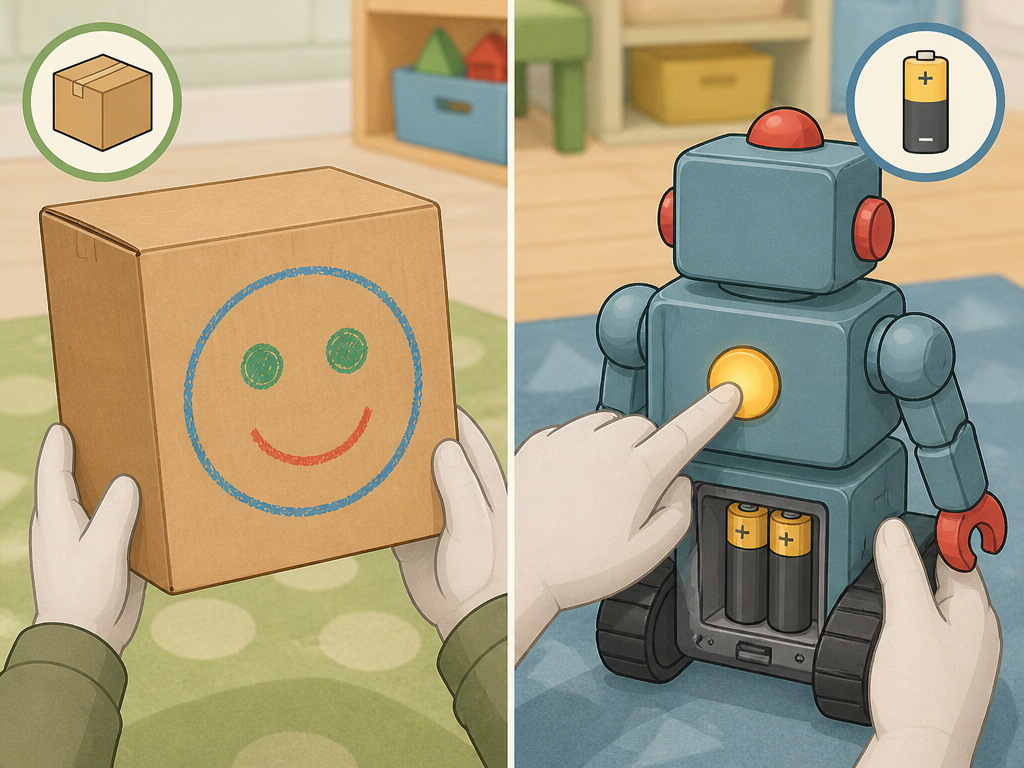
A cardboard box will outlast a talking robot in most playrooms.
Open-ended play works because the kid supplies the story. A box has no fixed script, so a new one gets written every day.
Where Battery Toys Win and Where They Lose
Head to head, here’s the honest split. Battery toys win on cause and effect, on accessibility for kids with motor delays, and on the specific thrill of a machine that answers back. Open-ended toys win on duration, on vocabulary, and on the number of ways a kid can play.
For a 2-year-old, open-ended wins. For a 4-year-old who needs to move, a ride-on wins. For a kid learning letters, a person beats both.
The electronic toys vs traditional toys split is really about how many ways a toy can be played. Robot toys sit right on that line. The robots for kids pros and cons argument is the same one, just with more blinking lights.
A toy with one button is a novelty. A toy with no buttons can be five toys. Buy the one that makes the kid do the work.
Weighing battery operated toys pros and cons for a specific child comes down to one question: what does this toy do that the kid can’t already do with a stick and a bucket?
Keeping Battery Toys Alive: Cleaning, Storage, and the Monthly Charge
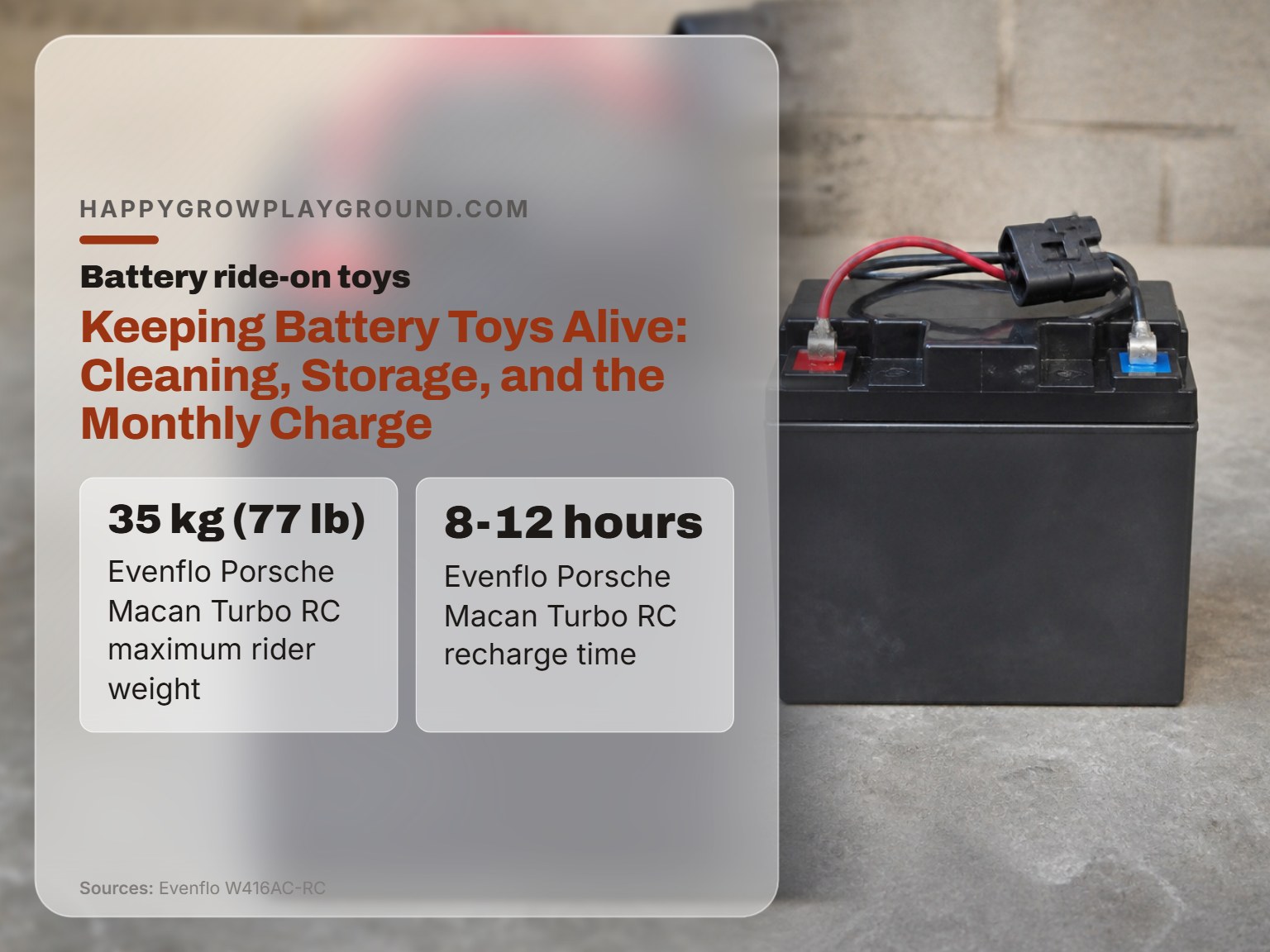
Battery toys die from neglect far more often than from defects.
A lead-acid ride-on pack that sits flat for a season comes back with less capacity. Mattel’s manual is blunt about it: charge the battery before storing the vehicle, and at least once per month even if it hasn’t been used. Leaving a battery discharged ruins it.
Storage Temperature: Two Manuals, Two Rules
Mattel sets hard numbers. Don’t store above 75°F (24°C) or below -10°F (-23°C). Evenflo’s manual states no storage temperature limit at all, and instead warns about sulfuric-acid leakage during charging and requires a well-ventilated area. Those are different rules, and merging them into one will get you into trouble.
Where the two manuals do agree is the monthly charge. Evenflo says to charge at least once a month even if the vehicle isn’t used or stored. Mattel says the same thing.
The maintenance routine I’d run on any ride-on:
- Charge after every use, not when the car dies. Evenflo’s manual calls for recharging immediately after each use.
- Charge once a month through the off-season. Both manuals require it, used or not.
- Disconnect the battery before long storage if your manual says to. Evenflo instructs disconnecting the battery connector from the engine connector.
- Keep water away from the charger housing. Evenflo’s manual warns that moisture around the charger causes short circuits.
For anything with a circuit board inside, the cleaning electronic toys routine is different from wiping down a plastic ride-on. No running water, no soaking, and let everything dry fully before power comes back.
| Symptom | Likely cause | What to do |
|---|---|---|
| Vehicle won’t run | Battery is low | Recharge the pack |
| Vehicle won’t run | Thermal fuse tripped | Turn the vehicle off and on |
| Runs a short time | Undercharged or overcharged pack | Check the connection, then the charge ceiling |
| Runs slowly | Weight over the limit | Stay under 35 kg (77 lb) |
| Runs slowly | Battery is old | Order a replacement from the maker |
The thermal fuse is the part people misread. Mattel’s BCK92 battery has a built-in thermal fuse that trips and shuts the vehicle down when it’s overloaded or the driving is too rough. Wait about 25 seconds, then try again. If the fuse keeps tripping under normal driving, Mattel says to call 1-800-348-0751.
Evenflo’s vehicles use a thermal fuse the same way, and the reset is the same: turn the vehicle off and on.
The part nobody mentions: A thermal fuse that trips once is a warning, not a fault. A fuse that trips every session means the kid is too heavy for the toy, the ground is too rough, or the pack is failing.
How to Pick a Battery Toy Without Reading 40 Reviews
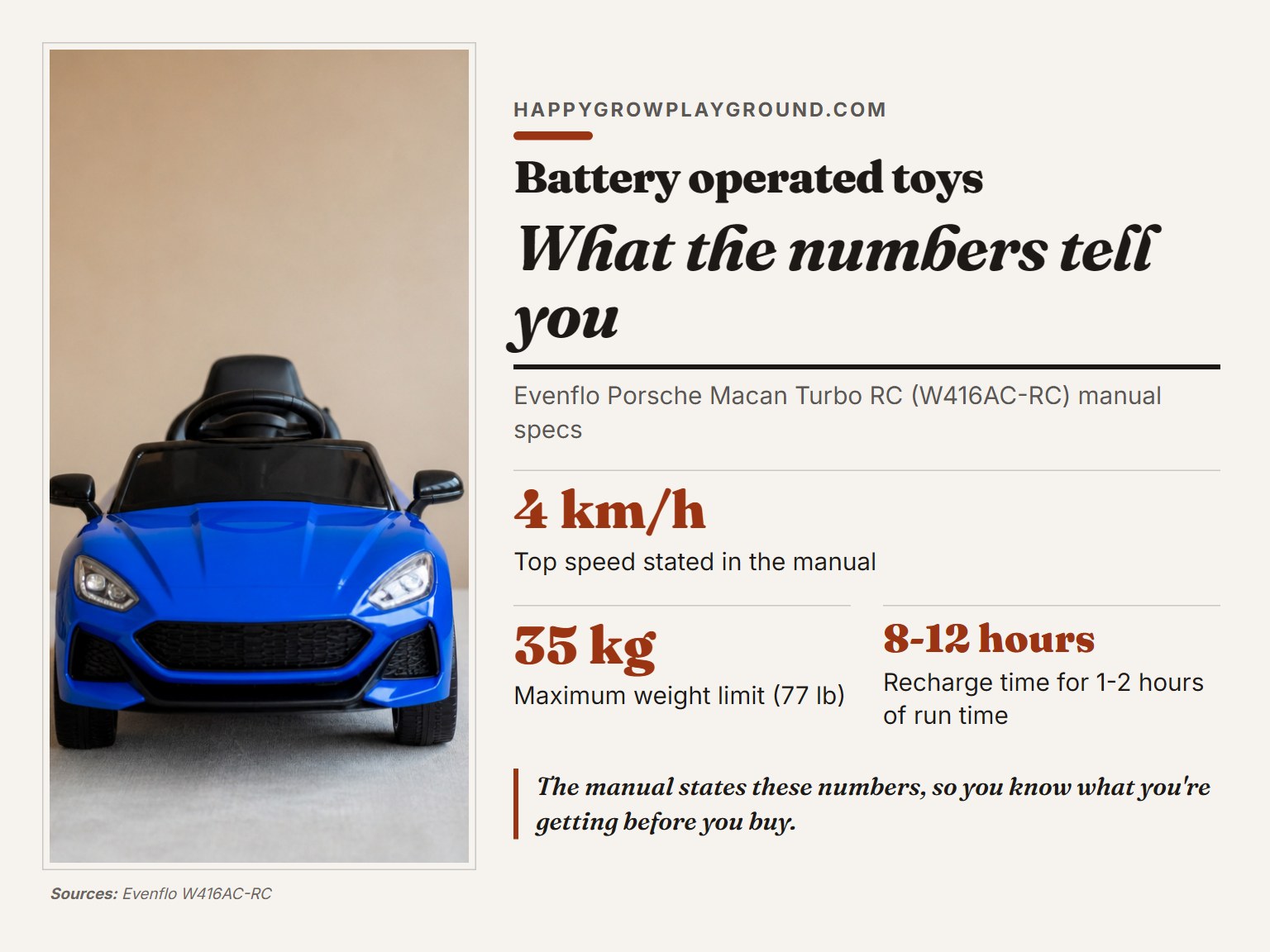
Three things decide whether a battery toy earns its shelf space: a stated charge window, a battery compartment that needs a tool, and a job the kid can’t do without it.
If a toy fails any of those, walk past it.
For most families, the answer is one ride-on plus a pile of open-ended stuff. The Evenflo Porsche Macan Turbo RC (W416AC-RC) is the ride-on I’d point at first, because the manual states a 4 km/h (2.5 mph) top speed, a 35 kg (77 lb) weight limit, and an 8-12 hour recharge for 1-2 hours of run time. Those numbers tell you exactly what you’re getting.
For a younger rider, the Mattel Power Wheels BCK92 is built for 12-36 months with a 40 lb (18 kg) weight limit, and it’s indoor-only. That indoor restriction matters more than it sounds. It runs a 6V 3.2 Ah sealed lead-acid pack, and the manual wants at least 18 hours on the first charge.
A ride-on toy buying guide that starts with the weight limit and the run time will serve you better than one that starts with the feature list.
The motorized toys for kids category gets crowded fast, so hold the line on those three checks and ignore the rest of the box.
What most people get wrong: Reading “ages 3+” as a safety rating. It’s an age recommendation, and it tells you nothing about whether the battery compartment needs a screwdriver.
Frequently Asked Questions
Are battery operated toys bad for kids?
No, and the honest answer is more specific than that. Battery toys add real value for cause-and-effect learning and for kids with motor delays. The risks are concentrated in two places: button cell ingestion and charger faults. Both are manageable with a compliant compartment and a manual you actually read.
At what age can a child use a battery operated ride-on?
It depends on the model, not the category. Mattel’s Power Wheels BCK92 is rated for 12-36 months with a 40 lb (18 kg) limit. The Evenflo Porsche Macan Turbo RC is rated for ages 3 and up with a 35 kg (77 lb) limit. Match the toy to the kid’s weight and coordination, not to the picture on the box.
How do I know if a toy’s battery compartment is compliant?
Check whether opening it needs a tool or at least two independent simultaneous hand movements. That’s the requirement under 16 CFR part 1263 for products made or imported after March 19, 2024. A compartment that pops open with one thumb press on a single latch doesn’t meet it.
Can I leave a ride-on battery charging overnight?
Check your manual, because the two big brands don’t agree. Evenflo states 8-12 hours with a 20-hour ceiling in one section and a 30-hour ceiling in another. Mattel allows up to 30 hours. If your manual gives a ceiling, respect the shorter number.
Do battery toys actually teach anything?
They teach cause and effect, and they teach it fast. A pedal press that produces motion in one second is a strong lesson. What they don’t do is teach vocabulary or problem-solving better than a person narrating play, which is why open-ended toys still hold up longer.
The Bottom Line
One rule sits above every other on this page. If a toy’s battery compartment doesn’t need a tool or at least two independent and simultaneous hand movements to open, it doesn’t come into a house with a kid under 5. That’s the line, and it isn’t negotiable.
For a child with motor delays, a ride-on or a switch-adapted toy does something blocks can’t.
