
10 Best Baby Toys in 2026
This post contains affiliate links. As an Amazon Associate, we earn from qualifying purchases.
The best baby toy for most families is the VTech Busy Learners Activity Cube. It packs five sides of play, 25 songs, and motion-activated learning into a compact cube that grows with your child from crawling to toddlerhood. For language development, the Baby Einstein 4-in-1 Kickin’ Tunes Music and Language Play Gym stands out, while the Fisher-Price Baby’s First Blocks remains the classic, battery-free shape sorter.
The real challenge isn’t finding a baby toy, it’s finding the right one for your child’s current stage. A toy that delights a 3-month-old will bore a 12-month-old, and a toy meant for a toddler can frustrate a baby just learning to sit. Age, motor skills, and sensory needs all matter.
This guide is research-based. We analyzed manufacturer specifications, expert round-ups on child development, and patterns in owner feedback to find the 10 best baby toys across key categories. Whether you need a first sensory toy or a long-lasting learning companion, we have a pick for you.
Top 10 Baby Toys in the Market

Certain content that appears on this site comes from Amazon. This content is provided "as is" and is subject to change or removal at any time.
The Best Baby Toys, Reviewed
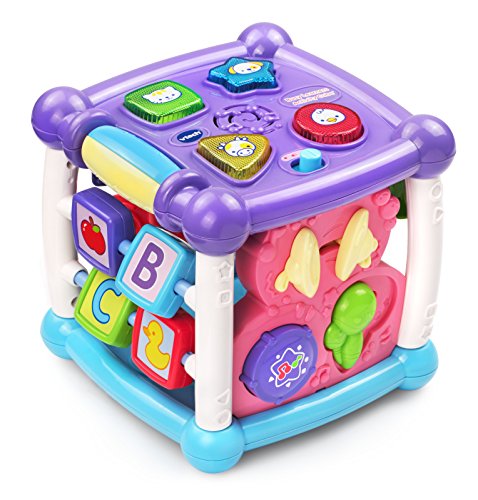
VTech Busy Learners Activity Cube
What We Like
- 5 sides of play encourage exploration
- 4 light-up buttons teach animals and shapes
- Motion sensor aids crawling and sitting
- 25 songs and melodies keep toddlers engaged
Trade-offs
- Requires 2 AAA batteries (included for demo only)
- No sound effects for older toddlers beyond age 3
With five sides of play and 14 interactive features packed into a compact 6.2-inch cube, this activity center gives a baby plenty to discover without taking over the floor. The four light-up buttons introduce animal names, sounds, and shapes, while a motion sensor triggers fun sounds when the cube is moved, helping encourage crawling and assisting babies with sitting up to play. It’s designed for little ones from six months up to three years. The 25 built-in songs and melodies keep things lively, and the adjustable volume means you can tone it down when needed.
The main trade-off is that the cube runs on batteries, two AAA are included for demo only, so you’ll need to supply fresh ones. Compared to a simpler, battery-free option like Fisher-Price Baby’s First Blocks, this cube offers more electronic engagement but also more to keep powered. For families who want a single toy that grows with their child from sitting to crawling to early learning, this cube delivers a lot of interactive value in a small footprint.
Baby Einstein 4-in-1 Kickin' Tunes Music and Language Play Gym
What We Like
- 4 play modes from lay to on-the-go
- Teaches colors, shapes, numbers in 4 languages
- 7 sensory toys plus kick piano
- Machine-washable mat
Trade-offs
- Requires 3 AA batteries not included
- At 3.2 pounds, not the lightest for travel
The piano’s 70+ melodies, sounds, and phrases reward kicks and presses, so even newborns get immediate feedback during tummy time or lay-and-play. That range of play modes, lay and play, sitting up, tummy time, and on the go, means the same mat and toy bars adapt as your baby grows from 0 to 36 months. No need to swap gear every few months. The piano also teaches colors, shapes, and numbers in English, Spanish, French, and German, giving early language exposure without extra effort. Seven sensory toys, crinkle medallion, triangle rattle, BPA-free textured music note, flash cards, self-discovery mirror, piano toy, and tummy time pillow, keep tiny hands busy right out of the box.
The trade-off is battery life: the piano ships with ‘try me’ batteries, so you’ll need to swap in three fresh AAs right away, and those aren’t included. At 3.2 pounds, it’s heavier than something like the VTech Busy Learners Activity Cube (1.4 pounds), so you won’t want to toss it in a diaper bag for a quick trip. But for a home-based gym that grows with your child and packs multilingual learning into one mat, this is a smart investment that saves you from buying separate toys for each stage.
Fisher-Price Baby's First Blocks
What We Like
- 10 colorful blocks for sorting and stacking
- All blocks store inside the bucket
- Easy-carry handle for take-along play
- No batteries needed
Trade-offs
- Only 10 blocks limit complexity for older toddlers
- Plastic bucket lacks softness for teething
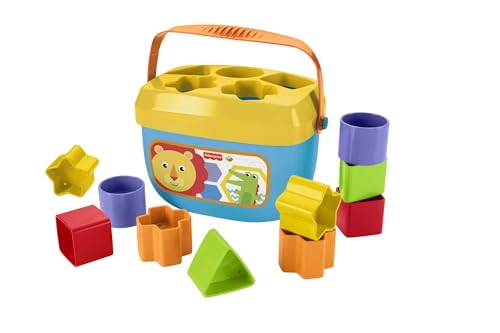
Ten colorful blocks and a shape-sorter lid mean this toy teaches color and shape recognition while building fine motor skills from six months onward. The bucket doubles as storage and includes an easy-carry handle, so it travels well to grandma’s or the waiting room. For a classic first sorter, the simplicity is the point: no batteries, no lights, just the satisfying clatter of a block dropping through the right hole. That makes it a smart pick for parents who want an uncluttered introduction to problem-solving without digital distractions.
Ten blocks won’t hold a toddler’s attention as long as a more complex toy with more features. But if you value a simple, battery-free shape sorter that stores neatly, this Fisher-Price set delivers exactly that. It’s a back-to-basics shape sorter that does one thing well and stores itself neatly, exactly what a first sorter should be.
Product photos
Learning Resources Spike The Hedgehog
What We Like
- Chunky pegs build fine motor skills
- Color sorting and counting practice
- Easy storage with quills inside hedgehog
- Great for visually impaired children
Trade-offs
- Limited to one shape and activity type
- No sound or lights for sensory variety
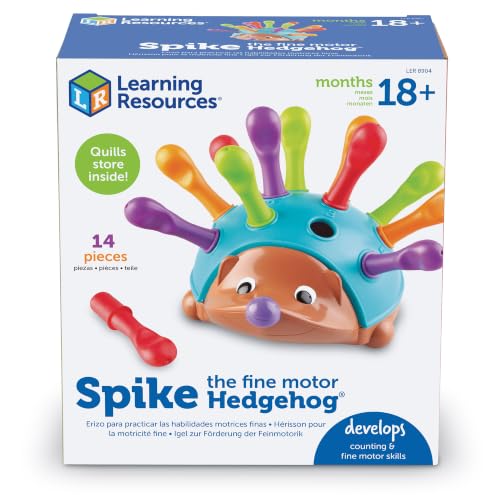
Twelve chunky, peg-shaped quills that fit into a friendly hedgehog’s back make this a focused tool for building fine motor control. The pieces are just the right size for little toddler and preschool hands to grasp, and the color sorting and counting opportunities add early learning layers. It’s a straightforward, no-battery toy that encourages repetitive practice without distractions, ideal for parents looking to strengthen dexterity and color recognition in one compact set.
Spike offers only one core activity, which may not hold the attention of children who crave variety or sound-based feedback. Compared to the VTech Busy Learners Activity Cube, which is a different type of toy with its own features, Spike is more singular in purpose. However, for focused fine motor development and easy cleanup, the quills store right inside the hedgehog, it delivers exactly what it promises without fuss.
Product photos
Melissa & Doug Flip Fish Stuffed Animal
What We Like
- Multi-textured with squeaker and crinkle
- Shatterproof baby mirror for self-recognition
- Hidden pictures under peek-a-boo scales
- Surface-washable fabrics for easy cleaning
Trade-offs
- Limited age range 0-9 months
- No electronic sounds or lights for engagement
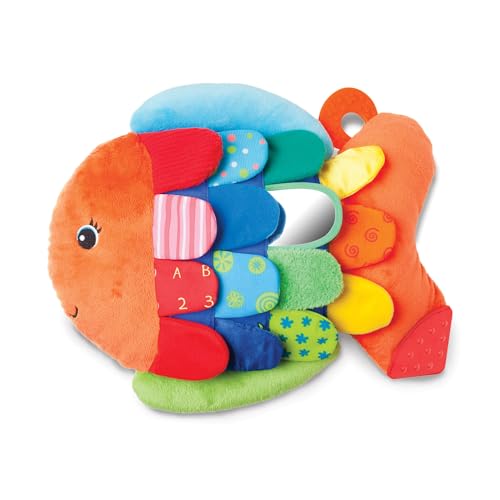
A squeaker tail, crinkly fabric, and a shatterproof mirror all packed into one soft fish mean this toy hits three different sensory notes at once. That variety is exactly what makes it a top pick for infants who are just starting to explore textures and cause-and-effect. The hidden pictures under each scale invite exploration, and at under a pound and sized to fit small hands, it’s easy for a baby to grasp and mouth safely. The surface-washable build means it survives the inevitable drool-and-spit-up phase without drama.
This fish doesn’t beep, light up, or talk back. For a baby who’s already captivated by electronic toys, other options with buttons and sounds might hold attention longer. But if you’re looking for a screen-free, low-battery-dependency toy that still delivers rich sensory feedback, the Flip Fish does it with fabric textures, a mirror, and that satisfying crinkle. It’s a deliberate, quiet kind of play that encourages a baby to focus on touch and sight rather than flashing lights.
Fisher-Price Laugh & Learn Smart Stages Puppy

What We Like
- 80+ songs, sounds and phrases
- 3 Smart Stages levels grow with child
- Lights and music teach colors
- Develops fine and gross motor skills
Trade-offs
- No volume control mentioned
- Requires 5 activations for full play
With 80+ songs, sounds and phrases packed into a soft plush body, this puppy does more than just sit there. Five press points on its belly trigger lights and music that teach colors, first words, and the alphabet, all while encouraging fine and gross motor skills. The three Smart Stages levels mean the toy adapts as your child grows from 6 months to 3 years, so it stays challenging without becoming frustrating. For a first electronic toy that feels more like a cuddly friend than a screen, this is a smart way to introduce early learning concepts through play.
The five activations are the only ways to interact, which keeps the play focused on the belly buttons. Compared to the VTech Busy Learners Activity Cube, which offers multiple sides and activities, the puppy’s interaction is more concentrated. But if you want a toy that combines comfort with learning and won’t take over your living room floor, this lightweight plush is a practical choice. It’s not a replacement for building blocks or stacking cups, but it fills a specific niche for musical, language-rich play.
The First Years Stack & Count Stacking Cups

What We Like
- Brightly colored for visual engagement
- Unique holes for water and bath play
- Large numbers on bottom for counting practice
- BPA-free and easy to clean
Trade-offs
- Only 8 pieces limit complex stacking builds
- No batteries or electronic features
Eight cups that stack, pour, and hide treasures under them, that’s the whole package here, and for a 9-month-old it delivers exactly what the age needs. The bright colors grab attention, the holes in the bottom turn bath time into a pouring experiment, and the large numbers on each cup give you a sneaky way to introduce counting during play. At just 0.3 pounds and small enough to tuck into a diaper bag, these cups travel easily and clean up in seconds. They’re a straightforward toy that works with a curious kid and some water.
The eight cups are small, so they’re easy to pack for travel or stash in a diaper bag, but they can also get lost in a bigger toy bin. For a first stacking toy that works in the tub, at the beach, or on the kitchen floor, these cups keep play straightforward and mess-free. If your child is in the 9-months-and-up range and you want something that supports counting and water play, this set fits the bill.
Product photos
Melissa & Doug 100 Wooden Building Blocks

What We Like
- 100 solid wood blocks in 4 colors
- 9 classic shapes for varied construction
- Sturdy storage box with carrying handle
- Montessori learning for fine motor skills
Trade-offs
- Cardboard storage box less durable than plastic
- No interlocking mechanism, purely stacking play
With 100 solid wood blocks in 4 colors and 9 shapes, this set gives toddlers the raw material for endless tower, bridge, and castle experiments. The variety means a child isn’t stuck repeating the same stack, they can sort by color, count pieces, or balance a rectangle on a triangle, which quietly builds fine motor control and early math sense. It’s the kind of open-ended play that grows with a kid: at two they knock it down, at four they plan a structure. For parents who want a classic, screen-free activity that teaches through doing, this is the one to grab.
The included storage is a cardboard box with a handle, sturdy enough for a shelf. But it’s not something you’d toss in a diaper bag or let a teething toddler chew on. Compared to the Fisher-Price Baby’s First Blocks, which uses BPA-free plastic and a lidded bucket, this set feels more like a home toy than a travel companion. For everyday play that encourages creativity without batteries or noise, this set delivers exactly what it promises.
Product photos
Kidoozie Whirl 'N Go Ball Tower

What We Like
- Six colorful levels for visual tracking
- Rattle balls with beads for sound
- No batteries or lights needed
- Teaches cause and effect through play
Trade-offs
- Requires a hard, flat floor for setup
- Tower must be lifted by base to stay together
- Only four balls included for repeated play
A 13.8-inch tower with six levels means each drop sends the ball spiraling to a different spot, so your baby keeps watching to see where it lands next. That repeated visual tracking builds hand-eye coordination and fine motor skills through a simple cause-and-effect loop. For a first birthday or any toddler between 9 and 24 months, this is a screen-free toy that rewards attention with a rattle and a pop. The four clear balls are filled with colorful beads, so every roll adds a gentle sound that draws little eyes back to the action. No batteries, no lights, just physics and curiosity doing the work.
The Kidoozie Whirl ‘N Go Ball Tower is all about motion and cause and effect, making it a perfect fit for the 9-to-24-month age range. To keep it stable, you’ll want to set it on a hard, flat floor and lift it by the base so the levels stay together. Compared to the Fisher-Price Baby’s First Blocks, which focuses on sorting and stacking, this toy delivers the kind of repetitive play that builds early skills.
Product photos
VTech Turn and Learn Driver
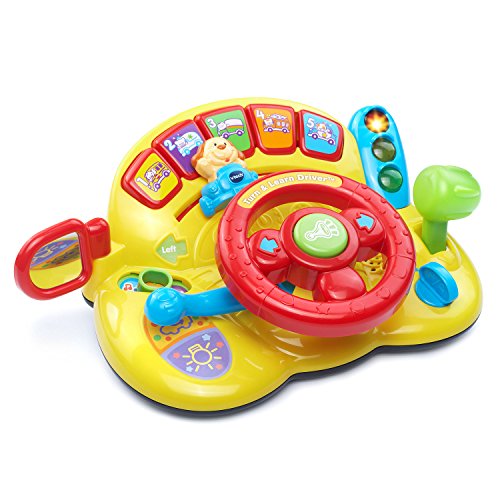
What We Like
- Over 60 songs and phrases
- Three play modes for variety
- Steering wheel with signal lever and mirror
- Horn teaches road safety with lights
Trade-offs
- Demo batteries only, new ones needed
- No sound or lights without fresh AA batteries
With over 60 songs and phrases packed into three play modes, this driving toy keeps little hands busy turning the wheel, pressing buttons, and shifting gears. It’s designed for ages 6 to 36 months, so it grows with your child from early cause-and-effect play to more imaginative role-play. The horn introduces red, yellow, and green lights, making it a subtle way to start teaching road safety and simple opposites like stop and go.
The toy comes with demo batteries only, so you’ll need to supply fresh AA cells right away for regular use. At 1.4 pounds, it’s light enough for a toddler to carry. The VTech Busy Learners Activity Cube is another option from the same brand, but the Turn and Learn Driver focuses on pretend driving with a steering wheel, signal lever, mirror, and gear shifter. If your little one loves mimicking grown-up actions like driving, this toy offers a range of sounds and modes to keep them engaged.
How We Evaluated Baby Toys
We started by reviewing manufacturer specifications and developmental claims for dozens of toys. We then cross-referenced those with expert round-ups from child development specialists and occupational therapists to understand which features truly support growth.
Four criteria mattered most. Age range and adaptability came first: a toy that only works for three months is a poor investment. Skill development was our second filter. Does the toy encourage fine motor skills, cause-and-effect learning, or language? Sensory engagement (textures, sounds, colors, music) ranked third, especially for younger infants. Durability and safety rounded out our list, because a toy that breaks or has small parts is no good to anyone.
Every evaluation has limits. This selection is based on specs, expert opinion, and parent feedback, so you can make a confident choice.
What To Look For In Baby Toys
Choosing a baby toy is simpler when you know what to check. Focus on age fit, skill-building potential, and safety first.
Pick toys that match your baby’s current developmental stage, offer at least two ways to play, and are made from safe, durable materials with no small parts that could become choking hazards.
Age Range and Adaptability
The best baby toys serve your child for months, not weeks. Look for toys with a broad age range, 6 months to 3 years is ideal, or toys with adjustable settings, like Fisher-Price’s Smart Stages technology. A toy that works for tummy time, sitting play, and standing play will earn its place in your home. Our guide on toys by age can help you match a toy to your baby’s exact stage.
Skill Development Focus
Every toy teaches something, but the best ones target specific skills. Fine motor toys like Spike the Hedgehog build hand strength and coordination. Shape sorters teach spatial reasoning. Musical toys develop auditory processing and cause-and-effect understanding. For a deeper look at which developmental toys target which skills, we have a full breakdown.
Sensory Engagement and Safety
Young babies learn through their senses. Look for multiple textures, contrasting colors, gentle sounds, and mirrors. For safety, ensure all parts are securely attached and materials are BPA-free. Also check that there are no small pieces that fit inside a toilet paper roll. Safe soft toys for infants and safe wooden toys offer great options for mouthing and chewing.
- Check the age recommendation on the box, it’s there for safety, not just marketing.
- Run your fingers over every edge and seam for sharp spots or loose threads.
- For electronic toys, confirm whether batteries are included or need to be purchased.
- Washability matters: machine-washable fabric toys and wipe-clean plastic toys last longer.
A good rule of thumb: if you wouldn’t let your baby put it in their mouth, don’t buy it.
Baby Toys Compared
The table below compares all 10 picks side by side, so you can quickly see which toy fits your baby’s age, skills, and play style.
| Product | Age Range | Weight | Dimensions |
|---|---|---|---|
| VTech Busy Learners Activity Cube | 6 months to 3 years | 1.4 pounds | 6.2 x 6.2 x 6.5 inches |
| Baby Einstein 4-in-1 Kickin' Tunes Music and Language Play Gym | 0 to 36 months | 3.2 pounds | 34 x 27 x 18 inches |
| Fisher-Price Baby's First Blocks | 6+ months | 0.7 pounds | 5.1 x 4.9 x 8.3 inches |
| Learning Resources Spike The Hedgehog | Toddler and preschool | 0.1 pounds | 10.0 x 10.0 x 4.0 inches |
| Melissa & Doug Flip Fish Stuffed Animal | 0-9 months | 0.8 lb | 9.8 x 3.7 x 13.5 in |
| Fisher-Price Laugh & Learn Smart Stages Puppy | 6 months to 3 years | 0.8 lb | 7.5 x 10.0 x 11.2 in |
| The First Years Stack & Count Stacking Cups | 9 months+ | 0.3 pounds | 3.5 x 3.2 x 2.5 inches |
| Melissa & Doug 100 Wooden Building Blocks | Ages 2+ | 0.2 pounds | 8.9 x 12.6 x 3.7 inches |
| Kidoozie Whirl 'N Go Ball Tower | 9-24 months | 1.2 lb | 10.2 x 4.7 x 13.8 in |
| VTech Turn and Learn Driver | 6-36 months | 1.4 pounds | 8.9 x 10.8 x 4.3 inches |
Frequently Asked Questions
What is the best baby toy for a 6-month-old?
A multi-textured sensory toy like the Melissa & Doug Flip Fish Stuffed Animal is ideal for 6-month-olds. It offers crinkle sounds, a mirror, and peek-a-boo flaps that engage a baby’s developing senses without overwhelming them with electronics.
When should I introduce shape sorters to my baby?
Most babies are ready for simple shape sorters around 6 to 9 months. The Fisher-Price Baby’s First Blocks works well at this age because the blocks are chunky and easy to grasp, and the bucket stores everything neatly.
Are electronic baby toys better than simple wooden ones?
Neither is inherently better, it depends on your child. Electronic toys like the VTech Busy Learners Activity Cube offer songs, lights, and interactive feedback that can hold attention longer. Wooden toys like the Melissa & Doug 100 Wooden Building Blocks encourage open-ended, screen-free creativity. Many families benefit from having both types.
How many toys does a baby actually need?
Babies do best with a small rotation of 5 to 10 toys that target different skills. Too many options can overwhelm them. Rotating toys every week or two keeps old favorites feeling fresh and helps your child focus on one type of play at a time.
What is the safest material for baby toys?
Solid wood with non-toxic finishes and BPA-free plastic are the safest common materials. Avoid toys with loose magnets, button batteries, or long cords. Always check that fabric toys are labeled as flame-retardant-free and machine-washable.
The Bottom Line
The VTech Busy Learners Activity Cube is the best overall baby toy because it adapts from crawling to toddlerhood, teaches multiple skills, and keeps little hands busy with five sides of play. It’s the one toy that earns its spot in any playroom.
If your budget is tight, the First Years Stack & Count Stacking Cups deliver real developmental value for just a few dollars, they work for stacking, counting, and bath time. For families who prefer battery-free play, the Fisher-Price Baby’s First Blocks and the Melissa & Doug 100 Wooden Building Blocks are timeless choices.
The single most important factor in choosing a baby toy is age fit. A toy that matches your baby’s current developmental stage will engage them, challenge them just enough, and keep them coming back to play again and again.
