
9 Best Wiffle Ball Pitchers in 2026
This post contains affiliate links. As an Amazon Associate, we earn from qualifying purchases.
For consistent batting practice without needing a live arm, the Personal Pitcher Pro Starter Package earns our top spot with its tripod, Web Glove, and Sweet Spot Pad that together teach proper mechanics. The Furlihong 692BH is our Best Budget Pick for families wanting a lightweight machine with plenty of balls, while the Heater Sports Double Play offers a complete all-in-one system with a pitch-back net.
The challenge with wiffle ball pitchers isn’t finding one, it’s finding one that matches your space, the player’s age, and how seriously you want to train. A machine that works great in a backyard might frustrate a family with limited storage, and a toy that delights a five-year-old won’t challenge a Little League player.
We built this guide by comparing specifications, manufacturer claims, and patterns in owner feedback across nine different models. Whether you need a compact unit for apartment living or a full training station for the yard, these picks cover the range.
Top 9 Wiffle Ball Pitchers in the Market
Certain content that appears on this site comes from Amazon. This content is provided "as is" and is subject to change or removal at any time.
The Best Wiffle Ball Pitchers, Reviewed
Personal Pitcher Pro Starter Package

What We Like
- Includes tripod for adjustable pitch height
- Web Glove teaches proper catch technique
- Sweet Spot Pad gives audible feedback on contact
- Focus Balls vary speed and location for training
Trade-offs
- At 9 pounds, heavier than some portable models
- Tripod adds setup steps before each session
- Plastic balls lack vibration feedback without pad
A 9-pound pitching machine with a collapsible tripod and four dozen balls means you can set up realistic batting practice anywhere a flat patch of ground exists. The tripod adjusts for baseball or softball height, so a young player learning to track pitches and an adult refining timing both get useful reps. What makes this package stand out is the Web Glove and Sweet Spot Pad: the glove teaches catching in the web (not the palm), and the pad strapped to the bat pops when you hit the sweet spot, replacing the missing vibration of plastic balls. That combination turns a simple machine into a complete skill builder for players from Little Leagues to the Big Leagues.
The trade-off is weight and setup time. At nine pounds, it is heavier than some portable models like the Furlihong 692BH (4.4 pounds) or the Franklin Sports MLB Pitching Machine (4.0 pounds), so carrying it from garage to backyard may require both hands. The tripod also means you cannot just unfold and toss: you have to extend legs, lock height, and level the base before each session. For a parent setting up quickly after work, that extra minute might chafe. But if you want a machine that grows with a player from beginner to advanced, the included accessories and adjustable delivery provide a versatile training package.
Personal Pitcher Pro Pitching Machine
What We Like
- Weighs under 6 lbs for easy carrying
- Mounts onto any standard camera tripod
- Throws left and right handed curveballs
- 4 speed settings from 15 to 95 mph
Trade-offs
- Requires a separate camera tripod to operate
- Uses only proprietary small balls (48 included)
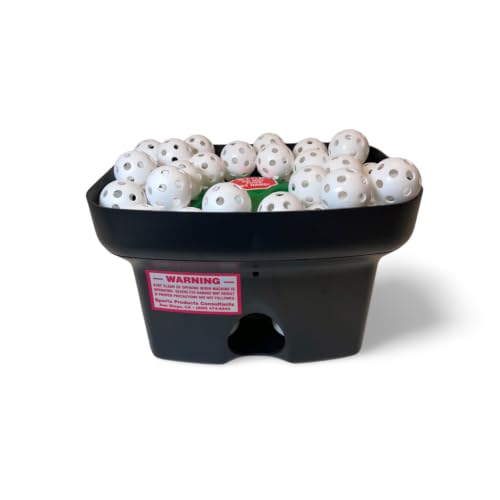
Weighing under six pounds and built to attach to any standard camera tripod, this pitching machine fits into a small backyard or garage for batting practice. It uses lightweight, perforated balls roughly the size of golf balls, so you can swing a real wood bat without worrying about cracked lumber. The four speed settings simulate anything from a gentle lob to a fastball based on distance and reaction time. That means a young kid learning to track pitches and a high school player working on timing can both get useful reps from the same unit.
The Personal Pitcher Pro is a compact specialist, not an all-in-one solution. It needs a tripod you already own or buy separately, and it only works with its own small balls. The 48 that come with it are enough for a session, but you cannot feed it standard wiffle balls or tennis balls in a pinch. Compared to the Heater Sports Double Play, which bundles a heavy net and machine into one thirty-pound package, this setup is far more portable and space-friendly, but you have to supply the stand and accept the proprietary ammo.
Personal Pitcher Pro Hitmaster Bat Package
What We Like
- 30-inch Hitmaster bat with thin barrel
- Tripod adjustable for varied pitches
- Web Glove for fielding practice
Trade-offs
- Small balls limit outdoor use in wind
- Sweet Spot Pad not included in this package
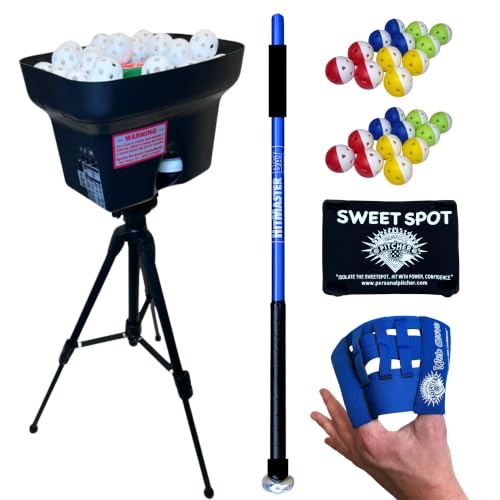
The 30-inch Hitmaster bat with its skinny aluminum barrel forces you to find the center every swing, training hand-eye coordination precisely. This combo pairs that bat with the Personal Pitcher Pro machine, which delivers major-league-quality practice for all ages, plus a tripod for adjusting pitch height and angle. It’s best for a player who wants a complete training system, bat, machine, balls, and even a web glove for catching drills, all in one box. So you can work on hitting weaknesses or break out of a slump without guessing.
Furlihong 692BH Baseball Pitching Machine
What We Like
- Includes 60 training balls
- Adjustable height via screw bolt
- Holds 40 balls for continuous training
- Portable with AC or battery power
Trade-offs
- Uses specialized 5-inch balls, not standard wiffle balls
- Batteries not included
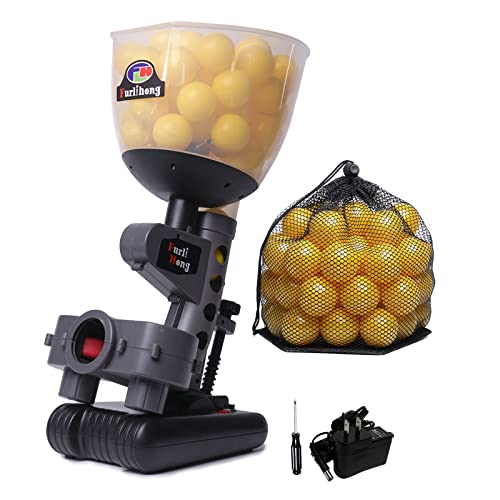
At 4.4 pounds, this machine is light enough to carry from garage to backyard, and the top basket holds 40 balls so you can set up a full practice session without constant reloading. It runs on either AC power or C batteries, which means you can use it anywhere there’s a flat surface, no extension cord required for the backyard. The screw bolt allows angle adjustment, making it suitable for trainers of all ages.
The machine pitches a specialized 5-inch circumference training ball at 18 mph, which is faster than typical wiffle-ball machines and forces batters to track a smaller target. That speed and size combination directly improves hand-eye coordination and swing precision. A full training kit arrives with 60 of these balls, so you can start running drills immediately without an extra trip to the store. Once those wear out or get lost, you will need to buy replacements separately, but the initial supply gives plenty of reps for the first few sessions.
Heater Sports Double Play Pitch Back Net & Pitching Machine
What We Like
- Pitch-back net returns balls automatically
- Large 5×5 catch net with strike zone
- Heavy-duty tripod keeps machine stable
- All-in-one system for pitching, fielding, hitting
Trade-offs
- At 30 pounds, it's the heaviest option here
- Requires setup of net, tripod, and machine
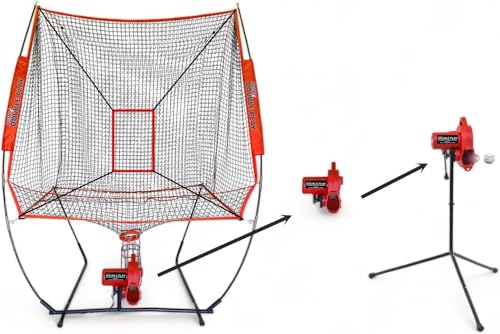
A 5×5 foot catch net with a built-in strike zone means you can pitch, field, and hit without chasing balls across the yard. The included pitching machine and heavy-duty tripod turn this into a complete practice station that works for solo drills or team sessions. It’s the kind of setup that saves time and keeps focus on skill development, especially for players who want to work on multiple parts of their game in one spot.
Weight and setup define this system. At 30 pounds, this is the heaviest system here, far more than the 4-pound Franklin Sports MLB machine. You’re not tossing this in a bag for the park; it’s a backyard anchor. But that weight also means the tripod and net stay put during hard throws, so you’re trading portability for stability. If you have a dedicated practice space and want a machine that does more than just lob balls, this covers the bases.
Product photos
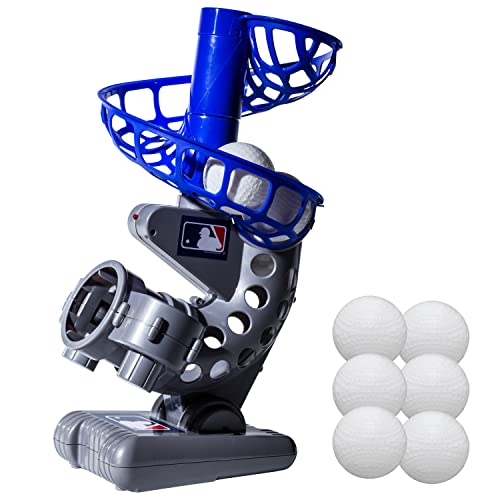
Franklin Sports MLB Pitching Machine
What We Like
- Automatic pitch every 7 seconds
- Flashing light signals pitch release
- Three adjustable pitching angles
- Comes with six training balls
Trade-offs
- Only use included balls, not regulation ones
- Requires plastic bat for best results
A 7-second automatic pitch cycle means this machine turns backyard practice into a steady, predictable rhythm, no parent needed to throw. The flashing red light cues the batter to get set, mimicking the timing of a real at-bat without the pressure of a live arm. It’s ideal for young hitters building hand-eye coordination and confidence, especially when you want consistent reps without wearing out your shoulder. The three angle adjustments let you vary the pitch trajectory, so a kid can work on different batting angles as they improve.
This machine is picky about its ammunition. You’re locked into the included AERO-STRIKE balls, and the instructions warn against using regulation baseballs or tee balls. That keeps things safe for plastic bats, but it also means you can’t just grab any ball from the bucket when the six wear out. Compared to the Personal Pitcher Pro Starter Package, which is heavier at 9.0 pounds and larger, the Franklin is lighter and more compact. For a young beginner focused on repetition in the backyard, that simplicity is a practical fit.
Product photos
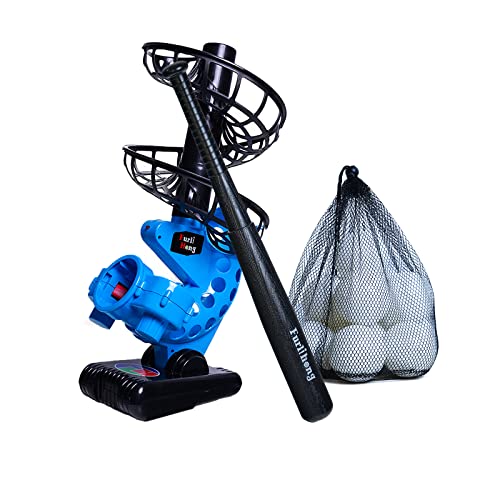
Furlihong 380BH Baseball Pitching Machine
What We Like
- Sting-free plastic training balls included
- Battery powered for outdoor use
- Adjustable launch angles for different ages
- Lightweight at 2.1 pounds
Trade-offs
- Only compatible with Furlihong training balls
- Requires 4 D batteries, not rechargeable
At just 20 MPH with sting-free plastic balls, this machine is built to eliminate fear and frustration for young hitters. The three adjustable launch angles let you tailor the pitch height as your kid grows, and the automatic feed every seven seconds keeps practice moving without constant ball retrieval. It runs on four D batteries, so you can set it up in the backyard or at the park without hunting for an outlet. For a parent looking to help a beginner build confidence at the plate, this setup removes the sting and the need for a power cord.
The Furlihong 380BH pitches at 20 MPH, which is gentle enough for young beginners to learn without fear of sting or dented bats, but a kid who’s already crushing faster pitches may outgrow it. You’re locked into using only Furlihong’s plastic training balls to avoid jamming or damage. For a lightweight, battery-powered trainer that takes the sting out of learning, this one hits the mark for young beginners.
Product photos
Franklin Sports MLB Pop A Pitch Baseball Pitching Machine

What We Like
- Step-on pedal for easy launch
- Auto ball feeder loads 3 balls
- Includes collapsible youth bat
- MLB approved toy
Trade-offs
- Only 3 balls included for practice
- Plastic balls limit realistic feel
The step-on pedal launch is the single most decisive feature here, your kid steps, the ball pops up, and they swing. That direct cause-and-effect keeps a young hitter engaged without fumbling with switches or remotes. It suits beginners who need instant feedback and a toy that feels like a game, not a drill. The auto ball feeder loads three plastic balls so you can run a quick sequence before reloading, which keeps practice moving fast enough for short attention spans. For a first introduction to batting, this machine removes the frustration of timing a machine that fires on a timer.
Those three plastic balls and fixed launch angle limit how far this can take a developing hitter. Once a kid outgrows the pop-up motion, they’ll want something like the Personal Pitcher Pro Starter Package that offers adjustable toss height and uses more realistic small balls. But for a child who’s still learning to keep their eye on the ball and make contact, the Franklin’s simplicity is exactly what you want, nothing to adjust, no batteries to check, just step and hit. It’s a starter toy, not a training machine, and that’s fine for its job.
Product photos
DGD MAX Baseball Pitching Machine
What We Like
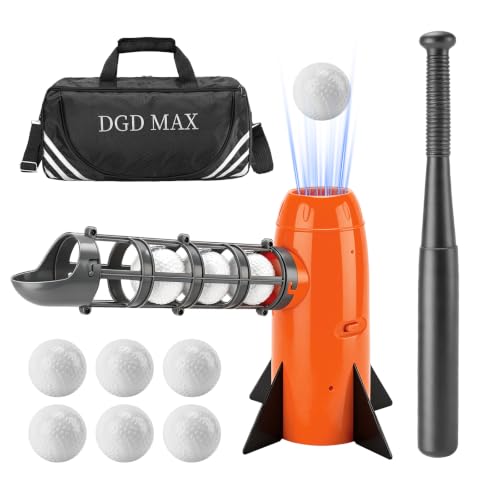
- Complete set includes bat, balls, bag
- Lightweight at 0.7 pounds
- Works indoors and outdoors
- Automatic pop-up pitching action
Trade-offs
- Batteries not included
- No angle or speed adjustments specified
The DGD MAX Pitching Machine weighs just 0.7 pounds and arrives as a complete set with 10 lightweight plastic balls, a collapsible wiffle ball bat, and a portable sports bag. That means you can pull it out of the box, add four AA batteries, and have a kid swinging in the backyard or basement within minutes. It’s designed for young beginners who need a simple, automatic pop-up toss to build hand-eye coordination without the frustration of chasing missed pitches. For parents wanting a ready-to-play kit that encourages active outdoor play and gets kids away from screens, this is the most straightforward option in the guide.
The DGD MAX launches balls straight up at a fixed height and speed, which means no adjustability for different pitch types. For a child just learning to connect bat with ball, the simplicity is actually a strength, fewer settings mean less frustration and more swings. The Franklin Sports MLB Pitching Machine offers three angle settings and a flashing light signal, but the DGD MAX keeps it straightforward. You will need 4 AA batteries (not included) to power it.
Product photos
How We Evaluated Wiffle Ball Pitchers
Our evaluation is research-based: we studied manufacturer documentation, expert round-ups, and recurring themes in owner experiences to separate what actually works from what only looks good on paper.
Three criteria mattered most. Pitch adjustability determines whether a machine grows with a player or becomes boring after a week. That includes speed settings and angle control. Portability and setup separates machines that get used from those that stay in the garage. A 30-pound all-in-one system serves a different purpose than a 2.1-pound toy. Ball compatibility matters because proprietary balls lock you into one system, while standard wiffle balls offer cheaper replacements.
The honest limit of a research-led evaluation is that feel matters, the sound of contact, the sting of a miss, and those are hard to measure from a spec sheet. We prioritized machines with clear, verifiable features and consistent owner feedback over those with flashy but vague claims. For a deeper look at the category, see our full guide on wiffle ball pitching machines.
What To Look For In Wiffle Ball Pitchers
A wiffle ball pitcher should match the player’s age, the available space, and how often you plan to use it. The right machine makes practice fun; the wrong one collects dust.
Look for adjustable speed and angle settings so the machine challenges the player as they improve. Check whether it uses standard wiffle balls or proprietary ones, and confirm the setup time matches your patience level. Weight and power source determine where you can use it.
Speed and Angle Adjustability
A machine with multiple speed settings keeps practice productive as skills improve. The Personal Pitcher Pro offers four speed settings from 15 to 95 mph, while simpler models like the Franklin Sports Pop A Pitch launch at a single speed. Angle adjustment matters too, a low launch angle simulates a real pitch, while a higher arc helps beginners track the ball. Machines with no adjustability tend to get outgrown quickly.
Portability and Setup
Weight ranges from 0.7 pounds for the DGD MAX to 30 pounds for the Heater Sports Double Play. A machine under six pounds, like the Personal Pitcher Pro Pitching Machine, can stow in a closet and mount on any standard camera tripod. Heavier all-in-one systems require dedicated backyard space and assembly time. Consider where you’ll store it and whether you’ll drag it to a field or leave it set up.
Ball Type and Replacement Cost
Some machines use standard wiffle balls you can buy anywhere, while others require proprietary balls. The Furlihong models use specialized 5-inch training balls, and the Personal Pitcher Pro uses its own small balls. Proprietary balls mean ongoing cost and the risk of being unable to find replacements later. If you plan to practice often, a machine that accepts common balls saves money and frustration.
- Check whether the machine comes with enough balls for a full practice session.
- Confirm the power source, battery, AC adapter, or both, matches where you’ll use it.
- Look at the ball feeder capacity: a 40-ball hopper means fewer interruptions than a 3-ball auto feeder.
- Consider the bat included: some packages add a thin-barrel trainer bat that improves swing mechanics.
A machine that needs proprietary balls costs more over time than one that uses standard wiffle balls.
Wiffle Ball Pitchers Compared
The table below compares key specs across all nine picks so you can see at a glance which machine fits your space, budget, and training goals.
| Product | Weight | Ball Type | Pitch Types / Speed |
|---|---|---|---|
| Personal Pitcher Pro Starter Package | 9.0 pounds | 4 dozen + 2 dozen Focus Balls | N/A |
| Personal Pitcher Pro Pitching Machine | 6.0 pounds | Small golf-ball-size plastic balls | Fastballs, curveballs, sliders, soft toss; 4 speed settings (simulates 15-95 mph) |
| Personal Pitcher Pro Hitmaster Bat Package | N/A | N/A | N/A |
| Furlihong 692BH Baseball Pitching Machine | 4.4 pounds | 5-inch circumference training ball | 18 mph |
| Heater Sports Double Play Pitch Back Net & Pitching Machine | 30.0 pounds | N/A | N/A |
| Franklin Sports MLB Pitching Machine | 4.0 Pounds | 6 AERO-STRIKE baseballs | Every 7 seconds; 3 adjustable angles |
| Furlihong 380BH Baseball Pitching Machine | 2.1 pounds | Furlihong plastic training balls (0.81 oz) | 20 MPH; 3 launch angles; every 7 seconds |
| Franklin Sports MLB Pop A Pitch Baseball Pitching Machine | N/A | 3 plastic baseballs | Step-on pedal launch |
| DGD MAX Baseball Pitching Machine | 0.7 pounds | 10 lightweight plastic baseballs | Automatic pitching |
Frequently Asked Questions
What is the best wiffle ball pitcher for a young child?
The Franklin Sports Pop A Pitch is designed for young children taking their first swings, with a step-on pedal for easy launch and an auto ball feeder that loads three balls. The Furlihong 380BH is another strong option at just 2.1 pounds with soft, sting-free training balls.
Can a wiffle ball pitcher throw curveballs?
Yes, the Personal Pitcher Pro Pitching Machine throws both left-handed and right-handed curveballs. It mounts onto any standard camera tripod and offers four speed settings, making it one of the few portable models with curveball capability.
How fast do wiffle ball pitching machines throw?
Speed depends on the model. The Personal Pitcher Pro series ranges from 15 to 95 mph across four settings, while simpler battery-powered machines like the Furlihong models launch at lower speeds suitable for beginners. Always match the speed to the player’s age and experience level.
Do I need a separate tripod for a wiffle ball pitcher?
Some models include a tripod, and some require you to supply your own. The Personal Pitcher Pro Starter Package comes with a tripod, while the Personal Pitcher Pro Pitching Machine needs a standard camera tripod. Check the package contents before buying to avoid an extra purchase. For players just starting out, a simple T-ball tee may be a better first step than a pitching machine.
What is the difference between a wiffle ball pitcher and a baseball pitching machine?
Wiffle ball pitchers are designed for lightweight plastic balls and are generally smaller, lighter, and slower than full-size baseball pitching machines. They work well for backyard practice with kids, while baseball machines handle regulation balls at higher speeds and usually require more space and a stronger power source. For younger players, exploring different baseball practice toys can help build foundational skills before introducing a machine.
The Bottom Line
The Personal Pitcher Pro Starter Package is the best overall choice for families who want a serious training tool that grows with the player. Its tripod, Web Glove, and Sweet Spot Pad provide feedback that makes practice productive, and the four speed settings keep it challenging from Little League through high school.
If space is tight, the Personal Pitcher Pro Pitching Machine stows in a closet and sets up on any camera tripod, ideal for apartments or small yards. For families on a budget, the Furlihong 692BH includes 60 training balls and runs on AC or battery power, giving you a lot of practice time for the money.
The single most important factor is honesty about how you’ll use it. A heavy all-in-one system is great if you have a dedicated backyard spot; a lightweight, battery-powered machine is better if you’ll pack it to the park. Pick the one that fits your actual routine, not the one with the most features on paper. For indoor fun that builds baseball knowledge, baseball board games make a good companion to outdoor practice.
