
10 Best Toys For Building Problem-solving Skills in 2026
This post contains affiliate links. As an Amazon Associate, we earn from qualifying purchases.
The best overall toy for building problem-solving skills is the Snap Circuits Explorer SC-100 Electronics Kit, which wins for its structured, tool-free approach to teaching circuitry through 100 guided projects. The MAGNA-TILES Classic 100-Piece Set is our pick for the best classic magnetic set, and the ThinkFun Roller Coaster Challenge is the best logic-building game for kids who love a clear goal.
The real challenge for parents is finding a toy that balances structured learning with open-ended exploration. A toy that is too rigid can bore a child, while one that is too free-form can leave them frustrated without a starting point. The best problem-solving toys give kids just enough guidance to begin, then step back and let them figure out the rest.
This guide is based on a careful review of manufacturer specifications, expert round-ups on child development, and patterns in owner feedback. We focused on toys that require a child to plan, test, and adjust their approach, the core of real problem-solving. Each pick earned its spot by offering a clear path from challenge to solution, whether that path is a project manual or a magnetic tile.
Top 10 Toys For Building Problem-Solving Skills in the Market


Certain content that appears on this site comes from Amazon. This content is provided "as is" and is subject to change or removal at any time.
The Best Toys For Building Problem-Solving Skills, Reviewed
Snap Circuits Explorer SC-100 Electronics Kit
What We Like
- 100+ projects from 29 parts
- No tools or soldering required
- Color-coded, numbered snap pieces
- Award-winning STEM kit
Trade-offs
- Requires batteries (not included)
- Projects limited to included parts
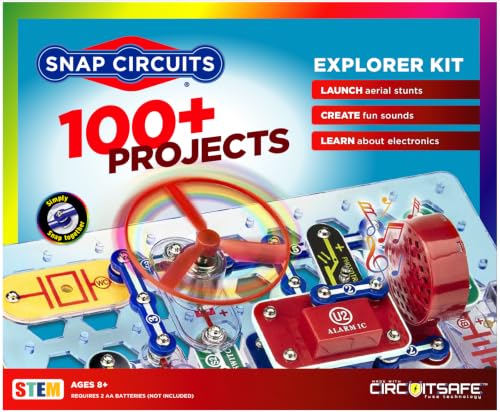
One hundred-plus projects from just twenty-nine snap-together parts, and that ratio alone tells you this kit is built to teach systematic troubleshooting. Each numbered, color-coded piece clicks onto the included plastic grid without a single tool or drop of solder, so an eight-year-old can dive straight into building a flying saucer or a sound-alarm circuit. The real problem-solving payoff comes from the manual: you follow a schematic, make a mistake, and have to trace the path back to find the loose connection. It’s the kind of patient, methodical thinking that sticks. For a family wanting one box that delivers weeks of genuine engineering logic without the frustration of hot glue or stripped screws, this is the kit I’d hand a kid first.
Once your child has built all hundred-plus projects, the creative ceiling is lower than, say, a magnetic building set like MAGNA-TILES, where the only limit is how many pieces you own. It’s a structured introduction to cause and effect in electronics, not an open-ended free-for-all.
MAGNA-TILES Classic 100-Piece Magnetic Construction Set
What We Like
- Certified STEAM toy for cognitive skill development
- Food-grade, non-toxic MABS plastic
- All pieces compatible with other MAGNA-TILES sets
Trade-offs
- No included guide or challenge cards for structured play
- Set weighs 7.0 pounds, heavy for small children to carry
One hundred translucent geometric shapes in six colors mean this set gives a child enough raw material to explore symmetry, balance, and structural logic from the ground up. The original magnetic building brand earned its reputation by using food-grade MABS plastic with riveted magnets that stay secure. That means you are not picking magnets off the floor or worrying about cracked tiles. This is the starter set for families with three-year-olds and up, and the lack of a prescribed build list is actually the point: the problem-solving happens when a tower keeps falling and the child has to figure out why.
The trade-off is that at 7.0 pounds, this set is heavier than many other building toys, and the 100 pieces include many small triangles that can be misplaced.
Learning Resources Gears Deluxe Building Set

What We Like
- 100-piece set for open-ended builds
- Crank handle adds mechanical motion
- Interlocking pieces teach cause and effect
- Develops fine motor and spatial reasoning
Trade-offs
- No project manual for guided play
- Small pieces are easy to lose.
A 100-piece set of interlocking gears, pillars, and bases gives kids the raw materials to build spinning machines, towers, and moving creations from the ground up. That crank handle turns abstract cause-and-effect into something they can see and feel, which is exactly what builds early engineering intuition. For a child who prefers tinkering over following blueprints, this set rewards experimentation and lets them learn through trial and error without a single wrong answer.
The 100-piece Gears Deluxe Building Set comes without a project manual, so children who need step-by-step instructions may require adult help to get started. That makes it a better fit for curious builders who enjoy figuring things out on their own, but less ideal for kids who want clear structure right away.
Product photos
ThinkFun Roller Coaster Challenge STEM Toy

What We Like
- 40 challenge cards with solutions included
- Forty mind-challenging cards with solutions included
- Game board, posts, tracks, and car included
Trade-offs
- Only one car included, limiting simultaneous play
- No official expansion sets available
Once they work through all forty cards, they’ve seen the full set of solutions, and there’s no official expansion to keep the challenge growing. If your child loves building and re-building the same coaster to perfect the ride, the finite challenges won’t bother them; if they burn through puzzles fast, they may want more variety before long.
MAGNA-TILES Downhill Duo 40-Piece Magnetic Set
What We Like
- Includes ramps and vehicles for motion play
- Encourages cause-and-effect learning through building
- Pieces compatible with all other MAGNA-TILES sets
- Safe, durable construction with secured magnets
Trade-offs
- 40 pieces limit complex track designs compared to larger sets
- Only two vehicles and two figures for multi-child play
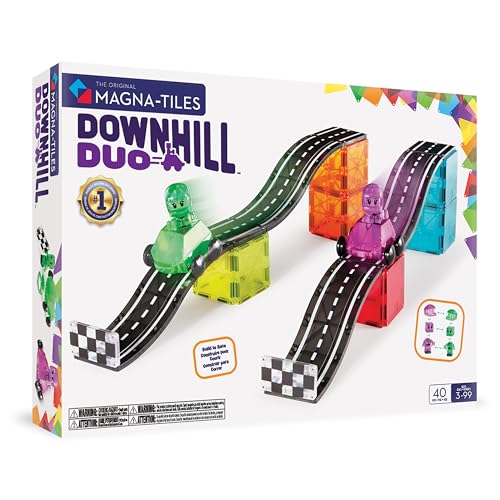
The set includes four ramps, two vehicles, and two figures, which let kids explore motion and cause-and-effect play as described in the product’s STEAM learning focus. The 40-piece count is a manageable size for young builders, and the food-grade MABS plastic with secured magnets means parents don’t have to worry about safety during play. It suits families who want a child-led introduction to building and action, especially kids who enjoy sending vehicles down ramps.
Forty pieces limit how much you can build at once, especially compared to larger sets like the MAGNA-TILES Classic 100-Piece set, which has more pieces for bigger structures. This Downhill Duo focuses on ramps and road pieces rather than vertical building, so it works best as a starter set for younger children. For a three-year-old learning how ramps and vehicles work together, it provides a focused, frustration-free experience.
Learning Resources STEM Explorers Machine Makers
What We Like
- 9 STEM challenges build critical thinking
- Real-world designs like satellite dish, crane
- Works with Gears! Gears! Gears! sets
- Lightweight at 0.9 pounds
Trade-offs
- Only 9 challenges limit long-term variety
- No storage case included for small pieces
Nine engineering challenges, building a satellite dish, crane, or space rover, teach kids to test and tweak designs, which is the heart of real-world problem solving. At just 0.9 pounds, this set is light enough for a five-year-old to carry between table and floor, and the trial-and-error process builds critical thinking without feeling like homework. It suits young engineers who need a structured starting point rather than open-ended free play.
The trade-off is that nine challenges give less replay mileage than sets with dozens of projects, like Snap Circuits Explorer SC-100. Younger builders may finish the included tasks quickly and want more, though the compatibility with Gears! Gears! Gears! sets means you can expand later without starting over. For a focused introduction to how machines work, this is a clean, frustration-free entry point.
Product photos
K'NEX Typhoon Frenzy Roller Coaster Building Set

What We Like
- Motorized power makes the coaster run
- 640+ pieces for detailed construction
- Second model available via online instructions
Trade-offs
- Age 9+ limits younger problem-solvers
- Finished 19 ft build needs a large open floor
With over 640 pieces and 19 feet of track, this set is a large-scale project that rewards careful assembly, and the motorized power means the finished coaster actually runs. It’s designed for kids aged 9 and up who enjoy building something that moves.
The finished coaster stretches 19 feet, so it will need a large open area to set up, not a desk or small table. Compared to the ThinkFun Roller Coaster Challenge, which uses a compact board game format, this K’NEX set requires more space and assembly time. It works well for a builder who wants a weekend-long project, but less so for families with limited floor space or those seeking a shorter activity.
Tsomtto 10-in-1 STEM Building Kit

What We Like
- 10 different build options in one kit
- Includes step-by-step guide booklet
- Non-toxic, washable blocks
- Sturdy storage box for cleanup
Trade-offs
- Only one model can be built at a time
- 167 pieces limit complexity for older kids
- No electronic or moving parts included
With 167 pieces that build into 10 different models, tower crane, forklift, rocket car, robot, helicopter and more, this kit gives a child multiple building challenges without needing a separate box for each one. The step-by-step guide booklet helps kids follow assembly instructions, which supports early STEM learning. For families who want a variety of builds from a single set, this offers a lot of options in one box.
You can only build one model at a time, so if two kids want to build simultaneously, they’ll need to share or take turns. At 167 pieces, the builds are designed for the 4-8+ age range, focusing on simple construction rather than electronics or moving parts. For a child just starting with building kits, this provides a straightforward introduction to following instructions and assembling models.
Product photos
Butterfly EduFields Girls Engineering Science Kit
What We Like
- 100+ hands-on engineering and science models
- Develops problem-solving, creativity, scientific thinking
- Clear illustrated step-by-step guides
- Reusable parts rebuild again and again
Trade-offs
- 1.3 pounds is light for complex builds
- 10-inch box limits large project storage
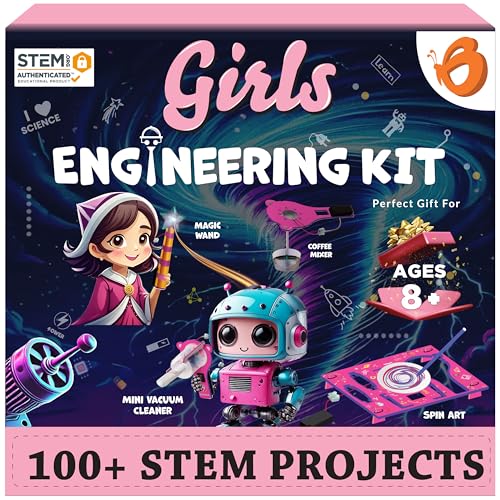
With over 100 hands-on engineering and science models, gears, levers, circuits, and working machines, this kit lets a daughter explore a wide range of STEM concepts without needing a new set every few days. Each project teaches a core science, technology, engineering, or math idea by doing, not memorizing, which builds problem-solving and scientific thinking through real experiments. The illustrated step-by-step guides are designed for elementary and middle-school girls, and the durable, child-safe parts can be rebuilt again and again. It’s a screen-free educational gift that supports curious young inventors over many sessions.
The kit weighs just 1.3 pounds and comes in a 10-inch box, so it’s easy to store on a shelf or take to a friend’s house. But it won’t support the kind of sprawling floor builds you get with the 7.0-pound MAGNA-TILES Classic 100-Piece set. That set offers open-ended magnetic construction for free-form play, while this one focuses on guided engineering projects. For a child who wants to follow step-by-step instructions to build working machines and circuits, this kit provides a structured introduction to STEM concepts.
Product photos
LEGO Technic NASA Artemis Space Launch System Rocket
What We Like
- Hand-crank 3-stage rocket separation
- Created with NASA and ESA
- Includes 4 astronaut nanofigures
- 632-piece build for older kids
Trade-offs
- Large finished height needs display space
- No electronics or moving parts beyond crank
- Single-build set with no rebuild options
A 27.5-inch-tall replica of the Artemis launch system means this isn’t just another brick pile, it’s a display-worthy model with a hand-cranked three-stage separation. The 632-piece count and NASA/ESA collaboration make it a detailed build for space-obsessed kids ages 9 and up. The hand crank lets them separate the solid rocket boosters, core stage, and upper stage with Orion spacecraft, showing the sequence of a real launch system.
The LEGO Technic NASA Artemis Space Launch System Rocket stands over 27.5 inches high when placed on its display stand, so it makes a dramatic centerpiece for any space fan’s room. Kids turn a hand crank to watch the rocket separate in three stages: the solid rocket boosters, then the core stage, and finally the upper stage with the Orion spacecraft. This 632-piece set was developed with NASA and ESA, meaning the build mirrors the real system that will send astronauts to the moon.
Product photos
How We Evaluated Toys For Building Problem-Solving Skills
We researched each toy by examining its official specifications, reading expert opinions on cognitive skill development, and analyzing what parents and educators report in their long-term feedback. This research-led approach means we can tell you what a toy is designed to do, how it works, and what kinds of kids tend to enjoy it most, without pretending we ran a lab test.
The three criteria that mattered most were the type of problem-solving each toy teaches, the age range it actually serves, and the ratio of structure to open-ended play. A toy like the Snap Circuits Explorer teaches sequential logic through guided projects, while the MAGNA-TILES Classic set teaches spatial reasoning and trial-and-error through free building. Both are valuable, but they serve different problem-solving styles.
An honest limit of this research-led evaluation is that we cannot tell you how a specific child will react to a specific toy. Every child learns differently, and the best predictor of success is matching the toy’s style to your child’s personality. We have done our best to describe each toy’s strengths and trade-offs so you can make that match with confidence.
What To Look For In Toys For Building Problem-Solving Skills
The best problem-solving toys give a child a clear challenge and the tools to solve it, then let them fail and try again. Look for a toy that matches your child’s current skill level and offers a path to grow.
A good problem-solving toy provides a clear goal, requires the child to plan and test a solution, and allows for multiple attempts without penalty. The best ones teach that failure is just data.
Type of Problem-Solving
Some toys teach sequential logic, where a child follows a step-by-step process to reach a specific outcome. Others teach spatial reasoning and trial-and-error through open-ended construction. A child who loves following instructions will thrive with a guided kit like the Snap Circuits Explorer or the Butterfly EduFields kit. A child who prefers to invent their own solutions will get more from a magnetic set like MAGNA-TILES or a gear set like Learning Resources Gears.
Age and Skill Level
A toy that is too easy will bore a child; one that is too hard will frustrate them. Pay attention to the manufacturer’s age recommendation, but also consider your child’s experience with similar toys. The K’NEX Typhoon Frenzy is recommended for ages 9 and up because it requires patience for a multi-step build. The MAGNA-TILES Downhill Duo works for ages 3 and up because the magnetic pieces are easy to connect and the cause-and-effect lesson is immediate.
Structure vs. Open-Ended Play
The best problem-solving toys offer a balance of guidance and freedom. A toy with challenge cards, like the ThinkFun Roller Coaster Challenge, provides a clear goal but lets the child figure out the path. A toy with no instructions, like the MAGNA-TILES Classic set, requires the child to invent their own goals. Consider which style your child responds to best.
- Does the toy include a project manual or challenge cards for guided play?
- Can the pieces be used to build multiple different models or just one?
- Does the toy allow for open-ended creative play after the guided projects are done?
- Are the pieces compatible with other sets for future expansion?
- Is the storage solution practical for your home?
A good rule of thumb: if a toy can only be built one way, it teaches following directions. If it can be built many ways, it teaches problem-solving.
Toys For Building Problem-Solving Skills Compared
The table below compares all ten toys across the key criteria that matter most for building problem-solving skills, including the type of play, age range, and number of projects or builds.
| Product | Piece Count | Age Range | Weight | Dimensions |
|---|---|---|---|---|
| Snap Circuits Explorer SC-100 Electronics Kit | 29 snap-together | Ages 8+ | 1.4 pounds | L 12.0 inches, W 9.5 inches, H 1.8 inches |
| MAGNA-TILES Classic 100-Piece Magnetic Construction Set | 100 translucent shapes | Ages 3+ | 7.0 pounds | L 12.1 inches, W 3.3 inches, H 8.7 inches |
| Learning Resources Gears Deluxe Building Set | 100 | Ages 4+ | 2.2 pounds | L 12.0 inches, W 10.4 inches, H 4.1 inches |
| ThinkFun Roller Coaster Challenge STEM Toy | 36 posts, 39 tracks, 1 car | 6 and Up | 1.3 pounds | L 11.0 inches, W 2.8 inches, H 11.6 inches |
| MAGNA-TILES Downhill Duo 40-Piece Magnetic Set | 40 magnetic pieces | Ages 3+ | 0.3 pounds | L 17.1 inches, W 2.6 inches, H 12.1 inches |
| Learning Resources STEM Explorers Machine Makers | 9 STEM challenges | 5+ years | 0.9 pounds | L 9.1 inches, W 10.9 inches, H 3.5 inches |
| K'NEX Typhoon Frenzy Roller Coaster Building Set | 640+ pieces | 9+ | 1.7 pounds | L 16.0 inches, W 14.0 inches, H 3.2 inches |
| Tsomtto 10-in-1 STEM Building Kit | 167 pieces | 4-8+ years | 2.3 pounds | L 10.0 inches, W 6.0 inches, H 5.0 inches |
| Butterfly EduFields Girls Engineering Science Kit | 100+ STEM projects | 8-12 years | 1.3 pounds | L 10.0 inches, W 5.0 inches, H 1.0 inches |
| LEGO Technic NASA Artemis Space Launch System Rocket | 632 pieces | Ages 9+ | 2.2 pounds | L 10.3 inches, W 15.0 inches, H 2.8 inches |
Frequently Asked Questions
What is the best toy for teaching a child how to solve problems step-by-step?
The Snap Circuits Explorer SC-100 Electronics Kit is our top recommendation for teaching sequential problem-solving. Its 100 guided projects teach a child to follow a logical process from start to finish, and the color-coded, numbered pieces make it easy to check their work. This is the best choice for parents who want a structured introduction to circuitry.
What is the best open-ended building toy for problem-solving?
The MAGNA-TILES Classic 100-Piece Magnetic Construction Set is the best choice for open-ended problem-solving. With no instruction manual, children must invent their own goals and figure out how to achieve them through trial and error. The magnetic pieces make it easy to experiment and revise, which is the heart of the problem-solving process.
What is the best problem-solving toy for a 4-year-old?
The Learning Resources Gears Deluxe Building Set is an excellent choice for a 4-year-old. The interlocking gears teach cause and effect in a very direct way, turn the crank and the gears move. This hands-on feedback helps young children understand that their actions produce predictable results, which is a foundational problem-solving skill.
What is the best budget-friendly problem-solving toy?
The Tsomtto 10-in-1 STEM Building Kit is our budget pick because it offers ten different build options from a single set of 167 pieces. The step-by-step guide booklet helps children learn to follow instructions, and the non-toxic, washable blocks make cleanup easy. It is a practical choice for families who want variety without spending a lot.
What is the best problem-solving toy for a 9-year-old who loves space?
The LEGO Technic NASA Artemis Space Launch System Rocket is the best choice for a space-enthusiast 9-year-old. The 632-piece build requires careful attention to detail, and the hand-crank mechanism that demonstrates three-stage rocket separation teaches a real-world engineering concept. It is a single-build set, but the result is a showpiece that rewards patience.
The Bottom Line
The Snap Circuits Explorer SC-100 Electronics Kit is our best overall pick because it offers the clearest path from a problem to a solution. Each of its 100 projects teaches a child to follow a logical sequence, check their work, and troubleshoot when something does not work. It is the best choice for parents who want a structured, tool-free introduction to circuitry.
If your child prefers to invent their own solutions rather than follow instructions, the MAGNA-TILES Classic 100-Piece Set is the better choice. For kids who love a clear logic challenge, the ThinkFun Roller Coaster Challenge provides 40 puzzles that build critical thinking. For a budget-friendly option that still offers variety, the Tsomtto 10-in-1 STEM Building Kit is a reasonable choice.
The single most important factor in choosing a problem-solving toy is matching its style to your child’s personality. A child who loves following instructions will thrive with a guided kit, while a child who prefers to experiment will do better with an open-ended set. Pay attention to how your child naturally approaches challenges, and choose the toy that fits that style.
