10 Best Toys For Autistic 3 Year Olds in 2026
This post contains affiliate links. As an Amazon Associate, we earn from qualifying purchases.
The best toy for most autistic 3-year-olds is the BUNMO Pop Tubes 4 Pack, which wins for its lightweight, open-ended design that encourages creative STEM play through pulling, bending, and connecting. For visual calming, the JOYIN Sensory Fidget Tubes 4 Pack offers excellent visual stimulation, while the hand2mind Sensory Fidget Tubes are our top choice for a dedicated calm down corner.
A three-year-old on the spectrum processes the world differently, and the right toy can make the difference between frustration and focused, joyful play. Sensory needs vary widely at this age, some children seek deep pressure and movement, while others need quiet visual input to self-regulate. The challenge is finding toys that match your child’s specific sensory profile without overwhelming them.
This guide is research-based, drawing on manufacturer specifications, expert recommendations in child development, and patterns in parent and therapist feedback. We’ve organized 10 picks by sensory need so you can match a toy to your child’s unique way of playing.
Top 10 Toys For Autistic 3 Year Olds in the Market
Certain content that appears on this site comes from Amazon. This content is provided "as is" and is subject to change or removal at any time.
The Best Toys For Autistic 3 Year Olds, Reviewed
BUNMO Pop Tubes 4 Pack

What We Like
- Encourages creative STEM play
- Lightweight at 0.1 pounds
Trade-offs
- Non-mouthable design limits oral sensory exploration
- Tubes can be noisy, not ideal for quiet settings.
At just 0.1 pounds, this four-pack of stretchy, bendable tubes lets kids build grip strength and bilateral coordination without adding noticeable weight to a bag. The pull-and-pop action supports cause-and-effect learning while children shape letters, numbers, or spirals, making it a practical choice for car rides or quiet time. Reviewers note the tubes survive repeated twisting and pulling, which keeps them in play longer than less durable alternatives.
Because these tubes are non-mouthable, they won’t serve as a teething or oral-motor tool. For comparison, the JOYIN Sensory Fidget Tubes weigh 3.0 pounds, so they are much heavier and less portable. This BUNMO set focuses on creative, connectable play in a lightweight form that suits small hands.
JOYIN Sensory Fidget Tubes 4 Pack

What We Like
- Visual and tactile stimulation for calm
- Helps manage anger and frustration
- Quiet, serene downtime play
- Supports social-emotional learning
Trade-offs
- At 3.0 lb, heavier than most fidget toys
- Larger size limits portability for small hands
A 3.0-pound set of four fidget tubes means these are built to stay put on a table or calming corner shelf, not to be tossed in a diaper bag. The visual stimulation and tactile interaction described in the product’s features give children a focused, quiet activity that helps them find tranquility and navigate emotions. The design aims to offer tactile feedback and fine motor coordination, which makes this a reasonable pick for parents or teachers setting up a calm-down space at home or in a classroom.
At 3 pounds, these fidget tubes are heavier than many other sensory toys, so they stay put on a desk or tabletop rather than getting knocked off during use. The 9.8-inch length gives them a substantial feel, and the materials are described as high-quality and built to withstand everyday wear and tear. For a stationary calming tool that provides visual and tactile engagement without noise, this set supports emotional regulation in a classroom or calming corner.
hand2mind Sensory Fidget Tubes

What We Like
- Four distinct tubes with unique settling times
- Includes expert tips and guided activities
- Securely sealed and easy-to-grip bottles
- Designed for quiet, independent play
Trade-offs
- At 1.4 pounds, heavier than some fidget options
- Heavier than many portable fidget toys at 1.4 pounds
Four distinct tubes, each with a different settling time and hand-eye interaction, give a child real choice in what helps them self-regulate. That variety is the core reason this set works so well in a calm down corner. Instead of one passive bottle, you get a small toolkit that lets a 3-year-old experiment with what soothes them in the moment. The included Getting Started Guide with four activities and expert tips means a parent or teacher doesn’t have to guess how to introduce them, which is a concrete help when you’re setting up a space for emotional learning.
The trade-off is weight. At 1.4 pounds, these tubes are noticeably heavier than BUNMO Pop Tubes (0.1 pounds), so they’re less suited for tossing in a diaper bag or letting a child carry them around all day. They’re designed to stay put in a designated calm down corner, not to be a grab-and-go travel toy. If portability matters more than the guided emotional learning component, a lighter option makes more sense. But for a dedicated space where a child can choose their own sensory reset, this set delivers exactly what the design promises.
hand2mind Colors & Shapes Sensory Pad

What We Like
- Refillable with soap, gel, oil, or shaving cream
- 16 guided activities with double-sided cards
- 24 shapes in 4 shapes and 6 colors
- Built-in pocket stores activity cards
Trade-offs
- Requires adult to fill and drain liquid medium
- At 0.8 pounds, lightweight but 12 inches wide
Twenty-four plastic shapes in four shapes and six colors come with sixteen double-sided activity cards, so a child can sort, match, and count while pressing shapes through a refillable pad. An easy-fill valve lets an adult add liquid soap, gel, oil, or shaving cream for tactile feedback, which helps build fine motor strength, bilateral coordination, and hand-eye control in kids as young as three. The built-in pocket stores the cards, and the pad travels well for use in a classroom calm corner or at home during quiet time.
This pad needs a grown-up to fill it and drain it between uses, so it is not a grab-and-go toy when the liquid runs low. Compared to the hand2mind Sensory Fidget Tubes, which are compact and portable, the Colors & Shapes Sensory Pad asks for a bit more setup in exchange for guided learning activities and a refillable sensory experience. For a three-year-old who benefits from structured tactile play and can wait while an adult preps the pad, the extra effort supports focused play sessions.
Learning Resources Calming Sounds Sensory Tubes

What We Like
- Three distinct rain sound patterns
- No batteries needed, screen-free play
- Easy-grip surface for small hands
- Supports emotional regulation and mindfulness
Trade-offs
- Only auditory and visual, no tactile feedback
- Single-purpose sensory tool, limited play variety
Three distinct rain sound patterns, Drizzle, Shower, and Storm, let a child choose the exact calming noise that matches their mood. That encourages self-awareness and simple decision-making during quiet time. Each tube is securely sealed, requires no batteries, and has an easy-grip surface designed for small hands, making it a practical anchor for mindfulness routines at home, in a classroom calm corner, or during therapy sessions. The gentle visual of beads moving and settling adds a soothing focal point that supports deep breathing and emotional regulation during transitions or independent breaks.
These tubes focus purely on auditory and visual input, so a child who craves tactile stimulation or more interactive play may lose interest faster than they would with a hands-on fidget like the BUNMO Pop Tubes, which offer physical stretching and popping. At 1.2 pounds and roughly 11 inches tall, the set is larger than some other sensory toys, which may affect portability. For a child ages 3 and up who responds strongly to sound and needs a reliable, battery-free tool for self-regulation, this set delivers exactly that without adding noise or complexity.
Learning Resources Cool Down Cubes

What We Like
- Textured cubes for tactile fidget play
- Quiet, screen-free sensory engagement
- Easy-grip size for little hands
- No loose pieces to manage
Trade-offs
- No visual or auditory sensory feedback
- No sounds, lights, or visual effects for auditory/visual learners
Each cube offers a distinct feel, movement, or action, giving toddlers a quiet, hands-on way to squeeze, twist, and reset during transitions or calm-down time. The easy-grip size and lack of loose pieces mean you can hand them to a three-year-old without worrying about lost parts or frustration. That makes this set a natural fit for a calm-down corner or a travel bag when you need a peaceful reset.
A child who needs to squeeze and fidget without distraction will find exactly that in this set. Each textured cube offers a unique feel, movement, or action, giving kids simple, screen-free ways to stay busy during playtime. The easy-grip design is sized for toddlers and children, encouraging natural fine-motor exploration with no loose pieces to manage. Reviewers note these are a helpful addition to calm-down corners and classroom quiet areas, offering a peaceful way for a toddler or older child to reset during breaks or transitions.
Product photos
Pushpeel Sensory Activity Board

What We Like
- Silent, mess-free play
- Portable with included travel bag
- Occupational therapist recommended
- Patented design for cognitive development
Trade-offs
- Small board limits two-handed play
- No sound feedback for auditory sensory seekers
This silicone board measures just 7 by 4.5 inches and comes with 11 removable strings, so you can tuck it into the included carry bag and pull it out the second your three-year-old starts to fidget in a restaurant or on a plane. The push, peel, loop, and bridge actions are silent and leave no mess. That means you get a calm kid and a clean table. The design is recommended by occupational therapists for enhancing dexterity, fine-motor skills, and hand-eye coordination, and the open-ended play supports cognitive development as a STEM-inspired Montessori-style activity.
The trade-off here is size: the board is compact enough to be travel-friendly, but a three-year-old with a big imagination might want more surface area to work with. Compared to the BUNMO Pop Tubes 4 Pack, which encourages gross-motor stretching and imaginative play, the Pushpeel focuses on precise finger movements and quiet concentration. If your child tends to lose small pieces, you will want to keep the travel bag handy so the strings do not wander off. It is a focused, portable tool for sensory calming, not a sprawling play set.
Product photos
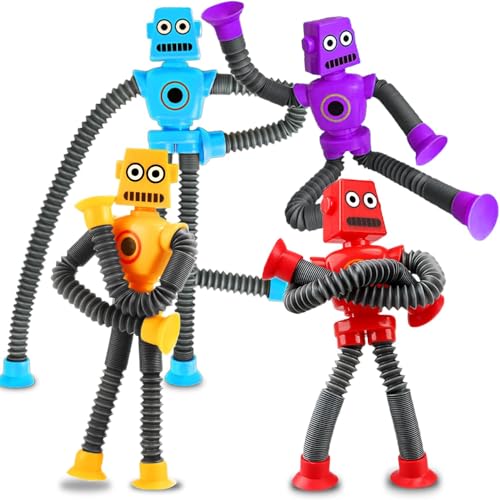
CHESLICR Robot Sensory Toys 4 Pack
What We Like
- Suction cups stick to windows and tiles
- Pop, stretch, twist for fine motor skills
- 4 colors for variety and engagement
- Compact size fits travel bags easily
Trade-offs
- Small 5.7-inch size limits arm span for stretching
- Suction cups need smooth surfaces to work
The suction cups on the hands and feet are the standout feature here. While most pop tubes just stretch and collapse, these robots can actually stick to a window, mirror, or tile wall. That turns play into a vertical, reach-and-stick game. That kind of interaction builds fine motor control and hand-eye coordination in a way a plain tube can’t. For a 3-year-old who craves sensory input, the continuous popping sound and the ability to reshape each robot into different poses gives them a satisfying, repeatable activity that travels easily in a diaper bag or backpack.
Size is the main trade-off here. At just 5.7 inches long, each robot is noticeably shorter than the BUNMO Pop Tubes, which are 10 inches and give more material to pull and twist. If your child likes to stretch tubes across their whole body or wrap them around a car seat strap, these will feel a bit stubby. But the suction cups make up for it in a different way, they add a cause-and-effect element that plain tubes lack. For kids who need to stick things together or attach toys to surfaces during a restaurant meal or car ride, this set wins on versatility, even if it loses on pure length.
Product photos
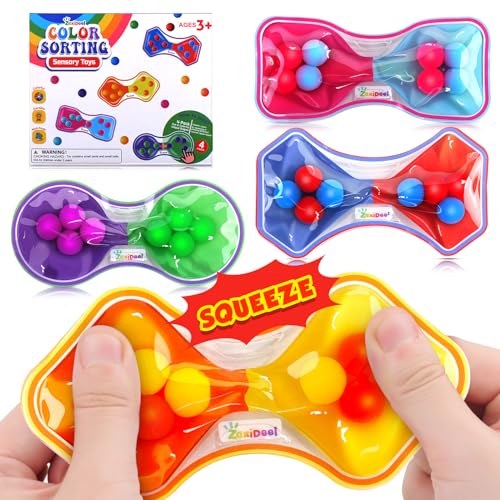
ZaxiDeel Color Sorting Squeeze Toys 4 Pack
What We Like
- Color sorting supports fine motor skills
- Quiet play with no loose pieces
- Leak-resistant sealed edges
- Lightweight and portable for travel
Trade-offs
- No auditory or visual feedback beyond the tactile squeeze
- Beads can be a choking hazard for children under 3
Four separate squeeze toys in one set means you can rotate them or hand one to a child without fighting over a single piece. Each toy uses a simple color-sorting action, squeeze the sides to guide beads into matching colored channels, which builds hand-eye coordination and concentration without requiring complex instructions. The quiet gel-and-bead fill makes it a practical choice for classrooms, waiting rooms, or car rides where silence matters, and the reinforced sealed edges reduce the chance of a leaky mess during everyday play.
At 4.8 inches across and 0.4 pounds, these are lightweight and easy to carry in a backpack or diaper bag. For a low-cost, focused sensory tool that travels well and keeps hands busy without noise, this set delivers exactly what it promises.
Product photos
Dr.Kbder Sensory Autism Balls Toy

What We Like
- 20 twistable spheres for endless configurations
- Non-toxic ABS plastic with smooth finish
- No loose parts, no choking hazards
- Compact and lightweight for travel
Trade-offs
- Single-piece construction limits variety of play compared to multi-part fidgets
- No auditory or visual features mentioned in product specifications
Twenty interlocking spheres that twist, flip, and reshape into endless configurations mean this little ball punches way above its weight for fine motor play. It’s built from non-toxic ABS plastic with a smooth, burr-free finish, and all pieces are permanently connected, so there are no loose parts or choking hazards. That safety-first design is exactly what I look for when recommending toys for young children who still explore with their mouths. The compact size and featherlight weight make it a natural for tossing into a diaper bag or backpack, turning a potential meltdown on a plane or at a restaurant into a focused, twisting challenge.
Its single-piece construction means it offers a narrower range of sensory experiences compared to the BUNMO Pop Tubes, which provide additional ways to play through stretching and popping. For a 3-year-old who craves variety in texture or sound, this ball might feel repetitive after a while. But for a child who finds comfort in repetitive, predictable twisting motions, or for parents who need a quiet, discreet fidget that won’t distract a classroom or cause a scene, this is a thoughtfully designed tool. It’s a focused solution for a specific need, not a one-size-fits-all sensory bin.
Product photos
How We Evaluated Toys For Autistic 3 Year Olds
We started by looking at the sensory categories that matter most at this developmental stage: tactile, visual, auditory, and proprioceptive input. Every toy was assessed against its stated purpose, whether it claims to calm, stimulate, or build fine motor skills, and we cross-referenced those claims with what therapists and parents report about similar products.
The four criteria that mattered most were safety for the age group, durability for repetitive play, the quality of sensory feedback, and how easily a child can use the toy independently. A toy that requires constant adult setup is less useful for a 3-year-old’s self-regulation than one they can grab and engage with on their own.
Every evaluation has limits: no one can predict how a specific child will react to a texture or sound. Every autistic child’s sensory profile is unique, so we prioritize toys with adjustable or varied feedback, something that works for a wide range of sensitivities. For more specific guidance on matching toys to your child’s needs, our guide on how to choose autism toys walks through the decision process step by step.
What To Look For In Toys For Autistic 3 Year Olds
The best toy for an autistic 3-year-old matches their sensory needs, is safe for their developmental stage, and can be used independently. Focus on the type of input the toy provides and whether it fits your child’s current skill level.
Sensory Input Type
Autistic 3-year-olds typically seek or avoid specific sensory inputs. Some need proprioceptive input (pushing, pulling, squeezing) to feel grounded, while others need visual stimulation (slow-moving glitter or liquid) to calm down. Know whether your child is a sensory seeker or an avoider before choosing. The sensory toys for 3-year-olds category covers a broad range, from tactile pads to visual tubes, so you can experiment with different inputs.
Safety and Durability
At age 3, many children still mouth toys, so avoid small parts that pose a choking hazard. Look for non-toxic materials (BPA-free, lead-free) and sealed construction that won’t leak if the toy is dropped or thrown. Durability matters because autistic play can be repetitive and intense, a toy that breaks on day one is worse than no toy at all.
Independent Play vs. Guided Play
Some toys require adult setup (filling a sensory pad with gel) while others are grab-and-go (pop tubes, fidget cubes). For a child who needs to self-regulate during transitions, independent play ability is critical. For structured learning time, guided activity cards can be a bonus.
- Check that the toy has no small parts that could be swallowed.
- Look for washable or wipe-clean surfaces for easy sanitation.
- Confirm the toy is age-labeled for 3+ to ensure safety standards are met.
- Test that the sensory feedback (sound, texture, movement) isn’t overwhelming for your child’s sensitivity level.
A toy that matches your child’s sensory needs will be used more than a toy that just looks fun.
Toys For Autistic 3 Year Olds Compared
The table below compares our top picks across sensory type, portability, and best use case so you can quickly find the right match for your child’s needs.
| Product | Dimensions | Weight | Age Range |
|---|---|---|---|
| BUNMO Pop Tubes 4 Pack | L 10.0 x W 8.0 x H 6.0 in | 0.1 lb | 3+ |
| JOYIN Sensory Fidget Tubes 4 Pack | 9.8 x 5.9 x 2.0 inches | 3.0 pounds | 3-5 years |
| hand2mind Sensory Fidget Tubes | L 2.5 inches, W 8.0 inches, H 9.0 inches | 1.4 pounds | Ages 3+ |
| hand2mind Colors & Shapes Sensory Pad | 12.0 x 9.7 x 1.5 inches | 0.8 pounds | Ages 3+ |
| Learning Resources Calming Sounds Sensory Tubes | 2.8 x 11.0 x 11.3 inches | 1.2 pounds | Ages 3+ |
| Learning Resources Cool Down Cubes | 7.0 x 2.1 x 8.5 in | 0.5 lb | Toddlers and up |
| Pushpeel Sensory Activity Board | 7.0 x 4.5 x 0.5 inches | N/A | 3+ & adults |
| CHESLICR Robot Sensory Toys 4 Pack | L 5.7 x W 3.6 x H 1.1 in | 0.3 lb | Ages 3+ |
| ZaxiDeel Color Sorting Squeeze Toys 4 Pack | 4.8 x 4.8 x 1.5 inches | 0.4 pounds | 3 years and up |
| Dr.Kbder Sensory Autism Balls Toy | 4.7 x 3.1 x 0.6 inches | 0.1 pounds | Age 3+ |
Frequently Asked Questions
What kind of toys are best for an autistic 3-year-old?
The best toys provide the sensory input your child seeks, whether that’s visual (glitter tubes, liquid timers), tactile (squeeze toys, textured cubes), or proprioceptive (pop tubes, stretchy fidgets). Look for toys that are safe for the age, durable for repetitive play, and easy for the child to use independently. No single toy works for every child, so observe what calms or engages your child and choose accordingly.
Are sensory toys the same as autism toys?
Sensory toys are a subset of autism-friendly toys, but not all autism toys are purely sensory. Many autistic 3-year-olds benefit from toys that build fine motor skills, encourage cause-and-effect learning, or support emotional regulation. The term “autism toy” usually means a toy designed to accommodate sensory sensitivities or communication differences, which often overlaps with sensory play but isn’t limited to it.
How do I know if a toy is safe for my 3-year-old with autism?
Check the manufacturer’s age recommendation (3+ is standard for this group) and look for small parts that could be a choking hazard. For children who still mouth toys, avoid anything with beads, loose pieces, or liquid that could leak. Choose non-toxic materials like food-grade silicone or BPA-free plastic. If the toy has a sealed chamber (like a sensory tube), press on it firmly to make sure it won’t burst.
Can toys help with emotional regulation for autistic toddlers?
Yes. Many toys in this guide are designed specifically for calming and self-regulation. Visual fidget tubes give the child a focal point to watch while their nervous system settles, and tactile squeeze toys provide deep pressure input that can reduce anxiety. The key is using the toy during calm moments so the child learns to associate it with regulation before needing it during a meltdown.
What if my autistic 3-year-old doesn’t like any of these toys?
Every autistic child has a unique sensory profile. If a visual toy doesn’t engage them, try a tactile or auditory option instead. Some children need movement-based play (swinging, bouncing) rather than tabletop toys. For children who are nonverbal or have limited communication, toys for nonverbal autism often focus on cause-and-effect or simple cause-and-response play that doesn’t require verbal instruction.
The Bottom Line
For most families, the BUNMO Pop Tubes 4 Pack is the best starting point. It’s lightweight, encourages creative building, and provides the satisfying pop-and-stretch feedback that many autistic 3-year-olds find regulating. If your child is more visually oriented, the JOYIN Sensory Fidget Tubes offer a calming stationary experience that works well in a quiet corner.
For budget-conscious families or those who need a quiet travel toy, the ZaxiDeel Color Sorting Squeeze Toys deliver reliable tactile feedback without noise or mess. The single most important factor is matching the toy to your child’s sensory needs, watch how they play, notice what they seek, and choose accordingly. For more age-specific options, our guide on toys for autistic 4-year-olds covers the next developmental stage.
