
10 Best Toys For 2.5 Year Old Boy in 2026
This post contains affiliate links. As an Amazon Associate, we earn from qualifying purchases.
The VTech Drill and Learn Toolbox earns our Best Overall spot because it combines role-play with real learning, the working drill spins gears, and the light-up buttons teach colors, numbers, and tool sounds. For parents who need a grab-and-go option, the Melissa & Doug Take-Along Wooden Barn packs eleven pieces in a handled case. And the VTech KidiBeats Kids Drum Set brings rhythm and early academics together for any toddler who loves a beat.
At two and a half, a boy is caught between baby toys and big-kid interests. He wants to imitate what he sees, tools, laptops, grown-ups talking on devices, but still needs chunky pieces, sensory feedback, and simple cause-and-effect play. The right toy meets both those needs without frustrating him.
We built this guide by studying manufacturer specs, expert recommendations on child development milestones, and patterns in what parents report their toddlers actually play with. Every pick on this list was chosen for its ability to engage a toddler’s growing curiosity while staying safe and durable.
Top 10 Toys For 2.5 Year Old Boys in the Market
Certain content that appears on this site comes from Amazon. This content is provided "as is" and is subject to change or removal at any time.
The Best Toys For 2.5 Year Old Boys, Reviewed
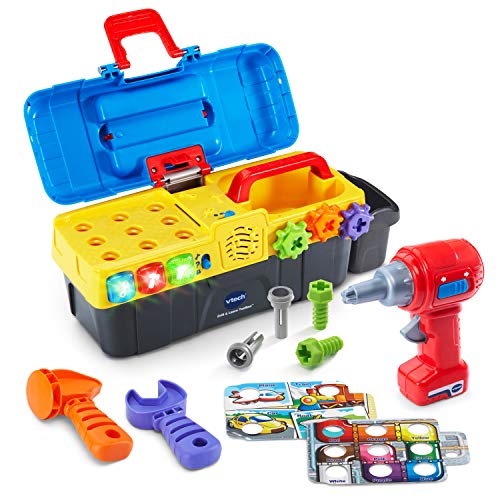
VTech Drill and Learn Toolbox
What We Like
- Working drill spins gears and screws
- Light-up buttons teach tool sounds and songs
- Double-sided cards teach colors and numbers
- Role-play set with 5 tool pieces
Trade-offs
- Demo batteries die fast; fresh ones needed
- No storage for loose screws and nails
A working toy drill that spins gears and drives screws into an electronic tray gives a toddler real interactive feedback while they play. The light-up buttons play songs and teach about tools, their uses, and the sounds they make. Double-sided instruction cards introduce colors and numbers during pretend repairs. For a child who enjoys role-playing with tools, this set turns imitation into hands-on learning.
The loose screws and nails have no built-in storage, so you will be hunting for them under the couch unless you keep the box closed between sessions. Compared to the Melissa & Doug Shape Sorting Cube, which is a wooden shape sorter with 12 shapes, the VTech requires more adult diligence. But if your child is already obsessed with real tools, the working drill and repair-themed cards make this the play set they will actually return to day after day.
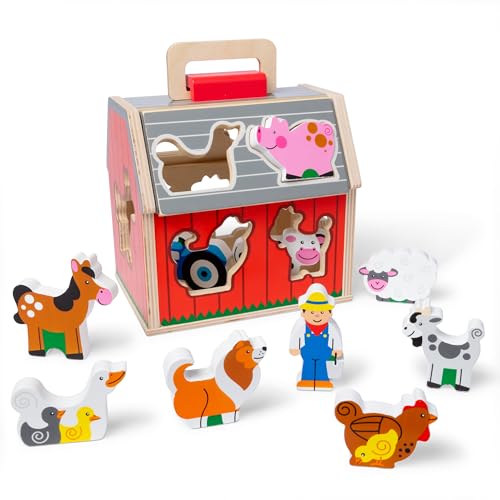
Melissa & Doug Take-Along Wooden Toy Barn
What We Like
- Built-in handle for easy portability
- 11 chunky wooden pieces included
- Flip-up roof for quick access and storage
- Encourages shape sorting and matching
Trade-offs
- At 2.1 pounds, heavier than some portable toys
- Compact size limits play surface area
The built-in carry handle and flip-up roof mean this barn can go from the living room floor to the backseat of the car in one grab, and the 11 chunky wooden pieces stay corralled inside. For a toddler who wants to haul their farm animals everywhere, that portability is the whole point. The shape-sorting slots on the roof also sneak in some matching practice without feeling like a lesson, which is exactly what you want at this age when attention spans are measured in minutes, not hours.
The compact size doesn’t leave much room for sprawling farm scenes, so this is more of a take-along toy than a stay-at-home playset. Compared to the Melissa & Doug Shape Sorting Cube, which focuses purely on shape matching with 12 pieces, this barn adds storytelling potential with the farmer and tractor, making it a better pick if your child wants characters, not just shapes. Just keep expectations realistic: it’s a portable set, not a playscape.
VTech KidiBeats Kids Drum Set

What We Like
- Three drum pads and cymbal with unique sounds
- Teaches letters, numbers, and music
- 9 pre-set melodies in rock, dance, pop
- LED lights on each drum pad
Trade-offs
- Only 4 sound options for the drums
- Batteries included are for demo only
Each of the three drum pads and the cymbal produces its own unique sound, so toddlers quickly learn that hitting different parts creates different results. The four modes. Free Play, Letters, Numbers, and Follow-Along, keep the activity fresh, and the nine pre-set melodies in rock, dance, and pop styles add variety. LED lights on each pad guide little hands and make the experience more engaging. This toy turns banging into a structured, educational activity without killing the fun.
The drum sounds are limited to four choices, so after a while your child might want more sonic variety. Compared to the LeapFrog 2-in-1 LeapTop Touch, which offers a broader range of learning activities, the KidiBeats is more focused on rhythm and music. If your kid is all about making noise and you want that energy channeled into something that teaches numbers and letters along the way, this is the one.
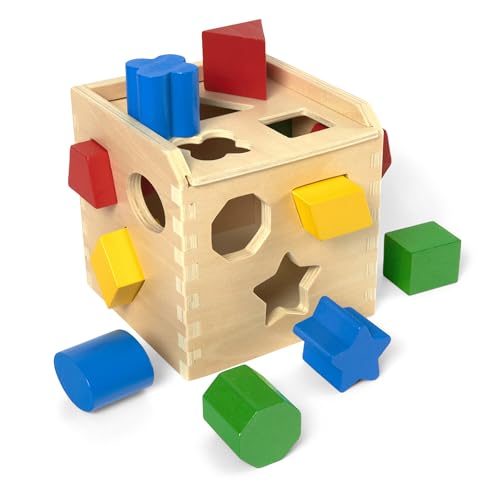
Melissa & Doug Shape Sorting Cube
What We Like
- 12 bright, easy-to-grip wooden shapes
- Teaches shape and color matching
- Sturdy wooden construction
Trade-offs
- Cube is small for active toddlers who scatter pieces
- No sound or lights for sensory-seeking kids
Twelve distinct wooden shapes and a matching hole for each one means this cube forces real problem-solving, not random pushing. At 5.5 inches square and 1.4 pounds, it’s compact enough for a toddler to carry around but heavy enough to stay put on a rug or table. For parents who want a calm, focused activity that builds fine motor control and early logic, this is the one that delivers without batteries or blinking lights.
This is a quiet, solo puzzle, not a multi-sensory toy. Compared to electronic options like the VTech Drill and Learn Toolbox, the Melissa & Doug cube requires more patience and offers no audio feedback. So it suits a child who already enjoys puzzles rather than one who needs constant noise. The cube does not include a carrying handle or built-in storage, so the shapes may scatter unless you keep them together. Still, for a durable, classic toy that builds focus and spatial thinking for ages two to four, this cube is a reliable learning staple.
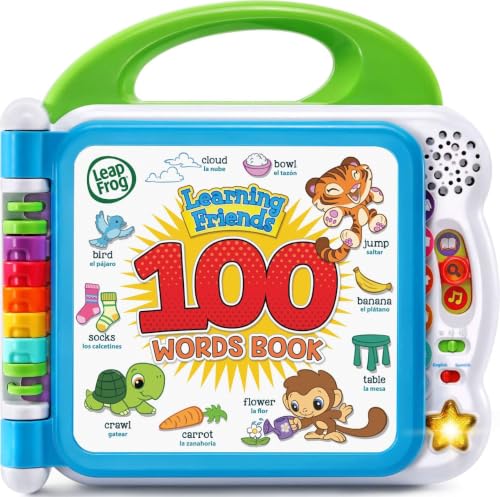
LeapFrog Learning Friends 100 Words Book
What We Like
- Bilingual English and Spanish modes
- Sound effects and fun facts on touch
- Light-up star button plays songs
Trade-offs
- Demo batteries only; new ones required for regular use
- No volume control mentioned on the pages
Pressing the light-up star button triggers the Learning Friends theme song and a special “My Favorite Word” track, giving toddlers a fun audio reward they can activate on their own. This simple cause-and-effect interaction helps little ones feel a sense of control over their playtime. The star button is easy for small fingers to find and press, so children can repeat the song as often as they like. Parents report that this feature keeps young learners engaged and encourages them to explore the book’s other touch-sensitive pages. It’s a thoughtful addition that turns passive listening into an active, rewarding experience.
The included 2 AA batteries are only for demo purposes, so you will need fresh ones right away. Compared to the Melissa & Doug Shape Sorting Cube, a purely mechanical wooden toy with no electronics, this book offers interactive audio feedback, but it also means you are tied to battery replacements. If you want a screen-free way to build early language skills in two languages, this fits that need.
LeapFrog 2-in-1 LeapTop Touch

What We Like
- 2-in-1 keyboard and tablet modes
- Five learning modes cover ABCs, numbers, games, music, messages
- Customizable name spelling activity
- Flips from laptop to touch tablet
Trade-offs
- Demo batteries included; new batteries needed for regular use
- Screen flips but is not a real touchscreen
- At 1.3 lb, light but still a tabletop toy
The flip screen that converts from a keyboard laptop to a touch tablet is the standout feature for a child in the 2-to-5-year range. Kids this age love to mimic whatever Mom and Dad are tapping on, and this gives them a dedicated device that actually does something back. Five learning modes. ABCs, numbers, games, music, and messages, keep play varied, and the customizable name-spelling activity lets you type in your child’s name so the toy says it back. It’s a smart way to channel that “I want a phone” urge into something that builds letter and number recognition instead of just watching videos.
The tablet mode uses a physical flip screen rather than a true capacitive touchscreen, so the interaction is more about pressing than swiping. Compared to the LeapFrog Learning Friends 100 Words Book, which is purely page-based and simpler for a younger toddler, this LeapTop demands a bit more directed play from an adult to unlock its full value. But for a child who’s already showing interest in letters and wants to copy grown-up tech habits, this is the toy that grows with them from pretend typing to early spelling, without handing them your actual laptop.
Product photos
Chuckle & Roar Pop It Book

What We Like
- Bilingual English & Spanish color learning
- Quiet mode option for low-noise play
- Sturdy plastic design for durability
- Combines pop-it sensory fun with education
Trade-offs
- Only covers colors, not other vocabulary
- No batteries included for sound features
A bilingual color-learning book that doubles as a pop-it sensory toy means your child gets two kinds of play in one sturdy plastic package. At 0.1 inches thick and weighing 1.4 pounds, it’s light enough to toss in a diaper bag for restaurant waits or road trips. The quiet mode lets you hand it over without driving everyone crazy. For a toddler who’s starting to name colors and loves that satisfying bubble-pop feel, this hits a sweet spot between education and fidget-friendly fun.
Its focus is narrow, colors only, in English and Spanish, so it won’t stretch much beyond that skill set as your child grows. Compare that to the LeapFrog Learning Friends 100 Words Book, which covers a wider range of vocabulary but lacks the tactile pop-it feedback that keeps some toddlers engaged. If your little one is more of a hands-on learner who needs that sensory hook, this Chuckle & Roar book earns its spot in the cart. If they’re already past color basics, you might want something broader.
Product photos
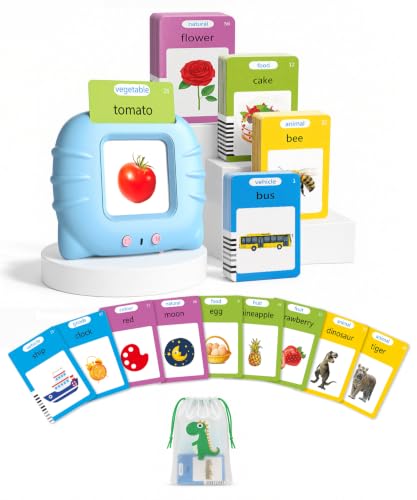
Aullsaty Talking Flash Cards
What We Like
- 224 words across 12 themes
- Screen-free interactive play
- Includes 3 nursery rhymes
- USB rechargeable and portable
Trade-offs
- Only 3 songs for variety
- No volume control mentioned for different environments
With 224 words across 12 everyday themes, this little reader gives a toddler a lot to listen to and repeat without ever turning on a screen. You slide a card in, hear the word, and sometimes get a sound effect, it turns vocabulary practice into a quiet, self-directed activity. That hands-on, listen-and-repeat loop is exactly why it works well for late talkers or any toddler building first words, and the USB rechargeable battery means no hunting for AAAs at bedtime.
You only get three nursery rhymes, so once those are memorized, the musical novelty fades fast. Compared to the LeapFrog Learning Friends 100 Words Book, which offers more variety in sounds and phrases, this one focuses tightly on word repetition and card play. For a toddler who needs focused speech practice without distractions, that narrow focus is a strength, just don’t expect a jukebox.
Product photos
Toyk Water Doodle Mat

What We Like
- No ink, no paint, no mess
- Reusable water-based drawing surface
- Large 40×28 inch play area
- Includes stencils and templates for guided play
Trade-offs
- Drawings fade in 3-10 minutes, so no permanent art
- Requires supervision to refill pens with water
- Water-resistant back but not waterproof for wet floors
A 40-by-28-inch reusable drawing surface that works with nothing but clean water means your toddler can scribble, stamp, and trace to his heart’s content without staining a single wall, table, or shirt. The mat’s ocean pattern and included stencils give him just enough structure to practice hand-eye coordination and color recognition. The six pens let a playmate join in. For parents who dread the cleanup after traditional art supplies, this is the kind of toy that actually gets used daily because you can set it up on the floor or a table and walk away confident that the only mess is a few water drops.
Every drawing vanishes within ten minutes, so there’s no masterpiece to hang on the fridge. That’s fine for a toddler who loves the process more than the product, but if your child prefers to admire his work for an afternoon, the LeapFrog Learning Friends 100 Words Book offers permanent pages with interactive sounds. The Toyk mat folds compactly for travel and weighs just a pound, making it the smarter pick for restaurants, waiting rooms, or long car rides where mess-free, packable entertainment matters most.
Product photos
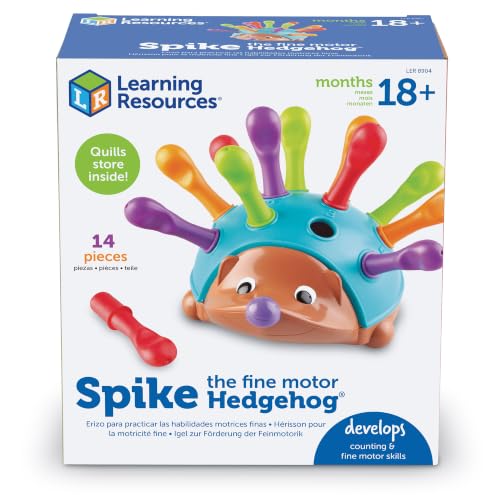
Learning Resources Spike The Fine Motor Hedgehog
What We Like
- Chunky pegs build fine motor skills
- Colorful quills teach color sorting and counting
- Easy storage: quills fit inside hedgehog
- Great for visually impaired children
Trade-offs
- Only 12 quills limits counting range
- No sound or lights for sensory variety
Twelve peg-shaped quills that fit into a hedgehog’s back give toddlers a focused fine-motor workout. Each piece is easy for small hands to grasp and push into place, building the finger strength needed for writing and buttoning later. Color sorting and counting are built into the play, offering a quiet learning moment with no batteries or noise. It’s a straightforward tool that builds dexterity through repetition.
This is a single-purpose toy with no lights, sounds, or moving parts, so it won’t hold the attention of a child who craves action or noise. That makes it ideal for calm, focused play sessions, but less suited for high-energy kids who need constant audio feedback.
Product photos
How We Evaluated Toys For 2.5 Year Old Boys
This guide is research-based. We examined specifications, manufacturer documentation, and patterns in parent feedback to understand what works at this specific age. A two-and-a-half-year-old isn’t a baby anymore, but he also isn’t ready for complex board games or small-parts construction sets, we kept that developmental window front and center.
Four criteria drove every pick. First, engagement without frustration, the toy must hold attention through sound, motion, or satisfying physical action without requiring skills a toddler hasn’t yet developed. Second, durability, at this age, toys get dropped, thrown, and stomped on. Third, skill-building, whether fine motor, vocabulary, or cause-and-effect, the toy should stretch a toddler’s abilities just a little. Fourth, parent sanity, noise level, mess, battery life, and portability all matter.
A research-led evaluation has limits. We haven’t watched every toy survive a real toddler’s afternoon, and parent experiences vary with each child’s temperament. What we offer is a well-informed starting point based on what the data and experienced parents tell us works.
What To Look For In Toys For 2.5 Year Old Boys
The best toy for a two-and-a-half-year-old boy balances engagement, safety, and skill-building. Focus on toys that match his current interests, tools, animals, music, or imitation play, while offering just enough challenge to hold his attention without causing frustration.
Look for chunky pieces that are too big to swallow, interactive features that reward curiosity, and durable construction that survives drops. Avoid toys with dozens of tiny parts or complex rules he can’t follow yet.
Age-Appropriate Complexity
A two-and-a-half-year-old can follow two-step directions, sort by shape or color, and imitate adult actions. Toys with simple cause-and-effect, press a button, hear a sound, are still engaging, but he’s ready for slightly more: matching shapes to holes, turning a screw with a drill, or flipping a laptop screen.
If the toy requires reading, counting reliably, or fine-motor precision he hasn’t developed yet, it will sit in the corner. The best toys for toddlers at this age offer a clear goal (fit the shape, make the song play) with a satisfying payoff.
Safety and Durability
Toddlers are rough on toys. Look for solid wood rather than thin plastic, rounded edges, and pieces that won’t snap off under pressure. Avoid anything with magnets that could be swallowed, long cords that could wrap around a neck, or stickers that peel off into choking hazards. Toy safety tips every parent should know include checking for small parts that fit through a toilet paper tube, if it fits, it’s too small for a two-and-a-half-year-old.
Sensory and Interactive Features
Some toddlers need lights, sounds, and movement to stay engaged; others get overstimulated and prefer quiet stacking or sorting. Know your child’s sensory profile before choosing. A toddler toy with multiple modes, quiet mode, music mode, learning mode, lets you adjust the stimulation level. For sensory-seeking kids, pop-it toys, drums, and light-up buttons are ideal. For calmer kids, wooden shape sorters and water doodle mats provide focus without noise.
Portability and Storage
At this age, toys travel, to Grandma’s house, the restaurant, the car, the waiting room. A built-in handle, a carrying case, or a compact size makes the difference between a toy that gets used and one that stays home. The toys that parents actually bring along are the ones that pack up fast and don’t lose pieces in transit. Also consider where the toy lives at home: does it have a designated spot, or will loose screws and cards scatter across the living room floor?
- Check that all pieces are larger than a toddler’s fist to reduce choking risk.
- Look for toys with volume control or a quiet mode for shared spaces.
- Choose toys with storage built in (quills that fit inside the hedgehog, cards that store in the reader) to keep cleanup manageable.
- Verify battery compartments are secured with a screw, toddlers can open pop-in battery covers.
A good rule of thumb: if you wouldn’t want to step on it barefoot in the dark, it’s too small.
Toys For 2.5 Year Old Boys Compared
The table below compares each toy’s key features, best-use scenario, and trade-offs at a glance, use it to narrow down your choices before reading the full reviews.
| Product | Weight | Dimensions | Age Range |
|---|---|---|---|
| VTech Drill and Learn Toolbox | 1.9 pounds | 12.6 x 5.7 x 4.9 inches | 2 to 5 years |
| Melissa & Doug Take-Along Wooden Toy Barn | 2.1 pounds | 6.5 x 7.5 x 8.0 inches | N/A |
| VTech KidiBeats Kids Drum Set | 1.4 pounds | 3.9 x 12.1 x 11.5 inches | 2 to 5 years |
| Melissa & Doug Shape Sorting Cube | 1.4 pounds | 5.5 x 5.5 x 5.5 inches | 2 to 4 years |
| LeapFrog Learning Friends 100 Words Book | 1.5 pounds | 9.4" wide x 9.2" tall | 18+ months |
| LeapFrog 2-in-1 LeapTop Touch | 1.3 pounds | L 2.0 x W 10.1 x H 6.0 inches | 2-5 years |
| Chuckle & Roar Pop It Book | 1.4 pounds | 11.5 x 2.2 x 0.1 inches | 1-4+ |
| Aullsaty Talking Flash Cards | 0.5 pounds | 4.2 x 3.5 x 0.8 inches | N/A |
| Toyk Water Doodle Mat | 1.0 pounds | 40 x 28 inches | 2 years and up |
| Learning Resources Spike The Fine Motor Hedgehog | 0.1 lb | 10.0 x 10.0 x 4.0 in | N/A |
Frequently Asked Questions
What is the best toy for a 2.5 year old boy who loves tools?
The VTech Drill and Learn Toolbox is the top choice for tool-loving toddlers. It includes a working drill that turns gears and screws, plus five tool pieces for role-play. The light-up buttons teach tool names, colors, and numbers, making it both a pretend-play toy and a learning tool.
Are electronic toys bad for 2.5 year olds?
Not when used in moderation. Electronic toys like the LeapFrog 2-in-1 LeapTop Touch or VTech KidiBeats Drum Set teach letters, numbers, and cause-and-effect in ways that passive screen time doesn’t. The key is to balance them with screen-free options like wooden shape sorters and water doodle mats.
What toys help a 2.5 year old learn to talk?
Interactive toys that label objects and play sounds support vocabulary development. The LeapFrog Learning Friends 100 Words Book offers bilingual English and Spanish word practice, and the Aullsaty Talking Flash Cards cover 224 words across 12 themes. For speech therapy purposes, always consult a pediatrician or speech-language pathologist.
How do I choose a toy that won’t frustrate my 2.5 year old?
Look for toys with simple, one-step actions, press, pull, slide, or place. Avoid anything that requires reading, counting accurately, or fine-motor precision he hasn’t developed. The age-appropriate toys for 2 to 3 year olds on our list all have clear, achievable goals that build confidence rather than frustration.
What is the best no-mess art toy for a 2.5 year old?
The Best Mess-Free Art Toy is the Toyk Water Doodle Mat. It uses only water to draw, so there is no ink, paint, or stains, and the large surface gives plenty of room for scribbles and stencil-guided designs. Drawings fade in minutes, which means the mat is ready for a fresh creation each time.
The Bottom Line
For most families, the VTech Drill and Learn Toolbox is the best overall choice for a two-and-a-half-year-old boy. It nails the sweet spot between pretend play and early learning, with a working drill that keeps little hands busy and light-up buttons that teach without feeling like a lesson. If your son loves imitating you with tools, this is the toy he’ll come back to every day.
If your budget is tighter or you prefer screen-free, wooden toys, the Melissa & Doug Shape Sorting Cube delivers classic skill-building at a lower price point. For parents who need a travel-friendly option, the Melissa & Doug Take-Along Wooden Barn packs learning and portability into one sturdy case. And for the sensory-seeking toddler, the Chuckle & Roar Pop It Book combines quiet fidget play with bilingual color learning.
The single most important factor when buying a toy at this age is whether it matches your child’s current interests and attention span. A perfect toy on paper is useless if it doesn’t engage him. Watch what he gravitates toward, tools, animals, music, or sorting, and choose from that starting point.
