
10 Best Toys For 18 Month Old Boy in 2026
This post contains affiliate links. As an Amazon Associate, we earn from qualifying purchases.
An 18-month-old boy is a whirlwind of curiosity, and the LeapFrog Yum-2-3 Toaster earns our Best Overall spot because it turns everyday pretend play into a lesson in numbers, colors, and opposites. For active toddlers, the TOMY John Deere Sit ‘N Scoot Tractor is our Best Lightweight Ride-On, while the Melissa & Doug Caterpillar Gear Toy is our pick for building fine motor skills. This guide covers 10 researched toys that match the way a toddler this age actually plays, short attention spans, growing mobility, and a hunger for cause-and-effect.
The real challenge at 18 months is finding a toy that holds interest without overwhelming. Too simple, and he walks away. Too complex, and he gets frustrated. The sweet spot is a toy that offers one clear interaction (push, turn, press) with a satisfying result, then layers in a second skill once he masters the first. We looked for toys that grow with a child, not ones that get abandoned after a week.
To build this guide, we analyzed manufacturer specifications, studied patterns in owner feedback, and consulted expert round-ups on child development through play. Our goal is to give you a short list of toys that earn their place on your floor, and in your toddler’s hands.
Top 10 Toys For 18 Month Old Boys in the Market
Certain content that appears on this site comes from Amazon. This content is provided "as is" and is subject to change or removal at any time.
The Best Toys For 18 Month Old Boys, Reviewed
LeapFrog Yum-2-3 Toaster
What We Like
- Teaches numbers, counting and colors
- Nine play pieces for variety
- Cause-and-effect push-and-pop action
- Interactive opposites lesson with dial
Trade-offs
- Small 3.5-inch depth limits counter space
- Demo batteries need replacement before play
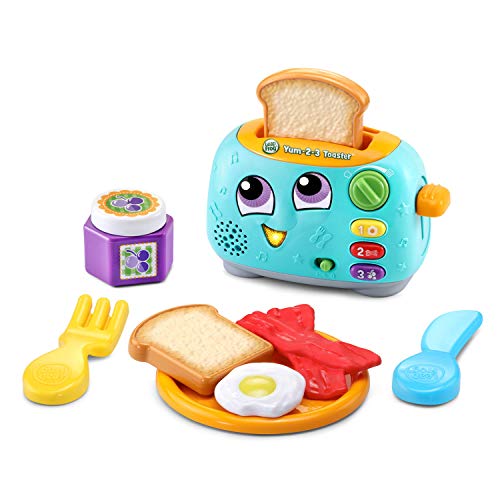
The LeapFrog Yum-2-3 Toaster comes with nine play pieces, two bread slices, a jelly jar, lid, an egg and bacon, served up on a plate with a fork and knife, so a toddler has plenty to handle during pretend cooking. Pushing the toast down and watching it pop up teaches cause and effect in a way kids naturally explore, and the three food buttons introduce numbers, counting, and colors. Weighing only 1.2 pounds, it’s light enough for a little one to move around, and its compact size means it won’t take over a small play area. For a child starting to mimic everyday actions, the toaster turns snack prep into a playful learning experience.
The demo batteries are meant for showroom use, so fresh AAA cells are needed before regular play. Compared to the Fisher-Price Corn Popper, which is a push-along toy with ball-popping action, the LeapFrog toaster offers seated pretend play with learning features. The TOMY John Deere tractor is a ride-on activity toy for ages 18 months and up, so it targets a different kind of movement. For a child who enjoys copying kitchen activities, this toaster provides a focused play experience with built-in early learning.
TOMY John Deere Sit 'N Scoot Tractor

What We Like
- Wide wheelbase for riding stability
- Lightweight for easy maneuvering
- Authentic John Deere colors and details
- Supports riders up to 60 pounds
Trade-offs
- No steering mechanism for directional control
- Foot-to-floor design limits speed to toddler pace
At 3.9 pounds, this ride-on is light enough that an 18-month-old can scoot it around corners indoors or pivot on the patio without getting stuck. The wide wheelbase keeps it stable while they push with their feet, so you are not chasing a tipping tractor across the yard. That low weight also means you can carry it to the park or toss it in the trunk without breaking a sweat. For a toddler just learning to coordinate push-and-glide, this makes the transition from crawling to cruising feel natural and safe.
The trade-off for that feathery build is that there is no steering mechanism. Your little one turns by lifting the front end or muscling it sideways, which takes some trial and error. If your priority is a ride-on he can actually move on his own at 18 months without you hovering every second, the Sit ‘N Scoot’s light weight and stable footprint give him the confidence to explore on his terms.
Product photos
Melissa & Doug Caterpillar Gear Toy

What We Like
- Six interchangeable colorful gears
- Sturdy wooden base with pegs
- Promotes hand-eye coordination and matching
- Smiling caterpillar face on red gear
Trade-offs
- At 1 lb, light enough to slide on slick floors
- Only 7 pieces: limited complexity for older toddlers
Six gears in bright colors spin on a solid-wood base with pegs that make it easy for small hands to match and place. That tactile cause-and-effect, turn one gear, watch the rest spin, is exactly the kind of repetition that builds fine motor control at 18 months. The caterpillar face on the red gear adds a playful focal point, and the whole thing weighs just a pound, so a toddler can carry it to the rug or coffee table without help. It suits a parent who wants a screen-free, open-ended toy that rewards trial and error without batteries or noise.
The trade-off is that seven pieces don’t leave much room for growing complexity. By age two and a half, your child may have mastered the pattern and want more gears to connect. But for the 18-month-old who’s still figuring out how to grip, align, and push, this wooden set delivers exactly the right challenge.
Fisher-Price Little People Caring for Animals Farm
What We Like
- 45+ songs, sounds, and phrases
- 3 Smart Stages grow with child
- Multiple play points for engagement
- Figures sized for small hands
Trade-offs
- At 23.4 inches long, it needs floor space
- Requires 3 AAA batteries for electronic features
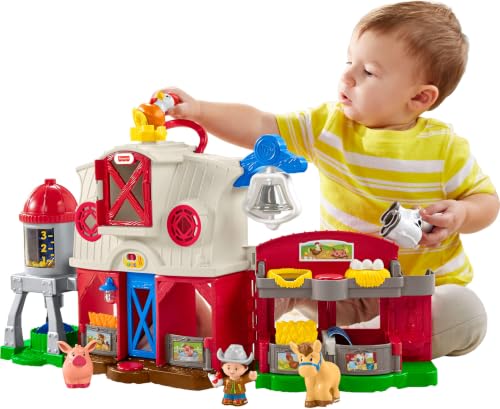
With 45 songs, sounds, and phrases in one playset, this farm gives a toddler plenty of audio cues to explore. The three Smart Stages levels teach counting, opposites, animal sounds, and colors, so the toy can grow with a child from age 1 to 5. Multiple play points, pressing the barn door, dropping figures through the hayloft, spinning the silo, keep little hands busy, and the figures are sized for small fingers to grasp and move.
This farm stretches 23.4 inches long, so it needs a clear patch of floor to really open up, not a toy you tuck into a corner shelf. The LeapFrog Yum-2-3 Toaster measures 3.5 inches long, making it far easier to stash on a countertop. For a child who loves animals and cause-and-effect play, that floor space is well spent, but you’ll want to measure your play area first.
Product photos
LeapFrog Learning Friends 100 Words Book
What We Like
- Bilingual English and Spanish audio
- Sound effects and fun facts per word
- Light-up star button plays songs
Trade-offs
- Requires 2 AA batteries for regular use
- No moving parts for active play
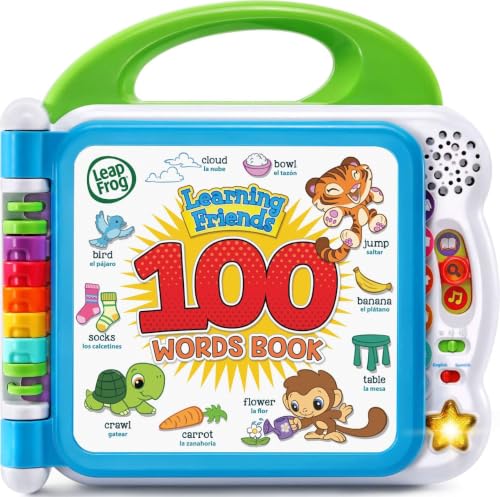
Touching a word on the page plays it aloud, along with sound effects and fun facts, so a toddler gets immediate audio feedback without needing a parent to read every label. The book covers categories like pets, animals, food, mealtime, colors, activities, opposites, outside and more, which lets you pick a topic your child is in the mood for. Turtle, Tiger, and Monkey introduce over 100 words chosen by learning experts, and pressing the light-up star button triggers the Learning Friends theme song or a favorite word. Words, songs, and instructions are available in both English and Spanish, so a bilingual household can use it from day one. The intended age is 18 months and up, and two AA batteries are included for demo purposes, so you will want fresh ones for regular play.
This is a stationary, lap-friendly toy, not one that encourages whole-body movement. The John Deere ride-on from TOMY is a ride-on toy for active play, while the LeapFrog book stays in one place. That makes it suitable for calm moments or travel, but if your 18-month-old prefers moving around, the tractor may be more engaging. The batteries are included only for demo purposes, so you will want fresh AA cells ready before the first real session.
SEREED Baby Balance Bike
What We Like
- 135° turning limit prevents tipping
- Closed wheels avoid pinching feet
- Aluminum alloy frame is sturdy
- Silent wheels for indoor use
Trade-offs
- No pedals limits older toddler use
- Gravity steering requires practice to master
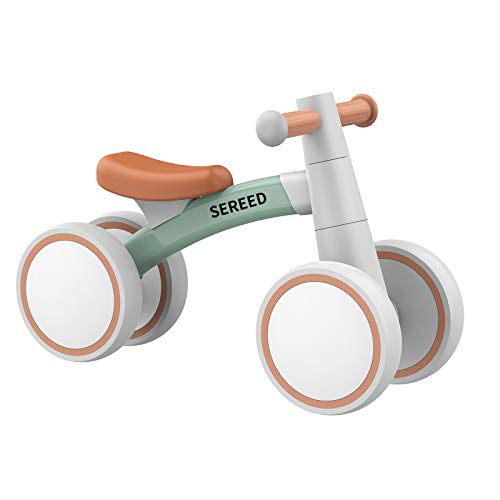
A 135-degree turning limit and fully enclosed wheels mean this little bike won’t tip over or pinch tiny toes, two worries that kept me up when my own kids first wobbled on wheels. The aluminum alloy frame keeps it light at 3.5 pounds, and the floor-friendly wheels let you use it indoors without damaging surfaces. This is a first ride-on that builds balance and steering coordination for toddlers ages 12 to 24 months.
The 55-pound weight limit and pedal-free design mean this bike is built for toddlers just learning to walk and balance, not for older kids who want to scoot fast. The John Deere ride-on from TOMY weighs 3.9 pounds and is recommended for ages 18 months and up, while the SEREED keeps the focus on steering and coordination. That makes it a safer choice for cautious beginners.
Product photos
VTech Spin and Learn Color Flashlight

What We Like
- 5 light colors that are not too bright
- Over 50 sing-along songs and phrases
- Ladybug button teaches animals, colors, numbers
- Auto shut-off after 45 seconds
Trade-offs
- Requires 2 AAA batteries (included, but eventual replacements)
- Only teaches numbers up to 3, limiting older toddlers
The flashlight has five light colors that are not too bright, so it won’t overwhelm a toddler’s eyes. The ladybug button triggers songs and phrases about animals, colors, and numbers, turning a simple light into a mini learning station. Over 50 sing-along songs and fun phrases keep the engagement fresh longer than most single-trick light-up toys, and the auto shut-off after 45 seconds means you are not hunting for a dead toy later.
At half a pound, the flashlight is light enough for a toddler to carry. Compared to the VTech Turn and Learn Driver, which has a steering wheel form that encourages both hands, this flashlight is a one-handed point-and-press affair. That is fine for quiet play or bedtime, but if your child is more into active pushing and rolling, the Fisher-Price Corn Popper might hold their attention longer. For a calm, educational light-up toy that teaches without overwhelming, this VTech fits the bill.
VTech Turn and Learn Driver
What We Like
- Steering wheel with over 60 songs and phrases
- Three play modes for varied engagement
- Horn and traffic lights teach road safety
- Signal lever, mirror, and gear shifter for role-play
Trade-offs
- Demo batteries included; new ones needed for regular use
- Demo batteries included; fresh AA batteries required for regular use
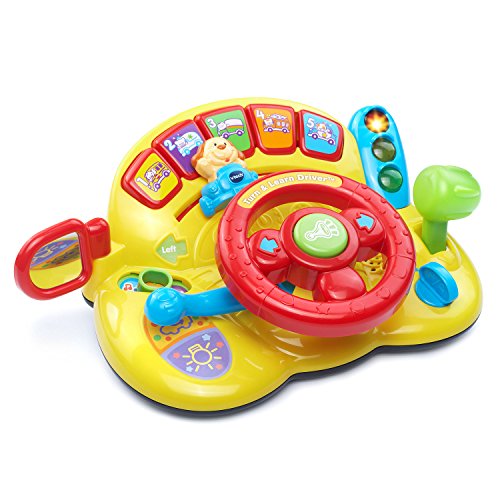
Over 60 songs and phrases packed into a steering wheel that turns and buttons that press means this little driver’s seat delivers more audio variety than most toys twice its size. The three modes. Animal, Driving, and Music, keep a toddler cycling through discovery without needing a parent to reset the fun. A horn that works with red, yellow, and green lights introduces traffic basics early, and the signal lever, mirror, and gear shifter turn lap-based pretend play into a mini cockpit. For an 18-month-old who watches cars and trucks with wide eyes, this is the closest thing to a real dashboard without leaving the living room floor.
The demo batteries are included only for try-me purposes, so you will need to install fresh AA batteries before regular use. At 1.3 pounds, the toy is lightweight, which makes it easy for a toddler to carry or reposition during play. For comparison, the John Deere ride-on from TOMY weighs 3.9 pounds and is designed for children 18 months and older who can ride and scoot. The VTech is better suited for seated, hands-on exploration with sounds and buttons, while the Tractor offers a ride-on experience for toddlers who want to move around.
Fisher-Price Corn Popper

What We Like
- Encourages walking with popping sounds
- Strengthens gross motor skills
- Teaches cause and effect
- Classic push-along design
Trade-offs
- 22.5-inch length needs clear floor space
- Assembly required out of box
- No volume control for popping sounds
At just 1.8 pounds, this push toy is light enough for a toddler to maneuver without tipping, which is exactly what you want when they’re learning to walk. The colorful balls pop around inside as your child pushes, providing immediate sound and visual feedback that rewards each step. That cause-and-effect loop helps build gross motor skills and introduces babies to how their actions create reactions, as noted in the product’s feature list for ages 12 months and up.
This toy needs room to roam. The John Deere ride-on from TOMY is a ride-on toy for kids 18 months and up, while the Corn Popper is a push-along toy that encourages walking. That makes it a better fit for families who are ready to encourage walking, but less ideal for those who prefer a sit-and-scoot option.
Product photos
Aigybobo Farm Animals Montessori Toy
What We Like
- Animals double as finger puppets
- Barn lids printed with numbers 1-10
- Dots on bodies for counting practice
- Safe vinyl and plastic with smooth edges
Trade-offs
- Only 10 animals limit variety for longer play
- No sound or music features for auditory engagement
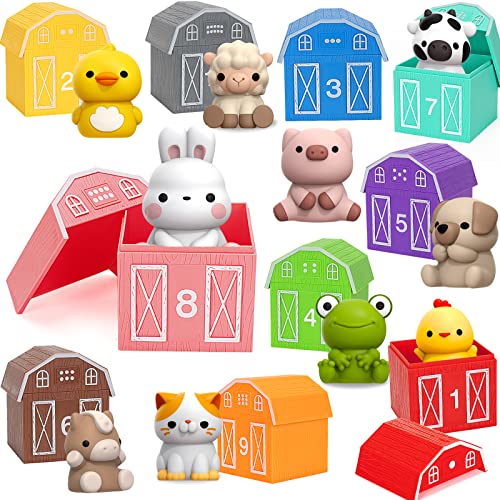
Twenty pieces, ten vinyl farm animals and ten matching plastic barns, give you a self-contained counting, sorting, and pretend-play set that fits in a small box. Each animal has a hollow bottom so little fingers can wear it like a puppet, and the barn lids show numbers 1 through 10 while the animal bodies have matching dots. That means a toddler can practice putting the cow in its barn, taking it out, and eventually matching numbers to dots, all while building fine motor skills. For a focused activity set, this is a tidy way to introduce early math concepts without overwhelming a toddler with too many pieces.
The Aigybobo Farm Animals Montessori Toy includes 20 pieces total, 10 farm animals and 10 matching barns, so it’s a compact set that fits easily on a small shelf or in a diaper bag. Each animal doubles as a finger puppet, with an opening at the bottom sized for little fingers, which helps toddlers practice “put in,” “take out,” “open,” and “close” motions while building hand-eye coordination. The barn lids are printed with numbers 1 through 10, and the animal bodies have corresponding dots, so kids can work on counting, color recognition, and matching during play.
Product photos
How We Evaluated Toys For 18 Month Old Boys
We started by reading through manufacturer specs for dozens of toys marketed to the 12-to-24-month range, noting weight limits, battery requirements, materials, and assembly needs. From there, we cross-referenced patterns in owner feedback, what parents say works in real homes versus what looks good on the box. We also reviewed expert guidance on developmental milestones for this age, focusing on gross motor, fine motor, and cognitive leaps.
Three criteria mattered most. Safety and durability came first: no small parts that choke, no sharp edges, and construction that survives a drop from a high chair. Engagement longevity came second: a toy that offers one clear interaction is fine. But one that layers in new skills, like the LeapFrog Yum-2-3 Toaster teaching opposites via a dial, keeps a toddler coming back. Developmental match came third: a ride-on is pointless if a toddler can’t reach the ground, and a gear toy is frustrating if the pegs don’t fit easily.
A research-led evaluation has limits. We didn’t watch 18-month-olds play with these toys in a lab, and every child develops at his own pace. What we can tell you is which toys consistently work for the widest range of toddlers based on what parents, experts, and the specs tell us.
What To Look For In Toys For 18 Month Old Boys
The right toy for this age balances a single, clear action with room to grow. You want something that rewards a push, turn, or press with a satisfying sound or movement, then offers a second skill once that first one gets boring.
An 18-month-old learns through repetition and cause-and-effect. Look for toys with one clear interaction, safe materials, and a second skill layer that kicks in as his abilities grow.
Safety and Material Quality
At 18 months, everything goes in the mouth. Look for BPA-free plastics, non-toxic paint on wood toys, and pieces too large to fit through a toilet paper tube (the standard choke-test gauge). Avoid toys with button batteries that aren’t secured behind a screw-lock compartment. The Fisher-Price Corn Popper‘s plastic balls are large and securely encased, while the Aigybobo Farm Animals set uses smooth vinyl with no sharp edges. Check seams on plush toys and wheels on ride-ons, loose parts are the number one safety complaint in this category.
Developmental Stage Match
The gap between a 12-month-old and a 24-month-old is enormous. An 18-month-old sits right in the middle: he can walk steadily, point to what he wants, and mimic simple actions. He does not yet understand turn-taking or complex rules.
The SEREED Baby Balance Bike works because its 135° turning limit prevents tipping while he learns to steer with his weight, a skill that builds walking confidence. The VTech Spin and Learn Color Flashlight teaches numbers up to 3, which is exactly right for this age, any higher and the information would be noise.
Engagement Longevity and Variety
A toy that does one thing well is better than a toy that does five things poorly. But the best toys offer a second layer of play. The LeapFrog Learning Friends 100 Words Book has bilingual audio and sound effects per word, but also a light-up star button that plays songs, two different ways to engage.
The Fisher-Price Little People Farm has 45+ songs and phrases across 3 Smart Stages, so it adapts as your toddler moves from cause-and-effect play to pretend play. Look for toys that reward both a random press and a deliberate action.
- Push the button: does it produce an immediate, satisfying result?
- Can the toy be used in two different ways (seated and standing, quiet and loud)?
- Are batteries required, and if so, are they included or easily replaceable?
- Does the toy fit your available floor space and storage?
A toy that lasts six months is a better investment than a toy that lasts six days. Look for adjustable difficulty or multiple play modes.
Toys For 18 Month Old Boys Compared
The table below compares all 10 picks across the features that matter most for an 18-month-old: play style, developmental focus, power source, and what makes each one unique.
| Product | Age Range | Weight | Dimensions |
|---|---|---|---|
| LeapFrog Yum-2-3 Toaster | 12+ months | 1.2 pounds | L 3.5 inches, W 7.1 inches, H 4.5 inches |
| TOMY John Deere Sit 'N Scoot Tractor | 18 months and up | 3.9 pounds | L 20.0 inches, W 9.8 inches, H 16.1 inches |
| Melissa & Doug Caterpillar Gear Toy | 18 months to 3 years | 1.0 pounds | L 2.2 inches, W 12.0 inches, H 16.0 inches |
| Fisher-Price Little People Caring for Animals Farm | 1-5 years | 1.0 pounds | L 23.4 inches, W 5.3 inches, H 7.3 inches |
| LeapFrog Learning Friends 100 Words Book | 18+ months | 1.5 pounds | L 9.2 inches, W 9.4 inches, H 1.9 inches |
| SEREED Baby Balance Bike | 12-24 months | 3.5 pounds | L 8.7 inches, W 3.7 inches, H 5.5 inches |
| VTech Spin and Learn Color Flashlight | 1 to 3 years | 0.5 pounds | L 3.0 inches, W 4.2 inches, H 5.8 inches |
| VTech Turn and Learn Driver | 6-36 months | 1.3 pounds | L 8.9 inches, W 10.8 inches, H 4.3 inches |
| Fisher-Price Corn Popper | 12+ months | 1.8 pounds | L 22.5 inches, W 8.5 inches, H 6.2 inches |
| Aigybobo Farm Animals Montessori Toy | 12-18 months | 1.4 pounds | L 12.0 inches, W 5.5 inches, H 3.0 inches |
Frequently Asked Questions
What is the best toy for an 18-month-old boy who is already walking well?
The TOMY John Deere Sit ‘N Scoot Tractor is an excellent choice. Its wide wheelbase provides riding stability, and the lightweight frame lets a toddler scoot independently. It supports riders up to 60 pounds, so it lasts well beyond the early walking stage.
Are electronic toys good for an 18-month-old’s development?
Yes, when used in moderation. Electronic toys like the VTech Turn and Learn Driver teach cause-and-effect, road safety concepts, and vocabulary through songs and phrases. The key is choosing toys that require a physical action (pressing, turning, sliding) rather than passive screen-based play.
What kind of toys help with speech development at 18 months?
Toys that name objects, animals, or colors out loud are helpful. The LeapFrog Learning Friends 100 Words Book offers bilingual English and Spanish audio with sound effects and fun facts per word. The Fisher-Price Little People Farm includes 45+ songs and phrases that introduce animal names and sounds through pretend play.
How do I know if a toy is safe for an 18-month-old?
Check for small parts that could be a choking hazard, anything that fits through a toilet paper tube is too small. Look for sturdy construction without sharp edges, and ensure battery compartments are secured with screws. The Aigybobo Farm Animals set uses large, smooth pieces with no small detachable parts.
What is the best budget-friendly toy for an 18-month-old boy?
The Aigybobo Farm Animals Montessori Toy is our Best Budget Pick. It doubles as finger puppets and a counting game, with barn lids printed with numbers 1-10. At 10 animals, it’s portable and simple, making it a strong value for parents who want learning without electronics.
The Bottom Line
For most families, the LeapFrog Yum-2-3 Toaster is the best overall toy for an 18-month-old boy. It combines pretend play with early math concepts, and the nine play pieces keep a toddler busy without overwhelming him. It’s the toy that grows with your child from random button-pushing to intentional matching and sorting.
If your toddler is on the move and needs a ride-on, the TOMY John Deere Sit ‘N Scoot Tractor is a stable, lightweight choice that won’t tip. For budget-conscious parents, the Aigybobo Farm Animals Montessori Toy delivers counting practice and finger-puppet fun for a very low investment. And if fine motor skills are your focus, the Melissa & Doug Caterpillar Gear Toy builds hand-eye coordination through simple, satisfying gear-turning.
The single most important factor in choosing a toy for an 18-month-old is whether it offers a clear, repeatable action that produces an immediate result. Push, pop, spin, or scoot, as long as your toddler can see the effect of his own movement, he’ll stay engaged and learn from it.
