
10 Best Toys For 16 Month Old in 2026
This post contains affiliate links. As an Amazon Associate, we earn from qualifying purchases.
At this age, your toddler is on the move, curious, and learning fast. The VTech Sit-to-Stand Learning Walker earns our Best Overall spot because it transitions from a seated activity center to a walking support with an adjustable two-speed switch. That gives you one toy that adapts to their changing skills. For fine motor precision, the Melissa & Doug Farm Animals Jumbo Knob Puzzle is our Best For Fine Motor Skills pick. The Kidoozie Whirl ‘N Go Ball Tower offers the best battery-free cause-and-effect fun.
That milestone is a sweet spot where babies are no longer infants but not yet preschoolers. They want to walk, climb, stack, and drop everything in sight. The challenge is finding toys that match their new mobility without overwhelming them or, worse, boring them in a week.
This guide is built on a close look at specs, manufacturer guidance, expert round-ups, and what parents report works best at this age. We narrowed it down to ten picks that target the key developmental leaps happening right now: walking, fine motor control, cause and effect, and pretend play.
Top 10 Toys For 16 Month Old in the Market
Certain content that appears on this site comes from Amazon. This content is provided "as is" and is subject to change or removal at any time.
The Best Toys For 16 Month Old, Reviewed
VTech Sit-to-Stand Learning Walker

What We Like
- Removable tray for seated play
- Two-speed switch grows with child
- Five piano keys encourage creativity
- Shape sorters build motor skills
Trade-offs
- At 4.6 lb, heavier than some walkers
- Requires floor space for both modes
A detachable activity panel that works on carpet or bare floors means this walker pulls double duty from sitting to cruising. The two-speed control switch lets you slow things down when your little one is still wobbly, then speed up as their confidence grows. Five piano keys and a telephone handset add pretend-play layers that keep a toddler engaged beyond just walking practice. That removable tray is the real standout, it turns the whole thing into a sit-down toy station for shape sorting and spinning rollers, so you get more use out of one piece of gear.
The trade-off is weight: at 4.6 pounds, it’s sturdier than the featherlight Kidoozie ball tower, but that also means your child will need a little more muscle to push it at first. The two-speed setting helps here, start on the slower speed so they build balance without the walker running away from them. If your priority is a single toy that transitions from seated play to walking support, this covers both phases better than a dedicated walker or a stationary activity cube. Just clear a path wide enough for the 16.5-inch wheelbase.
Melissa & Doug Farm Animals Jumbo Knob Puzzle

What We Like
- Jumbo knobs for easy grasping
- Full-color matching pictures under pieces
- Thick wooden pieces for durability
- Encourages animal recognition through play
Trade-offs
- Single activity type limits extended engagement
- No sound or light feedback for extra stimulation
Eight jumbo peg pieces with easy-to-grip knobs mean a toddler’s first puzzle experience is about success, not frustration. The extra-thick wooden board and full-color matching pictures under each piece give clear visual cues, so a one-year-old can figure out where the cow, pig, or horse goes without guessing. That built-in guidance builds confidence and hand-eye coordination at exactly the pace a young child needs, making this a strong pick for parents focused on fine motor development through independent play.
This is a quiet, single-activity toy, so once the puzzle is solved, it’s solved. Compared to the VTech Busy Learners Activity Cube, which offers multiple buttons, sounds, and lights to keep a toddler exploring, the Melissa & Doug puzzle relies on repetition and the satisfaction of a clean match. That works well for a calm, focused play session, but if your child craves variety or cause-and-effect feedback, you may want to rotate it with something like the Hieoby Baby Pop Up Toy for contrast.
Product photos
Kidoozie Whirl 'N Go Ball Tower

What We Like
- Six colorful levels for visual tracking
- Rattle balls add sight and sound
- No batteries or electronics needed
- Teaches cause and effect through play
Trade-offs
- Requires a hard, flat floor to play
- Only 4 balls included for repeated drops
Six levels of spiraling ramps give a toddler multiple chances to track where the ball goes next, turning a simple drop into a guessing game. The clear balls are filled with beads that rattle as they roll, so the toy grabs attention with both sound and motion without needing a single battery. That makes it a good option for parents who want a screen-free cause-and-effect lesson that keeps little eyes following the action. At 1.2 pounds and 13.8 inches tall, it is light enough to move from room to room.
This tower requires a hard, flat floor to work properly, so you’ll want to set it up on a table or uncarpeted area. Compared to the Hieoby Baby Pop Up Toy, which uses music and lights for cause-and-effect play, the Kidoozie is purely mechanical and battery-free, a detail some families prefer for simpler, screen-free fun. But if your child enjoys dropping objects and watching them reappear, this creates a satisfying loop that builds hand-eye coordination with every launch.
Product photos
Hieoby Baby Pop Up Toy With Music Light

What We Like
- Three play modes for varied engagement
- Five different button actions (push, turn, flip, press, slide)
- Includes music and light for cause-and-effect learning
- Non-toxic ABS material with smooth rounded edges
Trade-offs
- At 13.7 inches long, it's bulky for travel or storage
- Game mode requires batteries (not included) for music and light
- Only five animals limit long-term novelty for some toddlers
Five distinct trigger actions, push, turn, flip, press, and slide, mean this toy teaches cause and effect through real variety, not just a single button mash. That variety matters for toddlers around one year old, when little hands are figuring out how the world works. The three play modes let you dial the experience up or down: quiet mode for no-fuss pop-up fun without batteries, learning mode that pairs each animal with its sound, and a game mode that adds music and a light-up follow-the-button challenge. It works well for parents who want an interactive toy that grows with attention span and skill level, especially if your child enjoys sound and light feedback.
The trade-off is size and battery dependency. At nearly fourteen inches long, this isn’t a toss-in-the-diaper-bag toy, it’s a stay-at-home or daycare tabletop piece. The music-and-light game mode also needs batteries, which the box doesn’t include, so plan for that before handing it over. Compared to the VTech Busy Learners Activity Cube, which packs more activities into a compact 6.2-inch cube, the Hieoby offers more deliberate fine-motor challenges per action but less variety overall. If your toddler is already bored with single-action pop-ups, this one’s extra modes buy you more mileage.
Product photos
MEGA BLOKS First Builders Big Building Bag
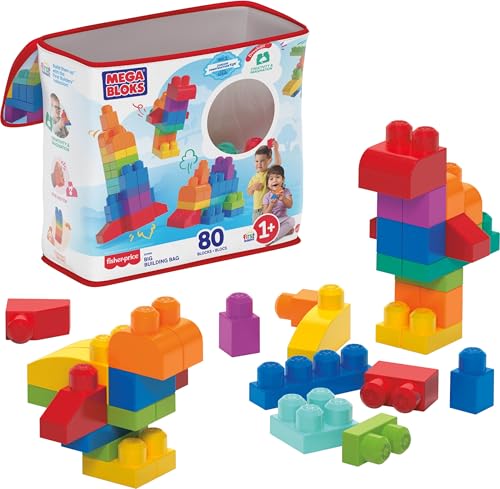
What We Like
- 80 pieces for open-ended building
- 10 shapes fit little hands
- 9 vibrant colors aid recognition
- Storage bag included
Trade-offs
- No themed pieces like wheels or figures
- No built-in sorting or shape-matching challenge
Eighty pieces in a single bag means a toddler age one and up gets enough blocks to actually build something recognizable, a tower, a wall, a wobbly castle, without running out mid-idea. The blocks are sized for small grips, with ten different shapes that encourage trial-and-error stacking. That variety keeps a toddler’s attention longer than a set of identical cubes, and the bright colors help with early color naming during play. For a child just learning to connect cause and effect (stack falls, laugh, repeat), this set delivers the raw material without overcomplicating things.
The 80 pieces include 60 blocks in 10 shapes and 9 colors, with the remaining pieces being specialty shapes that may not stack as neatly. If your little one is more into rolling things or pretend play, the Fisher-Price Little People Caring for Animals Farm offers characters and sounds that might hold their interest longer. But for pure, unstructured building practice, the kind that builds fine motor control and spatial reasoning, this bag gives you the volume and variety a one-year-old needs, all in a portable storage bag that keeps chaos contained.
SEREED Baby Balance Bike
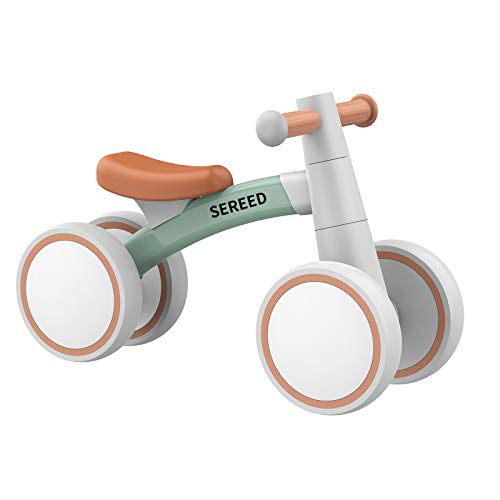
What We Like
- 135° turning limit prevents tipping
- Closed wheels avoid pinched feet
- Lightweight at 3.5 pounds
- Silent wheels for indoor use
Trade-offs
- No pedals means walking-only motion
- 55 lb limit outgrown before age 3
- Seat and handle not adjustable
Four silent wheels and a 135-degree steering limit mean this balance bike won’t scratch floors or tip over when a toddler yanks the handlebar sideways. The aluminum frame keeps it under 4 pounds, so a toddler can actually drag it around without frustration, and the closed wheel design spares little feet from getting caught. It’s a solid first ride-on for kids who are walking but not ready to pedal, offering early practice in steering and balance without the drama of a full bike.
This bike is a walking-only toy, with no pedals or coasting, just scooting. That’s fine for a one-year-old, but by 24 months many kids crave more speed. The VTech Sit-to-Stand Walker, by contrast, offers a stationary activity panel and a handle for upright support, which helps a younger toddler pull up, but it doesn’t teach steering or independent balance the way this bike does. If your child is already steady on their feet and you want something that builds coordination without the risk of a pedal bike, this is a smart, low-drama pick.
Product photos
Sassy Stacks of Circles Stacking Ring

What We Like
- Chunky rings easy for baby to grasp
- Each ring has different texture and weight
- Clear ring with colorful beads links sound to sight
- Straight post strengthens hand-eye coordination
Trade-offs
- Straight post lacks wobble or tilt challenge for older toddlers
- Only 9 pieces limits variety for extended play sessions
Nine pieces with distinct textures and weights mean this ring stacker does more than just teach size order, it gives a child aged 6 to 24 months something to explore with hands. The clear ring filled with colorful beads rattles when shaken, connecting sound with sight in a way that holds attention longer than a plain plastic ring. For a child who is developing fine motor control, the chunky rings are forgiving to grab, and the straight post keeps frustration low. This toy builds coordination without needing batteries or instructions.
The straight post accepts different sized rings without wobble or tilt, which makes it easy for a beginner to strengthen hand-eye coordination. But a child who has already mastered stacking might want more challenge. Compared to the Fisher-Price Baby’s First Blocks, which includes a bucket and 10 blocks, this 9-piece set offers more sensory variety through textured rings and a clear ring with colorful beads that connect sound to sight. For a child aged 6 to 24 months who is still building basic grasp, it fits well. For one who is already moving toward more complex puzzles, you may want to pair it with something that requires a bit more thought.
Product photos
VTech Busy Learners Activity Cube
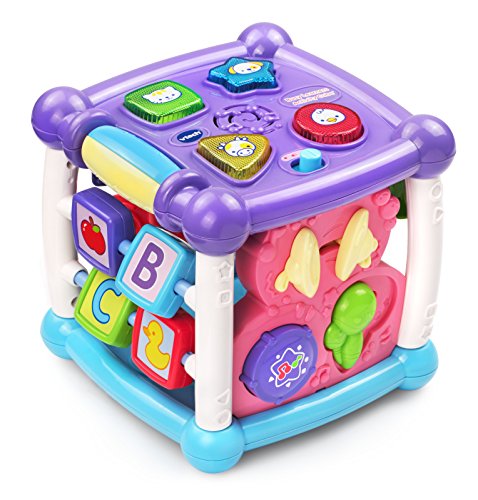
What We Like
- 5 sides of play encourage exploration
- 4 light-up buttons teach animals and shapes
- Motion sensor rewards movement and crawling
- Volume control and auto shut-off included
Trade-offs
- Demo batteries only, replacements needed soon
- At 1.4 lb, light enough to tip if pushed hard
- No music or lights on sides without buttons
Twenty-five songs and melodies packed into a six-inch cube means this little box keeps a baby busy without taking over the living room floor. The motion sensor is the real trick here: tip it or nudge it and it plays sounds, which turns crawling from a chore into a game. Four light-up buttons teach animal names and shapes, so the same toy that gets them moving also gives them something to focus on when they sit still. The volume dial lets you keep the peace without killing the fun.
The cube is light, 1.4 pounds, so a determined toddler can knock it over and lose the action on that side. The included batteries are only for demo, so you’ll need fresh AAA’s right out of the box. For a first activity cube that rewards wiggling and introduces early vocabulary, this one earns its spot in the cart.
Fisher-Price Baby's First Blocks
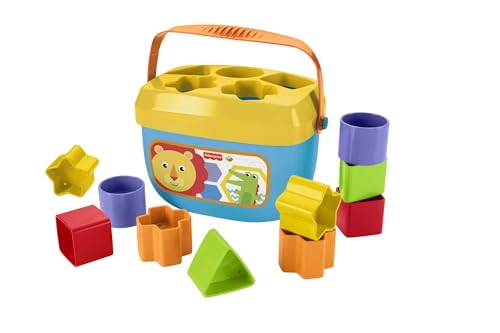
What We Like
- 10 colorful blocks for sorting and stacking
- Bucket doubles as storage with carry handle
- BPA-free plastic meets safety standards
- No batteries needed for play
Trade-offs
- At 0.7 lb, too light for sturdy stacking practice
- Only 10 blocks limit complexity for older toddlers
Ten blocks and a bucket with a shape-sorter lid mean this set gives a toddler exactly the kind of cause-and-effect play that builds fine motor control and early problem-solving. The whole thing weighs just 0.7 pounds, so a toddler can carry it by the handle without help, and the BPA-free plastic survives drops and gnawing without complaint. For a budget pick, it delivers the core sorting and stacking experience without bells, whistles, or batteries, which keeps the focus on the child’s own discovery rather than flashing lights.
Those ten blocks are a limited set. Once your child masters matching shapes through the lid, there isn’t much new challenge to grow into. But if you want a no-fuss, portable first shape sorter that cleans up in seconds and won’t break the bank, this bucket-and-blocks combo does exactly what it promises.
Product photos
Fisher-Price Little People Caring For Animals Farm
What We Like
- 45+ songs and phrases for storytelling
- 3 Smart Stages levels grow with child
- Multiple interactive play points
- Figures sized for small hands
Trade-offs
- At 23.4 inches long, needs floor space
- Only one farmer figure included
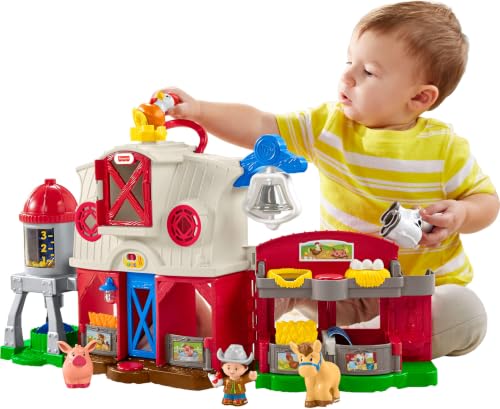
With 45+ songs, sounds, and phrases packed into a single playset, this farm gives a toddler plenty of narrative fuel without needing a parent to narrate every move. The three Smart Stages learning levels teach counting, opposites, animal sounds, and colors, so the toy adapts as your child’s understanding grows from simple cause-and-effect to more complex pretend scenarios. The multiple play points, pressing the barn door button, dropping figures through the hayloft, turning on the barn light, hatching chicks, and popping corn in the spinning silo, keep little fingers busy and encourage repeated exploration. That’s a lot of engagement for a toy that weighs just one pound, making it easy to move from room to room or tuck away when not in use.
This farm stretches 23.4 inches across, so it needs a dedicated spot on the floor rather than a small shelf or tabletop. If your living space is tight, you might find yourself shuffling furniture to make room. Compared to the compact Melissa & Doug Farm Animals Jumbo Knob Puzzle, which offers simple shape recognition and fine motor work in a 12-inch square board, the Fisher-Price farm delivers a richer, more interactive experience but demands more real estate and battery-powered attention. For a toddler who thrives on cause-and-effect sounds and open-ended storytelling, the space commitment is usually worth it, just measure your play area first.
Product photos
How We Evaluated Toys For 16 Month Old
Our research started with the physical and cognitive milestones typical for this age: pulling up, cruising, first steps, pincer grasp, and object permanence. We cross-referenced manufacturer specs and age recommendations with patterns in owner feedback to see which toys actually hold a toddler’s attention and survive daily use.
The criteria that mattered most were developmental match, durability and safety, longevity, and play value. A toy that a toddler can’t operate alone is a frustration; one that’s outgrown in two weeks is a waste. We looked for designs with rounded edges, non-toxic materials, and features like volume controls or adjustable settings that let the toy grow with the child.
A research-led evaluation has honest limits. We don’t test toys in a lab, so our recommendations come from studying what experienced parents and child development experts consistently point to as effective. The final ten picks represent the best balance of engagement, safety, and value we found across the market.
What To Look For In Toys For 16 Month Old
Choosing a toy at this age is about matching their current obsession, walking, dumping, stacking, while leaving room for the skill they are about to discover. Focus on safety, open-ended play, and whether the toy will still be interesting in three months.
Pick toys that encourage standing and walking, offer multiple ways to play, and use safe, durable materials. Avoid anything with small parts that pose a choking hazard, and look for volume control on anything with sounds.
Developmental Stage and Safety
Your toddler is likely walking or cruising, and everything goes in the mouth. Toys must be large enough to avoid choking hazards, the small-parts test cylinder is your friend. Look for BPA-free plastics, sturdy wood construction, and no sharp edges. At this age, a toy should challenge without frustrating, so check that buttons, knobs, and pieces are sized for small hands.
Play Value and Longevity
The best toys for this age have more than one way to play. A stacking ring that also rattles, a walker with a removable activity tray, or blocks that can be sorted, stacked, and knocked down all offer longer engagement. We prioritized toys that don’t rely on batteries for their core fun, since a dead battery can end a play session fast.
Physical Development and Movement
Look for toys that encourage standing, squatting, and walking. Ride-ons with a limited turning radius prevent tip-overs, while push toys with adjustable speed settings let you match your child’s confidence. For fine motor skills, jumbo knobs and chunky rings are easier for developing hands than standard puzzle pieces.
- Check that any ride-on or walker has a wide, stable base.
- Look for volume controls or a mute switch on electronic toys.
- Choose toys with smooth, rounded edges and non-toxic finishes.
- Avoid toys with strings longer than 12 inches to prevent strangulation risk.
- Make sure storage bags or bins are included if you value easy cleanup.
A good rule of thumb: if you can’t see at least two ways your child will play with it in three months, keep looking.
Toys For 16 Month Old Compared
The table below lines up our top ten picks so you can compare their best features, key trade-offs, and ideal use at a glance.
| Product | Dimensions | Weight | Key Feature |
|---|---|---|---|
| VTech Sit-to-Stand Learning Walker | L 16.5 in, W 14.2 in, H 18.1 in | 4.6 pounds | Removable activity tray |
| Melissa & Doug Farm Animals Jumbo Knob Puzzle | 12.0 x 12.0 inches | 1.6 pounds | 8 jumbo peg pieces |
| Kidoozie Whirl 'N Go Ball Tower | 10.2 x 4.7 x 13.8 inches | 1.2 pounds | 4 clear rattle balls |
| Hieoby Baby Pop Up Toy With Music Light | 13.7 x 3.0 x 2.9 inches | 1.8 pounds | 5 cute animals |
| MEGA BLOKS First Builders Big Building Bag | 12.0 x 12.0 x 10.0 inches | 1.0 pounds | 80 Colorful Pieces |
| SEREED Baby Balance Bike | 8.7 x 3.7 x 5.5 inches | 3.5 pounds | 4 silent wheels |
| Sassy Stacks of Circles Stacking Ring | 4.2 x 4.2 x 8.0 inches | 0.6 pounds | 9 piece set |
| VTech Busy Learners Activity Cube | 6.2 x 6.2 x 6.5 inches | 1.4 pounds | 14 interactive features |
| Fisher-Price Baby's First Blocks | 5.1 x 4.9 x 8.3 inches | 0.7 pounds | 10 blocks + bucket |
| Fisher-Price Little People Caring For Animals Farm | 23.4 x 5.3 x 7.3 inches | 1.0 pounds | 1 farmer, 4 animals, 2 food pieces |
Frequently Asked Questions
What is the best toy for a 16-month-old to help them walk?
The VTech Sit-to-Stand Learning Walker is our top choice because it works as both a seated activity center and a walking support. The two-speed switch lets you slow it down for new walkers and speed it up as they gain confidence. The removable tray means they can play with the shape sorters and piano keys from the floor.
Are stacking toys still good for a 16-month-old?
Yes, but look for stacking toys that offer more than just stacking. The Sassy Stacks of Circles Stacking Ring works well because each ring has a different texture, weight, and sound. The clear ring with beads adds a visual and auditory element that keeps a toddler engaged longer than a plain ring set.
What kind of blocks are best for a 16-month-old?
Large, lightweight blocks that are easy to grasp and too big to swallow. The MEGA BLOKS First Builders Big Building Bag gives you 80 pieces in 10 shapes and 9 colors, all sized for little hands. The included storage bag is a practical bonus for cleanup.
Should I buy electronic toys for my 16-month-old?
Electronic toys can be great for teaching cause and effect, but look for ones with volume control and multiple play modes. The Hieoby Baby Pop Up Toy With Music Light offers five different button actions and three play modes, which adds variety. Just remember that batteries are not included, and the toy is bulky for travel.
How many toys does a 16-month-old need?
Quality matters more than quantity. A good rotation of five to seven toys that target different skills, walking, fine motor, cause and effect, stacking, and pretend play, is plenty. The Fisher-Price Little People Caring For Animals Farm covers pretend play and language development in one set, which helps keep the toy box manageable.
The Bottom Line
The VTech Sit-to-Stand Learning Walker is the best overall choice for a toddler because it adapts to their rapid development from seated play to supported walking. If your toddler is already walking and needs a fine motor challenge, the Melissa & Doug Farm Animals Jumbo Knob Puzzle builds confidence with its easy-grasp knobs and matching pictures. For parents on a budget, the Fisher-Price Baby’s First Blocks offers a simple, durable shape sorter that works from six months onward.
The single most important factor in choosing a toy for a toddler is whether it matches their current skill level while leaving room to grow. A toy that is too simple gets ignored; one that is too complex gets frustrating. Pick the one that fits where your child is today, and you will both enjoy it more.
