
10 Best Toys For 13 Month Old in 2026
This post contains affiliate links. As an Amazon Associate, we earn from qualifying purchases.
The best toy for a toddler around one year old is the Kidoozie Whirl ‘N Go Ball Tower, a simple, battery-free toy that teaches cause and effect through colorful, repeatable drops. For interactive learning, the LeapFrog Spin and Sing Alphabet Zoo is a strong choice, while budget-conscious parents should look at the Aigybobo Farm Animals Counting and Sorting Set.
At thirteen months, your toddler is shifting from crawling to cruising and walking. They crave repetition, sensory feedback, and toys that let them practice new motor skills without frustration. The right toy needs to hold up to mouthing, survive drops, and offer just enough challenge to keep them engaged.
This guide is built from manufacturer specifications, expert round-ups, and patterns in parent feedback. We have ranked ten toys across key criteria like durability, developmental value, and safety to help you choose with confidence.
Top 10 Toys For 13 Month Old in the Market
Certain content that appears on this site comes from Amazon. This content is provided "as is" and is subject to change or removal at any time.
The Best Toys For 13 Month Old, Reviewed
Kidoozie Whirl 'N Go Ball Tower

What We Like
- Six colorful levels for visual tracking
- Rattle balls add sight and sound feedback
- Teaches cause and effect through dropping
- No batteries or electronics needed
Trade-offs
- Requires hard flat floor for stable play
- Tower must be lifted by base to stay together
- Only four balls included for repeated drops
A tower that stands 13.8 inches tall with six levels means your toddler gets a long, unpredictable spiral every time they drop a ball in the top. Each level drops the ball in a different spot, so little eyes keep tracking where it lands next. That repeated cause-and-effect loop builds fine motor skills and hand-eye coordination without a single battery or light. For a child in the 9-24 month range who is just starting to understand that their actions make things happen, this is pure learning disguised as entertainment. It also suits parents who want a screen-free toy that holds attention through simple physics, not flashing electronics.
The trade-off is that this tower needs a hard, flat floor to work properly, and you have to lift it by the base to keep the levels from separating mid-play. That makes it less portable than something like the VTech Pop-a-Balls Push and Pop Bulldozer, which can roll around the room. But for focused, stationary play that rewards a single drop with a long, rattling descent, the Kidoozie delivers more visual payoff per action. Just keep it on a rug-free surface and show your child how to hold the base when moving it.
Product photos
LeapFrog Spin and Sing Alphabet Zoo

What We Like
- Introduces letters A-Z and animal sounds
- Three learning modes: letter, animal, music
- Lights and musical responses reward touch
- Spin, push, slide build motor skills
Trade-offs
- At 1.9 lb, it's heavier than some handheld toys
- No volume control mentioned for quiet play
Three learning modes, letter, animal, and music, mean the toy can adapt as a toddler’s interests grow. Each spin of the wheel introduces a new letter and animal sound, so repetition feels like discovery. Lights and musical responses reward every touch, encouraging repeated play. At 1.9 pounds and roughly 6.5 by 7.1 by 8.5 inches, it is stable enough to stay put on a play mat yet light enough to carry between rooms. For a toddler just starting to connect sounds with symbols, this toy offers a focused, encouraging experience.
The LeapFrog Spin and Sing Alphabet Zoo introduces letters A-Z and animal names and sounds through a single spinning wheel, so after a few rounds some toddlers may want more physical variety than spin-push-slide offers. Compared to the VTech Pop-a-Balls Push and Pop Bulldozer, which adds ball-drop play and push-along action, the Spin and Sing Alphabet Zoo leans heavier on seated, fine-motor learning. That focus makes it a strong choice for calm, focused play sessions. For a parent who values early literacy skills and a toy that uses batteries sparingly, this one earns its spot.
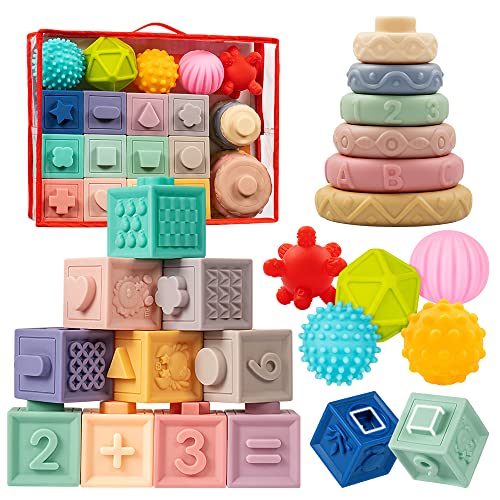
Jyusmile Montessori Stacking Blocks and Teethers Set
What We Like
- 24-piece set with blocks, rings, and balls
- Soft, BPA-free teething-safe material
- Squeaky sound adds sensory engagement
- Includes storage bag for portability
Trade-offs
- No electronic sounds or lights for variety
- Soft blocks wobble during stacking play
Twenty-four pieces in one box means you get blocks, stacking rings, and textured balls all at once, which gives a baby plenty of ways to explore shapes, colors, and sounds without buying separate kits. The soft, BPA-free material makes it safe for teething, and each piece has a small hole that lets out a gentle squeak when squeezed or bitten. For a child who is still mouthing toys and just starting to stack, this set covers both developmental stages in one tidy bundle.
The 24-piece set includes 12 colored blocks, 5 soft stacking rings, 5 textured balls, and a storage bag, so you get plenty of variety for sensory play without needing to buy multiple toys. Because the pieces are soft and BPA-free, they double as teething toys, each has a small hole that lets a baby bite and make a squeaky noise. That softness means towers won’t stack with the precision of hard plastic blocks, so a toddler who already loves building may find the wobble frustrating. The set is quieter and simpler than electronic toys like the LeapFrog Spin and Sing Alphabet Zoo, which keeps play calm but offers no lights or music for cause-and-effect engagement.
Product photos
Hieoby Pop Up Toy with Music and Light

What We Like
- Five different trigger actions for fine motor skills
- Three play modes including quiet, learning, and music
- Non-toxic ABS material with smooth rounded edges
- Lightweight and easy for small hands to operate
Trade-offs
- Game mode requires batteries for music and lights
- Only one animal sound per button limits variety.
Five distinct trigger actions, push, turn, flip, press, and slide, give a toddler multiple chances to figure out cause and effect, which is exactly what this age craves. Each action makes a different animal pop up, so the toy rewards exploration without needing a grown-up to reset anything. It suits toddlers who are just starting to connect their movements with a visible result. The three play modes let you dial the engagement up or down: quiet mode for fuss-free play, learning mode that pairs each pop with an animal sound, and a game mode with lights and music that follows a sequence. That range keeps it interesting as your child’s skills grow from simple pressing to following light cues.
The game mode’s music and lights need batteries, and at nearly fourteen inches long, this toy takes up noticeable floor space compared to a compact option like the LeapFrog Spin and Sing Alphabet Zoo. It’s not a problem if you have a clear play mat, but in a tight nursery corner the length can feel bulky. For a toddler who thrives on repetition and wants to master each button one by one, the variety of triggers here gives more cause-and-effect practice than a single-action pop-up. Just keep a few AAAs handy if you plan to use the musical mode regularly.
Product photos
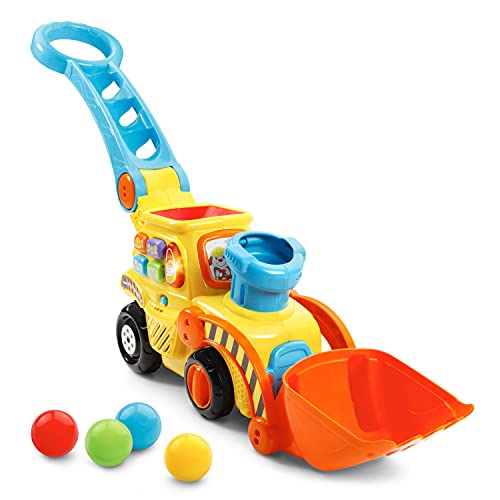
VTech Pop-a-Balls Push and Pop Bulldozer
What We Like
- Motion sensors trigger tunes while rolling
- Chunky handle encourages motor skill development
- Pops balls from chimney into bucket
- Buttons teach colors, numbers, and phrases
Trade-offs
- At 2.5 pounds, heavier than some push toys
- No volume control for the sound effects
A bulldozer that pops balls out of its chimney as you push it gives a toddler a clear cause-and-effect payoff for every step. The chunky handle fits small hands well, and the motion sensors reward movement with tunes, so the toy encourages walking practice without needing a grown-up to demonstrate. Pressing the buttons for colors and numbers adds a layer of early learning that keeps the play fresh longer than a simple rolling cart.
Weight is a factor: at 2.5 pounds, it is noticeably heavier than the LeapFrog Spin and Sing Alphabet Zoo, which means a toddler just finding their balance may tip it over more often. The balls also have no onboard storage, so they tend to scatter across the floor. For a child who is already cruising confidently and loves watching things move and pop, this bulldozer delivers satisfying feedback that keeps them coming back to push it again.
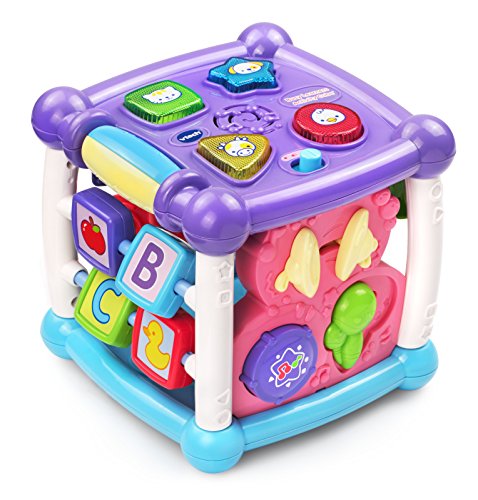
VTech Busy Learners Activity Cube
What We Like
- 5 sides of play encourage exploration
- Motion sensor activates sounds when moved
- 4 light-up buttons teach animals and shapes
- Adjustable volume and auto shut-off
Trade-offs
- At 6.2 inches per side, limited surface area
- Batteries included only for demo purposes
- No carry handle for easy portability
Fourteen interactive features packed into a 6.2-inch cube means a baby gets a lot of discovery without taking over the living room floor. Five sides of play, including light-up buttons that introduce animal names, sounds, and shapes, give a baby plenty to explore while sitting or during early crawling. The motion sensor adds a nice surprise: sounds kick in when the cube gets nudged, which can help encourage a reluctant crawler to move. With 25 songs and melodies in rotation, this thing keeps the engagement going longer than a single-toy meltdown window typically allows.
The compact size limits how much two little hands can do at once, especially compared to something like the LeapFrog Spin and Sing Alphabet Zoo, which offers a larger spinning surface. That said, the VTech cube’s auto shut-off and adjustable volume are thoughtful touches for parents who value their sanity during the hundredth play session. For a baby who’s just starting to sit up and reach for things, this is a solid, space-efficient option that grows with them through the crawling stage.
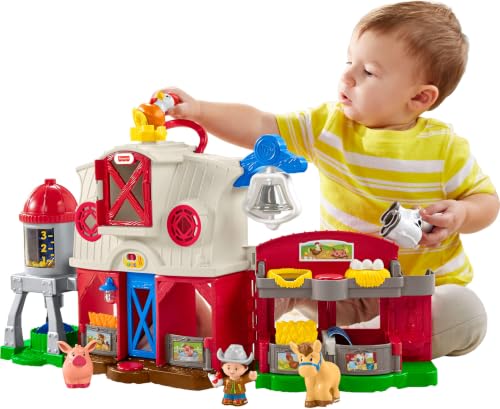
Fisher-Price Little People Caring for Animals Farm
What We Like
- 45+ songs, sounds, and phrases
- 3 Smart Stages learning levels
- Multiple play points for engagement
- Figures sized for small hands
Trade-offs
- At 23.4 inches long, needs floor space
- Only one farmer figure limits role variety
Forty-five songs, sounds, and phrases packed into a single barn means this playset keeps talking back as your toddler grows. The three Smart Stages learning levels adjust content from simple animal sounds to counting and colors, so it stays fresh well past the first birthday. That weight, just one pound, makes it easy to move from playmat to living room floor, and the chunky figures are sized for tiny fingers still mastering the pincer grasp. For a toddler just discovering cause and effect, pressing the barn door button or dropping figures through the hayloft turns every action into a reward.
The 23.4-inch length demands a dedicated spot on the floor, which might feel cramped if your play area already hosts a ball tower like the Kidoozie Whirl ‘N Go. The electronic sounds are engaging but constant, so if your child prefers quiet stacking or sensory exploration, the farm’s chatter could compete rather than complement. Still, for families wanting a single toy that grows with their child’s imagination and teaches real-world concepts through pretend play, this barn delivers more interactive mileage than most playsets at this age.
Product photos
hahaland Surprise Barn Farm Animals with Sounds
What We Like
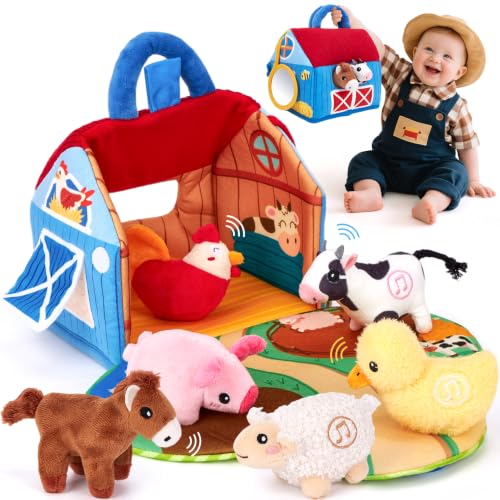
- 6 plush animals with realistic sounds
- Barn unfolds into play mat
- Crinkle paper and lift flaps for sensory play
- Mirror encourages self-discovery
Trade-offs
- Animals surface-wash only, not fully washable
- Barn mat is washable but animals need care
- No music or lights for extra engagement
Six talking farm animals each make three realistic sounds and repeat their name three times, which builds language repetition into a soft, baby-safe toy. The barn unfolds into a play mat with matching spots, hide-and-seek flaps, crinkle paper windows, and a mirror, so a baby can practice object permanence, fine motor skills, and self-discovery all in one spot. It’s a strong pick for parents who want a quiet, Montessori-style toy that encourages cause-and-effect without flashing lights or loud music.
The plush animals are only surface-washable because of the sound IC inside, so a drooly or muddy farm friend needs spot cleaning rather than a machine cycle. Compared to the Fisher-Price Little People Caring for Animals Farm, which offers a larger playset with Smart Stages music and pretend play, this hahaland set is more portable (0.9 pounds with a handle) and better suited for on-the-go or contained sensory play. Best for families who value language-rich, tactile exploration over electronic bells and whistles.
Product photos
Fisher-Price Laugh & Learn Mix & Learn DJ Table

What We Like
- 100+ songs and learning phrases
- 3 Smart Stages learning levels
- Record and play back feature
- 12 fine motor activities
Trade-offs
- At 4.5 lb, heavy for a tabletop toy
- Requires 3 AA batteries, not included
The 12 fine motor activities and 100-plus songs and phrases mean this table packs enough variety to hold a baby’s attention through multiple play sessions. The three Smart Stages learning levels let you adjust the content as your child grows, teaching colors, shapes, numbers, and even Spanish words. It suits a parent who wants a single toy that evolves from early cause-and-effect play into more structured learning, all while encouraging balance as the child pulls up to stand.
Weight is a factor: at 4.5 pounds, this is a solid, stable table that won’t tip easily, but it also means you won’t be moving it from room to room on a whim. Compared to the LeapFrog Spin and Sing Alphabet Zoo, which is lighter and rotates for a different kind of engagement, the DJ Table offers more interactive features but demands a dedicated spot on the floor. If your little one is easily overwhelmed by flashing lights and layered sounds, the simpler VTech Busy Learners Activity Cube might be a calmer alternative.
Product photos
Aigybobo Farm Animals Counting and Sorting Set
What We Like
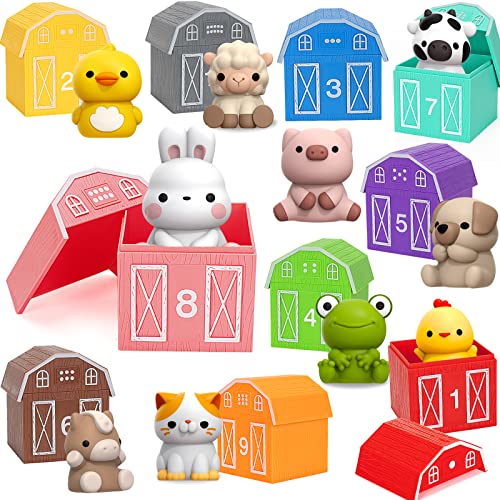
- 20-piece set with 10 animals and barns
- Animals double as finger puppets
- Barns have numbered lids and dots for counting
- Safe, smooth edges and drop-resistant materials
Trade-offs
- No sound or lights for auditory engagement
- Barns lack a locking mechanism to keep animals inside
Twenty pieces for well under what most single-function toys cost, that is the headline here. You get ten farm animals that also work as finger puppets, plus ten matching barns with numbered lids and dots that teach counting and color sorting. For a toddler in the 12-18 month range who is just starting to understand matching and putting things in containers, this set delivers a surprising amount of developmental mileage without any batteries or screens. It is the kind of toy that quietly builds fine motor skills while your child thinks they are just hiding a cow. If you are looking for something that stretches a modest budget across multiple learning areas, this is where I would put my money.
This is a quiet, tactile toy. Compared to something like the LeapFrog Spin and Sing Alphabet Zoo, there are no sounds, lights, or songs to grab a distracted toddler’s attention. The vinyl animals are lightweight and safe, and the plastic barns have smooth edges. Because the pieces are small, you will want to keep an eye on them during play, they can disappear under a couch faster than you can say “where did the duck go?” Still, for a parent who values open-ended, screen-free play and wants to introduce early number concepts without spending much, this set is a smart, practical buy.
Product photos
How We Evaluated Toys For 13 Month Old
We started by reviewing the specifications and safety documentation for dozens of toys designed for this age group. We then cross-referenced those specs with patterns in parent feedback and expert recommendations from child development sources. This research-based approach helps us separate marketing claims from real-world value.
The evaluation focused on four criteria. Developmental fit looked at whether a toy supports the motor, sensory, and cognitive skills typical of a toddler around one year old. Durability and safety covered material quality, edge smoothness, and the absence of small parts. Engagement measured how long a toy held a toddler’s attention through varied feedback. Value considered whether a toy offered multiple play modes or longevity.
The honest limit of a research-led evaluation is that every child develops differently. What one toddler loves, another may ignore. We prioritize toys that offer open-ended play or multiple ways to interact, giving you the best chance of finding a hit.
What To Look For In Toys For 13 Month Old
Choosing a toy for this age means balancing safety with the right amount of challenge. You want something that encourages standing, walking, and fine motor practice without overwhelming your child.
Look for toys that support cause-and-effect learning, offer varied sensory feedback, and are built from safe, durable materials. Avoid anything with small parts or sharp edges.
Cause and Effect
A toddler around one year old is learning that their actions create reactions. Toys like the Kidoozie Whirl ‘N Go Ball Tower or the Hieoby Pop Up Toy teach this directly: drop a ball and it rolls down; push a button and an animal pops up. This builds early problem-solving skills and gives your child a sense of control.
Look for toys with multiple triggers or actions so your toddler can experiment with different inputs. The VTech Pop-a-Balls Push and Pop Bulldozer rewards pushing with motion-activated tunes, adding a physical element to the learning.
Sensory Feedback
Toddlers at this age learn through their senses. Sound, light, texture, and movement all help them understand their world. The Jyusmile Montessori Stacking Blocks offer squeaky sounds and varied textures, while the hahaland Surprise Barn provides crinkle paper and realistic animal noises.
The best toys layer sensory inputs without overwhelming. The LeapFrog Spin and Sing Alphabet Zoo uses lights and music to reinforce letters and animal sounds, but gives your child control over when those sounds play.
Motor Skill Development
Thirteen months is a peak time for gross and fine motor development. Push toys like the VTech Pop-a-Balls Bulldozer help with balance and walking confidence. Smaller toys that require grasping, stacking, or twisting build hand strength.
The Fisher-Price Laugh & Learn Mix & Learn DJ Table offers 12 fine motor activities on one surface. When choosing, check that the toy’s size and weight match your child’s current abilities. A toy that is too heavy or hard to manipulate will cause frustration.
- Can your child easily grasp or push the toy without help?
- Does the toy have smooth, rounded edges and non-toxic materials?
- Are there multiple ways to interact with the toy?
- Will the toy still be engaging in two or three months?
- Can the toy be cleaned easily?
- The best toy is one your child can use independently part of the time.
Toys For 13 Month Old Compared
The table below compares the ten toys we evaluated, highlighting their key features and best use cases.
| Product | Dimensions | Weight | Age Range |
|---|---|---|---|
| Kidoozie Whirl 'N Go Ball Tower | L 10.2 x W 4.7 x H 13.8 in | 1.2 lb | 9-24 months |
| LeapFrog Spin and Sing Alphabet Zoo | 6.5 x 7.1 x 8.5 in | 1.9 lb | N/A |
| Jyusmile Montessori Stacking Blocks and Teethers Set | 11.0 x 7.8 x 2.5 inches | N/A | 0-3-6-9-12-18 months |
| Hieoby Pop Up Toy with Music and Light | 13.7 x 3.0 x 2.9 inches | 1.8 pounds | N/A |
| VTech Pop-a-Balls Push and Pop Bulldozer | 6.2 x 6.2 x 6.3 inches | 2.5 pounds | N/A |
| VTech Busy Learners Activity Cube | 6.2 x 6.2 x 6.5 in | 1.4 lb | 6 months, 3 years |
| Fisher-Price Little People Caring for Animals Farm | L 23.4 inches, W 5.3 inches, H 7.3 inches | 1.0 pounds | 1-5 years |
| hahaland Surprise Barn Farm Animals with Sounds | 7.9 x 6.5 x 8.7 inches | 0.9 pounds | N/A |
| Fisher-Price Laugh & Learn Mix & Learn DJ Table | L 12.0 inches, W 6.5 inches, H 0.1 inches | 4.5 pounds | 6 months to 3 years |
| Aigybobo Farm Animals Counting and Sorting Set | 12.0 x 5.5 x 3.0 inches | 1.4 pounds | 12-18 months |
Frequently Asked Questions
What is the best type of toy for a 13-month-old?
The best toys for this age combine cause and effect with sensory feedback and motor skill practice. Simple ball drop towers, push toys, and activity cubes are excellent choices because they let toddlers experiment and learn at their own pace.
Are electronic toys good for a 13-month-old?
Yes, when used in moderation. Electronic toys like the LeapFrog Spin and Sing Alphabet Zoo or the Fisher-Price Mix & Learn DJ Table can teach letters, numbers, and animal sounds through interactive play. The key is to choose toys that respond to the child’s actions rather than just playing sounds passively.
How many toys does a 13-month-old need?
A small rotation of five to eight toys is plenty. Toddlers at this age learn best through repetition, so having fewer toys that offer multiple ways to play is better than a large collection that overwhelms them. Rotate toys every week or two to keep things fresh.
What safety features should I look for?
Check for non-toxic, BPA-free materials and smooth, rounded edges. Ensure there are no small parts that could become choking hazards, and that the toy is sturdy enough not to tip over during play. For electronic toys, a secure battery compartment is essential.
Can a 13-month-old play with building blocks?
Yes, but choose soft blocks like the Jyusmile Montessori set rather than hard wooden ones. Soft blocks are safe for mouthing and won’t hurt if your child falls on them. Stacking practice helps with fine motor skills and hand-eye coordination.
The Bottom Line
For most families, the Kidoozie Whirl ‘N Go Ball Tower is the best overall choice. It is simple, durable, and teaches cause and effect without batteries or screens. Your child will learn by dropping balls and watching them tumble down six colorful levels.
If your toddler craves interactive feedback, the LeapFrog Spin and Sing Alphabet Zoo offers letters, animal sounds, and music in one engaging package. For a budget-friendly option that covers counting, sorting, and pretend play, the Aigybobo Farm Animals Counting and Sorting Set delivers excellent value.
The single most important factor when choosing toys for a toddler around one year old is whether the toy lets your child lead the play. The best toys respond to your toddler’s actions, not the other way around. Focus on toys that invite exploration and reward curiosity.
