
10 Best Stem Toys For Children No Artificial Intelligence
This post contains affiliate links. As an Amazon Associate, we earn from qualifying purchases.
This guide covers the best STEM toys for children, excluding those that use artificial intelligence, and the Klutz Lego Gear Bots Science Kit is the best overall pick.
Klutz Lego Gear Bots Science Kit wins as the best overall because it teaches real mechanical engineering through eight moving LEGO creatures that kids actually build themselves. It covers axles, cams, and cranks. The Snap Circuits Explorer SC-100 Kit earns the Best 100+ Project Electronics Kit award for its no-tools circuitry lessons, while the Sillbird 12-in-1 Solar Robot Kit takes Best Solar-Powered Build for renewable energy education without batteries.
Every parent we talk to wants a toy that teaches real science and engineering without relying on screens, apps, or artificial intelligence. The challenge is finding a kit that holds attention, matches your child’s age and skill level, and delivers genuine learning, not just flashing lights and pre-programmed responses.
We researched specifications, manufacturer documentation, and patterns in owner feedback to build this guide. You get ten thoughtfully ranked picks, clear buying criteria, and honest trade-offs for each one so you can choose with confidence.
Top 10 STEM Toys For Children No Artificial Intelligence in the Market

Certain content that appears on this site comes from Amazon. This content is provided "as is" and is subject to change or removal at any time.
The Best STEM Toys For Children No Artificial Intelligence, Reviewed
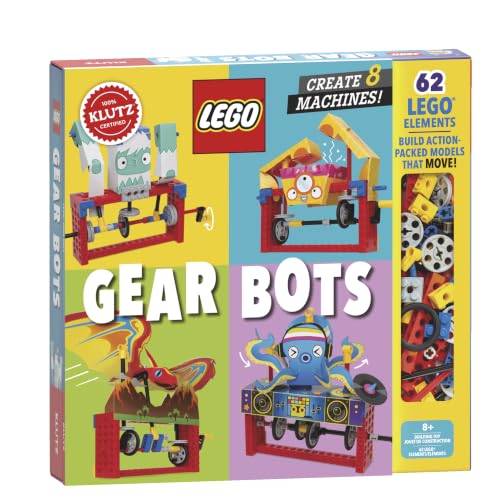
Klutz Lego Gear Bots Science Kit
What We Like
- Includes all LEGO elements needed
- Teaches axles, cams, and cranks
- 64-page book with step-by-step instructions
- Builds 8 physics-driven creatures
Trade-offs
- Only 8 builds before reusing pieces
- No replacement parts available if a piece is lost
This kit lets you build eight physics-driven kinetic creatures using LEGO Technic bricks and papercraft, with every LEGO element included in the box. The 64-page book provides step-by-step instructions and STEM content about axles, cams, cranks, and engineering in everyday machines. For a child who wants to see mechanical principles in action without a screen, this is a focused, hands-on introduction to how things move.
The trade-off is that once you have built all eight creatures, you are done unless you start taking them apart to rebuild. That gives it a shorter replay life than something like the Snap Circuits Explorer SC-100, where you can keep reconfiguring the same parts into over a hundred projects. But for a focused introduction to gears and motion that feels more like a build-and-display experience than a free-form lab, this kit delivers exactly what it promises.
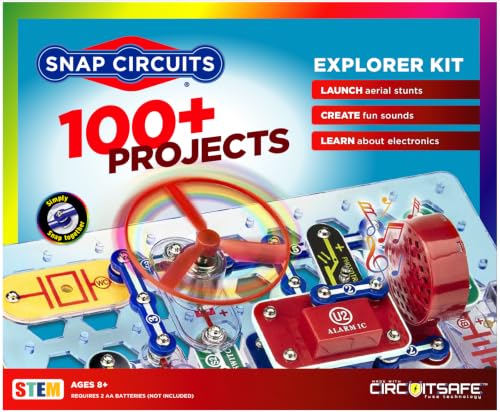
Snap Circuits Explorer SC-100 Kit
What We Like
- 100+ projects from a single kit
- No tools or soldering required
- Award-winning STEM kit design
Trade-offs
- Requires batteries not included in box
- 29 parts limit project complexity for older kids
The 28 snap-together parts in this kit let you build over 100 different projects. That means a single box can provide weeks of circuit-building activities. The numbered and color-coded pieces click onto the included plastic grid without any soldering or extra tools, so a child as young as eight can assemble a flying saucer that takes off and sounds an alarm shortly after opening the box. Because the kit is designed to introduce the basics of electrical engineering, it works well for families who want a self-contained starter set that doesn’t require immediate add-ons.
The downside of having only 28 parts is that after building the flying saucer, the alarm, and many other gadgets, your child might eventually want more complexity than this set provides. The Sillbird 12-in-1 Solar Robot Kit, for comparison, is powered by the sun and offers a different kind of variety, though its name suggests it builds twelve models. For project count and ease of getting started, the Snap Circuits Explorer is a strong option. You will need to supply batteries, as the kit requires them but does not include them.
Sillbird 12-in-1 Solar Robot Kit

What We Like
- 12 buildable models in one kit
- Solar powered, no batteries required
- Upgraded larger solar panel
- Clear step-by-step instructions
Trade-offs
- Indoor play needs a strong flashlight
- 190 pieces can overwhelm younger builders
Kids learn how renewable energy works by snapping together models that crawl, roll, and spin under the sun. This kit targets the 8-to-13 age range, appealing to builders who also benefit from outdoor play. The step-by-step instructions are clear enough that most children can work through assembly independently, which spares adults from hunting for lost pieces. With 190 parts and 12 possible builds, the difficulty scales from simple beginner robots to more advanced configurations. Reviewers note that the varying challenge levels keep the set engaging as skills develop. The solar panel has been upgraded with a larger sun-catching surface, delivering stronger power output so models move reliably in direct sunlight or under a bright indoor light like a flashlight.
Solar play depends on strong light. Indoors, you’ll need a bright flashlight pointed directly at the panel to keep things moving, which is fine for a tabletop but less convenient than a battery-powered set. For comparison, the Snap Circuits Explorer offers 100+ projects with snap-together parts and a full-color manual, but it requires a battery (not included). With the Sillbird, you’re trading instant-on convenience for the experience of harnessing sunlight, a fair swap if you want a renewable energy lesson that’s hands-on. Just be aware that in low-light rooms or on cloudy days, the robot may not move without a strong artificial light source.
LEGO Technic NASA Artemis Rocket

What We Like
- 3-stage rocket separation via hand crank
- Created with NASA and ESA for authenticity
- Includes 4 astronaut nanofigures
- 632-piece build for focused engagement
Trade-offs
- Narrow base: 3 in. wide, needs stable surface
- No motors or electronics for active play
A 70-centimeter-tall rocket that actually breaks apart in three stages using a hand crank, that’s the kind of mechanical payoff that keeps a 9-year-old from wandering off halfway through. The LEGO Technic NASA Artemis Rocket was created in collaboration with NASA and ESA. The separation sequence matches the real SLS launch profile: solid boosters drop away, then the core stage drops, then the Orion spacecraft sits on top. Four astronaut nanofigures and blue flame details let kids stage their own lunar missions. It suits a child who loves space and wants to understand how a rocket sheds weight to reach orbit, not just stack bricks into a static display.
The 632 pieces and a three-stage mechanism demand patience and a clean table. The rocket’s 3-inch footprint means a bump sends it tipping, so younger siblings or wobbly desks are a risk. This set is designed for kids ages 9 and up who enjoy following step-by-step building instructions and learning about space through a STEM toy.
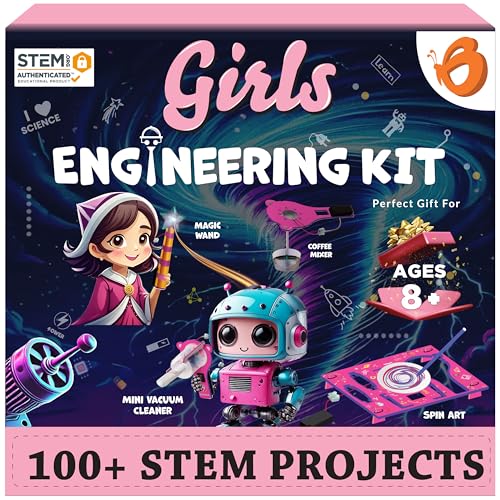
Butterfly EduFields Girls Engineering Kit
What We Like
- 100+ hands-on engineering and science projects
- Screen-free, reusable parts rebuild again
- Develops problem-solving and scientific thinking
- Clear step-by-step guides for ages 8-12
Trade-offs
- Only one box; no expansion sets mentioned
- No expansion sets to extend play beyond the box
With over 100 projects packed into a single kit, this engineering set gives a girl enough experiments to explore gears, levers, circuits, and working machines without needing to buy a second box anytime soon. Every build teaches a core STEM idea by doing, she learns how a lever actually lifts weight or how a circuit closes, not just a textbook definition. That hands-on repetition builds real confidence, especially for curious 8- to 12-year-olds who prefer figuring things out themselves. The illustrated guides are clear enough that a parent can step back, but the real win is the reusable parts mean she can tear down and rebuild something completely different next week.
The trade-off here is that 100 projects can feel like a lot to manage, especially for a younger 8-year-old who might need more one-on-one guidance. The Butterfly kit covers gears, gears, levers, circuits, and working machines, so it suits the girl who wants variety over depth in one discipline. If your daughter loves building and experimenting across different fields, this is the kit that keeps her busy without a screen.
MAGNA-TILES Classic 100-Piece Set

What We Like
- 100 geometric shapes in 6 colors
- Compatible with all other MAGNA-TILES sets
- Certified STEAM toy for developmental skills
- Food-grade, BPA-free, phthalate-free plastic
Trade-offs
- At 7.0 pounds, heavy for very young children to carry
- No project guide or instructions for structured building
A hundred translucent magnetic tiles in six colors give a child enough raw material to build towers, castles, bridges, and abstract sculptures without needing a single battery or screen. The pieces pull apart easily, which matters when small hands are still learning to control force. Because every tile is compatible with every other MAGNA-TILES set, this starter kit grows with the child; add more shapes later without worrying about compatibility. The food-grade MABS construction and lack of BPAs, phthalates, or latex mean the materials are safe for young children, though supervision is always recommended during play.
Weight and volume are the main considerations. At seven pounds, this set is sturdy, but a preschooler won’t be carting it from room to room easily. If you prefer guided builds with step-by-step instructions, something like the Klutz Lego Gear Bots kit offers a more structured experience, though with a narrower age range (8-12 years). For open-ended construction that prioritizes durability and safety, this set delivers exactly what it promises.
Product photos
Snap Circuits Flight Deck Launcher

What We Like
- Five projects teach circuits and aerodynamics
- Builds a working paper airplane launcher
- No extra tools needed to start
- Award-winning Snap Circuits brand
Trade-offs
- Batteries required but not included
- Limited to paper airplanes and small objects
Five distinct projects in one compact kit let kids explore circuits, motors, and aerodynamics without needing extra tools. This kit suits a curious 8-year-old who wants to see how electricity and physics work together, especially one who loves making things fly.
You need to supply your own batteries, which is a small hurdle if you don’t keep AA’s on hand. Compared to the Snap Circuits Explorer, which offers 100+ projects from a single box, this Flight Deck gives you five projects that focus on motion and air. That makes it a better fit for a child who wants quick, satisfying results with paper airplanes rather than a broader electronics introduction. For a kid who enjoys folding paper planes and wants to launch them with real circuits, this kit provides a focused way to play with STEM.
Product photos
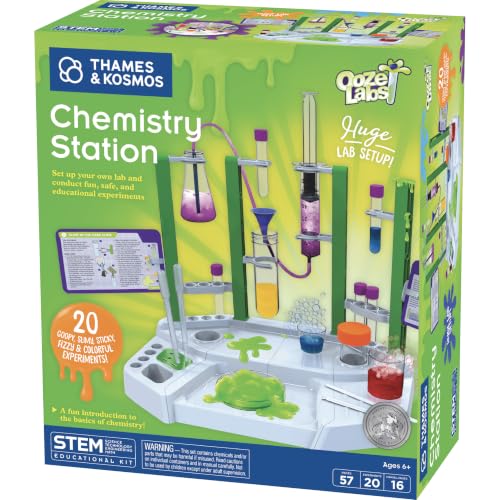
Thames & Kosmos Ooze Labs Chemistry Station
What We Like
- 57 pieces for real lab setup
- Includes non-hazardous chemicals
- 16-page full-color manual
- Experiment cards clip onto station
Trade-offs
- Ages 6+ limits complexity for older kids
- Lightweight frame can slide during reactions
A 57-piece chemistry station with beakers, test tubes, flasks and pipettes means a child can actually set up like a real scientist, not just watch from the sidelines. The printed experiment cards clip onto the lab station for easy reference and a separate 16-page manual gives extra experiments and explanations. That layout is why this kit suits a curious 6-year-old who wants to follow the cards and manual while mixing glowing slime or fizzing reactions.
The whole station weighs only one pound, so it is light enough to slide around on a tabletop during a bubbling reaction. That light weight means the plastic frame can shift if bumped, so a younger chemist may need a grown-up nearby to keep things steady. It is best for a child who loves colorful experiments and has help available.
Product photos
Thames & Kosmos Pinball Machine Maker

What We Like
- Edible gumballs double as pinballs
- Teaches physics through trial-and-error
- Reconfigurable obstacles for varied play
Trade-offs
- Gumballs can create sticky messes if crushed or eaten.
- Not a build-and-display set; requires active supervision with younger kids.
The kit includes approximately 45 edible gumballs to use as pinballs, so you can start playing right away. You build a customizable pinball machine with bumpers, slingshots, bells, and ramps, then rearrange those obstacles to change the playing field. That turns learning about force, motion, and gravity into a trial-and-error game that encourages creative problem-solving.
Product photos
Learning Resources STEM Explorers Machine Makers
What We Like
- 9 real-world engineering challenges included
- Builds satellite dish, crane, space rover
- Compatible with Gears! Gears! Gears! sets
- Designed for ages 5 and up
Trade-offs
- Only 9 challenges limit long-term replay value
- No motor or battery power for moving builds
Nine distinct engineering challenges, building a satellite dish, crane, or space rover, means your child isn’t just stacking gears; they’re solving problems that mirror real-world physics and engineering. At under a pound and sized for small hands, this set is light enough for a five-year-old to carry to the kitchen table and sturdy enough to survive a few design failures. That trial-and-error process builds critical thinking without a screen in sight, which is exactly what you want in a no-AI STEM toy.
Nine challenges are finite. Once your child has cracked each one, they’ll need the compatible Gears! Gears! Gears! sets to keep the gears turning, so factor that into your long-term plan. Compared to the Klutz Lego Gear Bots kit for ages 8-12, this set targets a younger builder with more structured guidance and less open-ended tinkering. If your child thrives on clear goals and immediate satisfaction, this is the better starting point.
Product photos
How We Evaluated STEM Toys For Children No Artificial Intelligence
We started by examining each toy’s mechanical or scientific principle, does it teach something real about physics, engineering, chemistry, or circuitry, or is it just a battery-powered gadget? Every pick here operates without AI, apps, or digital components. We read manufacturer documentation, reviewed project counts and age ranges, and studied what owners consistently report about build quality and replay value.
The four criteria that mattered most were educational depth, build variety, age appropriateness, and durability. Educational depth asks whether the child learns a real STEM concept. Build variety looks at how many different projects or configurations come in one box. Age appropriateness checks if the instructions and parts suit the stated age range. Durability considers whether the pieces survive repeated assembly and disassembly. A toy that scores well on all four made the cut.
This is a research-led evaluation based on publicly available information and owner feedback patterns. We did not conduct hands-on testing in a lab setting, so we focus on what the manufacturer says, what the specifications show, and what the community of buyers report, not our own testing data.
What To Look For In STEM Toys For Children No Artificial Intelligence
The best no-AI STEM toy teaches a real scientific or engineering concept through hands-on building, not through a screen. Look for mechanical principles, real chemistry, or physical construction, not apps, sensors, or pre-programmed responses.
Real Mechanical or Scientific Principle
The toy should teach something verifiable: gears transfer motion, cams create reciprocation, chemical reactions cause visible change, or solar panels convert light to energy. If the “learning happens on a screen, the toy is edutainment, not STEM. The best STEM toys for this category don’t involve artificial intelligence at all.
Project Count and Replay Value
A 100-project kit like the Snap Circuits Explorer SC-100 gives a family through a school year. A 12-model solar robot or a 100-piece magnetic set offers variety through reconfiguration. The best kits either give many distinct builds or allow open-ended construction. Single-build kits work for focused sessions but offer less long-term value.
Age Range and Part Count
Manufacturer age recommendations matter, a 190-piece solar robot overwhelms a six-year-old, while a 57-piece chemistry station feels too simple for a twelve-year-old. Check the piece count against your child’s experience with building toys. The STEM toy buying guide explains how to match these numbers to your child’s skill level.
Safety and Material Quality
Non-hazardous chemicals, BPA-free plastics, and food-grade materials matter when kids put things in their mouths or get chemicals on their hands. Look for certifications like food-grade, BPA-free, and phthalate-free on magnetic sets and chemistry kits.
- Does the toy require batteries you need to buy separately?
- Are replacement parts available if a piece gets lost?
- Can younger siblings choke on small pieces?
- Is the build surface stable enough for active kids?
- Are the instructions clear enough for independent play?
A good rule of thumb: if your child can explain what they built and why it works, the toy is doing its job.
STEM Toys For Children No Artificial Intelligence Compared
The table below compares all ten picks side by side, so you can see at a glance which kit matches your child’s age, interest, and age range.
| Product | Age Range | Pieces | Weight |
|---|---|---|---|
| Klutz Lego Gear Bots Science Kit | 8-12 years | N/A | 1.0 pounds |
| Snap Circuits Explorer SC-100 Kit | 8+ | 28 snap-together parts | 1.4 pounds |
| Sillbird 12-in-1 Solar Robot Kit | 8-13 years | 190 | N/A |
| LEGO Technic NASA Artemis Rocket | 9+ | 632 | 2.2 pounds |
| Butterfly EduFields Girls Engineering Kit | 8-12 years | N/A | 1.3 pounds |
| MAGNA-TILES Classic 100-Piece Set | 3+ years | 100 translucent shapes | 7.0 pounds |
| Snap Circuits Flight Deck Launcher | Ages 8+ | N/A | 0.6 pounds |
| Thames & Kosmos Ooze Labs Chemistry Station | 6+ | 57 | 1.0 pounds |
| Thames & Kosmos Pinball Machine Maker | Ages 6+ | 45 gumballs + building parts | 2.2 pounds |
| Learning Resources STEM Explorers Machine Makers | 5 years and up | N/A | 0.9 pounds |
Frequently Asked Questions
What is the difference between a STEM toy and a regular toy?
A STEM toy teaches a real scientific or engineering concept through hands-on building, gears, physics, or chemistry. A regular toy might move, light up, or make noise without teaching any principle behind it. A STEM toy asks “why does this work?”” and gives the child the answer through building.
How many projects should a single STEM kit have?
The right number depends on your child’s attention span and your budget. A 100-project kit like the Snap Circuits Explorer SC-100 lasts through a school year. A 12-model solar robot or a 100-piece magnetic set offers variety through reconfiguration. A single-build kit works for focused sessions but offers less long-term value.
What age should a child start with STEM toys?
Most kits start at age 5 or 6 with larger pieces and simple instructions. The Learning Resources STEM Explorers Machine Makers starts at age 5 with nine engineering challenges. The MAGNA-TILES Classic 100-Piece Set works for ages 3 and up with its large, magnetic pieces. Start with the manufacturer’s age recommendation and your child’s fine motor skills.
Are battery-powered STEM toys better than solar-powered ones?
Not necessarily. Battery-powered toys often use motors and electronics for moving builds, while solar-powered toys teach renewable energy. The Sillbird 12-in-1 Solar Robot Kit requires no batteries at all and teaches solar energy conversion. Both types have their place, choose based on whether you want to teach circuitry or renewable energy.
Can STEM toys be used without adult supervision?
Many kits are designed for independent play within the stated age range. The Snap Circuits Explorer SC-100 has clear step-by-step instructions for ages 8 and up. The Thames & Kosmos Ooze Labs Chemistry Station is designed for ages 6 to 8 but recommends adult supervision for chemical reactions. Always check the manufacturer’s supervision recommendation.
The Bottom Line
The Klutz Lego Gear Bots Science Kit is the best overall pick for families who want a child ages 8 to 12 to learn real mechanical engineering through eight physics-driven LEGO creatures. If your child loves paper airplanes and circuits, the Snap Circuits Flight Deck Launcher offers a unique combination of aerodynamics and electronics in one build.
Budget-conscious families should look at the Snap Circuits Explorer SC-100 for its 100+ projects from a single box, or the Sillbird 12-in-1 Solar Robot Kit for renewable energy learning without battery costs. The single most important buying factor remains matching the toy’s complexity to your child’s age and experience, a kit that’s too hard collects dust, and one that’s too easy collects boredom.
