
10 Best Stem Toys For 8 Year Olds in 2026
This post contains affiliate links. As an Amazon Associate, we earn from qualifying purchases.
The Klutz Lego Gear Bots STEM Kit is our best overall pick because it combines the universal appeal of LEGO with a 64-page STEM lesson on axles, cams, and cranks. For beginners, the Snap Circuits Explorer SC-100 offers a safe, tool-free introduction to electronics, while the Butterfly EduFields Girls Engineering Kit provides over 100 screen-free projects for curious builders.
An eight-year-old is at a perfect age for STEM toys: they can follow multi-step instructions, understand cause and effect, and still love the magic of making something work. The challenge is finding a kit that matches their attention span and skill level without frustrating them or boring them after one use.
This guide is research-based. We evaluated specifications, manufacturer documentation, expert round-ups, and patterns in owner feedback to find the ten best kits that actually teach something while keeping an 8-year-old engaged.
Top 10 STEM Toys For 8 Year Olds in the Market
Certain content that appears on this site comes from Amazon. This content is provided "as is" and is subject to change or removal at any time.
The Best STEM Toys For 8 Year Olds, Reviewed
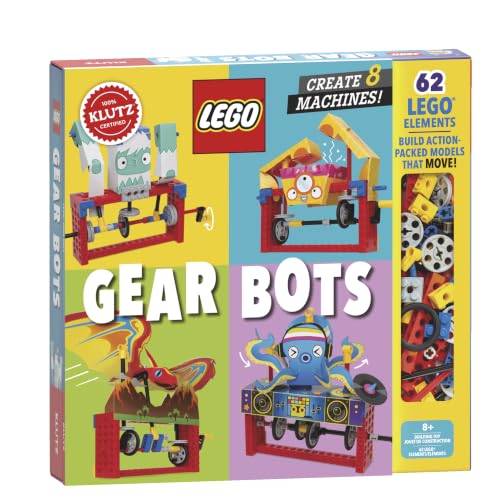
Klutz Lego Gear Bots STEM Kit
What We Like
- Builds 8 physics-driven kinetic creatures
- Includes all LEGO elements needed
- 64-page book with STEM content and instructions
- Teaches axles, cams, cranks, and engineering
Trade-offs
- Only 8 builds limit long-term replay without new kits
- Papercraft pieces are not reusable after assembly.
A 64-page book that doubles as a build guide means you are not hunting for missing bricks or flipping between screens. Every LEGO Technic element you need is in the box, so the only thing to lose is your patience with a stuck cam. The STEM content about axles, cams, and cranks is woven into the instructions, which makes it feel like a lesson disguised as a craft project. For an 8-year-old who loves paper folding and brick snapping, this kit turns a rainy afternoon into eight tiny moving machines.
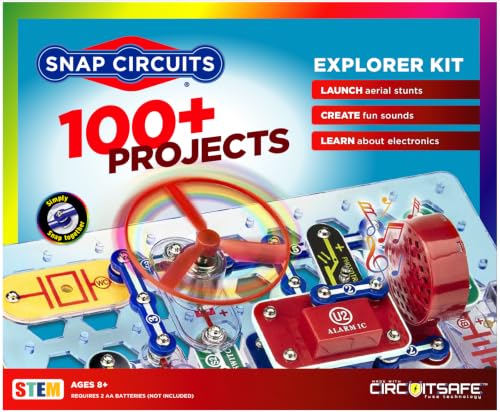
Snap Circuits Explorer SC-100 Kit
What We Like
- No soldering or tools needed
- 100+ projects from one kit
- Color-coded pieces snap onto grid
Trade-offs
- Requires batteries (not included)
- Only 29 parts limit project complexity
- Focuses on circuits, not other STEM areas
With over 100 projects packed into a single box, this kit lets an eight-year-old build everything from a flying saucer to an alarm system without ever touching a soldering iron. The color-coded pieces snap onto a plastic grid, so the only thing you need to supply is a bit of table space and a few batteries. That simplicity makes it a perfect starting point for a kid who is curious about how lights, buzzers, and spinning things actually work, but who might get frustrated by fiddly wires or tiny screws.
The trade-off for that ease is that the 29 included parts cover only basic circuit-building. Once your child has worked through the projects, they will likely want more, and the kit is designed to combine with other Snap Circuits sets, so you can expand without starting over. Just know that if your kid craves variety across chemistry, physics, and engineering all at once, a broader kit might keep them engaged longer.
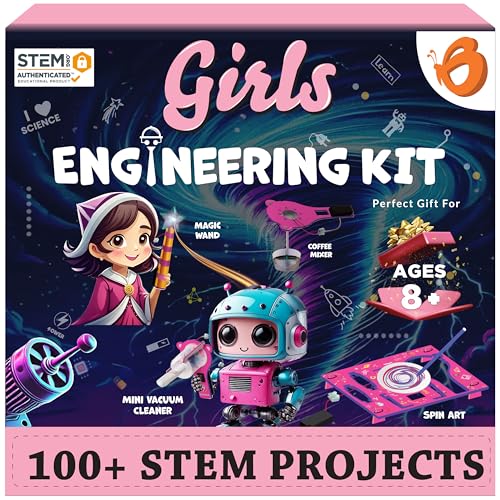
Butterfly EduFields Girls Engineering Kit
What We Like
- 100+ hands-on engineering projects
- Teaches core STEM concepts through doing
- Safe, sturdy, and reusable parts
- Screen-free educational gift for girls
Trade-offs
- 100 projects means many small pieces to track
- Too basic for teens or advanced builders
With over 100 engineering and science projects packed into one box, this kit gives an eight-year-old enough hands-on work to explore gears, levers, circuits, and working machines without needing a screen. That sheer volume of builds means she can make mistakes, take things apart, and try again, which is exactly how problem-solving and scientific thinking stick. It’s designed for girls ages 8 to 12, so the challenges grow with her, and the clear step-by-step guides keep frustration low. If you want a gift that builds confidence through doing rather than memorizing, this one delivers.
The sheer number of pieces is the main drawback: 100 projects means a lot of small components to keep organized, so you’ll want a tray or a dedicated spot on the floor. Compared to the Explorer SC-100, which also offers 100 projects but uses snap-together parts that are harder to lose, the Butterfly EduFields kit leans more toward mechanical builds (gears, levers) rather than pure electronics. If your daughter loves taking things apart to see how they work, the variety here is hard to beat, just budget a few minutes for cleanup after each session.
Snap Circuits Arcade SCA-200 Kit

What We Like
- Builds 200+ projects from one box
- No tools or soldering required
- Color-coded pieces snap onto grid
- Includes arcade-style games with lights and sounds
Trade-offs
- Batteries not included in the box
- 36-piece set limits complexity for advanced builders
Two hundred-plus projects from a single 36-piece kit means your child gets a wide variety of builds without needing extra parts. The snap-together design requires no soldering or tools, so kids can focus on learning circuits rather than handling dangerous equipment. The arcade-style games include lights and sounds, which makes the experience feel like play while introducing electrical engineering concepts. The color-coded pieces and included instruction book help children ages 8 and up get started on their own. For a kid who enjoys building and wants to understand how electronics work, this kit offers a safe, hands-on introduction to circuitry.
The 36 pieces only stretch so far: once your child has built all 200 projects, they may want more complexity than this kit alone can offer. Batteries aren’t included, which is a minor annoyance, but the real limitation is that advanced young engineers may outgrow the piece count before they outgrow the interest. For a first electronics kit that introduces circuit basics through fun projects, this is a strong starting point.
Blue Marble NGCIRCUIT120 Stem Toys

What We Like
- 120+ experiments cover wide range
- No tools needed for assembly
- QR code video instructions included
- Award-winning brand with US support
Trade-offs
- 2.7 pounds is heavier than most kits
- No battery type specified in listing
This kit includes over 120 electrical projects, from building a keyboard that plays songs to creating a light show, flying a copter, or amplifying your voice with a sound system. All connections snap together with included wires, so no tools are needed. The illustrated instructions and QR code for video guidance make it easy for kids to follow along, though a parent may want to help with the first few projects.
This kit is noticeably heavier and bulkier than most competitors, at 2.7 pounds and nearly 15 inches tall, it is not something you toss in a backpack for a road trip. The Explorer SC-100, by contrast, weighs half as much and fits in a smaller footprint, making it easier to stash on a bookshelf or carry to a friend’s house. If your child prefers sprawling out at the kitchen table and diving into project after project, the extra heft and size are non-issues. But if space or portability matters more than the sheer number of experiments, the lighter option might suit your setup better.
Product photos
National Geographic Chemistry Set

What We Like
- 45 experiments in one kit
- Includes volcano, geyser, rocket activities
- Kid-friendly illustrated instructions
- Hands-on STEM learning
Trade-offs
- Messy experiments need outdoor space
- Adult supervision required for all experiments
Forty-five experiments in one box mean this kit keeps an eight-year-old busy for weeks, not just an afternoon. You get a volcano, a geyser, and a rocket launch, so the wow factor is built right in. The illustrated step-by-step guide makes it easy for kids to follow along without constant adult rescue, which is exactly what you want when you’re trying to encourage independence. For a child who loves fizzy, bubbly, hands-on reactions, this is the kind of set that turns ‘boring science’ into ‘can I do one more?’
Those exciting reactions are messy. With a volcano eruption and a geyser, you will want to set up outside or on a covered table, not your dining room rug. But if your kid craves dramatic chemical reactions over quiet gear assembly, the extra mess is worth it.
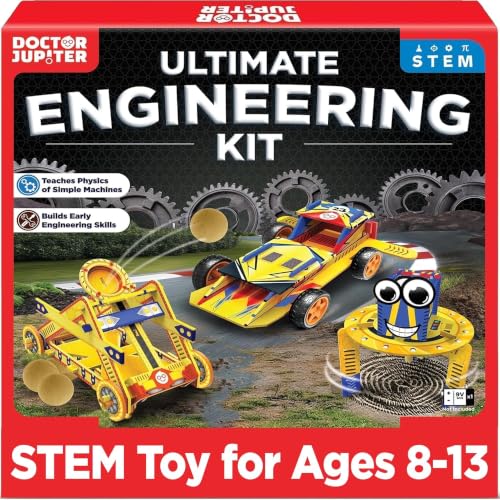
Doctor Jupiter Ultimate Engineering Kit
What We Like
- Three distinct engineering builds per kit
- Pre-cut wooden parts and motors included
- Step-by-step manual plus QR video tutorials
- Teaches circuits, motion, and energy conversion
Trade-offs
- Only three projects in the box
- Only three projects included, limiting long-term reuse
Three complete projects, a catapult, a race car, and a scribbling robot, means an eight-year-old gets to build something different each time without needing extra parts. The pre-cut wooden pieces and included motors snap together without glue or tools, so a kid can focus on the engineering principles rather than wrestling with a hot glue gun. For a parent who wants a screen-free activity that actually teaches something like projectile motion or basic circuits, this kit delivers real physics concepts through hands-on building. It suits the child who loves taking things apart and wants to see how machines move, not just follow a paint-by-numbers craft.
Once you finish all three projects, there’s nothing new to build unless you buy another kit. Compared to the Explorer SC-100, which offers over a hundred different circuit projects from the same set of parts, the Doctor Jupiter kit runs out of surprises faster. That makes it a better fit for a child who enjoys a focused weekend project rather than an ongoing tinkering habit. If your eight-year-old prefers variety over depth, the Snap Circuits approach gives more mileage per box. But for a clean, self-contained introduction to engineering that feels like a real achievement each time, this kit hits the mark.
Product photos
Thames & Kosmos Catapult Engineering Kit
What We Like
- Builds 6 different siege machines
- Includes safe foam projectiles
- 32-page illustrated manual with experiments
- Box transforms into a castle
Trade-offs
- Only foam projectiles limit real-world trajectory feel
- No electronics or motorized components
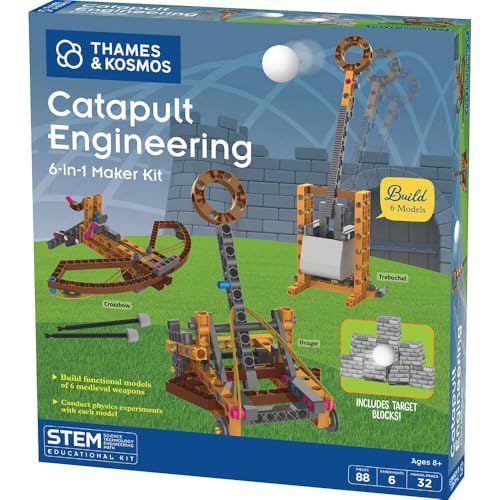
Six functional models in one kit means your 8-year-old can build a catapult, trebuchet, crossbow, reverse-draw crossbow, onager, and ballista without buying six separate boxes. That variety keeps the physics lessons fresh, each machine uses a different mechanism to store and release energy, so you get force, motion, and trajectory experiments from a single 32-page manual. The foam balls and foam-tipped projectiles let me relax about safety while still seeing real launch angles and distances. This is the kit I’d hand to a kid who loves medieval stuff or just wants to launch things across the room without breaking anything.
The foam projectiles trade dramatic flight for safety, so kids can launch at each other without injury, the kit includes soft foam balls and foam-tipped projectiles, and the building components only accept those included pieces. That means the action is more about gentle arcs than heavy-stone drama, but it also lets you set up cardboard target blocks and a colorable castle box for active target practice. At 0.9 pounds, the whole thing is light enough to carry to a friend’s house, making it a perfect weekend siege-warfare toy rather than a permanent display piece.
Product photos
PATHFINDERS Engineering Maker Set
What We Like
- Real water-powered hydraulic pistons
- Solid hardwood construction, not plastic
- Three build modes: guided, card, free tinker
- Teaches engineering design process
Trade-offs
- Hydraulics need water refill and troubleshooting
- Requires adult help for younger builders
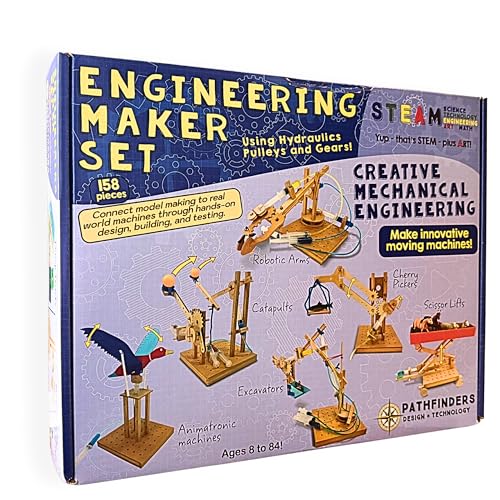
The real water-powered hydraulic system makes this kit genuinely different from anything else on the shelf. Kids operate a working excavator, scissor lift, and other machines using water pressure, which turns abstract concepts like mechanical advantage and gear ratios into something they can hold and operate. The solid hardwood beams and precision-drilled MDF give it a heft that plastic kits lack, and the components are built to survive hundreds of builds and rebuilds. The three build modes mean a child who needs step-by-step guidance gets it from the manual, while a tinkerer can grab the challenge cards and invent their own solution from scratch. The kit doesn’t get finished, it keeps going.
The real-wood feel comes with a size trade-off: at 8 by 4 by 10 inches, the kit is compact, which means some builds like the dump truck or animatronic monster are smaller than a sprawling playset. And while the hydraulic system is genuinely cool, it requires patience. Kids will need to troubleshoot air bubbles and refill water between builds, which is exactly the kind of friction that separates a toy from a teaching tool. Compared to the Thames & Kosmos Catapult Engineering Kit, which builds six medieval machines with foam projectiles, this Pathfinders set focuses on hydraulics, gears, levers, and pulleys for open-ended reuse. It rewards the kid who likes figuring out why something works, not just watching it fly.
Product photos
Thames & Kosmos Physics Workshop STEM Kit

What We Like
- 305 pieces for 38 builds and experiments
- 104-page manual with real physics equations
- Covers gravity, gears, pendulums, centrifuges
- NGSS-aligned and award-winning design
Trade-offs
- Small parts: 305 pieces require careful sorting
- Requires adult help for younger builders
This kit covers five physics chapters that build on each other, starting with gravity and inertia and moving through simple machines, gears, energy transfer, forces at work, and centrifugal force. That means a child can progress step by step, understanding how each concept connects to the next. The 104-page manual includes real physics equations and keyword definitions, so a curious kid can learn the why behind each build. With 305 pieces, there is plenty to explore, but the manual is detailed and requires reading or adult guidance for younger users.
Product photos
How We Evaluated STEM Toys For 8 Year Olds
We started by looking at what the manufacturer claims each kit teaches and how. That meant reading manuals, counting projects, and checking whether the instructions are clear enough for an 8-year-old to follow with minimal help. We also looked at how many builds or experiments each kit supports, since replay value matters at this age.
The three criteria that mattered most were educational depth, build quality, and age fit. A kit that teaches real engineering concepts (like the top picks for 8-10 year olds) beats one that just flashes lights. We favored kits with durable, reusable parts over single-use crafts. And we checked whether the recommended age range actually matched the difficulty, many “8+” kits require adult help for the first few builds.
This is a research-led evaluation, not a hands-on test. We didn’t build every catapult or snap every circuit ourselves. Instead, we synthesized what multiple expert sources and hundreds of owner reviews consistently reported about each kit’s strengths and weaknesses.
What To Look For In STEM Toys For 8 Year Olds
The right STEM kit makes an 8-year-old feel like a real engineer, not a student doing homework. Look for projects that produce something tangible, a moving creature, a working alarm, a foam-ball launcher, and that teach a concept you can point to and name.
The best STEM toy for an 8-year-old is one that matches their natural curiosity with clear instructions and enough projects to last more than an afternoon. Prioritize reusable parts and real STEM concepts over flashy packaging.
Project Count and Replay Value
An 8-year-old can burn through a single build in an hour. The best kits offer multiple projects. Snap Circuits Arcade SCA-200 gives you 200, while the National Geographic Chemistry Set offers 45 experiments. For kits with fewer builds, like the Doctor Jupiter Ultimate Engineering Kit (three projects), check whether the builds are substantial enough to take an afternoon each.
Material Quality and Reusability
Plastic snap-together components (Snap Circuits, Butterfly EduFields) last through multiple builds and can be recombined in new ways. Papercraft pieces, like those in the Klutz Lego Gear Bots kit, are typically one-time use. Wooden kits like the PATHFINDERS Engineering Maker Set offer real hydraulic parts but need careful storage to keep pieces from getting lost.
Adult Involvement Required
Some kits are truly independent; the best STEM toys for seven year olds often are. Others, like the National Geographic Chemistry Set and PATHFINDERS hydraulic kit, need an adult nearby for safety or troubleshooting. Read the fine print: if a kit says “adult supervision required,” plan on sitting with your child for at least the first few projects.
- Does the kit require batteries you don’t have on hand?
- Are the instructions written for the child or the adult?
- Can the pieces be reused for other projects or creative play?
- Is there a clear safety warning about small parts or mess?
- Does the kit match your child’s current interest (robots, circuits, chemistry)?
A good rule of thumb: if you can’t explain what your child will learn from the kit in one sentence, it’s probably not teaching much.
STEM Toys For 8 Year Olds Compared
The table below compares all ten kits side by side, so you can see at a glance which one fits your child’s interests and your family’s tolerance for mess.
| Product | Age Range | Projects / Builds | Weight | Dimensions |
|---|---|---|---|---|
| Klutz Lego Gear Bots STEM Kit | 8-12 years | 8 kinetic creatures | 1.0 pounds | L 10.0 x W 1.5 x H 10.0 inches |
| Snap Circuits Explorer SC-100 Kit | 8+ | 100+ projects | 1.4 pounds | L 12.0 x W 9.5 x H 1.8 inches |
| Butterfly EduFields Girls Engineering Kit | 8-12 years | 100+ STEM projects | 1.3 pounds | L 10.0 x W 5.0 x H 1.0 inches |
| Snap Circuits Arcade SCA-200 Kit | 8+ | 200+ total | 1.3 pounds | L 15.5 x W 2.5 x H 11.9 inches |
| Blue Marble NGCIRCUIT120 Stem Toys | N/A | 120+ | 2.7 pounds | L 12.0 x W 3.0 x H 14.8 inches |
| National Geographic Chemistry Set | 8-12 | 45 experiments | 2.9 pounds | L 8.8 x W 3.2 x H 11.9 inches |
| Doctor Jupiter Ultimate Engineering Kit | 8-13 years | 3 | 1.8 pounds | L 11.5 x W 9.8 x H 1.7 inches |
| Thames & Kosmos Catapult Engineering Kit | Ages 8+ | 6 models | 0.9 pounds | L 10.0 x W 1.7 x H 11.0 inches |
| PATHFINDERS Engineering Maker Set | Ages 8+ | 10 challenges + 15 challenge cards | N/A | L 8.0 x W 4.0 x H 10.0 inches |
| Thames & Kosmos Physics Workshop STEM Kit | Ages 8+ | 38 models, 37 experiments | 2.4 pounds | L 11.5 x W 3.1 x H 14.6 inches |
Frequently Asked Questions
What is the best STEM toy for an 8-year-old who loves LEGO?
The Klutz Lego Gear Bots STEM Kit is the obvious choice. It uses real LEGO elements to build eight different kinetic creatures while teaching how axles, cams, and cranks create movement. The included 64-page book combines building instructions with STEM explanations.
Are STEM toys for 8-year-olds safe?
Most are, but check for small parts and age recommendations. Kits like Snap Circuits and Butterfly EduFields use large, snap-together pieces with no soldering. Chemistry sets and hydraulic kits like the National Geographic and PATHFINDERS sets require adult supervision for safety.
How many projects should a good STEM kit have?
It depends on the project depth. A kit with 200 simple circuit builds (Snap Circuits Arcade) offers variety, while a kit with three complex engineering projects (Doctor Jupiter) can take just as long. For an 8-year-old, look for at least 5-10 projects unless each build is substantial.
What STEM subjects are most appropriate for an 8-year-old?
Physics and basic engineering are great starting points. Kits that teach circuits, simple machines (gears, pulleys, levers), and chemical reactions match the science curriculum for this age. The Thames & Kosmos Physics Workshop covers gravity, pendulums, and centrifuges in an age-appropriate way.
Can a STEM kit replace screen time?
Yes, many are designed to be completely screen-free. The Butterfly EduFields Girls Engineering Kit and Snap Circuits kits require no tablet or phone. The Blue Marble NGCIRCUIT120 kit uses QR codes for video instructions, but the building itself is hands-on.
The Bottom Line
For most families, the Klutz Lego Gear Bots STEM Kit is the best starting point. It teaches real engineering concepts through a medium (LEGO) that most 8-year-olds already love, and the 64-page book turns every build into a mini-lesson. It’s not a kit that will last for years of replay, but it will spark the right kind of curiosity.
If your child is more interested in electronics than paper crafts, the Snap Circuits Explorer SC-100 or Arcade SCA-200 offer a frustration-free way to learn circuits. For a child who loves dramatic reactions and doesn’t mind mess, the National Geographic Chemistry Set delivers 45 experiments worth of wow factor.
The single most important factor is whether the kit matches your child’s current obsession. An 8-year-old who wants to launch things will love the Thames & Kosmos Catapult Engineering Kit; one who wants to build a city needs a different kind of building toy. Pick the interest, then pick the kit.
