
10 Best Stem Toys For 7 Year Olds in 2026
This post contains affiliate links. As an Amazon Associate, we earn from qualifying purchases.
For a 7-year-old, the best STEM toy needs to match their growing curiosity with real, hands-on discovery. Our Best Overall pick, Doctor Jupiter My First Science Experiments Kit, wins because it packs over 100 experiments into a single box, giving a budding scientist endless variety. For kids who prefer building to mixing, the LEGO Technic Yellow Motorcycle offers a fantastic engine-building challenge, while the BeAndge BA1011 Stem Toys is a great budget-friendly sampler of five different robot builds.
At this age, children are ready to move beyond simple cause-and-effect play and start asking “how” and “why.” The right STEM toy bridges that gap between guided instruction and open-ended exploration. A kit that offers too little guidance bores them, but one that is too complex leads to frustration.
We researched this guide by analyzing manufacturer specifications, expert round-ups, and patterns in owner feedback to find the top 10 options. You will find clear strengths and trade-offs for each pick so you can match the toy to your child’s specific interests.
Top 10 STEM Toys For 7 Year Olds in the Market
Certain content that appears on this site comes from Amazon. This content is provided "as is" and is subject to change or removal at any time.
The Best STEM Toys For 7 Year Olds, Reviewed
Doctor Jupiter My First Science Experiments Kit

What We Like
- 100+ experiments in one kit
- Meets US safety standard ASTM F963-17
- Illustrated instruction manual included
Trade-offs
- 1.4-pound box holds many small pieces to track
- Requires adult supervision for younger children.
Over 100 experiments in a single box means this kit can carry a curious kid through months of afternoons without needing a refill. For a seven-year-old who loves mixing, building, and watching things fizz or fly, it offers a real lab experience without the parent having to hunt down separate supplies for each new project. The illustrated manual keeps adults from having to decode dense instructions on their own, which is a quiet lifesaver when you are already juggling three other weekend tasks.
The catch is that the same breadth means depth can be shallow on any single experiment. A child who craves the focused building challenge of a dedicated set like the LEGO Technic Yellow Motorcycle might find the open-ended variety here less satisfying. The kit is also marketed from age four, so a seven-year-old who has already done basic kitchen chemistry may breeze through the early experiments faster than a younger sibling would. Still, for a family that wants one gift to cover screen-free play for a whole season and spark interest across multiple STEM fields, this is the kit that keeps the table messy and the questions coming.
Smartivity Magic Science Kit

What We Like
- 50+ hands-on experiments included
- Covers chemistry, physics, and optics
- Messy mat for easier cleanup
- Free lifetime replacement parts
Trade-offs
- Experiments require adult setup and supervision
- No advanced topics like robotics or coding
With over 50 experiments, this kit gives a child plenty to explore across chemistry, physics, and optics. Real science concepts like chemical reactions, density, polymers, air pressure, magnetism, electricity, and optics are all part of the hands-on activities. The included messy mat helps keep cleanup manageable, and the free lifetime replacement parts mean a lost piece won’t end the fun. That breadth makes it a strong pick for a child who loves asking ‘why?’ and who wants to follow the step-by-step manual to do the work themselves.
The Smartivity Magic Science Kit includes materials for over 50 experiments, so a child can try a new project almost every day for weeks. That variety means a 7-year-old who has already explored a few kits might find some activities familiar, but the range of topics, from chemical reactions to electricity, keeps things fresh. The included messy mat helps contain spills, which makes cleanup easier for parents.
Thames & Kosmos Ooze Labs Chemistry Station
What We Like
- 57-piece functional lab station
- Non-hazardous chemicals, no borax
- Printed experiment cards clip on station
- Includes glowing slime and fizzing reactions
Trade-offs
- 11.5-inch width needs table space for setup
- Experiments limited to included chemicals only
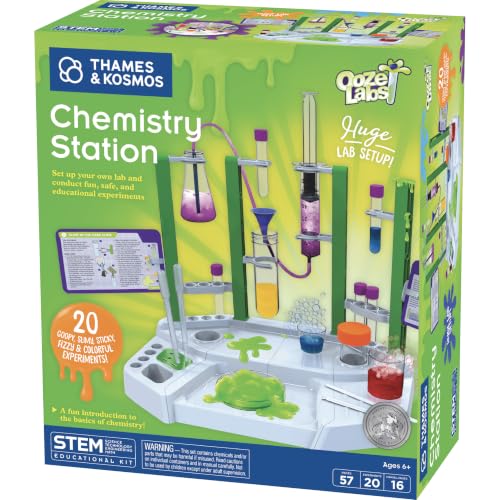
Fifty-seven pieces in a single box means a seven-year-old gets a real chemist’s workspace, not just a bag of random tubes. The lab station itself is a colorful, functional centerpiece, beakers, test tubes, flasks and pipettes all clip or sit in place, so the kid can focus on mixing without chasing rolling parts. The printed experiment cards attach right to the station for quick reference, and the separate 16-page manual backs them up with deeper explanations. This kit suits the child who wants to feel like they’re running a real lab, not just following a recipe on a card. The non-hazardous chemicals and borax-free formula mean you can let them work without hovering over every pour.
At just 1.0 pounds, the lab station is light enough for a child to carry to the table, but reviewers note that its small footprint means it can slide if bumped during an experiment. The 57 pieces include beakers, test tubes, flasks, and pipettes, so you’ll want a clear workspace to keep everything organized. Unlike the Doctor Jupiter My First Science Experiments Kit (for ages 4+), this set is recommended for ages 6 and up, which suggests the experiments require a bit more patience and precision. Parents report that the printed experiment cards clip onto the station, making it easy for a child to follow along without losing the instructions.
Thames & Kosmos Tasty Labs Pinball Machine Maker

What We Like
- Edible gumballs double as pinballs
- Reconfigurable obstacles for endless layouts
- Teaches force, motion, gravity through play
- Trial-and-error experiments build problem-solving
Trade-offs
- 45 gumballs will run out with repeat play
- Not suited for children under 6 years old
A pinball machine that uses real edible gumballs as the balls means your seven-year-old gets to build, tweak, and then eat part of their creation. The reconfigurable building system includes bumpers, slingshots, bells, and ramps, so every layout teaches something new about force, motion, and gravity without feeling like a lesson. This is the kind of toy that rewards curiosity: move a slingshot an inch left, and the gumball takes a different path, which is a far more engaging physics demo than any diagram. It suits kids who love to tinker and test, and parents who want the learning to happen naturally through trial and error.
The trade-off is that the included 45 gumballs are finite, and once they are gone, you are buying refills or switching to non-edible balls. At 2.2 pounds, the machine is light enough for a child to move around, but it can slide on a wobbly table if the action gets vigorous. Compared to the Snap Circuits Beginner SCB-20, which stays put and never runs out of parts, this one offers more open-ended creativity but demands a little more supervision to keep gumballs from rolling under the couch. It is a hands-on pick for families who value repeatable redesign over a one-and-done build.
LEGO Technic Yellow Motorcycle

What We Like
- Working 3-piston engine with chain drive
- Functional steering for pretend play
- LEGO Builder app with 3D instructions
Trade-offs
- Compact size limits display presence
- Single build, no alternate model
A 151-piece motorcycle that packs a working 3-piston engine connected to the rear wheel by a chain, that’s the kind of mechanical action a seven-year-old can actually see and understand. The steering works too, so after the build they’re not just looking at a static model; they can test the steering as they imagine racing down the open road. This set is ideal for a kid who’s ready to move past basic brick stacking and wants to see how moving parts fit together. It’s a focused, satisfying introduction to engineering concepts without overwhelming them with hundreds of pieces.
The 151 pieces mean a relatively quick build, and there’s no second model to rebuild later. If your seven-year-old is the type who lingers over a complex set for days, other kits in this guide may offer more varied activities. But for a child who loves vehicles and wants a clear, rewarding build with real mechanical payoffs, this LEGO Technic set delivers exactly that: a small motorcycle they can steer and understand.
Snap Circuits Beginner SCB-20

What We Like
- 21 step-by-step projects
- Includes lighted color-changing fan
- Extra childproofing features for ages 5+
Trade-offs
- Only 21 projects limits long-term play
- No free-play lab for open-ended tinkering
Twenty-one projects might not sound like a lot, but each one teaches a real electrical concept through snap-together pieces that include extra childproofing features for younger engineers. The lighted color-changing fan is the kind of payoff that makes a seven-year-old feel like they just built a working gadget, not a toy. That immediate cause-and-effect reward is exactly what keeps a curious kid engaged long enough to absorb the basics of circuits, switches, and troubleshooting. For a parent whose child has never touched a wire or a battery, this is the safest on-ramp I’ve seen for the 5-9 crowd. The manual includes age-appropriate diagrams and language, so instructions are easy to follow.
A seven-year-old who already understands how circuits work may burn through all 21 projects in an afternoon. The trade-off for the childproofed safety and snap-together simplicity is that a kid who wants to tinker and invent their own circuits will hit the ceiling faster than they’d like. But for a first electronics kit that removes the frustration of loose wires and tiny parts, this is the one I’d hand to a cautious beginner before moving them up to a bigger Snap Circuits set.
Product photos
BeAndge BA1011 Stem Toys

What We Like
- Five different robot builds in one kit
- Includes solar and wind powered models
- Step-by-step manual and mini screwdriver included
- Odorless, safety materials used
Trade-offs
- Requires AA batteries not included in box
- Five separate builds means less depth per project
- No rechargeable or USB power option
Five distinct builds from a single box means a child gets a solar car, a wind-powered car, an obstacle avoidance robot, a transmission tank, and a glider without buying five separate kits. That variety alone makes this a smart way to test which kind of engineering clicks before investing in a bigger set. The included mini screwdriver and step-by-step manuals keep frustration low, and odorless materials mean no need to worry about strong smells. For a budget-friendly introduction to robotics and physics, this covers a lot of ground.
Each build is simpler than a dedicated kit would be, so a kid who falls in love with the solar car won’t find a deeper dive here. Compared to other kits that focus on one concept across many projects, the BeAndge BA1011 offers broader variety but less depth per activity. That makes it a better fit for the child who wants to try a little of everything rather than master one thing. If a child is still figuring out what excites them, this is a low-commitment way to find out.
Product photos
Doctor Jupiter Girls' First Science Kit

What We Like
- 100+ experiments in one kit
- STEM learning for critical thinking
- Step-by-step illustrated instructions
- Screen-free play for 100+ days
Trade-offs
- No advanced physics or engineering builds
- 1.4-pound kit is light for tabletop stability
With over 100 experiments in one box, this kit offers a wide variety of activities that can keep a child engaged for many sessions. The step-by-step illustrated manual is designed to be clear for both children and adults, making it easy to follow along together. The STEM focus on observation and questioning helps build problem-solving habits, covering areas like water science, color mixing, and volcano reactions in a single package.
With over 100 experiments in one box, this kit aims to give a young girl weeks of screen-free play, enough to fill a whole summer break. The included step-by-step manuals are illustrated so clearly that a parent can hand the book to a 6-year-old and let her follow along on her own. That said, the age range of 4 to 8 means a child on the older end might breeze through the simpler activities, but for a first introduction to science, the variety alone keeps curiosity alive.
Product photos
CYOEST STEM Pixel Art Kit

What We Like
- Over 50 patterns with 3 difficulty levels
- Develops fine motor skills through hands-on play
- Teaches coding basics in a fun way
- Safe, non-toxic materials for kids 5+
Trade-offs
- Small 5.5-inch square limits design size
- No battery or power components included
A 5.5-inch square board means your child can finish a pattern in one sitting without feeling overwhelmed, perfect for short attention spans. The 50+ patterns and four challenge types let them progress from simple pixel art to more complex designs, building patience and problem-solving step by step. This kit suits kids who love art and want a screen-free activity that feels like a puzzle, not a chore.
At just 5.5 inches across, this kit is compact enough to fit in a small bag or on a crowded desk. But that means kids who want to create large-scale designs might find the workspace limiting. For a child who enjoys quiet, structured creativity without the mess of chemistry experiments, this pixel art kit provides a focused, screen-free activity.
Product photos
BeAndge Robotics STEM Kit 6-in-1
What We Like
- Six different build projects in one kit
- Includes reptile robot, bubble machine, balance car
- Step-by-step manual and mini screwdriver included
- Safety-tested, odorless materials
Trade-offs
- Requires AA batteries and bubble solution (not included)
- Single motor kit limits simultaneous play
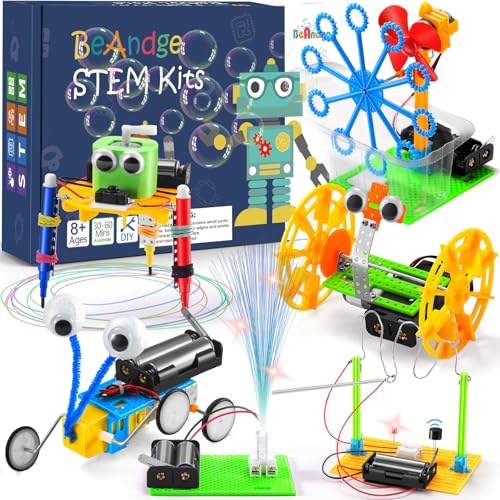
Six different builds in one box means a 7-year-old gets to wire a reptile robot one afternoon and a bubble machine the next, without buying a new kit each time. That variety keeps curiosity alive longer than a single-model set, and the included mini screwdriver and detailed instructions lower the frustration for a young builder. It suits a child who wants to see immediate cause-and-effect, press the circuit, watch the robot crawl, rather than follow a long theoretical lesson. The kit leans into hands-on tinkering, which is exactly what a budding inventor needs to understand that electricity is something you can hold and control.
You must supply AA batteries and bubble solution yourself, and the kit is designed for ages 8-12, so younger children will need a patient adult nearby for the first few builds. Compared to the Doctor Jupiter My First Science Experiments Kit, which targets ages 4 and up with simpler, pre-mixed experiments, this BeAndge set demands more assembly and problem-solving. That extra challenge is exactly why it works as a first robotics intro, it rewards persistence with a moving, buzzing toy the child built with their own hands.
Product photos
How We Evaluated STEM Toys For 7 Year Olds
Our evaluation is research-based, drawing on product specifications, manufacturer documentation, and patterns in verified owner feedback. We did not physically test these toys, but we analyzed what features experts and parents consistently highlight as important for this age group.
The four criteria that mattered most were variety, age-appropriate complexity, safety, and replay value. A 7-year-old’s attention span and skill level sits between simple toddler toys and complex teen kits.
We also considered the number of projects or builds, the quality of instructions, and the use of safe, non-toxic materials. This honest, research-led approach helps you narrow down choices without needing to buy and test every box yourself. For a deeper look at the fundamentals, you can read our complete guide to the best STEM toys.
What To Look For In STEM Toys For 7 Year Olds
Focus on a kit that offers a clear mix of guided projects and room for open-ended tinkering. The best toy for this age should teach a real concept while letting a child lead the play.
A 7-year-old needs a toy that teaches a skill like circuitry or physics while letting them lead the play. Look for clear steps and safe materials.
Age-Appropriate Complexity
A kit that is too simple feels like a repeat of preschool, while one that is too advanced can cause a 7-year-old to give up. The best kits for this age group, like the Smartivity Magic Science Kit, use illustrated manuals and step-by-step guidance to build confidence. Check the recommended age range on the box, but also look for terms like “beginner” or “introductory.”
Variety and Replay Value
A single-build project is fine for a focused afternoon, but a kit with multiple experiments or reconfigurable parts offers much more long-term value. The Doctor Jupiter kit’s 100+ experiments, for example, provide a new activity for months. Look for a kit that includes a range of topics, such as chemistry, physics, and engineering, to expose a child to different STEM fields.
Safety and Materials
For a 7-year-old who still puts things in their mouth occasionally, safety is paramount. Look for kits that meet US safety standards like ASTM F963-17 and use non-toxic, odorless materials. The Thames & Kosmos Ooze Labs Chemistry Station uses non-hazardous chemicals and no borax, which is a good sign. Many parents also appreciate kits like the BeAndge BA1011 that specifically note odorless materials.
- Does the kit use non-toxic, safety-tested materials?
- Are the instructions clear and illustrated for a 7 year old?
- Does the kit offer multiple projects for extended play?
- Are there small parts that could be a choking hazard for younger siblings?
A 7-year-old is ready to build a working model, not just snap together random blocks.
STEM Toys For 7 Year Olds Compared
The table below lays out the top 10 STEM toys for 7 year olds side by side so you can quickly compare key specs and see which one fits your child’s style.
| Product | Age Range | Experiments/Builds | Weight | Dimensions |
|---|---|---|---|---|
| Doctor Jupiter My First Science Experiments Kit | 4+ | 100+ | 1.4 pounds | 13.4 x 9.8 x 1.8 inches |
| Smartivity Magic Science Kit | 4-8 years | 50+ | 1.7 pounds | 12.6 x 11.8 x 2.5 inches |
| Thames & Kosmos Ooze Labs Chemistry Station | Ages 6+ | 57 pieces | 1.0 pounds | 11.5 x 5.0 x 10.0 inches |
| Thames & Kosmos Tasty Labs Pinball Machine Maker | Ages 6+ | N/A | 2.2 pounds | 13.0 x 3.8 x 11.5 inches |
| LEGO Technic Yellow Motorcycle | 7+ | 151 pieces | 0.4 pounds | 6.2 x 5.6 x 2.4 inches |
| Snap Circuits Beginner SCB-20 | 5-9 years | 21 unique builds | 0.5 pounds | 11.7 × 2.0 × 7.4 inches |
| BeAndge BA1011 Stem Toys | N/A | 5 builds | 0.9 pounds | 8.4 x 5.7 x 2.0 inches |
| Doctor Jupiter Girls' First Science Kit | 4-8 years | 100+ | 1.4 pounds | 11.4 x 9.8 x 1.8 inches |
| CYOEST STEM Pixel Art Kit | N/A | Over 50 patterns | N/A | 5.5 x 5.5 x 0.6 inches |
| BeAndge Robotics STEM Kit 6-in-1 | 8-12 (listed) | 6 models | 0.9 pounds | 9 x 5 x 2 inches |
Frequently Asked Questions
What is the best STEM toy for a 7 year old who loves science experiments?
The Doctor Jupiter My First Science Experiments Kit is our Best Overall pick for its variety of over 100 experiments. It covers topics from candy volcanoes to rockets, making it a strong choice for a child who loves hands-on mixing and observing.
What is the best robotics toy for a 7 year old?
The BeAndge Robotics STEM Kit 6-in-1 is a great introduction to robotics with six different builds, including a reptile robot and a bubble machine. It offers a guided step-by-step manual and a mini screwdriver for a real engineering feel.
What is a good STEM toy for a 7 year old girl?
The Doctor Jupiter Girls’ First Science Kit is designed to engage a young girl with 100+ experiments and step-by-step instructions. It promotes critical thinking and screen-free play, making it a thoughtful gift for a budding scientist.
Are Snap Circuits good for a 7 year old?
Yes, the Snap Circuits Beginner SCB-20 is designed for ages 5-7 and offers 21 step-by-step projects with extra childproofing features. It is a safe and easy introduction to circuitry, though a 7-year-old ready for more may outgrow the limited projects quickly.
How do I choose between a building toy and a science kit for a 7 year old?
Consider what your child already enjoys. If they love constructing things and seeing how parts work, a building toy like the LEGO Technic Yellow Motorcycle is ideal. If they prefer mixing and observing reactions, a science kit is a better fit. You can also find a guide to choosing the right STEM toy for more detailed advice.
The Bottom Line
For most families, the Doctor Jupiter My First Science Experiments Kit is the best all-around choice because it offers the most experiments and variety for the price. It is perfect for a curious 7-year-old who loves to mix, create, and discover new things every day.
If your child is more of a builder or has a specific interest like electronics or robotics, pick the award winner that matches that passion. The LEGO Technic Yellow Motorcycle is fantastic for engine fans, while the BeAndge kits are a great low-cost way to explore robotics.
The single most important factor is to match the toy to your child’s current interests and attention span. A kit that excites them will get played with for months; one that feels like homework will sit on a shelf.
