
10 Best Stem Building Blocks For Toddlers in 2026
This post contains affiliate links. As an Amazon Associate, we earn from qualifying purchases.
The ROHSCE Soft Building Blocks earn our top spot because they combine large, easy-to-hold pieces with soft, rounded edges that are completely safe for toddlers who still explore with their mouths. For themed play, the Leetous Insect Flower Garden Building Set offers 156 pieces, while parents wanting classic simplicity should look at the MEGA BLOKS First Builders Big Building Bag.
The challenge for parents of toddlers isn’t finding blocks, it’s finding blocks that are safe enough for a one-year-old yet engaging enough for a three-year-old. Pieces that are too small pose a choking hazard, while sets with too few pieces fail to hold a growing child’s attention.
This guide is built on manufacturer specifications, expert recommendations, and patterns in owner feedback. We focused on safety, piece size, and developmental value to help you pick the right set for your child’s age and interests.
Top 10 STEM Building Blocks for Toddlers in the Market
Certain content that appears on this site comes from Amazon. This content is provided "as is" and is subject to change or removal at any time.
The Best STEM Building Blocks for Toddlers, Reviewed
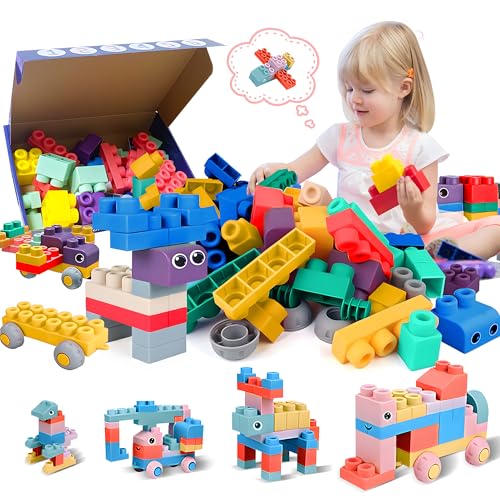
ROHSCE Soft Building Blocks
What We Like
- Large size easy for small hands
- Rounded flexible edges prevent injuries
- Bright colors and varied shapes
Trade-offs
- Only 40 pieces limits complex builds
- Soft material won't support tall towers
For toddlers 18 months and up, this set removes the worry of hard edges or choking hazards, letting kids explore stacking, squeezing, and early construction without constant hovering. It’s the kind of starter set that prioritizes safety and sensory exploration over piece count or structural ambition.
The trade-off is scale: with only 40 pieces, you won’t be creating elaborate castles or cars that hold their shape. A hard plastic set like the MEGA BLOKS First Builders Big Building Bag offers 80 pieces for sturdier results. But for a baby or young toddler still putting everything in their mouth, that softness is exactly the point. This is a first-block set, not a forever-block set, and it nails the job of being a worry-free introduction to building for the youngest builders.
Product photos
Leetous Insect Flower Garden Building Set

What We Like
- 156 pieces for open-ended garden building
- BPA-Free, non-toxic, odorless material
- Carrying case for easy storage
Trade-offs
- Only one theme: garden and insects
- No baseplate for stable vertical builds
Parents of toddlers who mouth everything will appreciate that the entire set is made from BPA-Free, non-toxic and odorless materials. So there is no need to panic when a piece inevitably ends up in a child’s mouth. The included carrying case keeps all 156 pieces organized and contained, which makes cleanup straightforward and prevents small parts from scattering across the floor. Reviewers note that this thoughtful storage solution helps maintain order during play and makes the set easy to transport for visits to grandparents or playdates.
This is a themed set, not a general building block collection. If your child wants to build cars or towers, the LEGO DUPLO Number Train offers broader construction play with numbered bricks for early counting. But for a toddler who prefers butterflies and blossoms over bricks, the Leetous garden set delivers variety and a clear, engaging goal, make something beautiful, without the frustration of pieces that pop apart too easily.
Product photos
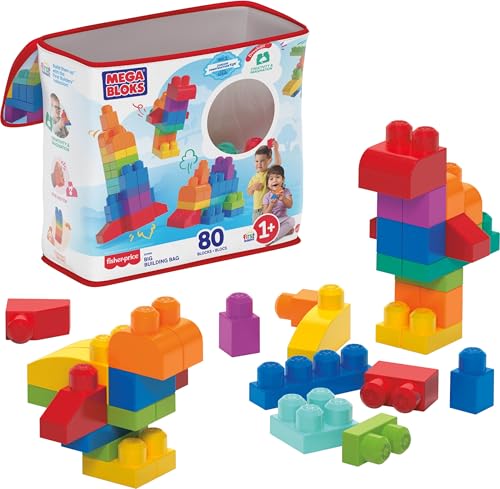
MEGA BLOKS First Builders Big Building Bag
What We Like
- Designed for easy grip and pull-apart
- Includes storage bag
Trade-offs
- No themed pieces or guided builds
- Not compatible with major building block brands.
These are the No. The included storage bag makes cleanup simple, and the open-ended design encourages imagination over following instructions. For a parent wanting a pure, classic block experience that grows with a child, this set delivers exactly that foundation.
There are no themed pieces like flowers or wheels, so a toddler who craves guided builds or vehicle play may lose interest faster. Compared to the Leetous Insect Flower Garden Set with its 156 themed pieces, this bag feels more like a starter kit than a complete play world. But if your priority is a durable, versatile block collection that teaches basic stacking and fine motor skills without gimmicks, the MEGA BLOKS First Builders set earns its place as the classic choice.
LEGO DUPLO Town Creative Garden & Flowers

What We Like
- Sensory variety with numbers, flowers, animals
- Three animal figures encourage pretend play
- Open-ended building for fine motor skill development
Trade-offs
- Only 45 pieces limits large-scale builds
- No storage bag or container for the 45 pieces
With three animal figures and bricks printed with numbers, flowers, and animals, this set turns stacking into a sensory exploration of the real world. The 45-piece count offers enough variety to build a garden scene or just sort and stack by color and shape. It suits toddlers who respond best to tactile variety and open-ended play, especially those already drawn to bugs and blossoms.
The biggest draw here is the sensory detail packed into 45 bricks, not the sheer volume of pieces. Compared to the MEGA BLOKS Big Building Bag, which gives you 80 pieces for 1.0 pounds, this set focuses on textured bricks and animal figures that invite storytelling rather than just stacking. If your toddler is more into tiny frogs and flower shapes than a giant pile of blocks, that trade-off works beautifully. But if they just want to dump and build something big, the MEGA BLOKS bag offers more raw material.
LEGO DUPLO Number Train

What We Like
- Teaches counting 0-10 with numbered bricks
- Push-along train builds fine motor skills
- Includes boy, girl, and dog figures
- DUPLO bricks are easy for small hands
Trade-offs
- Only 23 pieces limits open-ended building
- Train track not included for extended play
Ten DUPLO number bricks, each showing a numeral from zero through ten, ride in the carriages of a push-along train that toddlers push along. The set includes a boy, a girl, and a dog figure, giving little ones a reason to load and unload the bricks in order, which also builds the fine motor control needed for later handwriting. For a parent who wants a clear learning outcome from playtime, this set delivers it without fuss.
Twenty-three pieces won’t stretch far for a child who just wants to stack and build whatever comes to mind. Compared to the MEGA BLOKS Big Building Bag with eighty pieces, this is a focused tool rather than a free-form block bin. It earns its spot for counting practice, not for open-ended construction.
aotipol Big Building Blocks with Baseplate

What We Like
- 150 large pieces in 5 colors
Trade-offs
- Only 5 half-arc and 5 full-arc shapes limit curved designs
- Baseplate is too small for larger builds
The trade-off is shape variety: with only five half-arc and five full-arc bricks, you won’t be building many arches or rounded towers without supplementing from another set. If your child loves making cars with wheels or flower gardens, the Leetous Insect Flower Garden set offers more themed shapes for that kind of play. But for sheer block count, durability, and that essential baseplate, this set delivers more practical building power per box than most options in this guide. It’s a straightforward, no-fuss foundation for any toddler block collection.
Product photos
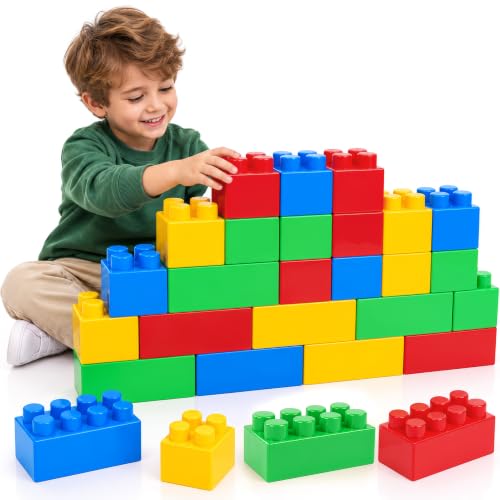
Liberty Imports Giant Interlocking Building Blocks
What We Like
- Oversized pieces for small hands
- Rounded edges survive crashes
- Snap together with easy pressure
- Non-toxic material wipes clean
Trade-offs
- Only 24 pieces limits big builds
- No baseplate for stable structures
- Large size means less variety in shapes
Each block is a full seven inches long and three inches wide. That means a one-year-old can wrap both hands around one and still push it onto another without help. That chunky size is the whole point here: toddlers who are still working on grip strength and hand-eye coordination can actually click these together on their own, feel the snap, and watch a tower rise without frustration. The rounded edges and non-toxic plastic also mean you don’t flinch when a block goes airborne or gets mouthed mid-build. This set suits parents who want a first building toy that prioritizes success over complexity, where the win is a kid stacking three blocks and clapping.
The trade-off for those giant pieces is that 24 blocks disappear fast once a child wants a fort or a castle. The 80-piece MEGA BLOKS Big Building Bag offers more pieces for a similar age range, though its pieces are smaller. The ROHSCE Soft Building Blocks are made of soft material and include 40 pieces, but they are not directly comparable in size or snap-fit design. For a two-year-old who is still learning to aim and push, the oversized snap-fit design makes handling easier, as the pieces are large enough to grip and connect with minimal effort.
Product photos
WSKC STEM Soft Building Blocks

What We Like
- 83 pieces for rich, varied builds
- Soft, flexible, safe rounded edges
- Includes storage box for easy cleanup
- Supports group play for 2+ kids
Trade-offs
- No baseplate for stable foundations
- Soft blocks limit tall or intricate builds
With 83 pieces, this set gives toddlers enough blocks to build airplanes, trucks, dinosaurs, and more without running out mid-creation. The soft, slightly flexible material and rounded edges mean you can let an 18-month-old explore freely, no sharp corners, no hard falls. It’s the kind of set that grows with a child from simple stacking to imaginative group play, and the included storage box keeps the chaos contained between sessions. For a parent or teacher looking for a low-worry introduction to construction toys, this delivers volume and safety in one box.
Product photos
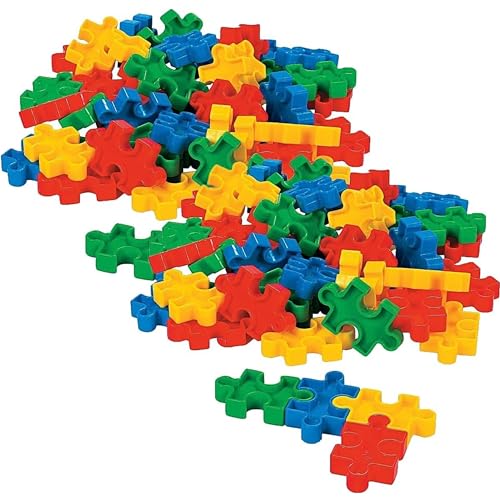
Fun Express Puzzle Shaped Block Set
What We Like
- Puzzle-shaped pieces snap flat or stack
- 50 chunky pieces for small hands
- Teaches counting, sorting, color matching
- Wipes clean between play sessions
Trade-offs
- No storage bin included for 50 pieces
- Pieces are too small for children under 3
Fifty chunky plastic pieces that snap together flat like a puzzle or stack up into towers give this set a versatility most toddler blocks lack. The pieces measure 2.2 inches long, sized for small hands, and the four bright colors turn counting, sorting, and color matching into hands-on play rather than a worksheet. It suits parents who want a single set that works as a building toy, a shape puzzle, and a math manipulative for the kitchen table, all without screens or batteries.
At 0.6 pounds for fifty pieces, this set is lightweight enough for a toddler to carry from room to room. But the plastic pieces are not designed for teething, they’re meant for stacking, sorting, and snapping together. No storage bag or bin is included, so you’ll need to supply your own container to keep the 50 chunky blocks from wandering off. For a child past the mouthing stage who’s ready to sort and stack with purpose, these puzzle-shaped blocks offer more structured play than basic stacking cubes.
Product photos
MEGA BLOKS Build & Match Animal Tractor

What We Like
- 8 farm animals to stack and match
- Mix-and-match blocks create new animals
- Compatible with other MEGA BLOKS sets
Trade-offs
- Only 30 pieces limits large builds
- No baseplate included for stable stacking
Thirty pieces is a modest count, but every block here serves a clear purpose: building a rolling tractor and matching eight farm animals by color and shape. That focused design makes this set ideal for toddlers around 18 months who are just starting to grasp sorting and pairing.
Thirty pieces run out fast once a toddler wants to build anything beyond the tractor. Compared to the 80-piece MEGA BLOKS Big Building Bag, this set is more of a guided activity than an open-ended construction kit. If your child thrives on free building, the Big Building Bag gives more raw material. But if you want a structured first building toy that teaches animals and colors while rolling across the living room floor, the Build & Match Animal Tractor hits that mark neatly.
Product photos
How We Evaluated STEM Building Blocks for Toddlers
Our evaluation began with a close look at each set’s safety certifications, material composition, and piece dimensions. We cross-referenced manufacturer claims with expert round-ups from child development specialists and occupational therapists who focus on early motor skills. Owner feedback patterns, both praise and consistent complaints, helped us separate marketing hype from real-world performance.
The three criteria that mattered most were safety (BPA-free, non-toxic materials, no sharp edges), age-appropriate sizing (pieces large enough to prevent choking but small enough for little hands), and open-ended play value (sets that encourage creativity rather than rigid, single-outcome builds). A fourth criterion, storage, surprised us with its importance. Parents consistently reported that sets without a storage bag or bin led to lost pieces and frustrated cleanup.
A research-led evaluation has honest limits. We cannot replicate the noise of a living room floor or the unpredictable grip of a specific toddler.
What To Look For In STEM Building Blocks for Toddlers
Choosing the right set comes down to matching the blocks to your child’s current abilities, not their potential ones. The safest, most engaging set for an 18-month-old will frustrate a three-year-old, and vice versa.
Look for blocks that are at least 1.5 inches in their smallest dimension to prevent choking hazards. Prioritize soft, flexible materials for toddlers under two and rigid blocks with easy-connect mechanisms for children closer to three. The best sets offer enough pieces for two children to build simultaneously without fighting over a single piece.
Safety and Material
The single most important factor is material safety. Toddlers put everything in their mouths, so blocks must be BPA-free, non-toxic, and free of phthalates and lead. Soft foam or silicone blocks are ideal for babies and young toddlers because they are chewable, flexible, and silent when knocked over, no loud crashes to startle a sensitive child. Hard plastic blocks are durable and easier to clean, but they should have rounded edges and no sharp corners. Check for the manufacturer’s age recommendation and ASTM certification before purchase.
Piece Size and Quantity
Piece size determines both safety and frustration level. Blocks smaller than 1.5 inches are a choking hazard for children under three. For toddlers 18 months to two years, look for oversized blocks that measure at least 2 inches across, these are easy to grip and impossible to swallow. Quantity matters too: a set with a modest number of pieces works for a single toddler, but siblings or playdates need more pieces to avoid conflict. The sweet spot for most families is a set with a moderate number of pieces.
Open-Ended Play Value
The best STEM blocks for toddlers do not dictate what a child builds. Sets with themed pieces, flowers, animals, or vehicles add variety, but the core blocks should be simple geometric shapes that can become anything. Avoid sets that only build one thing, a single train or a single tractor, unless you are specifically working on a learning goal like counting or animal recognition. Look for sets that include at least two different shape types and three different colors to support sorting, pattern-making, and early math skills.
- Confirm the blocks are dishwasher-safe or wipe-clean for quick sanitation.
- Check that the storage solution is included, bags are better than boxes for toddler cleanup.
- Verify compatibility with other block brands if you plan to expand the set later.
- Look for sets with at least one baseplate if your child wants to build upward.
- Ensure the pieces are uniform in size and shape so replacements are easy to find.
A good rule of thumb: if you cannot build a recognizable house, a tower, and a bridge with the same set, it does not offer enough open-ended play value.
STEM Building Blocks for Toddlers Compared
The table below compares all ten sets across the criteria that matter most for toddler safety and development: piece count, age range, material type, and key features.
| Product | Pieces | Age Range | Weight |
|---|---|---|---|
| ROHSCE Soft Building Blocks | 40 | 18 months and up | N/A |
| Leetous Insect Flower Garden Building Set | 156 | 2-6 years | 1.6 pounds |
| MEGA BLOKS First Builders Big Building Bag | 80 | 1+ | 1.0 pounds |
| LEGO DUPLO Town Creative Garden & Flowers | 45 | 2+ | 1.4 pounds |
| LEGO DUPLO Number Train | 23 | 1.5+ | 1.2 pounds |
| aotipol Big Building Blocks with Baseplate | 150 | 2-5 | 3.6 pounds |
| Liberty Imports Giant Interlocking Building Blocks | 24 | 1, 2, and 3 year olds | N/A |
| WSKC STEM Soft Building Blocks | 83 | 18 months, 6 years | N/A |
| Fun Express Puzzle Shaped Block Set | 50 | N/A | 0.6 pounds |
| MEGA BLOKS Build & Match Animal Tractor | 30 | 1.5+ years | 0.2 pounds |
Frequently Asked Questions
At what age should I introduce building blocks to my toddler?
Most children are ready for oversized, soft blocks around 12 months. By 18 months, they can stack two to three blocks and will benefit from sets with a modest number of pieces. Rigid interlocking blocks are best introduced around age two, when fine motor control improves.
How many blocks does a toddler need?
A single toddler can play happily with a modest number of blocks. For siblings or playdates, aim for more pieces to share. The right number also depends on the set’s complexity, themed sets with many small pieces require more supervision than simple geometric block sets.
Are wooden blocks better than plastic blocks for toddlers?
Wooden blocks are durable and eco-friendly, but they are heavy and can hurt if thrown. Soft foam or silicone blocks are safer for children under two. Plastic blocks are lightweight, easy to clean, and often interlocking, which makes them better for structured building. The best choice depends on your child’s age and temperament.
What STEM skills do building blocks teach toddlers?
Building blocks develop fine motor skills, spatial awareness, and hand-eye coordination. They also introduce early math concepts like counting, sorting, patterns, and basic geometry. When toddlers build a tower and watch it fall, they learn cause and effect and develop problem-solving persistence.
How do I clean toddler building blocks?
Soft foam blocks can be wiped with a damp cloth and mild soap. Hard plastic blocks are often dishwasher-safe on the top rack. Always check the manufacturer’s cleaning instructions, and avoid harsh chemicals that could leave residue on blocks that go into mouths.
The Bottom Line
The ROHSCE Soft Building Blocks are the best overall choice for most families because they prioritize safety without sacrificing play value. Their large, soft pieces are ideal for toddlers 18 months and up who are still learning to grip, stack, and knock down. If your budget allows for a second set, the Leetous Insect Flower Garden Building Set adds variety with 156 themed pieces that encourage creative storytelling.
For parents of younger toddlers, ages one to three, the Liberty Imports Giant Interlocking Building Blocks offer the easiest snap-together mechanism and the largest pieces in this guide. Parents of children ready for guided learning should consider the LEGO DUPLO Number Train, which teaches counting through play.
The single most important factor in choosing blocks for a toddler is safety first and piece count second. A set that is safe for your child’s current age will always beat a larger set that requires constant supervision.
