
6 Best Square Trampolines in 2026
This post contains affiliate links. As an Amazon Associate, we earn from qualifying purchases.
The best square trampoline is the Skywalker Trampolines 15 Ft Square Trampoline, which wins on safety with a patented no-gap enclosure and a galvanized steel frame that resists rust. The Zupapa 14×14 Ft Square Trampoline is our Best Heavy Duty pick for families with older kids, while the Springfree 11 Ft Square Trampoline is the Best Springless Safety option for younger children.
A square trampoline offers a fundamental advantage over its round counterpart: significantly more usable jump space. Because the mat is anchored at four corners, jumpers are naturally directed toward the center, giving you a larger effective bouncing area without needing a massive yard.
This guide is built on a research-led evaluation of specifications, manufacturer documentation, patterns in owner feedback, and expert round-ups on the top-rated trampoline designs. We focused on safety certifications, frame durability, weight capacity, and enclosure design to help you choose with confidence.
Top 6 Square Trampolines in the Market
Certain content that appears on this site comes from Amazon. This content is provided "as is" and is subject to change or removal at any time.
The Best Square Trampolines, Reviewed
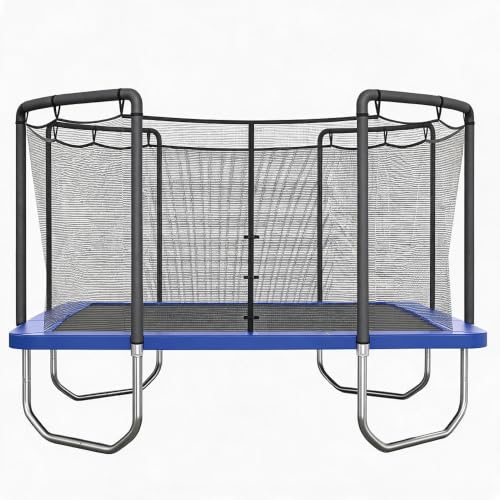
Skywalker Trampolines 15 Ft Square Trampoline
What We Like
- Patented no-gap enclosure reduces pinch points
- Galvanized steel frame resists rust
- Square shape offers 20% more jump area
- ASTM-tested frame holds 4x rated load
Trade-offs
- 200 lb limit restricts older teens and adults
- No-gap net requires careful zipper closure
A 200-pound weight capacity is the first number to notice here, it means this trampoline is built for a single child or lighter teen, not for two jumpers or a parent joining in. The square shape gives you about 20 percent more usable jumping surface than a round trampoline of similar footprint, which translates to fewer collisions and more room for tricks. The patented no-gap enclosure eliminates the dangerous seam where net meets mat, and the galvanized steel frame with reinforced T-sockets is designed to stay stable through seasons of outdoor use. For a family with one or two kids who want a safer, roomier bounce, this is the pick that balances space and security without overbuilding for a crowd.
The 200-pound weight limit means this trampoline is best suited for a single child or lighter user, not for multiple jumpers at once. The frame is tested to four times that load under ASTM standards, so it’s built to handle the stress of one person bouncing safely. The square shape offers about 20 percent more jumping area than a round trampoline of comparable size, giving a single jumper more room to move. The patented no-gap enclosure reduces pinch points at the seam, which is a real safety improvement over designs with gaps between the net and jumping surface.
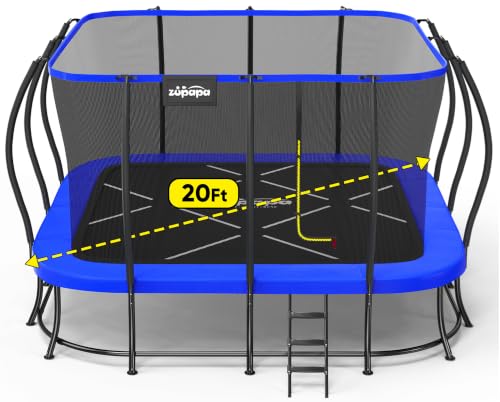
Zupapa 14×14 Ft Square Trampoline
What We Like
- Patented no-gap safety net design
- 2000 lb static load capacity
- Double frame for tip resistance
- 120 high-strength electrophoretic springs
Trade-offs
- 410 lb weight makes relocation difficult
- 14×14 ft footprint needs large yard
A 2000-pound static load capacity means this trampoline can handle multiple kids, adults, or even a parent joining the fun without worrying about frame failure. The double-frame design lowers the center of gravity and resists tipping, while the patented no-gap net keeps jumpers safely on the mat. This is the pick for families who want a heavy-duty backyard centerpiece that won’t sag or wobble under serious use, backed by a 10-year frame warranty that matches its build quality.
The trade-off is size and weight: at 410 pounds and 14 feet square, this is a permanent installation, not something you drag around the yard. It also requires a smaller footprint than the Skywalker 15-footer, though both need ample backyard space. If you have the room and want a trampoline that feels planted and safe for years, the Zupapa delivers where lighter frames might flex or shift.
Product photos
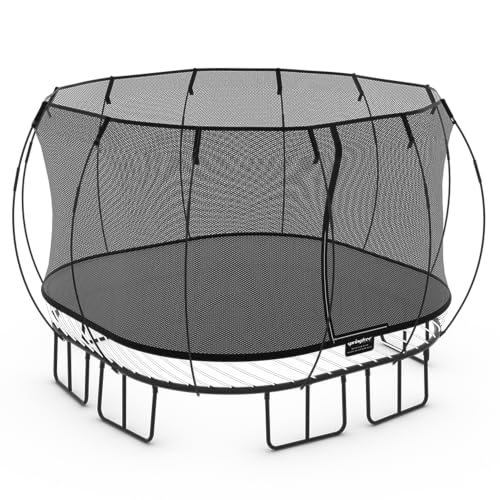
Springfree 11 Ft Square Trampoline
What We Like
- No metal springs eliminates pinch points
- FlexiNet absorbs impact and centers jumpers
- 113 sq ft for gymnastics and fitness
- Steel frame built for outdoor durability
Trade-offs
- 11 ft size limits simultaneous adult jumpers
A 113-square-foot jump area gives you room for tumbling, cardio, or basketball without feeling cramped, but the real story here is what’s missing: metal springs. Springfree replaces them with flexible composite rods tucked beneath the mat, so there are no pinch points for little fingers or toes to find. That design also delivers a smoother, more controlled bounce that reduces impact on joints, which matters for a kid learning flips or for your own morning workout. The FlexiNet enclosure wraps the whole perimeter, absorbing sideways falls and guiding jumpers back to center rather than letting them ricochet off a stiff wall. For families who prioritize safety without sacrificing usable space, this is a thoughtful build.
The 113-square-foot jump area gives you room for gymnastics, tumbling, and family play, but if you regularly have multiple teens or adults bouncing at once, the 11-foot size will feel tight. The springless composite rods eliminate pinch points and deliver a cushioned bounce, which some jumpers love for its smoothness, while others miss the more energetic snap of traditional springs. The steel frame is built to handle year-round outdoor conditions, so it stands up to weather without rust or wobble. If your backyard fits a smaller footprint and you want to remove the most common trampoline injury risk, this design earns a spot on your short list.
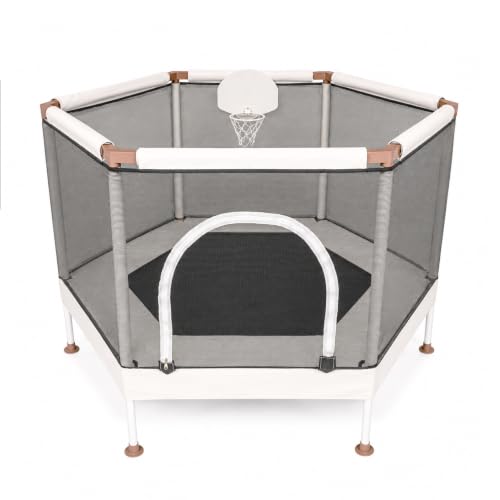
Square House 5 Ft Kids Trampoline
What We Like
- Included basketball hoop for added play
- Mesh enclosure and padded frame rails
- Zippered entry for safe access
- Understated design suits modern homes
Trade-offs
- 5 ft jump surface limits older kids
- Adult assembly required before use
- One child at a time only
A 60-inch square trampoline with a basketball hoop attached means your toddler can bounce and shoot without needing separate equipment. The mesh enclosure, padded frame rails, and covered springs give you the safety basics, while the zippered entry keeps little ones from wandering out mid-session. For a child aged 2 to 8, this size is manageable indoors or on a patio, and the coordinated frame and enclosure blend into a playroom without screaming ‘toy aisle.’
The trade-off is the 5-foot jump surface, fine for a preschooler, but a 7-year-old who wants to practice flips will outgrow it fast. Adult assembly is required, and the 220-pound max weight means one child at a time only. If your kid is closer to 2 than 8 and you want something that adds a hoop without taking over the living room, this delivers exactly that.
Giantex 7 Ft Square Kids Trampoline
What We Like
- 220 lb weight capacity for growing kids
- Hot-dip galvanized steel for rust resistance
- L-shaped zipper with buckle for double closure
Trade-offs
- 56.5 lb assembly requires two adults to move
- 7.3 ft jump area limits older kids' tumbling room
- No ladder included for smaller toddlers to climb
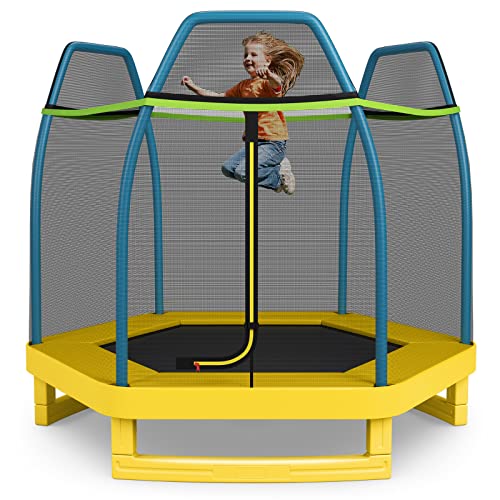
The Giantex 7-foot square trampoline has a 220-pound weight limit, which means it can handle two or three small children bouncing together without overloading the springs. The frame uses hot-dip galvanized steel, a process that helps prevent rust and keeps the structure stable over time. The U-shaped base legs are widened and curved to reduce the chance of tipping when kids jump near the edge. ASTM certification confirms the safety net and padded frame meet a recognized standard, so you don’t have to wonder if the materials are up to the job.
Assembly is straightforward with the clear manual, though at 56.5 pounds you’ll want a second set of hands to flip it upright. The frame uses hot-dip galvanized steel pipe inside, which resists rust and keeps the structure stable over time. A widened, curved U-shaped base adds further stability, helping prevent tipping during active play. Owners note that the 36 strong strings provide a noticeably responsive bounce, while the tear-resistant jumping mat holds up well to repeated use. The upper steel frame is covered with soft foam, reducing impact if a child bumps into it. For a 7-foot square trampoline, the assembly process is manageable for two people in under an hour.
Product photos
GYMAX 37 Inch Toddler Trampoline
What We Like
- Full-width foam handlebar for balance support
- 330 lb capacity for growing kids
- Spring safety cover prevents pinching
- Alphabet prints encourage letter recognition
Trade-offs
- 37-inch jump area limits older or taller kids
- No enclosure net for containing jumps
- Square shape offers less bounce area than larger models
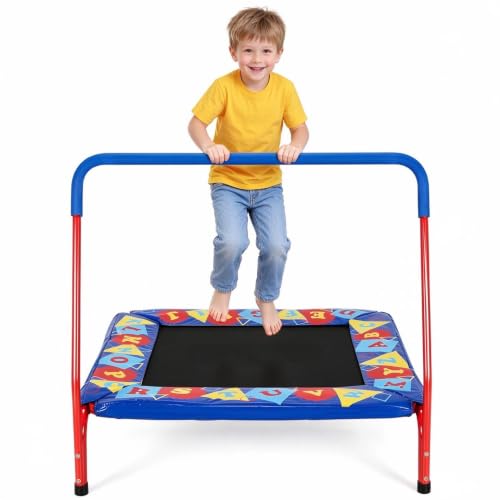
A 330-pound weight capacity on a 37-inch toddler trampoline means this little square can support a single child up to that limit. The full-width foam handlebar runs across the mat so a child can grab stable support no matter where they land, which builds confidence in kids still finding their balance. The trade-off is that 37 inches is genuinely small, a six-year-old with long legs will feel cramped, and there’s no enclosure net to stop an over-enthusiastic bounce from turning into a tumble onto the floor.
The GYMAX 37-inch toddler trampoline includes a full-width foam handlebar, so a child can grab a stable support no matter where they land while bouncing. That makes it a practical choice for young jumpers who are still building balance and confidence, rather than a model loaded with extras like a basketball hoop or enclosure net.
Product photos
How We Evaluated Square Trampolines
We analyzed each model using manufacturer specifications, safety certifications, and patterns in owner feedback. Our research focused on the structural elements that determine a trampoline’s lifespan and safety. The shape itself was a primary filter: we only considered square models, which we compared against the best round trampolines and rectangular models to understand their unique benefits. We also looked at the different trampoline shapes available to see where squares fit in.
The four criteria that mattered most were frame construction (galvanized or electroplated steel), enclosure design (no-gap vs. Standard netting), weight capacity (static and dynamic loads), and jump surface area. For instance, a shape comparison like rectangular vs round showed us that square trampolines offer a middle ground in bounce directionality and space efficiency.
An honest limit of a research-led evaluation is that we can’t replicate years of outdoor exposure. We rely on material specs and owner reports of rust or frame failure to project durability, but your local climate and assembly quality will play a major role.
What To Look For In Square Trampolines
Choosing a square trampoline means prioritizing jump space and bounce quality over the predictable, centering action of a round model. Here are the key buying criteria to consider.
A square trampoline gives you up to 20% more usable jumping area than a round trampoline of the same frame size. Prioritize a no-gap enclosure, a rust-resistant steel frame, and a weight capacity that fits your household.
Frame Material and Coating
The frame is the trampoline’s skeleton. Look for hot-dip galvanized steel, which resists rust far longer than painted or powder-coated tubes. The best trampoline models use a thicker-gauge steel, often with a T-socket joint system that prevents the legs from wobbling over time. A double-frame design, like the one on the Zupapa, adds tip resistance for heavier use.
Enclosure and Safety Net Design
A no-gap enclosure is the single biggest safety upgrade. It eliminates the pinch points between the springs and the net where fingers or limbs can get caught. Check that the net is UV-resistant and that the zipper closure is reinforced. Some models, like the Springfree, ditch springs entirely and use flexible composite rods, which is the safest option for gymnastics trampolines.
- Check the weight capacity for both the frame and the net (static load vs. Dynamic load).
- Confirm the trampoline has an ASTM certification stamp.
- Measure your yard space, adding a 3-foot clearance buffer on all sides.
- Check the spring count and length; more high-tensile springs generally mean a softer, more responsive bounce.
A good rule of thumb: for every foot of trampoline diameter, budget enough clearance around the frame.
Square Trampolines Compared
The table below compares the six square trampolines side-by-side on key specs like jump area, frame material, and weight capacity.
| Product | Shape | Weight Capacity | Frame Material |
|---|---|---|---|
| Skywalker Trampolines 15 Ft Square Trampoline | Square | 200 lb | Galvanized steel |
| Zupapa 14×14 Ft Square Trampoline | Square | 2000 lbs static | 51 mm Q195 steel |
| Springfree 11 Ft Square Trampoline | Square | N/A | Steel |
| Square House 5 Ft Kids Trampoline | Square | 220 lb | Steel |
| Giantex 7 Ft Square Kids Trampoline | Square | 220 lbs | hot-dip galvanized steel |
| GYMAX 37 Inch Toddler Trampoline | Square | 330 lbs | Rust-resistant steel |
Frequently Asked Questions
Why choose a square trampoline over a round one?
Square trampolines provide a larger effective jumping area because the mat doesn’t pull jumpers toward a single center point. This makes them better for gymnastics drills, multiple kids jumping at once, and taller jumpers who need more room.
What is the safest type of trampoline for toddlers?
A springless trampoline like the Springfree 11 Ft Square Trampoline eliminates pinch points entirely, making it the safest option for young children. For toddlers under five, a mini square trampoline with a full-width handlebar, like the GYMAX 37 Inch model, provides balance support without the height risks of a full-size unit.
How much space do I need for a 15-foot square trampoline?
You need a flat, level area that is large enough to fit the trampoline frame plus clearance on each side for the safety net and to prevent jumpers from hitting nearby fences or walls.
Can adults use a square trampoline safely?
Some high-capacity models like the Zupapa 14×14 Ft Square Trampoline support over 2000 pounds of static weight. However, the Skywalker 15 Ft model has a 200-pound dynamic limit, which restricts use for heavier adults during active jumping.
What is the best square trampoline for gymnastics?
Square trampolines are the preferred shape for gymnastics because the flat mat allows for consistent bounce height across the entire surface. For serious training, look for a model with a high spring count and a large jump surface, such as the Springfree 11 Ft.
The Bottom Line
The Skywalker Trampolines 15 Ft Square Trampoline is the best choice for most families with lighter children. Its patented no-gap enclosure and galvanized steel frame deliver a safer, larger jumping surface without the yard footprint of a round model. If you have older kids or multiple jumpers, the Zupapa 14×14 Ft is the heavy-duty pick with a rock-solid double frame.
For safety-conscious parents of young children, the Springfree 11 Ft eliminates the most common injury source, metal springs, entirely. Toddler-specific options like the Square House 5 Ft with basketball hoop or the GYMAX 37 Inch with handlebar round out the selection for the smallest jumpers.
The single most important factor in your decision is the weight capacity relative to your household. A trampoline that is undersized for its jumpers will degrade faster and be less safe, so always buy for your heaviest expected user, not your lightest.
